A “strong Venus” is often sold as a shortcut to marriage, money, beauty, and an easy life. That shortcut is unreliable. In Vedic astrology Venus, or Shukra, is a computed graha whose results depend on house lordship, placement, dignity, condition, timing, and confirmation across the chart.
A Venus placement can describe attraction, taste, pleasure, artistic ability, partnership themes, and material comfort. It can also increase desire, spending, visibility, or opportunities without guaranteeing commitment or net wealth. Serious Jyotisha begins with that distinction.
Table of Contents
- Why Venus Is Not a Standalone Marriage or Wealth Verdict
- The Identity of Shukra and What It Symbolises
- Which Houses Venus Rules and Why the Ascendant Matters
- Venus Across the Houses and Signs
- Measuring Venus Through Shadbala and Ashtakavarga
- Venus in Dasha, Transit, and the Sun-Venus Rhythm
- Reading D-1 and D-9 Together for Venus
- A Four-Question Checklist Before You Pay Anyone
Why Venus Is Not a Standalone Marriage or Wealth Verdict
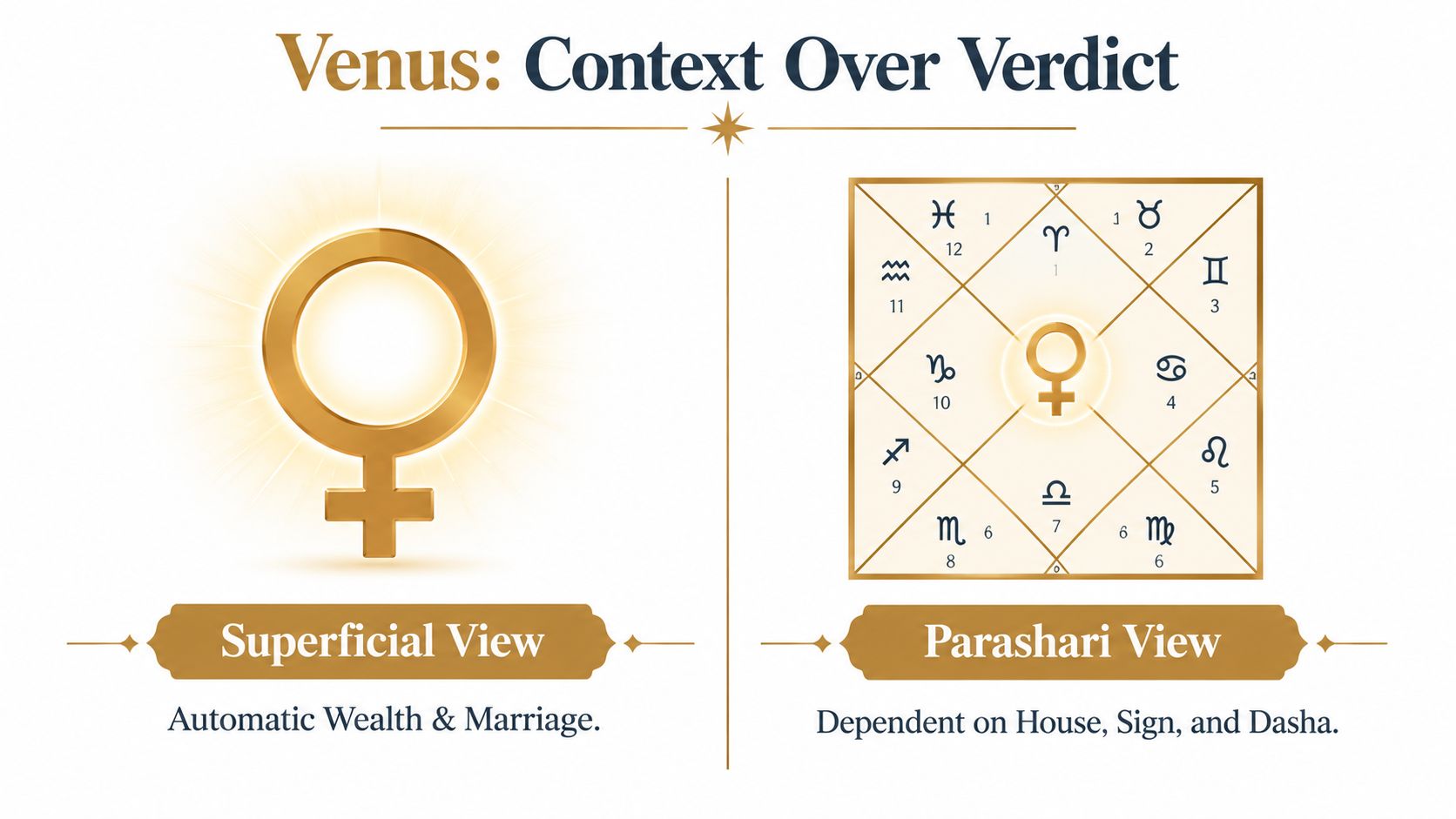
Venus isn't a marriage verdict on its own. In a Parashari chart, it acts through the houses it owns, the house it occupies, its sign, its dispositor, its associations, and the dasha periods that activate it. The seventh house and its lord still matter for partnership. Wealth requires more than enjoyment or access to comforts. Savings, accumulation, family resources, and financial stability involve other chart factors.
The traditional identity of Venus supports a broad reading. Shukra is associated with relationships, pleasure, beauty, fertility, art, refinement, and material enjoyment. Those themes describe the field in which Venus operates. They don't decide the durability of a relationship, the quality of a spouse, or whether resources remain available over time.
| Common claim | What Venus actually signals | What it cannot decide alone |
|---|---|---|
| A strong Venus guarantees marriage | Attraction, bonding, affection, and relationship themes | Commitment, spouse quality, timing, or relationship durability |
| Venus promises wealth | Pleasure, taste, access to comforts, and material refinement | Savings, asset preservation, stable accumulation, or financial judgment |
| Venus in a favourable sign solves relationship problems | Easier expression of Venusian qualities | Whether the seventh house, its lord, and dasha support partnership |
| Venus in a difficult house ruins love | A conditional expression of desire, intimacy, or comfort | The final result without lordship, aspects, divisional charts, and timing |
A useful rule is simple:
A strong Venus can increase what you want without guaranteeing that what you want will last.
That is why a serious reading compares the Rashi chart, or D-1, with the Navamsha, or D-9. It checks whether Venus is combust, how its dispositor behaves, what the active Vimshottari dasha is doing, and whether transits activate relevant natal promises. Any reading that offers marriage or wealth from Venus alone is selling certainty the chart can't prove.
The Identity of Shukra and What It Symbolises
In classical Jyotisha, Venus is Shukra, one of the Navagrahas, the nine planetary principles used in Vedic astrology. Shukra is also called Bhārgava, meaning a figure connected with the sage lineage of Bhrigu. In earlier Sanskrit material, the related figure appears as Kāvya Uśanas, meaning a wise poet-priest. These names show that Venus has a long literary and intellectual history rather than being a modern label for romance.
Its working themes are practical:
- Relationships: attraction, affection, agreements, and partnership.
- Pleasure: enjoyment, comfort, sensual appreciation, and recreation.
- Beauty and art: design, music, aesthetics, performance, and taste.
- Fertility: generative capacity and the wish to create or continue.
- Material refinement: clothing, luxuries, manners, adornment, and cultivated living.
The historical record also includes a mathematical side. The Rigveda is generally dated to approximately 1500 BCE, while later classical astronomical works formalised planetary calculation. Aryabhata's Aryabhatiya dates to the 5th century CE, Varahamihira's Panchasiddhantika to the 6th century, Brahmagupta's Khandakhadyaka to the 7th century, and Lalla's Shishyadhivṛddhida to the 8th century. These milestones are discussed in the historical account of Shukra.
The astronomy gives Jyotisha a measurable clock. NASA lists Venus's sidereal orbital period at approximately 224.701 Earth days and its synodic period at approximately 583.92 days. The European Southern Observatory describes the synodic cycle as approximately 584 days, during which Venus can appear as the Morning Star or Evening Star. Five such periods total roughly 2,920 days, close to eight solar years of about 2,922 days, creating a near-repeat in Venus visibility patterns. See the European Southern Observatory explanation of Venus's cycle.
Those numbers describe physical motion. They don't prove an astrological outcome. Jyotisha applies interpretive rules to computed longitudes, dignity, houses, dashas, and transits.
Which Houses Venus Rules and Why the Ascendant Matters
Venus owns Taurus, or Vrishabha, and Libra, or Tula. The ascendant determines which houses those signs occupy. That means Venus can't be interpreted correctly from its sign alone.
Start with your rising sign, also called the lagna. Locate Taurus and Libra from that starting point. The houses containing those signs are the houses Venus rules. Then combine that lordship with Venus's actual placement.
Aries ascendant
For Aries rising, Taurus falls in the second house and Libra falls in the seventh house. Venus therefore rules the second and seventh houses. Its themes can connect wealth, speech, family resources, food, marriage, contracts, and partnership.
This doesn't mean an Aries ascendant person is promised money or marriage because Venus rules those houses. It means Venus carries those topics in the chart. Its condition decides whether that connection is supportive, strained, delayed, or mixed.
Capricorn ascendant
For Capricorn rising, Taurus falls in the fifth house and Libra falls in the tenth house. Venus rules a trine and an angle, the fifth and tenth houses, so classical Parashari practice treats it as a yogakaraka. That means Venus can connect intelligence, creativity, children, learning, career, public standing, and visible work.
The result still depends on placement and timing. A yogakaraka Venus isn't a licence to skip the rest of the chart. Combustion, difficult associations, a weak dispositor, or an inactive dasha can change how its promise appears.
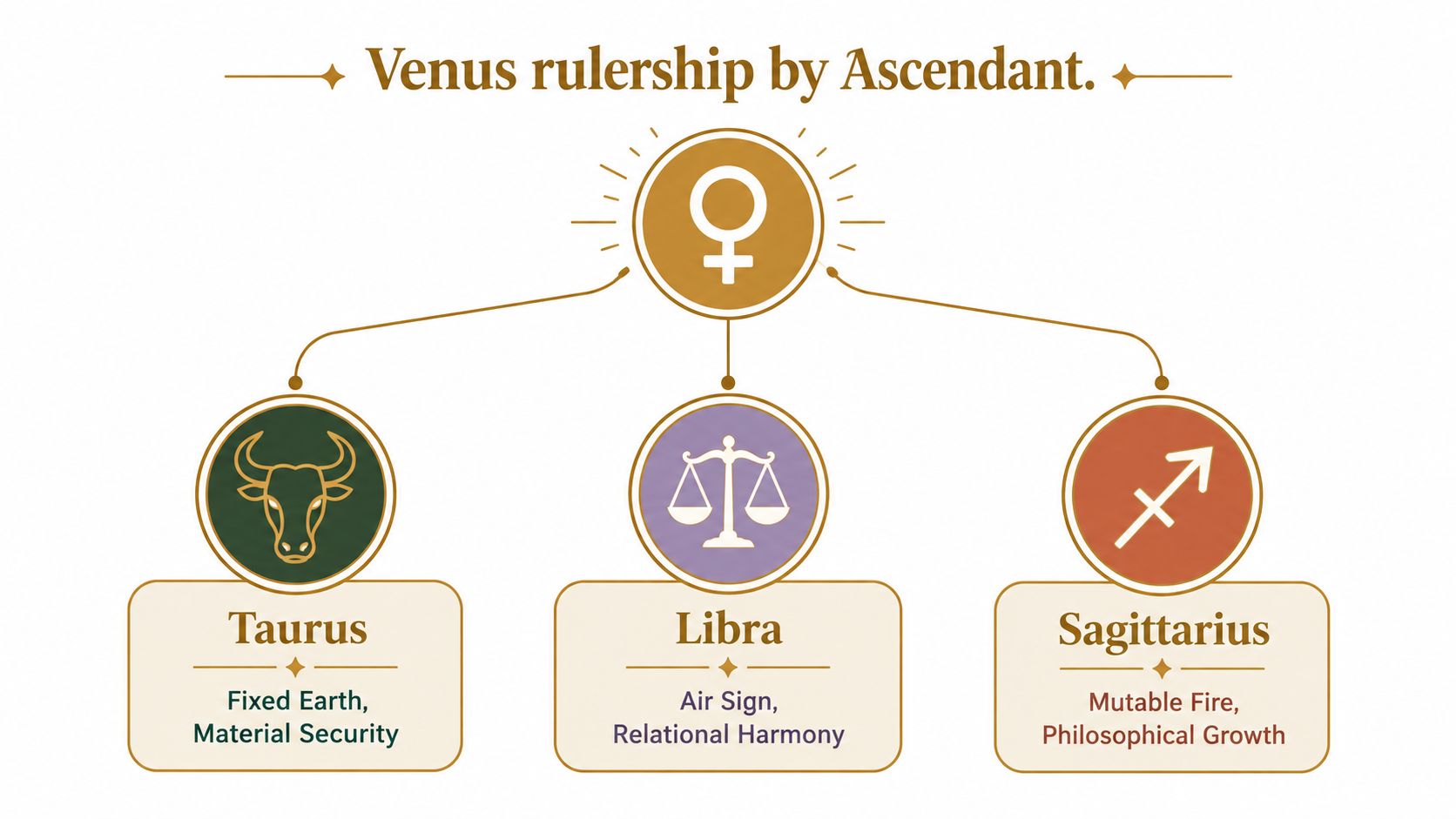
The mechanic is more important than memorising keywords. A Venus placement that supports income for one ascendant may connect to education, status, or children for another. This is why generic “Venus in this sign” content often misses the actual chart.
Practical rule: Calculate Venus's lordship from the ascendant before interpreting its sign or house. The lagna changes the job Venus is being asked to perform.
Venus Across the Houses and Signs
Venus in a kendra, the angular houses one, four, seven, and ten, becomes visible in identity, home, partnership, or public life. It may emphasise comfort, aesthetics, cooperation, relationship needs, or the wish to create a pleasant environment. The result is still conditional because the same angle can carry different lordships and associations.
In a trikona, the first, fifth, and ninth houses, Venus can connect enjoyment with creativity, learning, children, teachers, belief, or meaningful opportunity. These houses are classically supportive, but Venus still needs dignity and timing. A favourable placement doesn't remove conflict elsewhere.
The dusthana houses, the sixth, eighth, and twelfth, require more care. Venus may express through service, debt and competition, vulnerability and shared resources, privacy, retreat, expenditure, or intimacy. That isn't automatically failure. It often means Venusian matters develop through complicated circumstances rather than simple access.
The upachaya houses, the third, sixth, tenth, and eleventh, are growth-oriented houses. Venus there may become more usable through effort, skills, work, networks, or repeated experience. The tenth and eleventh can make Venus visible through career or community, while the sixth can tie its themes to service, routines, and disputes.
Sign dignity and condition
Venus is in its own signs in Taurus and Libra. Traditional Jyotisha treats Pisces as Venus's exaltation sign and Virgo as its debilitation sign. These labels describe dignity, not a guaranteed life result. Venus in Virgo may express through analysis, selectiveness, or practical service. Venus in Pisces may heighten idealism and imagination, but idealism can still require boundaries.
A sign doesn't override lordship. A dignified Venus ruling difficult houses may remain complicated. A debilitated Venus with strong support, useful associations, and an appropriate dasha may produce meaningful results.
Combustion needs an actual calculation
Venus combustion is measured by angular distance from the Sun, not by sharing a sign. A commonly used classical threshold places Venus within 10° of the Sun, while the threshold is often narrowed to 8° when Venus is retrograde. Some practitioners use a 6° operational threshold, so the convention must be stated.
The calculation uses total zodiacal longitude. Venus at 29° of one sign and the Sun at 1° of the next can still fall within the relevant distance. Store the exact separation, retrograde status, and chosen rule before interpreting possible pressure on relationship, pleasure, artistic expression, or Venus-ruled houses. The technical discussion of Venus combustion explains why sign boundaries don't end the calculation.
For a sign-focused supplement, see signs ruled by Venus.
Measuring Venus Through Shadbala and Ashtakavarga
“Venus is strong” is incomplete unless the practitioner says strong by which measure, in which chart, and for which result.
Shadbala is a classical strength framework that combines six sources of strength. In plain language, it tests factors such as planetary position, directional support, temporal conditions, motion, natural strength, and aspectual contribution. It gives a structured view of how capable a planet is within the chart.
Ashtakavarga works differently. It distributes benefic points through signs and houses based on planetary contributions. The result helps assess the support available to a house and the movement of transiting planets through that structure. Venus's own condition matters, but so does the score of the house Venus occupies or rules.
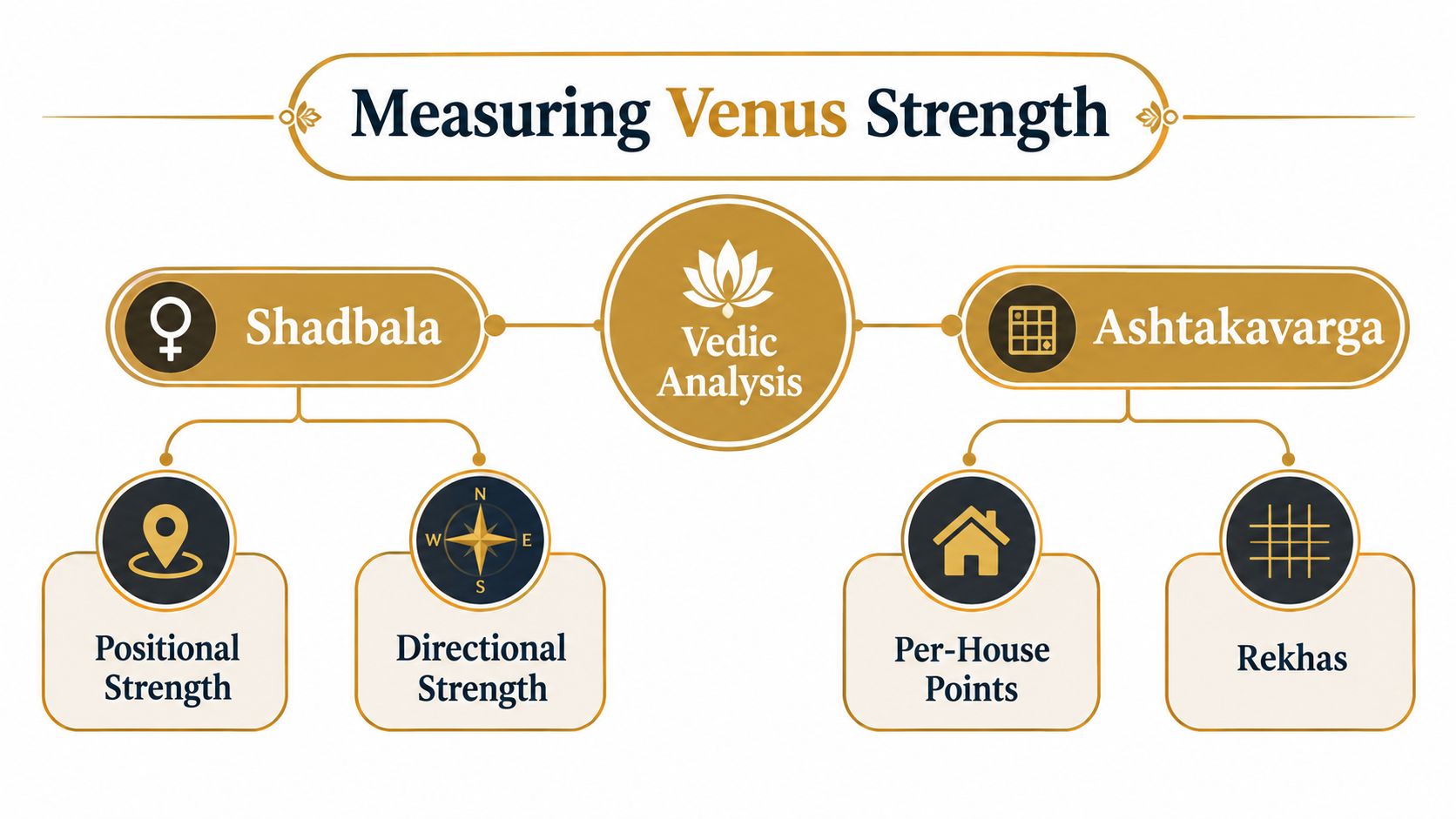
Why one score is not enough
A high Shadbala result may show capacity, but capacity isn't the same as clean delivery. Venus can have positional strength while ruling houses that create pressure. It can occupy a good sign while suffering from combustion or difficult association. It can score well while the relevant dasha remains inactive.
Ashtakavarga adds a house-based perspective. If Venus is expected to deliver through partnership, career, income, or comfort, the relevant houses deserve attention. A practitioner who quotes only a planetary score may miss the condition of the field in which Venus must operate.
The same logic answers the opening problem. A strong Venus in isolation may increase attraction, taste, spending, or opportunities. A strong Venus in the whole life context requires alignment among lordship, dignity, house support, divisional confirmation, and timing.
A number is evidence about one layer of the chart. It isn't a verdict about the person.
For a deeper treatment of the house-based method, compare Ashtakavarga chart analysis. The calculation should remain visible enough that another practitioner can understand what was measured and what remains uncertain.
Venus in Dasha, Transit, and the Sun-Venus Rhythm
Natal placement describes potential and pattern. Timing shows when those themes become active.
In Vimshottari dasha, Venus may operate as the major-period lord or sub-period lord. A Venus period connected to supportive houses, good dignity, and helpful divisional confirmation may bring relationship, creative, comfort, or material themes into focus. An afflicted Venus period may activate the same subjects through negotiation, expense, dissatisfaction, separation, or reassessment.
That doesn't make the period uniformly good or bad. The result depends on what Venus owns, where it sits, who influences it, and which sub-period is operating. A Venus sub-period inside another planet's major period must be read through both planets.
Transits are triggers, not isolated promises
A gochara, meaning a planetary transit, moves through the current sky and interacts with the natal chart. A Venus transit can coincide with a short-term opening or emphasis, but it shouldn't be called universally benefic. The natal Venus, relevant houses, house lords, and active dasha must support the subject being judged.
NASA gives Venus a synodic period of approximately 583.92 days, the interval between comparable alignments relative to Earth and the Sun. The NASA Venus fact sheet also provides the astronomical basis for tracking apparent motion and visibility. The physical cycle is measurable. Its astrological meaning remains a separate traditional interpretation.
A practical timing flow looks like this:
- Dasha: Identify the long arc and the planets currently operating.
- Natal promise: Check whether Venus connects to the relevant house, lord, or significator.
- Transit: Use gochara to identify a nearer trigger.
- Validation: Compare the timing with lived events before making a forward claim.
An Anvaya Samhita can store dasha, transit, strength, and divisional layers together so the reasoning remains auditable. For the transit concept itself, read what gochar means in Vedic astrology.
Reading D-1 and D-9 Together for Venus
The D-1 Rashi chart is the main birth chart. It shows the broad structure of life themes, including Venus's house, sign, lordship, associations, and condition.
The D-9 Navamsha tests how those themes hold up at a subtler level. Practitioners give it particular weight for marriage, dharma, and the durability of planetary indications. It doesn't replace the D-1. It qualifies it.
Consider two contrasting patterns:
| Pattern | Cautious interpretation |
|---|---|
| Venus is strained in D-1 but dignified in D-9 | The visible or early expression may be difficult, while the underlying capacity for relationship or Venusian development may improve with maturity and commitment |
| Venus is comfortable in D-1 but strained in D-9 | Attraction or opportunity may be apparent, while durability, commitment, or sustained satisfaction may require more work |
These are diagnostic tendencies, not fixed outcomes. A D-9 Venus can't rescue every D-1 problem, and a difficult D-9 Venus doesn't erase every strength in the birth chart. The house lordship, dispositors, aspects, and dashas still control the context.
A practitioner should therefore answer more than “Is Venus strong?” Ask instead: What does Venus promise in D-1, how is that promise confirmed in D-9, and when is it activated? A Navamsha read in isolation is another form of oversimplification.
A Four-Question Checklist Before You Pay Anyone
Use these questions before accepting a marriage, wealth, or remedy claim.
Which houses does Venus rule for my ascendant?
Start with the lagna. Locate Taurus and Libra. The houses Venus owns tell you which life areas it carries. Without this step, “strong Venus” has no precise meaning.Where is Venus placed, and is it under stress?
Check the house, sign, dispositor, conjunctions, aspects, retrograde status, and combustion distance from the Sun. Ask which combustion convention the practitioner is using. A calculation should be reproducible, not implied from a shared sign.What does D-9 add to D-1?
The Rashi chart shows the main promise. The Navamsha helps assess durability and deeper support. If someone reads only one chart for a serious partnership question, ask what remains untested.Which dasha is operating now?
A natal Venus may be relevant without being active. Check the Vimshottari hierarchy and then use transits as triggers. Timing should connect to a chart promise rather than create one from nothing.
Remedies need the same honesty. Charity, devotional practice, Friday observances, aesthetic disciplines, or a gemstone may carry personal or traditional meaning. They shouldn't be sold as guaranteed planetary correction, and expensive gemstones deserve particular caution. A useful remedy should be tied to a specific chart condition and followed through observable behaviour, such as clearer communication, better boundaries, or more careful budgeting. This is for personal reflection and self-understanding, not professional advice.
Gender assumptions also need restraint. Some traditions assign Venus and Jupiter different significator roles by gender, but that is a traditional interpretive framework, not a universal law. A treatment of Venus in the tenth house on Paramarsh rejects the assumption that Venus is weaker in a man's chart and notes that Malavya Yoga does not depend on gender. The same principle matters for international readers whose partnerships and family structures don't fit one household model.
We use declared Parashari computation, then seek Pramāṇa, meaning calibration against events you lived, before making forward claims. A structured Samhita should show the calculations behind Venus, distinguish evidence from interpretation, and label uncertainty rather than turn a symbolic keyword into a promise.
Anvaya can calculate Venus through house lordship, dignity, divisional charts, Shadbala, Ashtakavarga, dasha, and transit layers, then calibrate the reading against your lived events through Pramāṇa. If you want a chart-first reading instead of a generic Venus verdict, generate your Samhita.