Venus rules two signs in standard Vedic astrology: Taurus and Libra. That pairing has stayed stable in classical doctrine for over two millennia, and your Sun sign is only one small part of how those Venus themes show up in a birth chart.
You've probably seen the problem already. One article says Taurus and Libra are both “Venus signs,” so both should be graceful, romantic, and good with people. Then you look at real charts and it doesn't hold evenly. One person with strong Taurus placements builds comfort, saves carefully, and prefers steady bonds. Another person with Libra rising keeps running into strain around partnership, taste, or money choices, even though Venus is supposed to be “their” planet.
That gap confuses people because the label is true, but incomplete.
In serious chart reading, sign rulership is a starting layer, not the whole judgment. Venus may rule your rising sign. It may sit in a difficult house. It may be dignified by sign, or weakened by other conditions. If you skip those layers, you end up with generic advice that sounds nice but doesn't explain your life.
At Anvaya, we don't start with personality adjectives. We start with birth data, run a declared Vedic compute stack, then calibrate against events you've lived. That matters here, because Venus is one of the easiest planets to romanticize and one of the easiest to misread.
Table of Contents
- Why Venus Shows Up Differently in Your Chart
- What Venus Rules in Classical Vedic Doctrine
- How Venus Expresses in Taurus Versus Libra
- Why Venus Placement Often Matters More Than Sign Rulership
- Reading Venus Accurately for Money, Relationships, and Taste
- How to Verify Venus Readings Before Trusting Them
- Next Steps for Chart-Based Venus Clarity
Why Venus Shows Up Differently in Your Chart
A common reading mistake goes like this. Two people hear the same line: “Venus rules your sign, so relationships and comfort should come naturally.” One nods because it fits. The other feels annoyed because it doesn't.
The difference usually isn't that astrology failed. It's that the reading stopped too early.

The same Venus advice can land very differently
Take a simple contrast.
One chart has Venus in one of its own signs. That often gives Venus topics a cleaner baseline. The person may still have real struggles, but the planet has support in the chart's structure.
Another chart belongs to someone with Taurus or Libra emphasized, but Venus sits in a difficult house or is under affliction. That person may still care about harmony, comfort, beauty, or partnership. But those areas won't necessarily feel easy.
So the question isn't only, “What are the signs ruled by Venus?”
A better question is, “What does Venus rule, where is Venus placed, and what conditions shape its output?”
Practical rule: Rulership tells you which areas belong to Venus. Placement tells you how those areas behave in lived life.
Strong symbolism doesn't guarantee smooth results
Classical sources in Vedic astrology treat Taurus and Libra as Venus-ruled signs and as a core dignity, not just a loose symbol, as noted in this Vedic reference on Venus rulership and chart context. But even with that baseline, chart context changes the reading.
That means:
- A Venus-ruled sign isn't a promise. You can still see friction in Venus matters.
- A difficult Venus isn't an erasure. The person still has Venus themes. They may just express with strain, delay, excess, or contradiction.
- The Sun sign alone won't settle it. In Vedic work, rising sign, house placement, and timing matter more than social-media shorthand.
If you keep that frame in mind, the rest becomes much easier to read without forcing the chart into a mood board.
What Venus Rules in Classical Vedic Doctrine
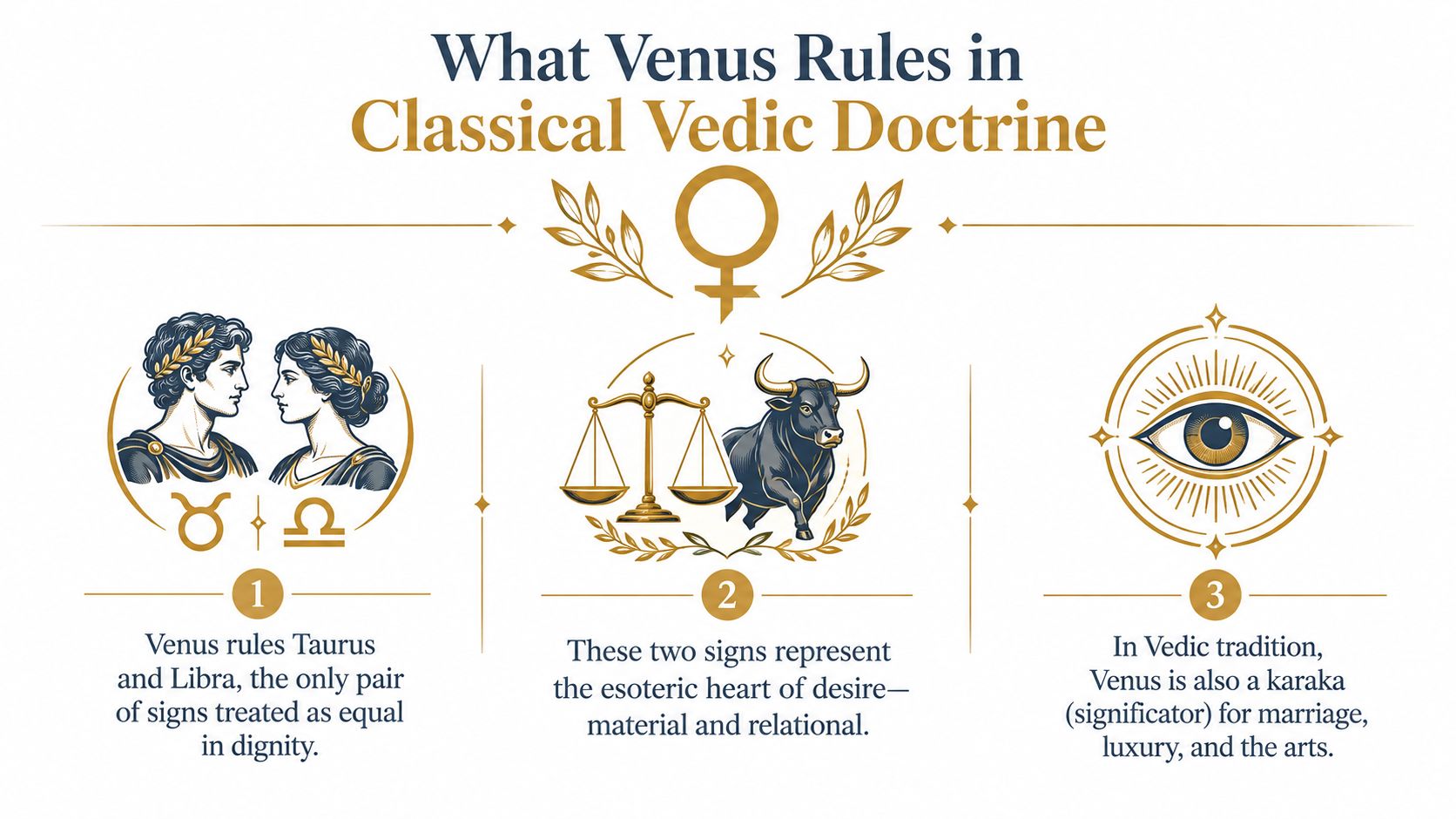
Classical doctrine is clear on the baseline. Venus rules Taurus and Libra. That assignment appears across major traditions, including Hellenistic, Roman, Vedic, and later classical frameworks, and one overview notes that the Taurus-Libra pairing has remained stable for over two millennia in astrological tradition, with the historical rationale tied to Venus appearing as both morning star and evening star (LoveToKnow on Libra's ruling planet).
What rulership means in practice
Rulership doesn't mean “this planet likes these people.” It means the planet has ownership over those signs. In chart reading, that gives Venus more coherence there than in signs ruled by planets with very different agendas.
A classical dignity framework also places Venus exalted in Pisces and in detriment in Aries and Scorpio, which readers use to judge whether Venus themes are stabilized or stressed in a chart. That same framework often treats Taurus as materialization and sensory consolidation, while Libra is read as social calibration and symmetry (Cafe Astrology's Venus reference).
What Venus is actually handling
If you strip away decorative language, Venus usually governs themes such as:
- Attraction and bonding
- Value and exchange
- Pleasure and comfort
- Aesthetic proportion
- Relational balance
A traditional description of Venus presents it as temperate, warm, and chiefly moist, which links it with bonding, attraction, and constructive mixture rather than conflict. In chart work, that's why Venus-ruled signs are often treated as lower-friction settings for Venus topics, though each sign implements that function differently (traditional Venus correspondence reference).
Venus isn't just “love.” It's the chart's way of showing how you seek agreement, pleasure, proportion, and value.
Why this still isn't enough by itself
Many readers stop at “Venus rules Taurus and Libra” and jump straight to personality labels. That's where confusion starts.
There's also a layered dignity model in some Vedic frameworks. One reference notes that the first 15 degrees of Libra are Venus's moolatrikona, meaning a more essentialized zone inside an already Venus-owned sign (moolatrikona note on Venus). So even inside a Venus sign, not every placement is equal.
That's the doctrine. The expression is where things get more interesting.
How Venus Expresses in Taurus Versus Libra
Taurus and Libra share Venus. They don't act the same.
That's the main point most simplified astrology misses. If Venus owns both signs, then Venus must have at least two operating styles. Ancient astrologers had a symbolic reason for this too. Venus is the brightest planet visible from Earth, has a sidereal orbital period of about 224 days, completes roughly 1.6 circuits around the Sun per Earth year, and takes about 10 to 12 months to move through the zodiac. Historical Venus tables from Babylon tracked its appearances and disappearances through an 8-Earth-year cycle, equal to 5 Venus years, showing how carefully its changing visibility was observed (European Southern Observatory background on Venus cycles).
Taurus keeps Venus tangible
In Taurus, Venus tends to work through embodiment, retention, and steadiness.
You often see the person asking practical questions. Is this relationship stable? Is this purchase worth keeping? Does this environment feel comfortable in the body? Taurus usually wants value that lasts.
Examples help:
- With money: Taurus often prefers slow accumulation over quick churn.
- In romance: It may show care through consistency, presence, food, touch, or dependable routines.
- In conflict: It often resists sudden change and may hold a line for longer than others expect.
Libra keeps Venus relational
In Libra, Venus tends to work through comparison, reciprocity, and proportion.
The person may care less about possession and more about whether the exchange feels balanced. Libra notices tone, fairness, timing, and mutual adjustment.
You might see this as:
- With money: spending to improve social setting, presentation, or shared experience
- In romance: strong attention to mutuality, manners, and whether the bond feels even
- In conflict: negotiation first, direct rupture later
Taurus asks, “Can this hold?” Libra asks, “Can this balance?”
That's why two Venus signs can look so different in real life.
A useful way to test the difference
If you're trying to read your own chart, don't ask which sign is “more Venusian.” Ask how Venus solves problems in that sign.
Taurus usually solves by stabilizing. Libra usually solves by adjusting.
If you want to see how sign logic changes relationship interpretation, this piece on Libra and Gemini compatibility is a good example of why simple sign labels don't finish the job.
Why Venus Placement Often Matters More Than Sign Rulership
A chart can contain Venus rulership and still deliver mixed results. That isn't a contradiction. It's normal chart mechanics.
One Vedic reference states that Venus is considered weak or afflicted when debilitated in Virgo, conjoined with or aspected by malefics, or placed in the 6th, 8th, or 12th house (Astromitra on Venus conditions). That single point corrects a lot of bad reading habits.
The rule most people need
If you remember one thing, keep this.
Rulership tells you the domain. House placement tells you the condition of that domain in actual life.
A person may have Libra rising. Venus rules the ascendant. Good. But if Venus is under pressure by house or affliction, the native may still experience strain around agreements, attraction, expense, or relationship balance.
Venus condition layers in chart reading
| Condition Layer | What It Indicates | Typical Effect on Venus Themes |
|---|---|---|
| Sign rulership | Whether Venus is in its own domain | More baseline coherence in Venus topics |
| Exaltation or debility | Whether Venus is specially supported or weakened by sign | Easier or more strained expression |
| House placement | Where Venus operates in life | Shows the arena where Venus results are most visible |
| Affliction | Pressure from malefic contact or hard conditions | Adds friction, contradiction, or delay |
| Timing | When Venus topics become active | Determines when the pattern is felt strongly |
Why sign-only readings fail
A sign-only reading treats every Taurus or Libra person as if the same script should apply. But serious work doesn't read Venus in isolation. It compares the whole pattern.
For example, many readers also learn that Venus behaves very differently from Mars. That becomes obvious when you compare charts where attraction, conflict, and preference are split across both planets. If you want a contrast point, this article on Mars in Vedic astrology helps clarify why Venus can't be read as a generic desire marker.
A Venus-ruled sign can describe the style. It can't, by itself, certify ease.
This is also why two people with similar sign emphasis can report opposite lived results. The chart isn't arguing with doctrine. The chart is adding the layers doctrine always required.
Reading Venus Accurately for Money, Relationships, and Taste
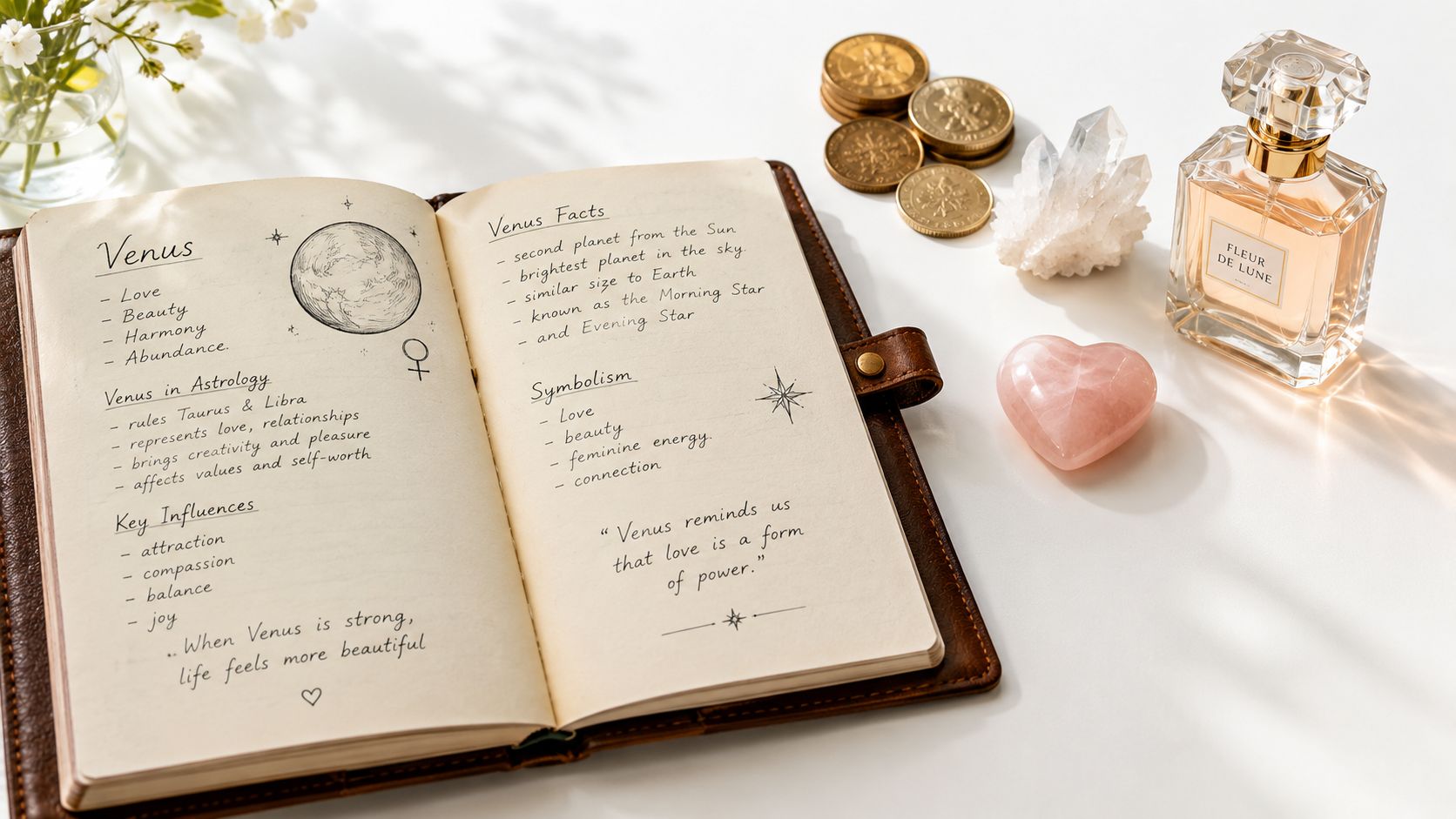
Most online writing about Venus jumps straight to romance. That's too narrow. Venus often shows up across money habits, relationship style, and taste. But you should read those areas through chart condition, not through flattery.
Start with money
Venus can describe how you relate to comfort, accumulation, exchange, and refinement. In some charts, that leans toward retention and quality control. In others, it leans toward display, shared experience, or aesthetic spending.
Check three things before making a claim:
- Sign dignity: Is Venus supported, neutral, or weakened by sign?
- House context: Which life area carries the Venus story?
- Activation: Is Venus active by dasha or transit in a meaningful way?
A broad transit calendar may tell you dates like Venus entering Libra on August 6, Scorpio on September 10, and retrograde from October 3 to November 13 in 2026, but that still doesn't answer whether those periods matter equally for everyone. One source discussing those 2026 transit windows also highlights the gap between generic transit content and the more useful distinction between natal rulership, transit activation, and house context (2026 Venus transit discussion).
Then read relationships
Venus can matter a lot in partnership reading, but not all Venus signatures point to the same thing.
A strong Venus may support smoother bonding, better reciprocity, or clearer taste in choosing people. A stressed Venus may show conflict around preference, compromise, expectations, or pleasure. None of that should be overstated. It's for personal reflection and self-understanding, not professional advice.
Don't forget taste
Taste sounds soft, but it's one of the easiest Venus domains to verify. People often reveal Venus through what they keep, how they arrange space, what they find excessive, and what they consider “worth it.”
One underserved problem in online astrology is that many Venus claims about romance, beauty, and compatibility are interpretive, but the pages people see rarely offer population-level evidence for those outcomes. A better standard is to treat Venus rulership as symbolic, then verify it against the chart and real life rather than claiming certainty too early (Cosmopolitan discussion of the evidence gap in Venus content).
If you want chart-based help instead of generic sign advice, Anvaya reads Venus inside a full Samhita using declared compute first and then calibrates against lived events through Pramāṇa.
How to Verify Venus Readings Before Trusting Them
A good Venus reading should be testable. Not perfectly. But enough that you can compare the chart with your own history and see whether the claim has signal.
That matters because much of astrology content repeats the same Venus language without clear audit trails. You'll see “Venus in Libra brings harmony” or “Venus in Taurus is romantic,” but repetition isn't proof.
A simple verification workflow
Use a short checklist.
- Find Venus in the chart. Note the sign and house.
- Judge condition. Check dignity, possible affliction, and whether the house helps or strains expression.
- Mark activation windows. Look at periods when Venus should become louder through timing techniques.
- Compare with lived events. Did those periods correlate with changes in relationship patterns, spending habits, or aesthetic decisions?
If a Venus claim can't survive contact with your own timeline, don't trust the confidence of the wording.
Use past evidence before future claims
Many readers get more value from a chart. Not by asking, “What will happen?” first. By asking, “What has already happened when Venus was active?”
You can even support this with simple record-keeping. A daily or event-based log helps more than memory. If you already track timing through a Panchang and day-quality workflow, that habit can make Venus verification much sharper.
What honest uncertainty looks like
Not every Venus pattern will be dramatic. Some show up. A change in what you tolerate. A shift in how you spend. A clearer sense of what feels proportionate in love or in objects.
That's still useful.
The point isn't to force every Venus activation into a story. The point is to read the chart carefully enough that the claim can be checked.
Next Steps for Chart-Based Venus Clarity
If you came here asking about the signs ruled by Venus, the direct answer is still simple. Taurus and Libra.
The useful answer is a bit more disciplined.
First, see whether Venus rules your rising sign or another important area in your chart. Then check where Venus sits. After that, compare those placements with periods in your life when Venus themes became more obvious. That sequence gives you something testable.
A lot of confusion disappears once you stop treating Venus as a personality sticker. In classical Vedic reading, Venus rulership matters. But it matters inside a larger structure of sign, house, dignity, affliction, and timing.
We prefer that structure because it's more honest. It also helps you avoid paying for decorative certainty before you know whether the chart is describing your life at all. If you want more background on how chart-first reading differs from vague horoscope writing, the Anvaya methodology and blog library is a good place to continue.
You don't need more Venus adjectives. You need a rule you can test.
If you want that kind of chart clarity, Anvaya generates a Samhita from your birth details, then checks the reading against lived events through Pramāṇa before making forward claims. That's useful for Venus questions because it shows not just that Taurus and Libra are Venus signs, but how Venus behaves in your chart.