

Jupiter typically spends about one year in each zodiac sign and completes a cycle in approximately 12 years, while Saturn spends about 2.5 years in a sign and takes roughly 29.5 years to complete its cycle. In Vedic astrology, gochar, also spelled gochara, means measuring these current planetary movements against a fixed natal chart reference, usually the birth Moon sign.
Two friends see the same viral post about Saturn entering a new sign. One feels anxious. The other feels nothing at all. Neither post explains why the same sky could matter differently to each person.
That gap is where gochar in Vedic astrology begins. A transit headline describes the moving planet, but a serious reading asks which natal chart point it activates, whether the relevant life theme is promised in the birth chart, and whether the running dasha supports it. The result is a timing layer, not a universal verdict.
This approach is for self-understanding and reflection, not medical, legal, financial, or other professional advice. We'll use plain language, name uncertainty, and keep the distinction clear between a possible activation and a guaranteed event.
Table of Contents
- The Question Behind the Headlines
- What Gochar Means
- Why Planet Speed Changes Everything
- Reading Gochar the Classical Way
- How Gochar Sits Inside a Real Reading
- Filters That Make a Transit Honest
- What a Calibrated Samhita Does With Transits
The Question Behind the Headlines
A headline such as “Saturn enters a new sign” is shared by everyone watching the same sidereal sky. The interpretation isn't shared in the same way. One person may have Saturn counted from a particular natal Moon sign, while another has a different Moon sign, house structure, dasha sequence, and natal promise.
That's why generic transit posts often feel strangely personal and strangely empty at the same time. They use a real planetary movement, but they leave out the fixed reference that turns movement into an individual reading.
The missing reference point
Gochar supplies that reference. It compares a planet's current position with the positions recorded in your birth chart. In classical Jyotish, astrologers commonly begin with the natal Moon sign, then add the ascendant, houses, natal planets, aspects, strength, and dasha context.
Practical rule: A transit headline tells you what moved. Your birth chart tells you where that movement lands.
The rest of the interpretation depends on hierarchy. The natal chart describes the underlying promise. Dasha shows which themes are active. Gochar helps time or trigger those themes. A favorable transit can support an outcome, but it can't create a promise that the wider chart doesn't show.
That's the difference between reading a transit and repeating a forecast. A careful jyotishi doesn't ask only, “Is Jupiter favorable?” The better question is, “What is Jupiter activating in this chart, during which period, and with what supporting evidence?”
What Gochar Means
Gochar, also written gochara, describes the current movement of planets through the zodiac in relation to a birth chart. Both spellings refer to the same practice. A transit position needs that chart context, because the current sky alone does not show how a movement meets one person's life pattern.
The usual classical reference is the natal Moon sign, called Janma Rashi, or Chandra Lagna, the Moon-based reference point. The method follows four steps:
- Find the sign occupied by the Moon at birth.
- Locate the transiting planet's current sign.
- Count from the natal Moon sign to the transit sign across the zodiac.
- Read that count as the first, second, third house from the Moon, continuing through all twelve signs.
Suppose your natal Moon is in Aries and Jupiter is currently in Gemini. Gemini is the third sign from Aries. If another person's natal Moon is in Taurus, that same Jupiter in Gemini is the second sign from their Moon.
The planet has not changed, and neither has the sky. The reference point has changed, so the transit relationship changes as well. This is why one planetary movement can receive different gochar interpretations for different people. The count gives an initial position, not a complete prediction.
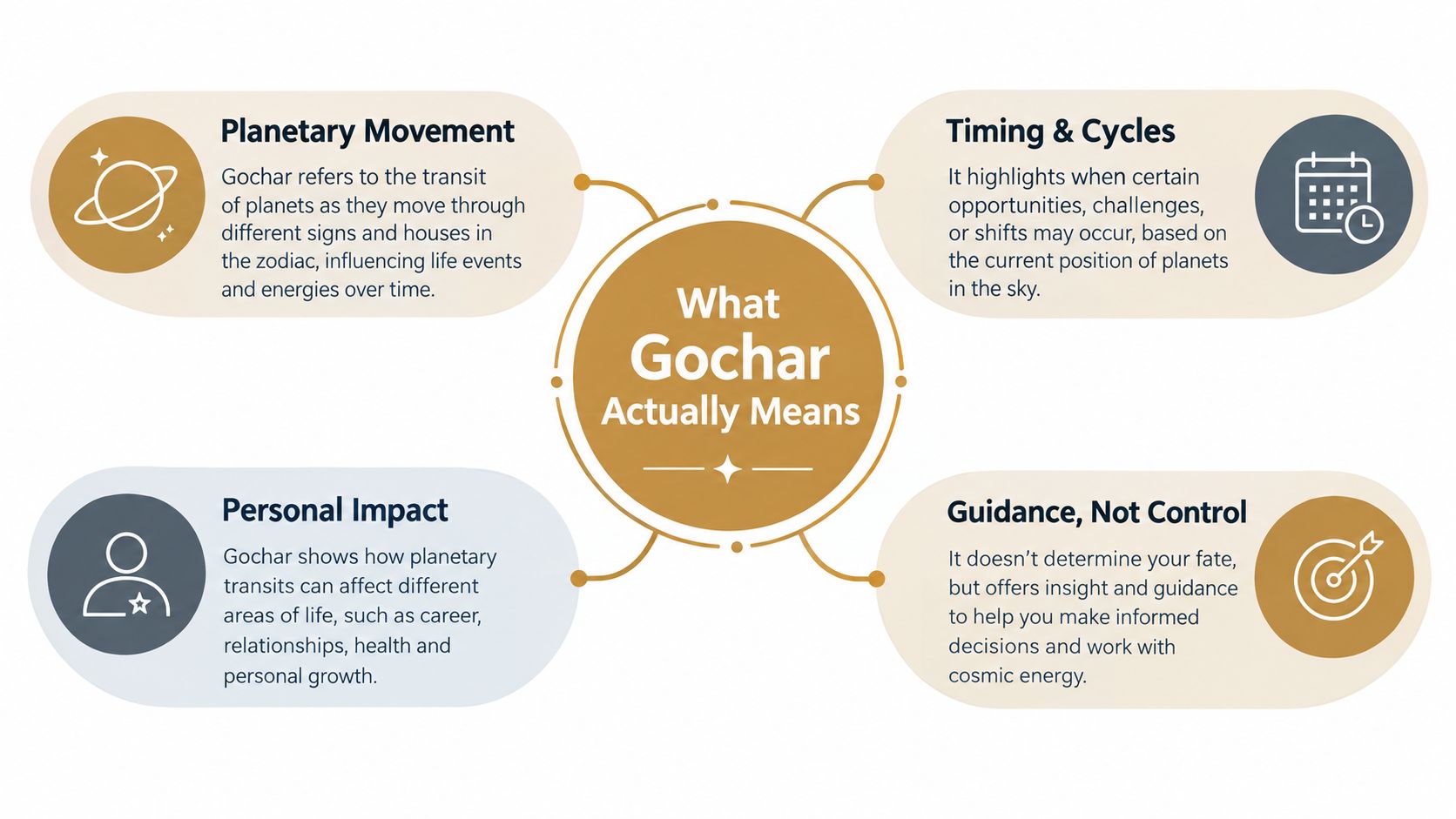
Birth chart first, transit second
A birth chart is fixed at the time and place of birth. Gochar is the changing layer placed against it. Traditional transit discussions include the Brihat Parashara Hora Shastra, Phaladeepika, Saravali, and Varahamihira's Brihat Samhita, generally dated to approximately 550 CE. Together, these works belong to a Jyotish tradition spanning roughly 1,500 years as described in this overview of classical transit methods.
These texts provide methods and interpretive principles, not automatic answers. A careful reading still requires the chosen reference point, the chart assumptions, and an assessment of how much weight the transit deserves beside natal strength and dasha.
Why Planet Speed Changes Everything
Gochar uses several timing clocks at once. Their different speeds help a jyotishi separate a broad period from the shorter moments within it.
The Moon remains in a sign for roughly 2 to 2.25 days and completes the zodiac in about 27 days. The Sun spends about one month per sign. Jupiter stays in a sign for about one year, completing its zodiac cycle in approximately 12 years. Saturn remains in a sign for about 2.5 years and takes roughly 29.5 years to complete a cycle. Rahu and Ketu spend about 1.5 years per sign, a duration discussed in classical transit traditions including Varahamihira's Brihat Samhita. A technical transit reference provides the planetary timing overview.
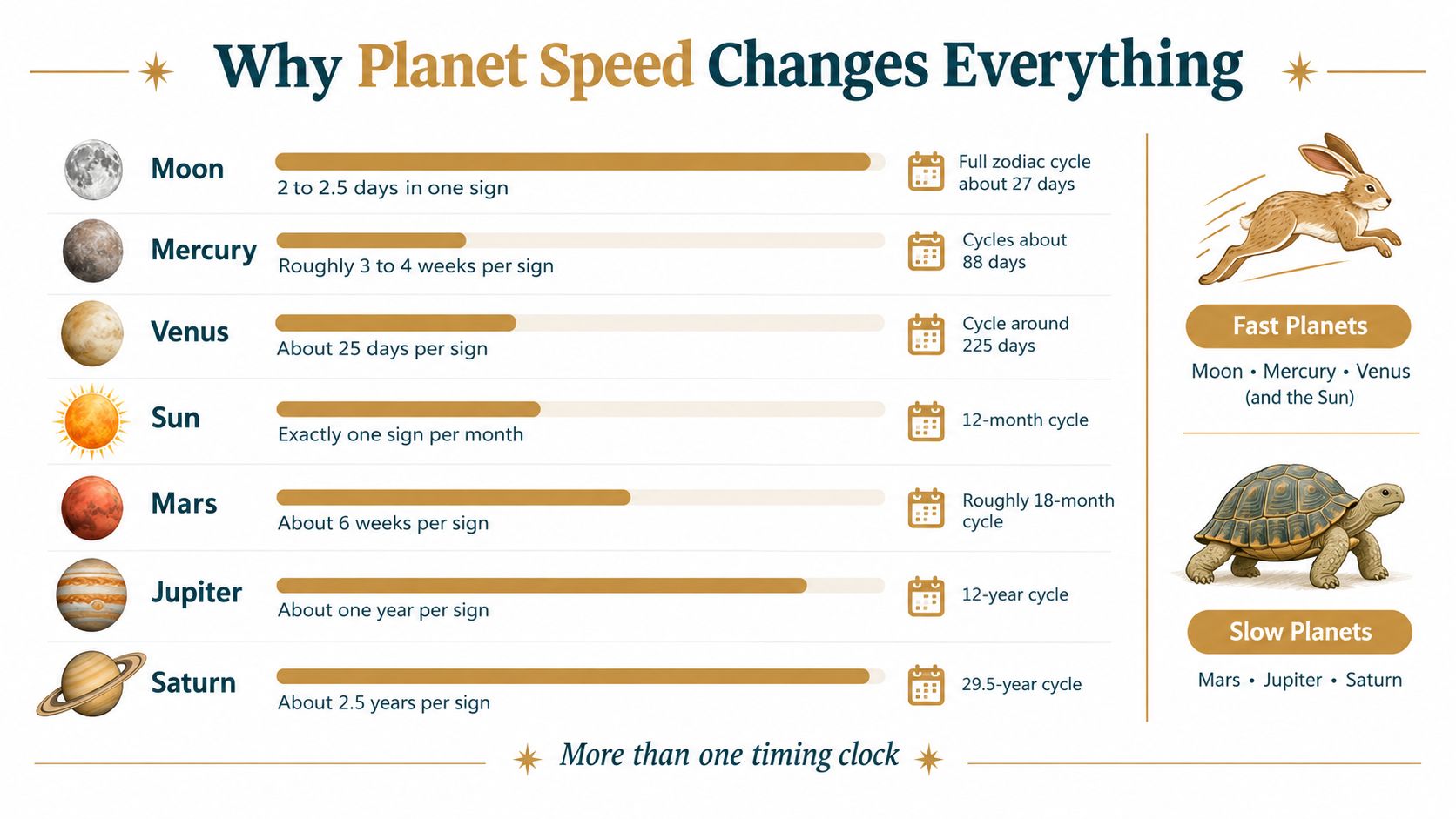
Slow planets set the season
Jupiter's roughly annual movement can describe a recurring development theme. Saturn's longer stay in one sign works on a slower, more structural scale, often bringing questions of responsibility, consolidation, learning, or sustained effort. Speed alone does not decide whether either planet produces ease or difficulty. Natal strength, house relevance, dasha, and the planet's condition still determine how much weight to give the transit.
A faster planet can act like a clock hand moving across a larger season. The Moon changes sign within days, so it may help identify a shorter period when a broader promise becomes noticeable. The Sun's monthly movement can mark a recurring stage in that process. Other planets may refine the timing when their contact with relevant chart factors fits the question being asked.
A long transit can describe the season. A short transit may describe the day you notice what the season is asking of you.
This hierarchy also prevents a common mistake. A slow transit may indicate the background, while a dasha may decide whether that background becomes active. A fast transit can help time an expression, but it should not overrule weak natal support or an unrelated period.
Exact timing requires more than a sign announcement. Degree contacts, retrograde phases, and house boundaries can change the interpretation, so a careful workflow records dates and times before assigning meaning.
Reading Gochar the Classical Way
Traditional gochar rules often begin with house counting from the natal Moon. Several baseline patterns are commonly taught:
| Planet | Generally favourable houses from the Moon | Practical caveat |
|---|---|---|
| Sun | 3rd, 6th, 10th, or 11th | The natal Sun, house context, aspects, dignity, and exact degree can change the expression. |
| Jupiter | 2nd, 5th, 7th, 9th, or 11th | A favorable house count still needs support from the birth chart and active dasha. |
| Saturn | 3rd, 6th, or 11th | A baseline favorable placement can still involve effort, delay, or obstruction. |
These are baseline rules, not standalone predictions. A favorable house count doesn't mean an event must occur. The natal planet's strength, dignity, aspects, exact transit degree, and relevant houses all matter. So does the question itself. A transit connected with partnership isn't interpreted the same way as one connected with work, family, study, or a move.
Name the reference point
A serious reader should always ask whether the transit is being judged from the Moon, the ascendant, or another chart factor. “Saturn is in the tenth house” is incomplete unless the reader knows which reference created that house count.
The ascendant can add a house-based view of external circumstances. The Moon often describes the experience and mental orientation of the period. Natal planets show specific points of contact. None of these should automatically erase the others.
The same principle applies to favorable language. Instead of saying “Jupiter is good for everyone,” a careful interpretation might say that Jupiter is placed in a traditionally supportive position from this natal reference, provided the chart and dasha support the relevant promise.
For readers who want a more numerical filter, Anvaya's Ashtakavarga chart analysis gives context for how bindus can refine a transit judgment. The number doesn't replace interpretation. It makes one layer easier to inspect.
How Gochar Sits Inside a Real Reading
Gochar belongs near the end of a decision hierarchy, not at the beginning. A useful sequence has four parts.
- Identify the natal promise. Does the birth chart show a meaningful connection to the life area being considered?
- Check the running mahadasha and antardasha. These are the major and sub-periods that show which planetary themes are active.
- Read the current gochar from the Moon and ascendant. This shows where the moving planets are landing from both reference points.
- Weigh strength and obstruction. Consider dignity, aspects, exact degrees, retrograde status, and vedha before making a claim.
A simple example shows why this order matters. Suppose Jupiter is moving through a house associated with career when counted from someone's Moon. That may look favorable in a headline. But if the running dasha doesn't activate career-related houses or planets, the transit may not produce a major career event. It could still support learning, planning, or a smaller development, but the stronger claim would lack enough support.
The opposite can also happen. A demanding transit may coincide with a dasha that strongly activates a natal promise. The period may feel busy or effortful while still producing meaningful movement. “Difficult” and “unproductive” aren't synonyms.
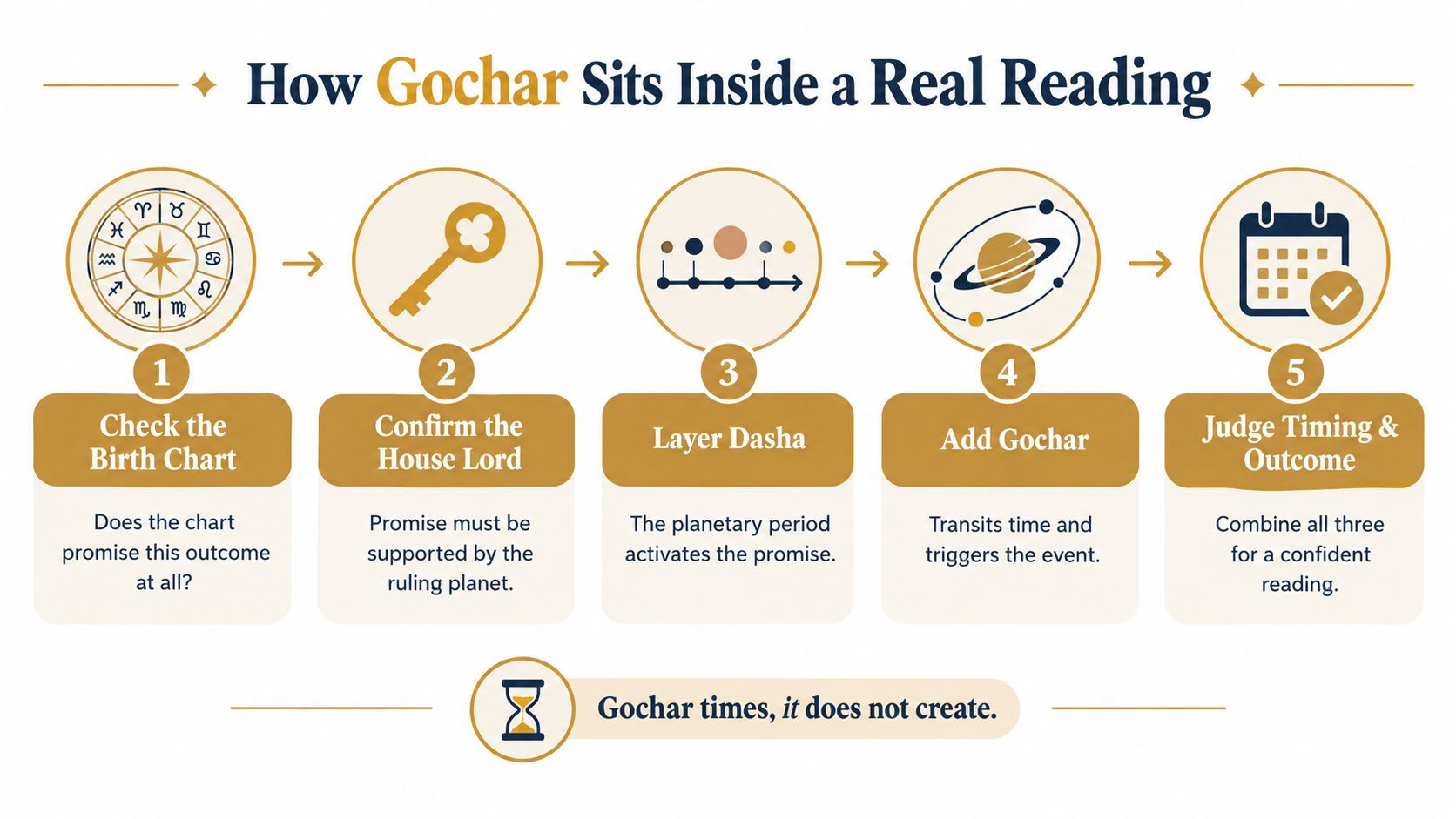
The hierarchy in one sentence
The natal chart shows what is available, dasha shows what is active, and gochar helps show when activation may become visible.
This doesn't turn astrology into certainty. It creates a disciplined way to handle conflicting signals. If the three layers agree, confidence can be stronger. If they disagree, the honest answer should narrow the claim or state that the chart doesn't say enough.
Filters That Make a Transit Honest
A headline may name only a planet and sign. A useful gochar reading checks what could support or obstruct that broad signal.
Vedha describes an obstruction in classical transit practice. Another planetary transit can interrupt, delay, or complicate a result that initially appears favorable. The effect may show up as friction, competing duties, or conditions that are not yet complete. A supportive transit therefore describes an opening, not a guaranteed event.
Ashtakavarga supplies another filter. In a planet's individual Bhinnashtakavarga table, each zodiac sign receives 0 to 8 bindus, contributed by the seven classical planets and the ascendant. A commonly used scale treats 0 to 1 as very difficult, 2 to 3 as strained, 4 as neutral or a threshold, 5 to 6 as good, and 7 to 8 as excellent as outlined in this Ashtakavarga reference. The aggregate Sarvashtakavarga system distributes 337 points across the twelve signs, averaging about 28 points per sign.
These figures do not decide an outcome. They help distinguish two transits that would otherwise receive the same house-based description.
A bindu score is a filter, not a verdict. Its weight increases when the natal chart and active dasha already support the same life area.
A careful reader can ask three questions: Is the house count supportive? Does Ashtakavarga add support or reduce it? Does vedha create friction? The answers remain subordinate to the birth chart and dasha hierarchy. If those layers disagree, narrow the prediction rather than forcing certainty.
For a shorter daily timing question, a Panchang of the day provides calendar context. It should remain separate from a personalized gochar assessment.
What a Calibrated Samhita Does With Transits
A calibrated Samhita begins with a calculation, not a headline. It records exact timestamps, sidereal longitudes, retrograde status, the natal Moon sign, and derived house counts before translating movement into a forecast. A sign-only check can miss a small positional change that alters a house or aspect classification, which matters when auditing an event window. A technical walkthrough of timestamp-level transit logging shows why that precision belongs in the workflow.
The interpretation then follows a clear decision hierarchy:
- Chart promise: identify the natal houses, planets, and significations connected with the question.
- Active period: check whether the mahadasha and antardasha activate that area.
- Transit reference: calculate positions from the Moon and ascendant, then check relevant natal contacts.
- Strength and obstruction: review dignity, aspects, retrograde status, vedha, and Ashtakavarga where appropriate.
- Plain-language conclusion: distinguish what is supported, what is possible, and what remains unclear.
This order prevents a fast-moving transit from overpowering the chart. A transit may act like a trigger, while the natal chart supplies the underlying wiring and the dasha identifies the circuit currently carrying power. If those layers disagree, the reading should narrow its claim rather than turn tension into certainty.
The assumptions also need to remain visible. If the calculation uses the natal Moon sign, state it. If the ascendant changes the house reading, show the difference. If dasha and gochar point in different directions, describe that conflict plainly instead of smoothing it into confident prose.
Pramāṇa gives the method a practical test. Anvaya uses declared computation and calibrates it against recorded lived events before making forward claims. Its calibration approach centers on chart-derived questions and confirmation records, rather than inviting a user to supply a story that the interpretation could merely reflect back.
Frequently asked questions
Is gochar the same as a birth chart?
No. The birth chart records planetary positions at birth. Gochar tracks current positions against that fixed reference, adding timing without replacing the natal chart.
Why is gochar usually counted from the Moon?
The natal Moon sign, or Janma Rashi, is a principal classical reference. A reading may also check the ascendant, natal houses, and exact planetary contacts. The chosen reference should be stated.
Can a favorable Jupiter transit guarantee an event?
No. It can support or trigger a result when the natal chart and running dasha show a related promise. Without that support, it may express through a smaller theme.
What is the difference between gochar and dasha?
Dasha describes the active planetary period. Gochar describes current planetary movement. Dasha establishes the active theme, while gochar refines timing.
Why do two people experience the same Saturn transit differently?
Their Moon signs, ascendants, houses, planetary strength, dasha sequences, and chart promises differ. The shared sky is only one input.
Does exact birth time matter for transit analysis?
Yes. It can change the ascendant, house structure, Moon position, and dasha timing. A careful reading states its assumptions and avoids presenting a broad sign transit as a personal event window.
Anvaya uses the Samhita format to place current transits inside a persistent reading instead of a horoscope feed. You can generate your Samhita to see how chart, dasha, and gochar layers connect while uncertainty remains visible.
Generate a Samhita with Anvaya to explore current planetary movements alongside natal chart strength and dasha timing.