You're considering a move, and a marriage conversation is getting serious. You close a sun-sign app feeling vaguely recognised, but no clearer about either question. Vedic astrology chart analysis should offer a slower alternative: birth data first, a declared calculation method second, and only then language about your life.
Table of Contents
- When a Reading Feels Personal but Says Nothing
- What Vedic Astrology Chart Analysis Actually Computes
- The Order That Keeps a Chart Reading Honest
- How to Check a Chart Against Lived Events
- Timing and Matchmaking in Plain Numbers
- A Persistent Samhita Instead of a One-Off Sitting
- Questions to Ask Before You Act on a Chart
When a Reading Feels Personal but Says Nothing
A reading says you care but sometimes hide your feelings. It says change is approaching and asks you to stay open. You can find yourself in those sentences, but you can't tell what would make them wrong.
That's the problem with recognition alone. A sentence can feel intimate without identifying anything specific about you. When you're already uncertain, warmth can be mistaken for accuracy.
Recognition isn't verification
Consider the difference between a personality adjective and a testable statement. Calling you resilient doesn't identify a period, an event, or a reason. A chart-derived question about a defined past window gives you something you can confirm, reject, or mark uncertain.
A serious reading should let you distinguish:
- The calculation: What was derived from your birth details?
- The interpretation: Which traditional rule connects that calculation to a life theme?
- The check: What experience would support or contradict that interpretation?
You shouldn't have to disclose your whole history before the reader produces anything specific. Otherwise, it becomes difficult to separate chart interpretation from a skilled retelling of what you've just shared.
A reading should become more accountable as it becomes more personal, not harder to question.
Keep the purpose clear
Use this approach for personal reflection and self-understanding, not medical, legal, financial, or employment advice. A chart doesn't replace practical evidence about your circumstances.
The useful questions are modest. What was computed? Why was a particular timing window selected? Does the reading remain intact when your lived experience disagrees?
Conditional language matters here. A period may support a theme within a classical interpretation. That isn't the same as saying an event must occur, or that you should organise your life around it.
What Vedic Astrology Chart Analysis Actually Computes
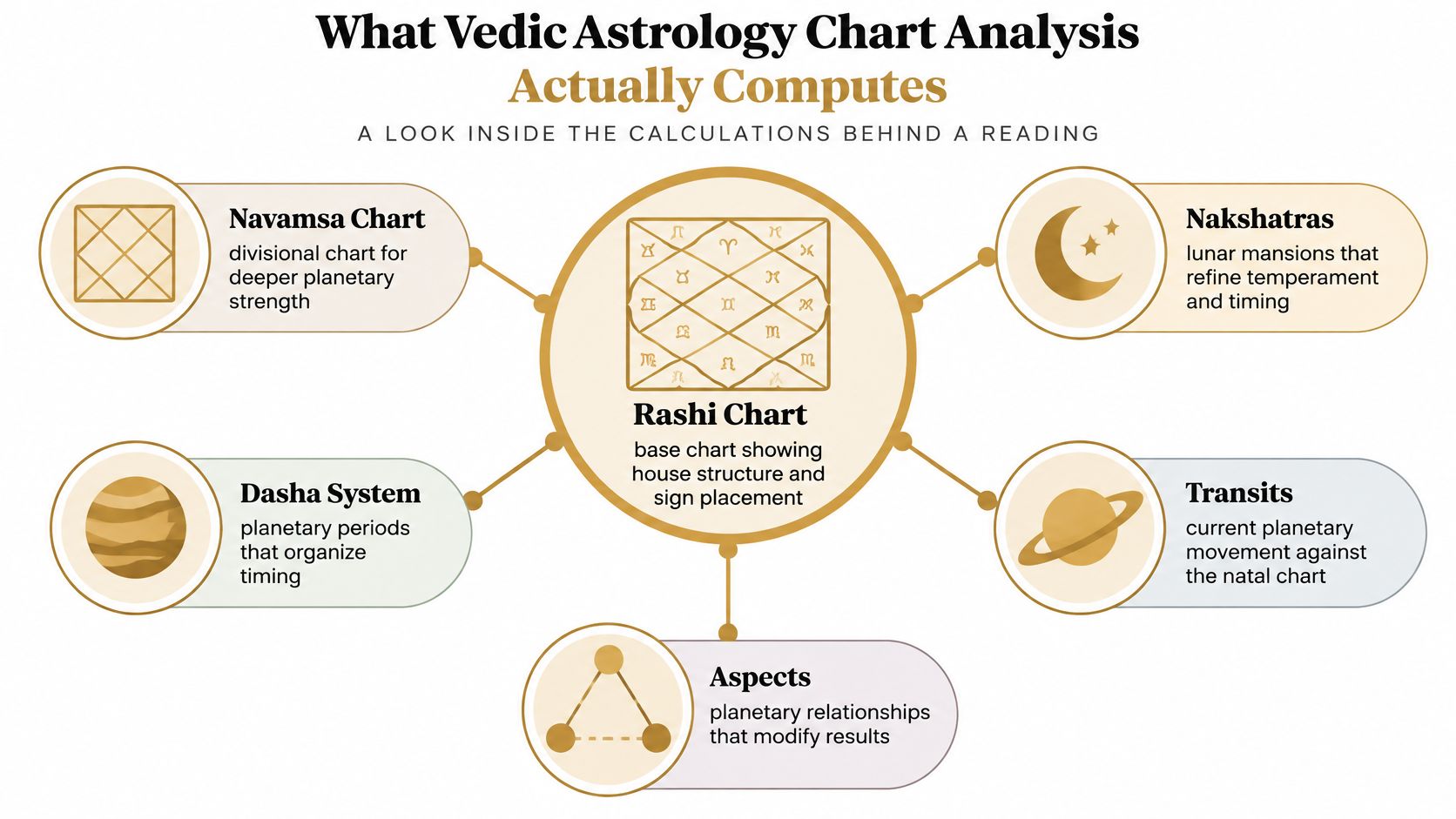
A chart reading can sound precise while mixing calculation with interpretation. To follow the reasoning, treat the Parashari approach as a declared compute stack: each layer has a defined input and role, and any forward claim should be checked against lived events before it is trusted.
The rashi chart, or base birth chart, places planetary positions in signs and houses. A house is a traditional life-area category. For example, “Mars in the first house” states a placement; what that placement may signify is a separate interpretive step.
Different layers do different jobs
Shodashvarga refers to the sixteen divisional charts in the Parashari tradition. Each transforms the same planetary longitudes within a sign's 30-degree span; it does not provide an independent observation. Finer divisions make the reading more sensitive to birth-time uncertainty. Their relevance and reliability need separate consideration, as described in this guide to divisional charts.
Agreement between related charts may matter within the tradition, but shared inputs limit how much independent confirmation that agreement provides.
Vimshottari dasha organizes time into planetary periods. The opening period is determined by the Moon's birth nakshatra, its lunar-mansion division. A guide to finding your birth nakshatra explains how that starting point differs from a general Moon-sign description.
Other layers add relationships or timing context:
- Yogas: Traditional combinations of planets and houses. Multiple yogas can rely on the same placements, so counting them does not create separate evidence.
- Aspects: Defined planetary relationships used to modify an interpretation.
- Gochara: Current planetary transits considered in relation to the birth chart and active period.
Exact arithmetic has a boundary
Math first, language second: Record the calculation before interpreting it. A reproducible placement is a clearer claim than a prediction about what it means for your life.
A precise calculation can still lead to an uncertain interpretation. Before making a forward claim, compare the method's past-period indications with events you can confirm, reject, or mark uncertain.
The free Panchang calendar provides calendar information for a given day. Anvaya's methodology articles explain how calculation and interpretation fit together.
The Order That Keeps a Chart Reading Honest
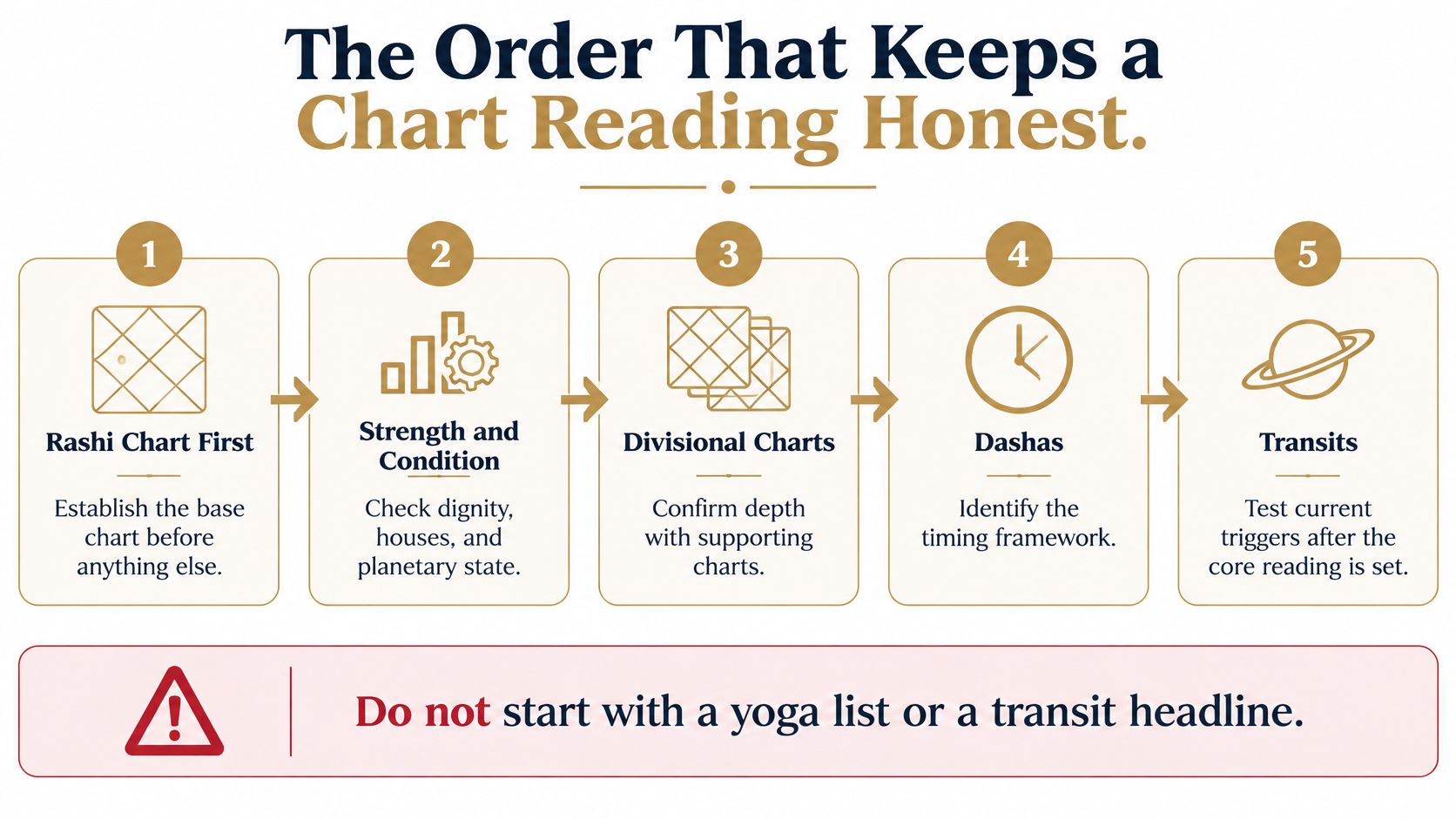
Don't begin with a dramatic yoga name or a transit headline. Begin by asking whether the underlying chart can be reproduced.
Confirm the birth date, recorded time, and birthplace. Preserve any uncertainty instead of turning an approximate time into an exact one. Then declare the ayanamsha, the offset used for sidereal positions, along with the house method and ephemeris, the astronomical position tables or calculation system.
Establish the base before adding detail
Read the rashi chart in relation to the question. Identify the relevant houses and their lords, meaning the planets that rule the signs assigned to those houses.
Examine dignity, a planet's traditional condition by placement, and its other associations. Strength methods such as Shadbala, a structured planetary-strength calculation, or Ashtakavarga, a point-based assessment, should clarify the declared method rather than overwhelm you with scores.
A practical reading ladder is:
- Establish the base: Confirm inputs, settings, house structure, and the question being considered.
- Assess condition: Examine the relevant planets, their lordships, and the strength rules used.
- Consult relevant divisions: Use supporting charts suited to the topic, discounting sensitive placements when the time is uncertain.
- Locate the period: Identify the mahadasha, or major period, and antardasha, its subperiod.
- Check current context: Consider transits and, where relevant, Varshaphala, the annual chart.
Yogini dasha is another timing ladder. If it's consulted, its role should be named. It shouldn't become an alternative explanation brought in only because the first interpretation didn't fit.
Watch windows aren't instructions
For a career question, the reader might identify a period to observe for changes in responsibility. That remains a reflective watch window, not an instruction to resign, accept an offer, or delay an application.
For a ceremony, muhurta means selecting a traditional timing window. You would consider that window alongside venue availability, travel, family needs, and consent. An annual chart or transit shouldn't override those realities.
Agreement across layers can increase interpretive confidence within the method. It doesn't establish predictive accuracy. If the layers conflict, the reading should preserve the disagreement rather than select whichever factor makes the strongest sentence.
Traditions differ on some rules. A careful reader names the rule used and explains why it applies. Later layers shouldn't be used to conceal a weak foundation.
How to Check a Chart Against Lived Events
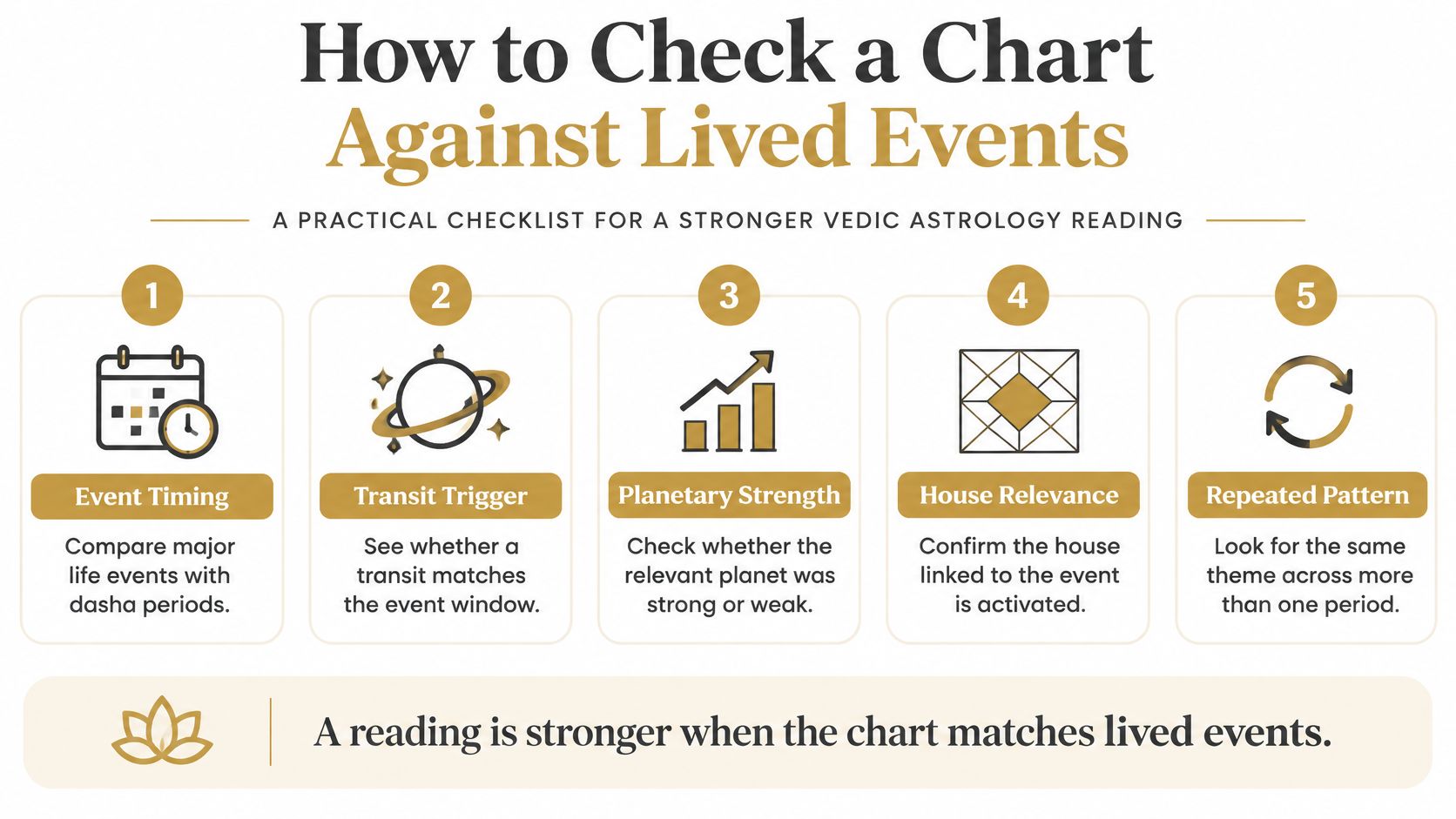
Suppose a chart reading names a career change in a past period. Before you share your history, the reader should record the dates and what kind of change the chart suggests. You can then compare that claim with your own recollection or records.
Pramāṇa, or the stage of checking a claim against evidence, makes the comparison explicit. A match may support confidence in that interpretation within the chosen method. A mismatch should remain visible, rather than prompting a new explanation after the fact.
Preserve enough information to repeat the test
Keep a record that another reader could follow:
- Birth inputs: The original date, time, place, and any stated uncertainty.
- Calculation settings: Ayanamsha, time zone, ephemeris version, and house method.
- Intermediate results: Placements, period balances, and calculations behind each proposed window.
- Original claims: The event described, the dates proposed, the confidence label, and your response.
If the analysis uses a secondary timing system, record its calculation and role too. The Yogini dasha calculation guide explains that separate timing ladder.
Why a correct chart isn't proof of a correct interpretation
A Maharashtra study examined 200 natal charts, split between students classified as academically high-performing and students classified in the study as mentally disabled. The charts were randomised, and 51 astrologers received 40 charts each. Aggregate classification was marginally below the 50% coin-toss baseline, according to the statistical test of astrology.
The finding applies to that task. It does not settle every question about astrology. It does show that precise astronomical inputs alone did not establish predictive success in the study.
A separate 2025 exploratory study surveyed 237 respondents. Researchers found that 195 had heard of astrology apps and 21 used them, identifying credibility and trust as barriers in their research on astrology-app adoption.
A mismatch should lower confidence or prompt a documented review. It should not give the original statement a new meaning after you answer.
Past-event matching is an accountability check, not scientific validation by itself. Memory can be incomplete, proposed windows can be broad, and flexible interpretations can make a reading seem more successful than it was.
Before relying on a forward claim, ask whether the past window was specific, whether confidence was recorded in advance, and how the reader handles disagreement.
Timing and Matchmaking in Plain Numbers
Suppose you're considering when to start a personal project. A chart cannot supply a responsible timing claim until its calculation settings and past-event fit have been checked. Without your birth details, the example here shows the method, not a forecast.
A timing ladder you can inspect
The reader starts with the Moon's birth nakshatra, calculates the balance of its opening period, then follows the prescribed sequence to identify the current major period and subperiod. Each step depends on the birth data and calculation settings.
The Vimshottari Mahadasha lengths follow a 120-year cycle. The sequence below is a timing framework, not an estimate of lifespan, as described in the classical Vimshottari specification.
| Order | Period lord | Years |
|---|---|---|
| First | Ketu | 7 |
| Second | Venus | 20 |
| Third | Sun | 6 |
| Fourth | Moon | 10 |
| Fifth | Mars | 7 |
| Sixth | Rahu | 18 |
| Seventh | Jupiter | 16 |
| Eighth | Saturn | 19 |
| Ninth | Mercury | 17 |
| Total | Complete cycle | 120 |
The durations sum to the full cycle. Your age alone cannot identify the active period because the opening balance depends on the Moon's position at birth.
A period's length does not indicate whether it will feel easy. Interpretation also considers house, sign, dignity, lordship, associations, and whether other timing factors support the same reading. For a project, record a specific window and the reasons for it, then compare that claim with dated events before making a forward prediction.
A compatibility total you can examine
Suppose a couple compares charts. Ashtakoota Guna Milan is a traditional weighted compatibility method. Its score is not a probability that a marriage will succeed.
The eight kootas total 36 points: Varna 1, Vashya 2, Tara 3, Yoni 4, Graha Maitri 5, Gana 6, Bhakoot 7, and Nadi 8, as listed in the traditional Ashtakoota framework.
The weights differ, so the same total can conceal different component results. Nadi and Bhakoot carry more points than Varna. A report that shows only the final score hides those differences.
A transparent report keeps the inputs and components visible:
- Birth data and lunar placements: Both records and the nakshatra assignments used.
- Component results: Each koota score, the total, and any exception rules applied.
- Broader chart context: The seventh house, its lord, Venus, Jupiter, and relevant periods.
Sambandha refers to this two-chart reading. It includes Ashtakoota and Mangal Dosha, a traditional Mars-related compatibility check. For more context on the method, see this guide to online kundli matching.
Use the result to guide a conversation, not to decide a relationship by score. A chart cannot establish how partners communicate, respect boundaries, or handle disagreement.
A Persistent Samhita Instead of a One-Off Sitting
Suppose you want to revisit a chart reading months later. A consultation, a horoscope feed, and a stored interpretation leave different records, so they offer different ways to check what was said against events in your life.
A consultation can support useful dialogue. If its calculations and conclusions aren't saved, though, you may have only your memory to rely on. A horoscope feed gives you new text, but new text alone doesn't show how an interpretation has changed.
Compare what remains after the reading
| Format | What to examine |
|---|---|
| A one-off consultation | Whether the reader provides settings, calculations, and a dated written record |
| A horoscope feed | Whether statements refer to your complete birth chart or a broad audience category |
| A persistent Samhita | Whether the stored calculations, confidence labels, and earlier interpretations remain inspectable |
A Samhita is a structured reading based on birth data, designed to be revisited rather than consumed as a stream of general predictions. Its core reading is listed at ₹2,099. International visitors see USD at checkout, and the core reading has no subscription requirement. Current details appear on the Samhita pricing page.
Pramāṇa offers chart-derived questions about past periods before paid forward-looking content is added. The point is to check a reading against your experience before relying on a forecast. That check can fail, and a careful interpretation should leave room for that result.
A saved reading needs more than saved prose
A persistent record should preserve the calculations behind its claims, not just the written interpretation. The stored stack includes the divisional charts and timing systems described earlier, along with strength calculations, annual charts, transits, and yogas. It also includes Jaimini karakas, planetary role indicators used in a distinct classical method.
The reading is organised into 19 named chapters. Right Now, Watch Windows, and The Year Ahead connect their interpretations to active period context. Daily Practice follows the current period rather than offering a daily sun-sign forecast. The Samhita offering describes these features.
- Audit history: Earlier outputs and updates remain timestamped and viewable.
- Linked context: Sambandha connects calibrated readings; Parivara adds family-tree context for household timing.
- Privacy: Account content stays private unless you choose to share it.
- Other tools: Free instruments include Panchang, Janma Akshara for naming, Muhurta for timing, Sangati for daily confluence, and Pravāha for suitability views.
Persistence lets you compare a claim with what happened and inspect how an interpretation changed. It does not establish predictive accuracy. That depends on whether the method is declared, the record is preserved, and the reading holds up against lived events.
Questions to Ask Before You Act on a Chart
A reading may sound specific and still leave you unsure what to do. Before acting on it, ask how the chart was calculated, what supports each claim, and where the method's limits begin.
Why can jyotishis disagree about the same birth details?
Jyotishis, or Vedic astrology practitioners, may use different calculation settings or interpretive rules. Ask each reader to state the ayanamsha, house system, and opening dasha balance. These are part of the calculation stack, much like settings that affect the output of a measuring instrument.
If the calculations match, disagreement can still come from interpretation. Ask which Parashari rule supports the claim and whether it fits past events. A difference is not evidence of a hidden message.
What if your birth time is approximate?
Keep the uncertainty visible. Ask the reader to compare the chart across the plausible birth-time range and identify which conclusions stay stable.
A small time shift can affect fine divisional placements. Broader chart themes may be less sensitive, but they still need checking against lived events. Treat any interpretation that changes sharply with a few minutes' difference as tentative.
What does a low-confidence chart claim mean?
It means the claim has limited support under the stated method. Conflicting chart layers, uncertain birth details, or past-event checks that do not fit should lower confidence.
A confidence label is not a measured probability unless the method has been tested and calibrated that way. “Unclear” is a useful result. It marks where interpretation should stop rather than grow more certain.
Should a chart settle a consequential decision?
No. A chart cannot establish whether a treatment, contract, investment, or job choice is right for you.
Use professional advice and direct evidence for those decisions. For relationships, consider consent, communication, behaviour, and your circumstances. A compatibility indicator should not overrule them.
You should be able to question a reading without being blamed for its uncertainty. Keep traditional interpretation distinct from established fact, and check claims against experience before relying on forward timing.
Anvaya's Samhita begins with declared chart calculations and free Pramāṇa questions about past windows before paid forward content. The structured reading includes confidence labels and a saved record you can revisit. As noted earlier, a lasting record makes claims easier to inspect, but it does not prove that they predict events.