A family receives an online kundli matching report after dinner. The first page shows 28 out of 36 in large type. The families feel relieved, but nobody can explain what the number means, whether the birth details were accurate, or whether the couple's marriage timing supports the match.
That confusion is common. Kundli matching online can produce a neat score without showing the calculations behind it. A serious reading should explain where the score comes from, what it leaves out, and how much confidence the birth data deserves. The point isn't to reject Guna Milan. It's to use it as one step in a chart-based process, not as a verdict.
Table of Contents
- The Report That Says 28 Out of 36 and Tells You Nothing
- How the 36-Point Ashtakoota Score Is Built
- What Goes In Before Anything Comes Out
- Mangal Dosha Checked on Its Own Terms
- Why a High Score Is Not the Same as a Good Match
- How to Verify an Online Kundli Match Before You Trust It
- What a Trustworthy Online Matching Flow Looks Like
The Report That Says 28 Out of 36 and Tells You Nothing
The family scrolls past the headline score and finds a coloured bar, a short description, and perhaps a line saying “excellent compatibility.” The couple still has practical questions. Which factors created the score? Was one koota unusually weak? Is Nadi affected? What does the report say about Mangal Dosha, the Navamsa chart, or the timing of marriage?
A bare total answers none of these. It tells you that the eight Ashtakoota factors added up to a particular result. It doesn't tell you whether the birth time was exact, whether the generated charts are correct, or whether both partners are moving through periods that support partnership at the same time.
A useful report should show:
- The input record: Both names, dates of birth, times of birth, and places of birth.
- The calculation: Each koota, its points, and the reason for the result.
- The separate checks: Mangal Dosha, Bhakoot, Nadi, and any applicable cancellation rules.
- The chart context: Moon sign, Nakshatra, Lagna, Navamsa, seventh-house condition, and dasha periods.
- The confidence level: A clear warning when the birth time or place is uncertain.
The traditional system is called Guna Milan or Ashtakoota Milan. It uses eight compatibility factors and a total of 36 gunas, as explained in this guide to Guna Milan for marriage. The useful questions are simple: where do those 36 points come from, and what should you verify before treating the result as serious?
How the 36-Point Ashtakoota Score Is Built
The Ashtakoota system assigns points to eight areas. Together, they make the full 36-point score, not an open-ended percentage. The allocation below follows the standard structure used by kundli matching calculators, including the eight kootas in Kundli matching.
| Koota | Max Points | What It Checks |
|---|---|---|
| Varna | 1 | Broad value orientation and traditional social compatibility. A low result usually has limited weight on its own. |
| Vashya | 2 | Mutual influence, adjustment, and the way two people may respond to one another. A low score can point to control or cooperation friction. |
| Tara | 3 | Birth-star compatibility and supportive or difficult patterns between the Nakshatras. A low result suggests the need for closer chart review. |
| Yoni | 4 | Traditional instinctive and physical compatibility. A low result may indicate differences in closeness, preferences, or natural responses. |
| Graha Maitri | 5 | Friendship between the planetary rulers of the Moon signs. A low score can signal differences in thinking, communication, or emotional style. |
| Gana | 6 | Temperament and behavioural disposition. A low result is commonly read as possible friction in habits, reactions, and expectations. |
| Bhakoot | 7 | The relationship between the Moon signs and its traditional implications for shared life direction. A low result calls for dosha and cancellation analysis. |
| Nadi | 8 | A traditional compatibility category connected with biological and family considerations. Nadi carries the highest point value and is often treated as a major concern when unfavourable. |
The score is useful because it forces the report to show its first calculation layer. It becomes misleading when the report presents the total without the individual kootas or treats every point as equally meaningful in lived experience.
Nadi alone carries 8 points, so it can change the total sharply. But a low Nadi result shouldn't automatically end the analysis. Traditional practice includes exceptions and cancellation rules, and those must be checked in the relevant charts rather than assumed from a headline score.
What Goes In Before Anything Comes Out
Every calculation depends on the birth data entered for both people. Most online matching systems ask for a name, date of birth, exact time of birth, and place of birth before generating the charts and koota breakdown. This input pattern is described in the workflow used by online kundli matching calculators.
The time matters because the Lagna, or rising sign, depends on the birth moment. The place matters because a city identifies the geographical coordinates used to calculate the chart. “Born in the district” may not be enough when several towns share similar names or when the system selects the wrong location.
Common input problems
- Approximate time: “Around sunrise” or “between two calls” should not be treated as confirmed data.
- Unknown time: A report should say that the time is unknown instead of producing a high-confidence chart without noting it.
- Ambiguous place: A district, suburb, or village name may map to the wrong coordinates.
- Unverified rectification: A corrected birth time is only useful when the rectification method and supporting life events are recorded.
The downstream effects can be substantial. A weak input can alter the Lagna, house placements, Moon details, and the resulting compatibility calculations. The report should display the entered data and flag uncertainty before it displays a polished score.
Practical rule: If the inputs are weak, 28 out of 36 is decoration, not dependable data. Ask what the system knows, what it inferred, and what remains uncertain.
Mangal Dosha Checked on Its Own Terms
Mangal Dosha is not another point inside the 36-point Guna Milan total. It is a separate check based on the placement of Mars in the chart. A common rule identifies Mars in the first, second, fourth, seventh, eighth, or twelfth house from the Lagna as the trigger, while some traditions apply related checks from the Moon chart as well. The rule itself varies across traditions, so a report should state which method it uses.
A simple “Mangal Dosha present, match cancelled” message is not enough. Traditional interpretation considers mitigating or cancellation conditions, including relevant benefic aspects or conjunctions. The result also needs to distinguish between one partner having the indication and both partners having a comparable indication.
| Mangal Dosha at a glance | What a clear report should show |
|---|---|
| Trigger houses from Lagna | Mars in the first, second, fourth, seventh, eighth, or twelfth house, with the method stated. |
| Additional reference point | Whether the Moon chart was checked and how that check was applied. |
| Cancellation or mitigation | The relevant aspect, conjunction, or tradition-based exception, rather than a blanket rejection. |
| Chart evidence | Mars's house, sign, aspects, and relationship to key chart factors for each person. |
| Comparison | Whether the indication appears in one chart or both, and whether the two cases are comparable. |
The report should show the house and sign of Mars before drawing a conclusion. It should also explain whether the result is strong, modified, or uncertain. Readers can use this Mangal Dosha calculator guide to understand why the check should remain separate from the Guna score.
Mangal Dosha isn't a substitute for comparing the full charts. It's one technical condition that needs its own method, evidence, and limits.
Why a High Score Is Not the Same as a Good Match
A score of 18 out of 36 is commonly used as a minimum acceptable threshold in online kundli matching, with higher bands often described as 18 to 24 acceptable, 24 to 32 good or strong, and 32 to 36 excellent. These bands are presented as traditional decision rules by Kundli matching references. They are filters, not guarantees.
The distinction matters. A score of 25, 28, or 32 out of 36 describes the total from the Ashtakoota layer. It doesn't establish that the relationship will function well in a particular period. It also doesn't prove that both people are ready to marry at the same time.
Timing changes the practical reading
A deeper comparison adds the Vimshottari dasha periods of both partners. A dasha is a time period ruled by a planet, and the sequence can show when relationship, family, responsibility, or delay themes become more active. The question isn't whether a couple has identical dashas. It's whether their relevant periods overlap in a way that supports the marriage window being considered.
The Navamsa, or D-9 chart, provides another layer. A practitioner may review the seventh house, the condition of Venus, and the long-term strength indicated by the broader chart. The seventh house is the area traditionally associated with partnership, while Venus is one of the relationship significators. These factors don't erase the Guna score. They give it context.
The score tells you whether to investigate further. It doesn't make the decision for you.
A 2020 study found no evidence that astrologically compatible couples were overrepresented in marriages or less likely to divorce, as summarised in this discussion of the limits of kundli matching. That is a reason for honest uncertainty, not a reason to hide the method. A serious report should explain what the chart indicates and what it cannot establish about real outcomes.
How to Verify an Online Kundli Match Before You Trust It
Treat the report like a calculation you can audit. Don't begin with the prediction text. Begin with the chart.
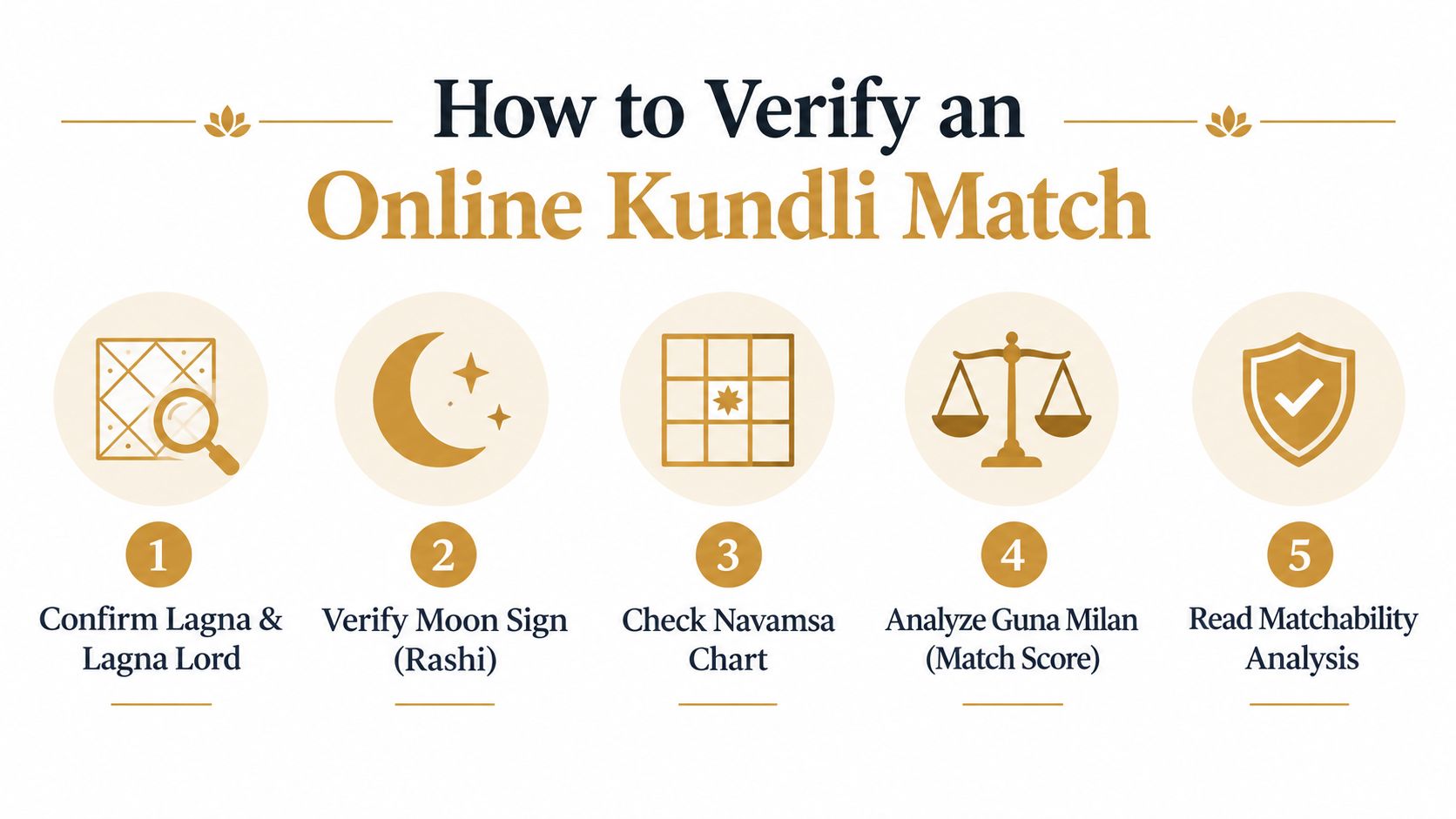
Start with the generated charts
Confirm the following for both partners:
- Lagna and Lagna lord: Check the rising sign and the planet that rules it.
- Moon sign and Nakshatra: Make sure the lunar details match the birth data entered.
- Planetary placements: Review the listed signs and houses instead of relying on a summary paragraph.
- Navamsa chart: Confirm that the D-9 chart is present and clearly labelled.
- Birth location: Check that the system used the intended town or city.
The system should flag an approximate birth time, an unknown time, or an unclear place of birth. It shouldn't average uncertain inputs or present a thin chart as precise.
Ask for a past-event check
Before accepting a forward-looking claim, look for a cold-read past event. This means a specific life detail derived from the chart, such as a career change during a particular dasha, presented before you supply the story yourself. A general statement such as “you've faced challenges” isn't a meaningful test because it can fit almost anyone.
Chart-first verification is also the central trust question behind an AI astrology reading. The label matters less than the process. The system should show what it calculated, ask you to confirm relevant lived events, and mark uncertain conclusions.
Only after those checks should you read the matching layers:
- Guna Milan: Review every koota, not only the total.
- Mangal Dosha: Check the placement, method, and any stated mitigation.
- Dasha overlap: Compare the relationship timing of both charts.
- Confidence indicators: Slow down when the report shows low chart clarity or thin data.
What a Trustworthy Online Matching Flow Looks Like
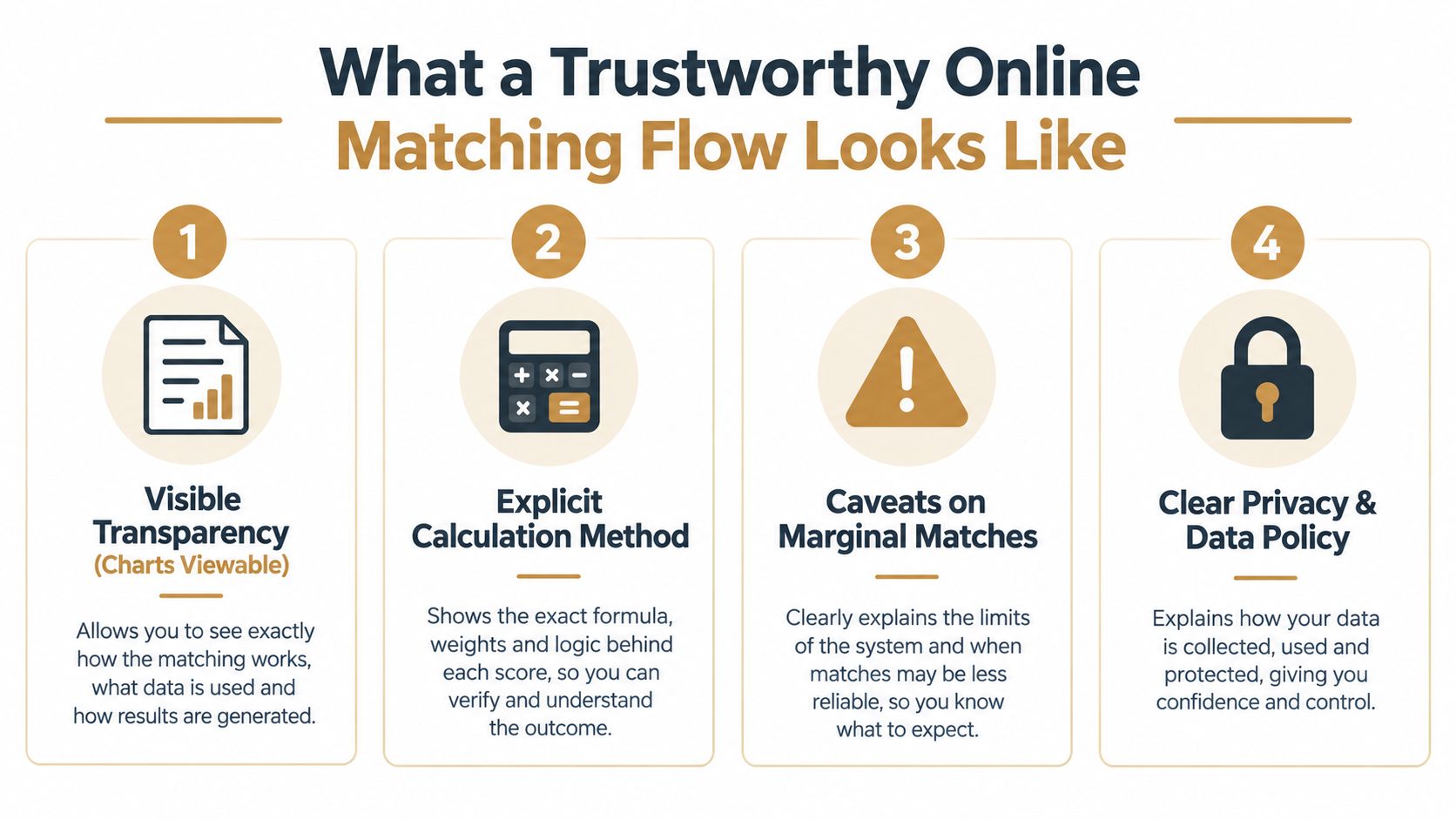
A reliable online kundli matching flow behaves more like a verification tool than a fortune-telling app. It exposes the chart, separates calculation layers, and makes uncertainty visible.
The first checkpoint is transparency. Both partners should be able to view the generated Lagna, Rashi, and Navamsa charts. The report should also show the birth details used to produce them. If the evidence is hidden while the conclusion is displayed, you can't meaningfully review the result.
The second checkpoint is an explicit calculation method. The report should explain how it calculated Guna Milan and which tradition it used for Mangal Dosha. Bhakoot and Nadi results should appear in plain language, with relevant cancellation rules applied rather than treated as automatic rejection.
Four signs of a serious workflow
- Visible charts: You can inspect the source charts instead of receiving only a compatibility label.
- Separate layers: Guna matching, Mangal Dosha, Navamsa review, and dasha timing aren't collapsed into one unexplained verdict.
- Caveats on marginal matches: The report identifies uncertain birth data, mixed indications, and areas where traditions differ.
- Privacy and data clarity: You understand what happens to both people's birth details and who can view the relationship record.
A confidence indicator should tell you when the birth time is approximate or the place is unclear. It should never be used as decoration. Low chart clarity means you should verify the inputs or seek a careful reading before making a major personal decision.
The final check is Pramāṇa, or calibration against lived events. A chart-first system should let you test whether the computed chart describes something you have already experienced before it makes forward-looking claims. For personal reflection and self-understanding, that is a safer standard than accepting flattering language or fear-based conclusions.
Frequently asked questions
Is 18 out of 36 a good kundli match?
It is commonly treated as the minimum acceptable threshold, not as proof of a successful marriage. The individual kootas, chart condition, Mangal Dosha analysis, and timing layers still need review.
Is a score above 24 enough to proceed?
A higher score can pass the initial Ashtakoota screen, but it doesn't replace a full chart comparison. Dasha overlap, Navamsa, the seventh house, and the reliability of the birth data can change the practical interpretation.
What happens if the birth time is unknown?
The report should mark the chart as uncertain. Some calculations may still be possible, but a precise Lagna, house analysis, and timing assessment shouldn't be presented with unwarranted confidence.
Is Mangal Dosha included in the 36 gunas?
No. Mangal Dosha is checked separately from the 36-point Guna Milan score. The report should show Mars's placement and explain the rule and any applicable mitigation.
Can an online report replace a practitioner?
An online report can organise calculations and make the method easier to inspect. It shouldn't replace careful interpretation, personal judgment, or professional advice in areas such as health, law, finance, or mental health.
Anvaya provides a chart-first Samhita and a two-chart Sambandha workflow for compatibility analysis, including Guna Milan, Mangal Dosha checks, and relationship timing with confidence signals. If you want to inspect the method before relying on a score, visit Anvaya and start with the chart rather than the headline number.