You type your details into one calculator and get Rohini. You try a second one, and it says Krittika. A third doesn't even ask for your birth time. Your date of birth nakshatra shouldn't depend on which website you opened first. It should depend on math you can check. We don't start with personality adjectives. We start with birth data, run it through a declared compute stack, then calibrate against events you lived.
Table of Contents
- When Two Tools Give You Different Nakshatras
- What a Birth Nakshatra Actually Is
- The Four Inputs a Nakshatra Lookup Actually Needs
- How the Moon's Longitude Maps to a Nakshatra
- Quick Reference Table of the 27 Nakshatras
- When the Birth Time Is Uncertain
- Using a Nakshatra Result Without Overreading It
- How Janma Akshara Computes the Result
- Where the Nakshatra Fits in the Larger Chart
- A Reusable Lookup Checklist
- Frequently Asked Questions
When Two Tools Give You Different Nakshatras
You search the same birthday on three sites on a Sunday evening. Two agree. One gives you the nakshatra before it. None of them tells you why, and you're left guessing which label to use for naming, matchmaking, or a reading.
That gap usually isn't a mystery. It's a settings problem.
Why answers split
- Different inputs: One tool used only your date. Another used date, time, and place.
- Different framework: One used a sidereal zodiac, which is the Vedic framework. Another may have mixed in a tropical setting.
- A boundary Moon: Your Moon sits close to the edge between two nakshatras, so a small time or ayanamsha difference moves the answer. Ayanamsha means the correction that aligns the zodiac with the fixed stars.
Practical rule: Trust the result whose inputs and settings you can inspect. If a tool won't declare them, treat its answer as provisional.
A defensible lookup follows a fixed order. Calculate the Moon first. Name the nakshatra second. Check how close you are to a boundary third.
You'll see that order applied below, from the definition and the mapping rule to the reference table and birth time checks. It's the same discipline behind a daily Panchang calendar from Anvaya, where the Moon's position for the day is computed, not guessed.
Don't pick the answer you like better. Reproduce the answer, then decide what it means.
What a Birth Nakshatra Actually Is
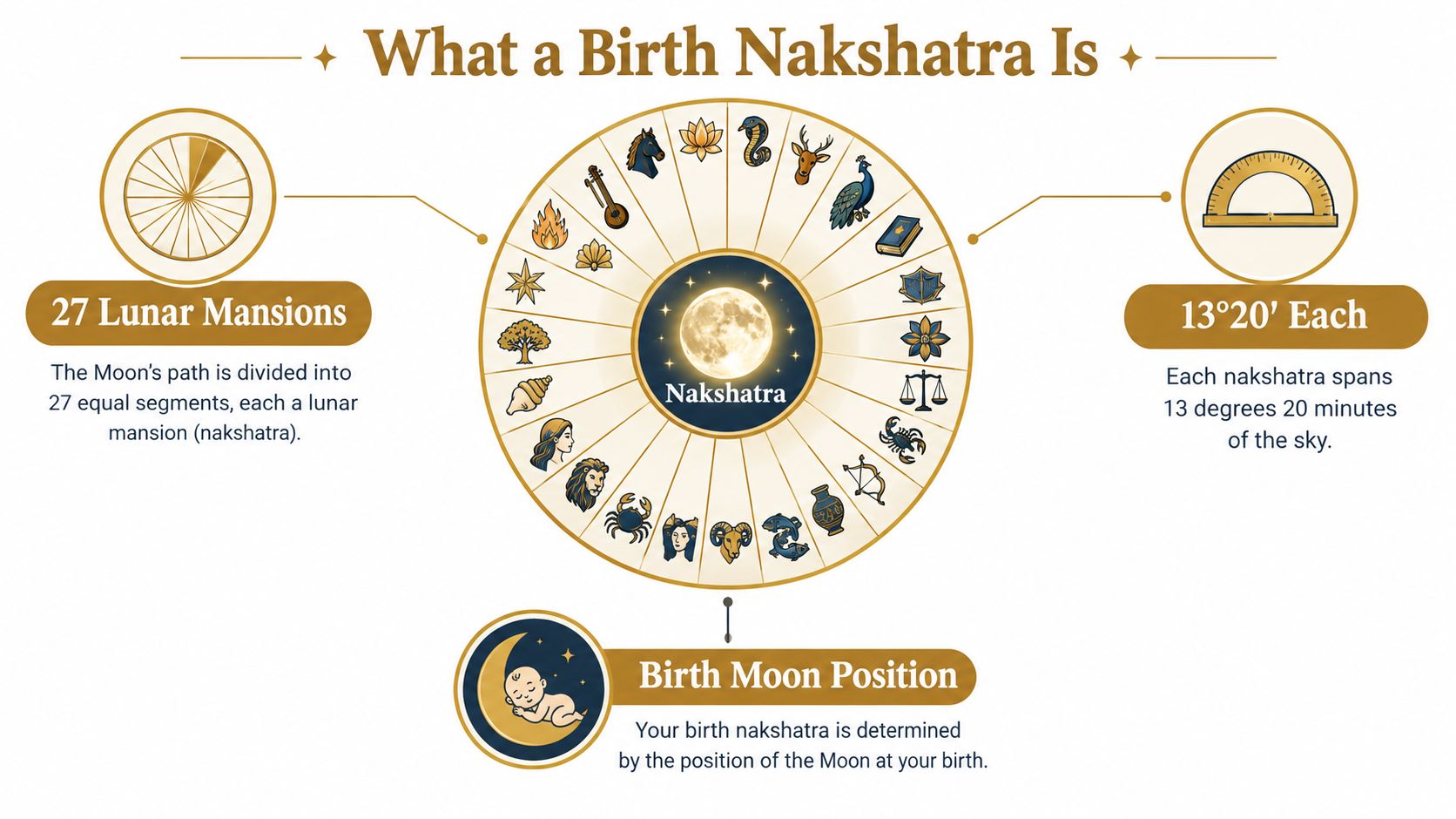
A nakshatra is one of 27 equal lunar mansions. That means the full zodiac circle is divided into 27 equal parts, and your birth nakshatra is the part that held the Moon at your recorded moment of birth.
Each nakshatra spans 13 degrees 20 minutes of the 360 degree zodiac, and the Moon's sidereal longitude, its measured position in that sidereal zodiac, decides the result. The calendar date alone doesn't assign anything.
How it differs from a sign
A rashi, or zodiac sign, covers 30 degrees. A nakshatra covers less than half of that. It's a finer slice, which is why two people born on the same date, even in the same sign, can have different nakshatras.
It's also not a sun sign. A sun sign follows the Sun. A birth nakshatra follows the Moon, and the Moon moves fast enough that time of day can matter.
Think of it as an address. The sign is the street. The nakshatra is the building. You still need the full address before you describe who lives there, and we'll add the room, called a pada, shortly.
That's the whole definition. No traits yet, no verdicts. Just a measured Moon placed inside one of 27 equal divisions.
The Four Inputs a Nakshatra Lookup Actually Needs
A date-only lookup is a shortcut, not a calculation. Before you trust any calculator, confirm these four declarations.
- Date of birth: This sets the day, but on its own it only narrows the Moon to a stretch of sky.
- Exact time of birth: The Moon keeps moving through the day, so morning and evening births on the same date can fall in different nakshatras, or different quarters of the same one.
- Place of birth: Place fixes the time zone and its historical offset. That conversion decides which universal moment your local clock time points to, and the Moon is calculated for that moment.
- Declared sidereal framework: The tool should state its ayanamsha and confirm it's using the Vedic sidereal zodiac, not the Western tropical one.
The order of operations
- Convert your local birth time to a single universal moment using the place.
- Compute the Moon's sidereal longitude at that moment.
- Map that longitude to a nakshatra and pada.
If a tool skips step one or hides step three's settings, you can't audit it. You also can't compare its output with another tool's output in a fair way, because you're probably comparing different moments or different zodiacs.
Write your four inputs down before you calculate. You'll need them again when you check boundaries.
How the Moon's Longitude Maps to a Nakshatra
The mapping rule is plain arithmetic. You don't need to do it by hand, but you should be able to follow it.
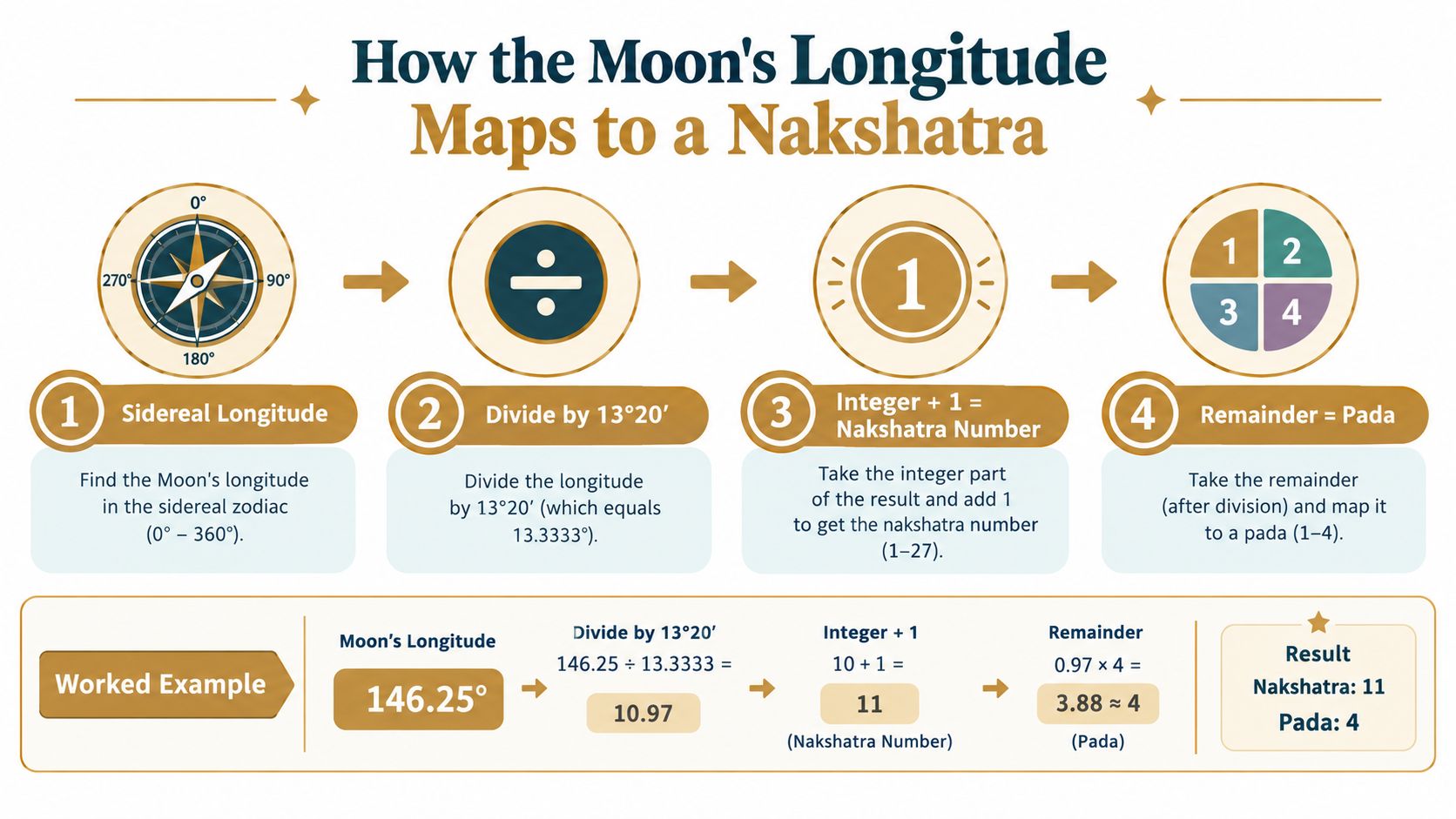
Take the Moon's sidereal longitude as a number from 0 to 360 degrees. Divide it by 13 degrees 20 minutes. The whole number part of the answer, plus one, gives the nakshatra number. The remainder tells you where inside that nakshatra the Moon sits.
A worked fragment
Say a calculator reports a sidereal Moon at 47 degrees. Divide 47 by 13 degrees 20 minutes. You get 3 whole divisions, with a remainder. Add one, and you're in the 4th nakshatra. The remainder places you within it.
The pada is the second level
Each nakshatra splits into four padas, or quarters, making 108 equal quarters of 3 degrees 20 minutes each across the zodiac. Find which quarter holds the remainder, and you have the pada.
You can keep the same nakshatra and still change pada. The pada feeds finer interpretation and Navamsha mapping. That means it helps place the Moon in the ninth divisional chart used alongside the birth chart.
A calculator that gives you a nakshatra but no pada has given you half the standard result.
Ask for three outputs every time. Nakshatra name, pada number, and the Moon's degree inside the nakshatra. With those three, you can sanity check any other tool in minutes.
Quick Reference Table of the 27 Nakshatras
Use this table as a lookup artifact, not a personality list. Each row confirms a name, its traditional ruling planet, and where it sits in sidereal longitude. That lets you check a known result, spot a pada boundary, or verify a calculator's degree in seconds.
The 27 Birth Nakshatras at a Glance
| # | Nakshatra | Ruling Planet | Range (sidereal longitude) |
|---|---|---|---|
| 1 | Ashwini | Ketu | 0°00′ to 13°20′ |
| 2 | Bharani | Venus | 13°20′ to 26°40′ |
| 3 | Krittika | Sun | 26°40′ to 40°00′ |
| 4 | Rohini | Moon | 40°00′ to 53°20′ |
| 5 | Mrigashira | Mars | 53°20′ to 66°40′ |
| 6 | Ardra | Rahu | 66°40′ to 80°00′ |
| 7 | Punarvasu | Jupiter | 80°00′ to 93°20′ |
| 8 | Pushya | Saturn | 93°20′ to 106°40′ |
| 9 | Ashlesha | Mercury | 106°40′ to 120°00′ |
| 10 | Magha | Ketu | 120°00′ to 133°20′ |
| 11 | Purva Phalguni | Venus | 133°20′ to 146°40′ |
| 12 | Uttara Phalguni | Sun | 146°40′ to 160°00′ |
| 13 | Hasta | Moon | 160°00′ to 173°20′ |
| 14 | Chitra | Mars | 173°20′ to 186°40′ |
| 15 | Swati | Rahu | 186°40′ to 200°00′ |
| 16 | Vishakha | Jupiter | 200°00′ to 213°20′ |
| 17 | Anuradha | Saturn | 213°20′ to 226°40′ |
| 18 | Jyeshtha | Mercury | 226°40′ to 240°00′ |
| 19 | Mula | Ketu | 240°00′ to 253°20′ |
| 20 | Purva Ashadha | Venus | 253°20′ to 266°40′ |
| 21 | Uttara Ashadha | Sun | 266°40′ to 280°00′ |
| 22 | Shravana | Moon | 280°00′ to 293°20′ |
| 23 | Dhanishta | Mars | 293°20′ to 306°40′ |
| 24 | Shatabhisha | Rahu | 306°40′ to 320°00′ |
| 25 | Purva Bhadrapada | Jupiter | 320°00′ to 333°20′ |
| 26 | Uttara Bhadrapada | Saturn | 333°20′ to 346°40′ |
| 27 | Revati | Mercury | 346°40′ to 360°00′ |
Each range contains four padas of equal width, so you can divide any row into quarters to locate a pada. If your Moon's degree sits deep inside a row, small input errors usually won't move your nakshatra. If it sits near either edge, treat the result as borderline until you've checked your birth time.
The table is scaffolding. Meaning, if the chart supports it, comes from the full chart, not from a single row.
When the Birth Time Is Uncertain
Many people don't have a clean birth time. A hospital record may be rounded. A family member may remember "around evening." A time zone conversion or daylight saving rule may have been applied wrongly years ago.

Most lookup pages ignore this and print one confident answer. That's false precision.
What a small error can and cannot change
Coverage of birth verification and rectification in classical predictive astrology indicates that even a 5 to 10 minute discrepancy can materially alter the ascendant and dasha balance, while a 60 minute time zone error may change the ascendant sign entirely. The ascendant is the rising sign at birth, and it moves quickly.
The Moon is steadier. It often stays in one nakshatra for many hours, so an approximate time may still give you a provisional lunar result. But finer layers move faster. Descriptions of pada level sensitivity in fast changing chart divisions place one 3 degree 20 minute segment at roughly 13 minutes of clock time for certain divisions, and deeper divisional charts can need accuracy within only a few minutes.
A confidence framework you can use
- Stable: Your nakshatra stays the same across your whole plausible time window.
- Borderline: The nakshatra or pada changes inside that window.
- Rectification needed: You want ascendant or divisional claims treated as settled, but the time won't support them.
Preserve the uncertainty in writing. Don't pick one time and build a reading on it.
Using a Nakshatra Result Without Overreading It
A nakshatra can carry cultural meaning without becoming an instruction. Families use it for naming syllables and ceremony. Individuals use it for reflection. Those uses don't require predictive claims.
The trouble starts when one birth star is asked to decide a marriage, a career move, a medical choice, or a financial action. Interest alone doesn't validate that leap. A 2025 summary on daily horoscope habits and mainstream astrology engagement reports that 30% of U.S. adults consulted astrology, horoscopes, tarot, or fortune tellers at least annually, while only about 1% relied heavily on such practices for major decisions and 6% engaged weekly. Broad curiosity, light reliance. That's a sensible calibration.
Generic trait lists also deserve caution. The Barnum effect means broad statements can feel personally specific to almost anyone. If a description would fit your sibling too, it isn't evidence.
Keep three layers separate. Your static birth nakshatra. Time sensitive layers like dasha, transit, and muhurta. And the quality of your birth data underneath all of them. Naming practice, for example, is a cultural use you can explore through Rashi Naama at Anvaya without treating a syllable as a prediction.
Use this material for personal reflection and self understanding, not professional advice. It shouldn't replace a doctor, lawyer, therapist, or financial advisor.
How Janma Akshara Computes the Result
Janma Akshara is Anvaya's naming and birth syllable tool. It computes the result the way this article describes, and it shows its working.
The workflow inside the tool
- Collect inputs: Date, time, and place, with explicit time zone handling rather than a silent default.
- Declare compute: The sidereal framework is stated before the result, following Anvaya's declared compute approach.
- Compute the Moon: The Moon's sidereal longitude is calculated for that exact moment.
- Report resolution: You get nakshatra, pada, and degree within the pada, not just a name.
Verification before final claims
Anvaya calibrates against lived events through Pramāṇa. That means chart derived questions about specific past windows are put to you before forward looking content is treated as settled. We tell you something checkable about your life before asking you to trust anything ahead. We don't sell your own story back to you.
When a birth time is approximate, alternative calculations are preserved instead of overwritten. You can see which conclusions hold across reasonable time variations and which ones don't. Each statement carries its confidence plainly, and prior outputs stay dated and auditable.
That's the difference from a sun sign feed or personality quiz. Those return a label with nothing to audit. Janma Akshara, inside the wider Samhita reading, returns a computation you can revisit, question, and refine before you pay a rupee for deeper modules.
Where the Nakshatra Fits in the Larger Chart
Your nakshatra is one data point. It's a stable one, but it isn't a chart.
It connects to several larger layers. The ruling planet of your Moon's nakshatra opens your Vimshottari dasha sequence. That means it sets which planetary period you start life in, and the Moon's position inside the nakshatra sets how much of that period remains at birth.
The pada maps the Moon into the Navamsha, the ninth divisional chart read alongside the birth chart. The pada also gives the traditional naming syllable, which is where Janma Akshara begins its work.
Nakshatra quality is also one ingredient in muhurta, the selection of a suitable time for an activity. It's one ingredient, not the whole recipe.
What you still need before conclusions
- Ascendant and house placements: These structure the chart and are far more time sensitive than the Moon.
- Active dasha and transits: These supply timing context a static birth star can't supply alone.
- Verified birth data: Without it, the layers above rest on sand.
If you want the fuller structure explained in plain language, the guide to reading a Vedic astrology birth chart walks through how these layers sit together. Panchang, Muhurta, and a full Samhita each answer different questions from there.
A Reusable Lookup Checklist
Keep this list beside any calculator you use. It works for your own chart, a child's naming, or a family member's records.
- Confirm inputs: Date, time as recorded, and place, written down exactly as sourced.
- Declare framework: Sidereal zodiac and ayanamsha stated by the tool, not assumed.
- Compute Moon first: Sidereal longitude for the converted universal moment.
- Map fully: Nakshatra, pada, and degree inside the nakshatra.
- Check sensitivity: Re run the edges of your plausible time window. Label the result stable or borderline.
- Verify before trusting: Test chart derived claims against documented past events.
If any step can't be shown, the answer is provisional. Say so and keep the alternatives.
That single habit, labeling confidence clearly, separates a reusable method from a lucky lookup. Your date of birth nakshatra becomes a result you derived, not a label you borrowed.
Frequently Asked Questions
Why does an approximate time often still give the right nakshatra
The Moon moves about 12 degrees per day, so it typically spends many hours inside one 13 degree 20 minute mansion. An approximate time often keeps the same nakshatra even when faster chart layers, like the ascendant, have already shifted. Check the pada and boundary distance before relying on that stability.
How is this different from a sun sign horoscope
A sun sign follows the Sun through 30 degree tropical signs and groups everyone born across many days together. A birth nakshatra follows your Moon's sidereal position at your specific moment and place. Different body, different zodiac, different resolution.
What does the pada have to do with a child's name
Tradition links each pada to a naming syllable. Janma Akshara uses the Moon's nakshatra and pada to suggest the starting syllable, which families then build a name around. It's a naming convention, not a character prediction.
Can a wrong birthplace change my nakshatra
It can, if the wrong place produces the wrong time zone conversion. That shifts the universal moment, which shifts the Moon. If your Moon sits mid nakshatra, you may notice no change. Near a boundary, a place error can flip the result.
If you'd like this checked workflow applied to your full chart, with declared compute, Pramāṇa calibration against your lived events, and confidence shown on every claim, generate your Samhita with Anvaya. Start free, audit the math, and decide only when the chart has earned it.