
You enter the same birth details into different tools. One gives you an opening period that looks familiar. Another names a different Yogini, and the later dates don't line up. Before you trust either Yogini Dasha calculator, you need to know whether the disagreement comes from your birth record, the calculation settings, or the way the result is displayed.
A tidy timeline can hide uncertain inputs. The useful question isn't which screen looks more authoritative. It's whether you can trace the dates back to a declared method.
Table of Contents
- Why Your Yogini Dasha Dates Keep Changing
- What Yogini Dasha Measures
- How the Sequence and Periods Are Computed
- Using a Yogini Dasha Calculator Step by Step
- Why Different Calculators Show Different Dates
- Yogini Dasha vs Vimshottari
- Frequently Asked Questions
Why Your Yogini Dasha Dates Keep Changing
Suppose you're checking a period around a move or a family transition. You copy your birth date, time, and place into another calculator because you want confirmation. Instead, you get a different answer.
That doesn't immediately prove that either tool is wrong. But it does mean you shouldn't start interpreting the dates yet.
Separate the kinds of disagreement
Look at where the results first diverge. An opening Yogini mismatch is different from a timeline that names the same periods but places their boundaries differently.
Use this comparison before reading any description of favourable or challenging periods:
- Different opening Yogini: Compare the birth nakshatra, meaning the Moon's birth-star division, and the rule used to assign its Yogini.
- Same opening Yogini, different opening balance: Compare the Moon's exact position and the fraction of the first period remaining.
- Same sequence, shifted calendar dates: Check how each tool converts period lengths into calendar dates.
- Matching major periods, different subdivisions: Inspect the sub-period settings rather than assuming the whole chart has changed.
These are diagnostic questions, not verdicts. They help you ask the calculator provider for something specific.
A person whose birth time comes from a hospital record has a different starting point from someone whose family remembers “around sunrise.” Entering both as exact clock times hides that difference. The software may accept the input without knowing how reliable it is.
Key principle: A calculated date can be exact within a method without being certain about your life.
Compare the calculation before the interpretation
Save the original results. Keep the entered details, selected settings, and any calculation notes together. Otherwise, you may change a setting and lose the evidence needed to explain the discrepancy.
Don't choose the timeline because its description sounds more like you. A broad account of responsibility, change, or learning can feel familiar without establishing that the underlying dates are correct.
Instead, ask for the intermediate result: which Moon position was used, which nakshatra it fell in, and what opening balance followed. If a tool supplies only dates and descriptive text, you have less to audit.
Your aim is reproducibility. That means another person should be able to follow the declared assumptions and understand how the result was produced. Interpretation comes after that check, not before it.
What Yogini Dasha Measures
Suppose two calculators show different dates for the same Yogini period. To assess the discrepancy, first separate the system's timing framework from the interpretation attached to it. Yogini Dasha organizes time into named periods; it does not describe each day as a separate horoscope.
The method uses eight Yoginis, a 36-year cycle, and an opening assignment based on the Moon's position among the 27 nakshatras, as outlined in the Yogini Dasha system explanation. A nakshatra is a section of the zodiac used to locate the Moon in this timing method.
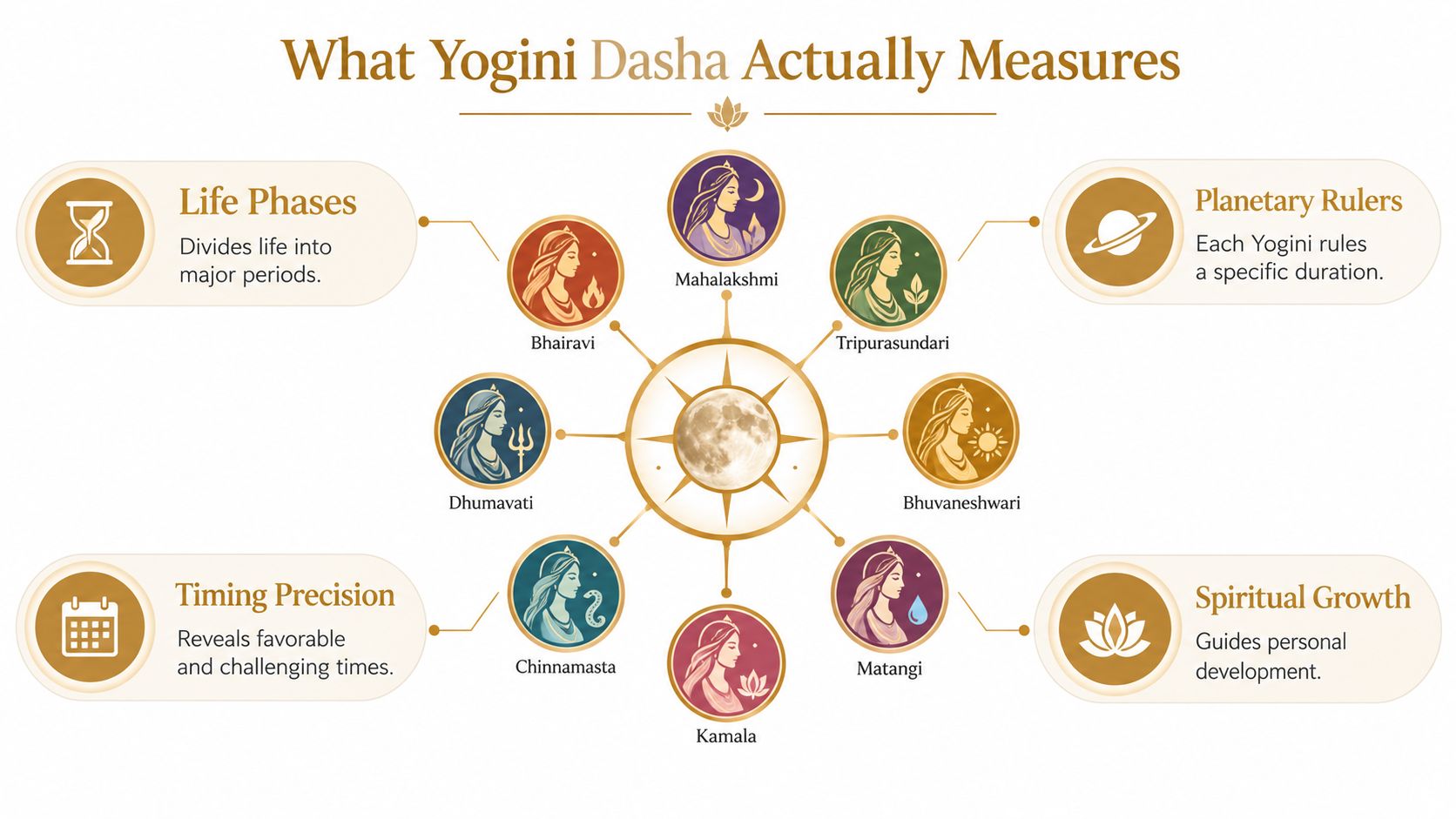
The sequence runs Mangala, Pingala, Dhanya, Bhramari, Bhadrika, Ulka, Siddha, and Sankata, then returns to Mangala. These names mark successive periods in a repeating framework. They do not, on their own, predict an event.
A few terms clarify what a calculator is displaying:
- Mahadasha: The major period, which sets the broad timing context.
- Antardasha: A sub-period within a Mahadasha, adding a narrower timing layer.
- Opening balance: The portion of the opening period left at birth, rather than its full duration.
- Period ruler: The planetary association an astrologer examines in the birth chart.
The timing framework is only one part of a reading. A season gives context, but it cannot tell you whether it will rain at a particular home tomorrow. Likewise, a dasha period gives a time frame; interpreting it requires examining the birth chart. A guide to a Vedic astrology birth chart explains the chart's structure, which is distinct from the calendar used to interpret it.
In classical interpretation, chart promises are possibilities suggested by planetary placements and their relationships. The phrase does not mean the software has promised an outcome. Descriptions such as “favourable,” “challenging,” or “growth” are interpretive themes, not measurable results of the date calculation.
This distinction helps explain why two tools can agree on the sequence yet show different dates: the dates depend on the calculation settings, while the descriptions depend on interpretation. Treat Yogini Dasha as a tool for personal reflection and self-understanding, not professional advice. A timing window should not replace appropriate advice or serve as the sole basis for a major decision.
How the Sequence and Periods Are Computed
A calculator performs several separate operations before it can print a timeline. Understanding those operations lets you inspect the result without having to accept the accompanying interpretation.
The arithmetic has a starting position, an opening balance, a sequence, and a calendar conversion. Each should be visible or documented.
Establish the opening period and its balance
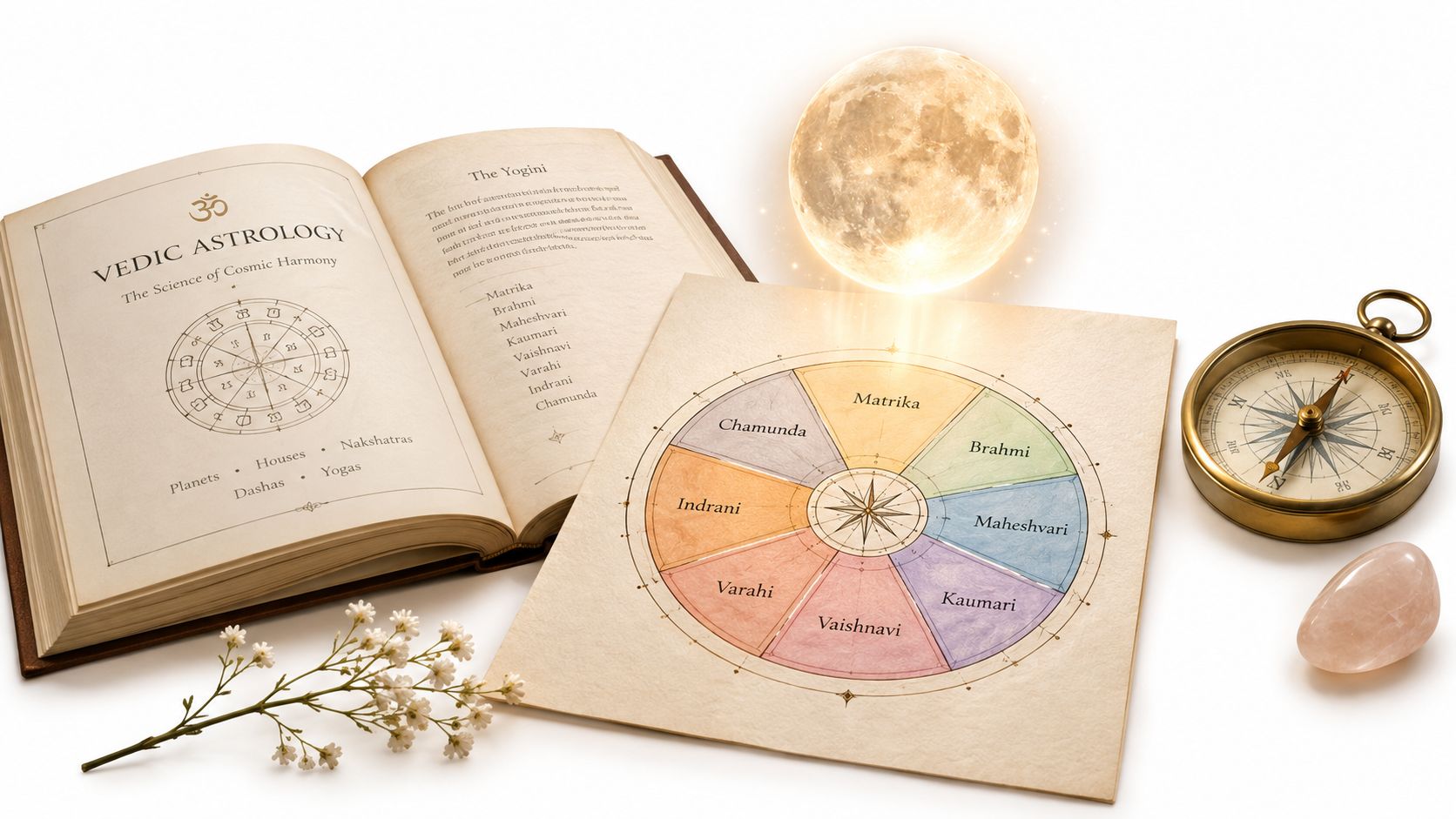
First, the tool calculates the Moon's position for the birth instant. It identifies the nakshatra containing that position, then applies its nakshatra-to-Yogini assignment rule.
Ask for that rule. A calculator that prints the opening name without exposing the assignment leaves an important part of its method hidden.
Next, it calculates the untraversed fraction. That means the portion of the nakshatra the Moon hadn't yet crossed at birth.
The opening-balance relationship is:
Remaining opening period = untraversed nakshatra fraction × full opening-period duration.
Consider a hypothetical chart without assigning invented birth coordinates or dates. Suppose its Moon is close to the end of the birth nakshatra. The untraversed fraction is small, so only a small portion of the opening Yogini remains after birth.
Move the hypothetical Moon closer to the beginning of that same nakshatra. The opening Yogini can stay the same, while its remaining balance becomes longer. This explains why matching period names don't guarantee matching end dates.
Extend the timeline and calculate subdivisions
After the opening balance finishes, the calculator advances through the declared Yogini sequence. It uses full durations for the following major periods, rather than applying the birth fraction again.
An antardasha, or sub-period, is calculated proportionally:
Sub-period duration = major-period duration × sub-period Yogini duration ÷ full-cycle duration.
The proportional relationship is described in the system explanation linked above. It gives a duration within the major period, not an independent prediction.
To audit a result, request these intermediate values:
- Moon position: The position used before the period assignment.
- Birth nakshatra: The division identified from that position.
- Opening rule: The mapping that produced the Yogini name.
- Remaining fraction: The input used to calculate the opening balance.
- Calendar convention: The method used to turn durations into printed boundaries.
A worked calendar example needs all those inputs. Without them, a neat numerical demonstration would teach you to trust an unexplained result.
Also check whether the displayed opening sub-periods belong to the complete major period or only its remaining portion after birth. Don't infer that from indentation alone. Ask how the tool anchors its subdivisions.
Using a Yogini Dasha Calculator Step by Step
Suppose two birth records give slightly different times, or one lists the time only approximately. The calculator can still produce a neat timeline, but the result is only as precise as the details and settings entered. Keep a record of your choices so you can tell a documented result from an adjusted one.
Enter details you can support
Use the recorded birth date and time, preserving the original notation where possible. If the time is approximate, note that in your own records, even if the calculator has no field for uncertainty.
Choose the birthplace listed in the birth record. A current city, ancestral home, or nearby location may not represent the intended place.
Before calculating, review the settings:
- Civil time: Check that the clock time is local time at the birthplace.
- Time-zone handling: Review historical conversion and daylight-saving information where relevant.
- Ayanamsha: Record the selected sidereal offset, the adjustment used to express planetary positions in the sidereal zodiac.
- Calculation notes: Save any explanation of the Moon calculation, period conventions, and date rounding.
If Lahiri is selected by default, record it. Defaults still affect the result and should be visible when comparing tools.
Check the opening of the timeline
Read the birth nakshatra, opening Yogini, and opening balance before looking at the current period. These are the starting points of the calculated timeline, so an error in one can carry through to later dates.
Major-period dates and sub-period dates mark different layers of timing. A boundary marks a change in the calculated timing layer; it is not an announcement of an event on that day.
| What to save | Why it helps |
|---|---|
| Entered birth details | Lets you reproduce the input |
| Selected calculation settings | Makes tool comparisons meaningful |
| Opening period and balance | Shows where the timeline began |
| Original dated output | Preserves what the calculator returned |
| Uncertainty notes | Prevents an approximate record from becoming an assumed fact |
For a practical reading check, gather dated records of past events you are comfortable reviewing, such as a move, the start of a course, or a family ceremony. Keep each recorded date separate from the meaning you later assigned to it.
If a memory is vague, leave it vague. A broad date window in the documentation should remain a broad window, rather than being turned into an exact date to fit the timeline.
A careful review keeps three things distinct: the calculator's dates, your interpretation, and your record of experience. That separation helps you assess the reading without treating a calculated boundary as proof of an event.
Why Different Calculators Show Different Dates
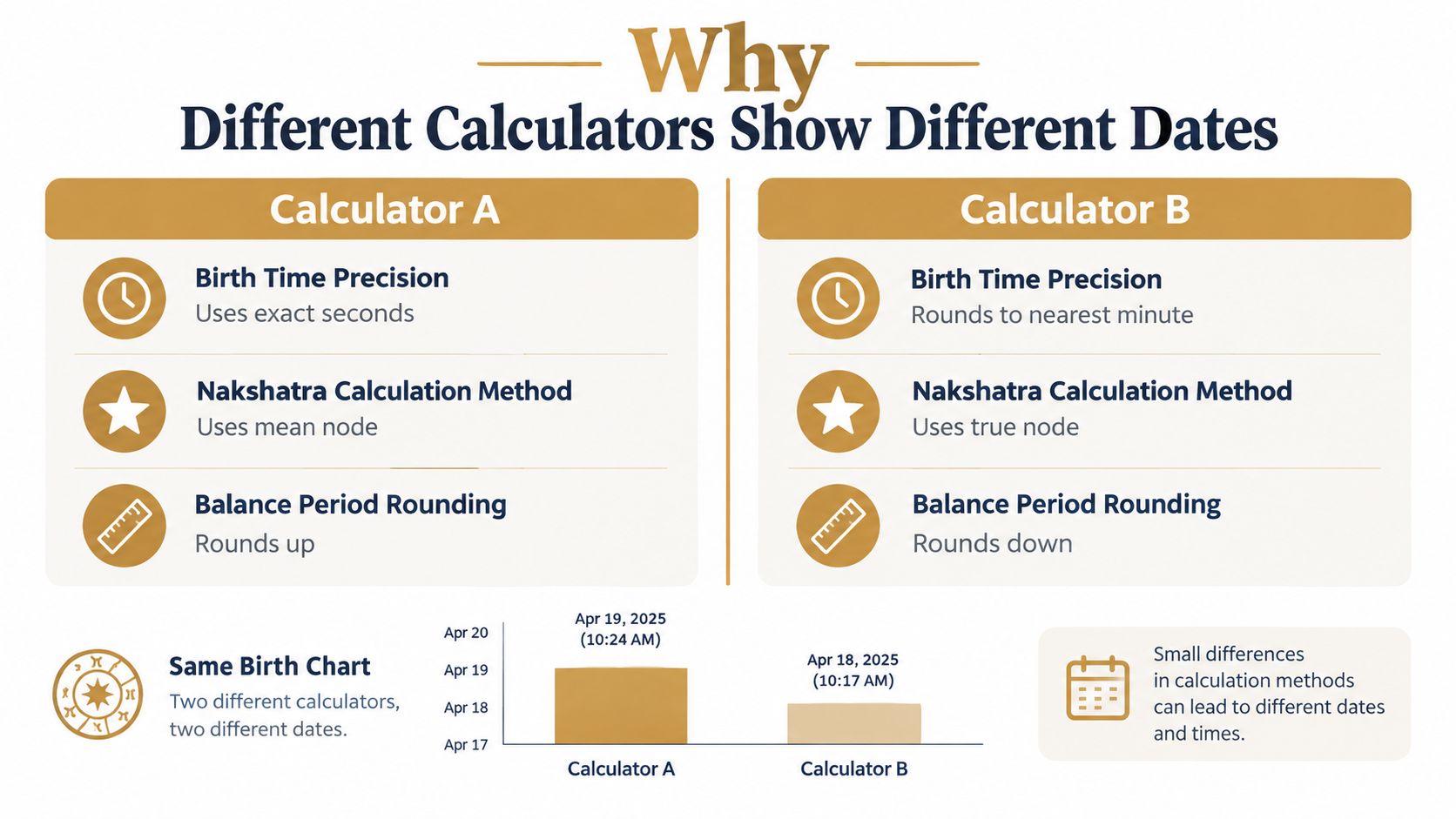
Suppose two calculators receive the same birth details but return different Yogini Dasha dates. The difference may begin with how each tool calculates the Moon's position, then carry through the opening period and later boundaries. Comparing their assumptions is more useful than treating either calendar as self-explanatory. The Yogini Dasha calculation notes identify differences in ephemerides, ayanamsas, year definitions, rounding methods, and birth times as possible causes of shifts.
An ephemeris supplies the astronomical data or method used to calculate planetary positions. An ayanamsha is the sidereal offset applied to those positions. Both choices can affect the Moon's calculated position, so a reproducible result should make them visible.
Trace where the timelines part
Follow the calculation from the Moon's position to the date shown on the calendar. For example, a birth time recorded only approximately may place the Moon differently in a calculation, affecting the opening balance. A different sidereal offset may also change which birth nakshatra the tool assigns.
Other differences arise later in the process. Local clock time must be converted to the intended birth instant. Tools may use different nominal year lengths when translating period-years into elapsed time, or apply rounding at different stages. These choices can shift printed boundaries even when the opening assignment remains unchanged.
Near a nakshatra boundary, a small positional difference can change the opening assignment itself. Farther from a boundary, the opening Yogini may stay the same while its dates vary. That distinction helps explain why two outputs can agree on the sequence but disagree on timing.
Mean-node and true-node settings do not replace checking the Moon calculation. The opening assignment depends on the Moon's nakshatra, so inspect that position first.
Judge the result by its sensitivity
A useful calculator should declare its conventions and make it possible to compare results across plausible birth times. It may also flag proximity to a nakshatra boundary. Treat these as evaluation criteria, not features every tool is guaranteed to provide.
Look at major and sub-period boundaries separately. A major-period identification may remain stable while a sub-period date shifts. Stability in one layer does not establish stability in another.
More digits on a date don't repair an uncertain birth record.
With an approximate birth time, compare plausible alternatives rather than choosing the result that best fits an interpretation. Keep each output beside the assumptions that produced it. Call the spread an input-sensitivity range, not a statistical confidence interval unless a statistical method supports that description.
The guide to evaluating an online dasha calculator offers another way to assess what a tool explains. Before paying for an interpretation, ask whether its calculation method is clear and whether uncertainty remains visible.
Yogini Dasha vs Vimshottari
Yogini and Vimshottari are different clocks, not competing labels for the same calendar. Vimshottari uses a 120-year framework, as stated in the comparison of Yogini and Vimshottari timing frames. Yogini uses the shorter repeating framework described earlier.
That difference can make Yogini useful as another timing lens. It doesn't establish that shorter periods produce more accurate event predictions.
Yogini Dasha vs Vimshottari at a Glance
| Feature | Yogini Dasha | Vimshottari |
|---|---|---|
| Framework | Shorter repeating Yogini sequence | Longer planetary-period framework |
| Useful reading role | Additional thematic timing lens | Broad organising framework for a reading |
| Starting-point audit | Check Moon position, assignment, and balance | Check its own starting assignment and balance |
| Relationship to the other system | Can supply corroboration or disagreement | Doesn't need identical boundaries to be validly calculated |
| Main caution | Shorter windows aren't proof of greater precision | Longer periods aren't complete event explanations |
| Evaluation standard | Declared method and retained event checks | The same standard |
Neither automatically replaces the other. If a practitioner uses Vimshottari as the main framework and Yogini as a cross-check, that choice should be declared before interpreting your history.
Avoid averaging conflicting dates. The resulting midpoint would not be a boundary calculated by either system.
Test a reading without fitting the story afterward
Choose the interpretive method before inspecting the outcome. Then write down the chart-derived theme and the window you intend to test against a documented past event.
Pre-registration means recording that proposed check before learning whether it matches. For a past-event test, the reader should derive the proposed window from the chart before you disclose the relevant event.
Keep the assessment concrete:
- Define the event category: A relocation is more testable than “a major transformation.”
- Keep the proposed window: Don't widen it after discovering a near miss.
- Check transits separately: Transits are planetary positions at the time being reviewed.
- Retain failures: A missed window belongs in the record alongside a match.
- Avoid forced agreement: Different indications may remain unresolved.
Agreement between timing systems can support consistency within the chosen astrological method. It isn't proof that a future event will occur. Disagreement should lower interpretive confidence rather than invite a more elaborate explanation designed to rescue the reading.
For relationship questions, keep compatibility analysis separate from timing. The guide to reading a Navamsa chart for marriage addresses that distinct chart-reading task.
A mature reading can say that the calculation is stable while the proposed meaning remains uncertain. Those are different judgments, and you deserve to hear both.
Frequently Asked Questions
Should Yogini Dasha replace Vimshottari?
No, not automatically. They are distinct classical timing lenses, and a practitioner should explain whether Yogini is being used independently or as corroboration. Choose the method before comparing it with your experiences, rather than switching whenever another timeline looks more convincing.
How do I validate whether a period matched my life?
Ask for a chart-derived event category and a defined window before sharing the relevant history. Compare the proposed check with documented events, the chart interpretation, and transits. Preserve misses, ambiguous matches, and successes so the record doesn't become a collection of favourable examples.
Why does my birth time matter?
The birth instant affects the Moon position used to establish the opening period and its remaining balance. Boundary-sensitive births need particular care. If your record is approximate, ask which parts of the timeline stay stable across plausible inputs and which should remain tentative.
Does a longer explanation mean better accuracy?
No. More text and more subdivisions can make a result look complete without improving its input quality or interpretive validity. Look for declared calculation choices, specific testable statements, and an unchanged record of what was originally said.
What should I do if calculators still disagree?
Save both outputs and identify the earliest point of disagreement. Compare the birth instant, Moon position, nakshatra assignment, opening balance, and calendar conventions. If either tool won't disclose those details, leave the discrepancy unresolved rather than choosing the result that feels reassuring.
Before interpreting: You should be able to explain where the dates came from and which uncertainties remain.
Anvaya offers a Samhita, a structured reading built from declared Vedic computations, with Pramāṇa calibration against lived events before forward claims. Rather than treating a Yogini timeline as a standalone verdict, we preserve the reading and its confidence indicators for later review. Visit Anvaya to generate your Samhita and examine the chart before accepting the interpretation.