
You're about to lead a meeting, send a difficult message, begin a side project, or leave for a short trip. You know what needs to happen, but hesitation arrives first. The question isn't whether you have an idea. It's whether you'll turn that idea into an action you can repeat.
This is the territory of third house Vedic astrology. In classical Jyotish, the third house describes the movement from intention to effort, from private thought to visible expression. It doesn't promise that courage will always feel natural. It helps you examine how courage, communication, skill, and persistence develop in your life.

Table of Contents
- Introduction to the Third House
- What the Third House Represents
- How the Third House Works in Your Chart
- Planetary Influences and Dasha Timing
- Remedies and Strengthening the Third House
- Sample Readings and Interpretations
- Frequently Asked Questions
- Conclusion - Making Your Move
Introduction to the Third House
The third house is classically called Sahaja Bhava, a name connected with what is natural, familiar, or developed through one's own effort. It's also known as Parakrama Bhava, the house of courage and initiative, and Vikrama Bhava, which brings in the idea of effort under resistance.
These names matter. They show that the house isn't limited to public speaking, writing, or relationships with siblings. It concerns the repeated acts that make a person more capable: asking a clear question, practising a skill, travelling locally, repairing a strained bond, or continuing after an awkward first attempt.
A person with a visible third-house emphasis might enjoy starting conversations with strangers. Another might write clearly but avoid speaking in groups. Someone else may appear hesitant early in life and become direct only after repeated experience. None of these patterns can be judged from the third house alone, but the house gives a classical place to investigate them.
Practical principle: The third house describes effort in motion. It isn't a certificate of permanent bravery or permanent weakness.
This is why a serious birth chart reading in Vedic astrology must separate potential from timing. A birth chart may show a capacity for communication or initiative, but the capacity may need practice, supportive planetary periods, and lived confirmation before you make a strong claim.
The third house is therefore useful at a crossroads. It can help you ask better questions about what you're willing to practise, where you hold back, and which forms of action become easier with repetition. That's reflection and self-understanding, not professional advice or a guarantee about what will happen.
What the Third House Represents
The easiest way to understand Sahaja Bhava is to treat it as the part of the chart concerned with everyday initiative. It covers actions close enough to your daily life that you can repeat them, test them, and improve them.
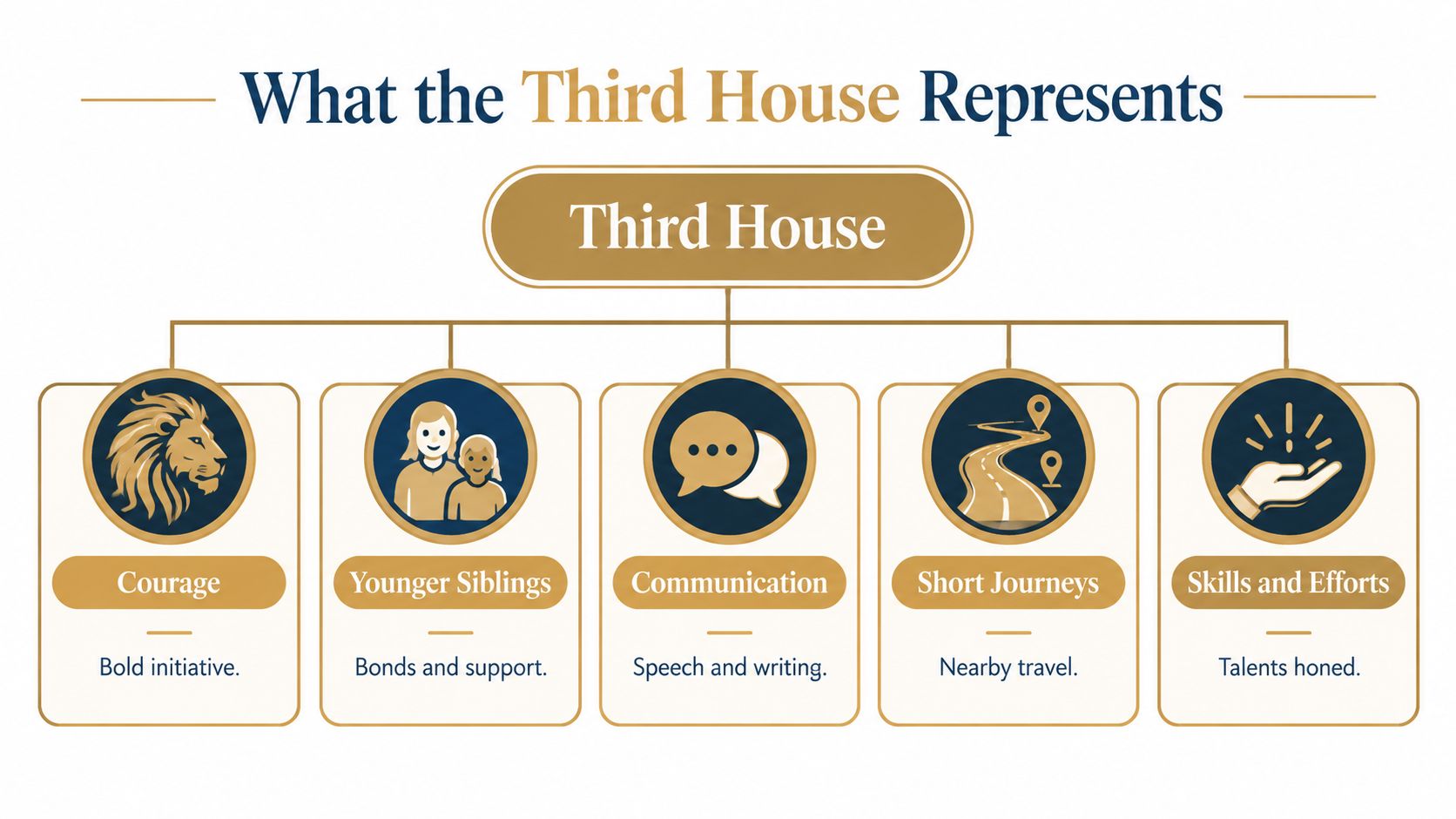
Courage and self-effort
Courage here doesn't mean fearlessness. It can mean sending the proposal, making the first call, asking for clarification, or speaking up when silence would be easier. The third house shows how you approach small acts of risk and assertion.
Classical descriptions connect it with stamina, valour, perseverance, and self-initiated effort. This makes the house relevant to entrepreneurship and personal projects, but only in a conditional sense. The rest of the chart, the condition of the third-house lord, and timing still matter.
Communication and writing
Speech, correspondence, writing, media, and practical expression belong to this house. Your chart may be examined for how you form and deliver messages, not merely whether you're “good with words.”
One person may communicate through concise instructions. Another may process ideas by writing before speaking. A third may have a sharp voice that needs restraint. For a focused example, see this guide to Mercury in the third house, where communication and learning are considered through a specific planetary placement.
Younger siblings and close circles
The third house traditionally signifies younger siblings, especially the relationship and dynamics around them. It can point to support, rivalry, responsibility, distance, or shared activity, but it shouldn't be read as a complete description of another person.
Modern family structures also require care. If biological siblings are absent, some contemporary interpretations extend the symbolism to peers, cousins, neighbours, or close circles that function like a sibling network. That is an interpretive refinement, not permission to force every friend into a sibling category.
Short journeys and manual skills
The house is associated with short travel, such as local movement, brief journeys, correspondence between places, and familiar routes. It also connects with the hands, arms, and practical skills involved in doing. Learning an instrument, editing documents, crafting, typing, or handling tools can all illustrate this action-oriented symbolism.
How the Third House Works in Your Chart
In the classical whole-sign method, the third house has a stable structural position. The Ascendant, or rising sign, begins the count. The next full sign is the second house, and the following full sign is the third house. In other words, the third house is always the third sign from the Ascendant.
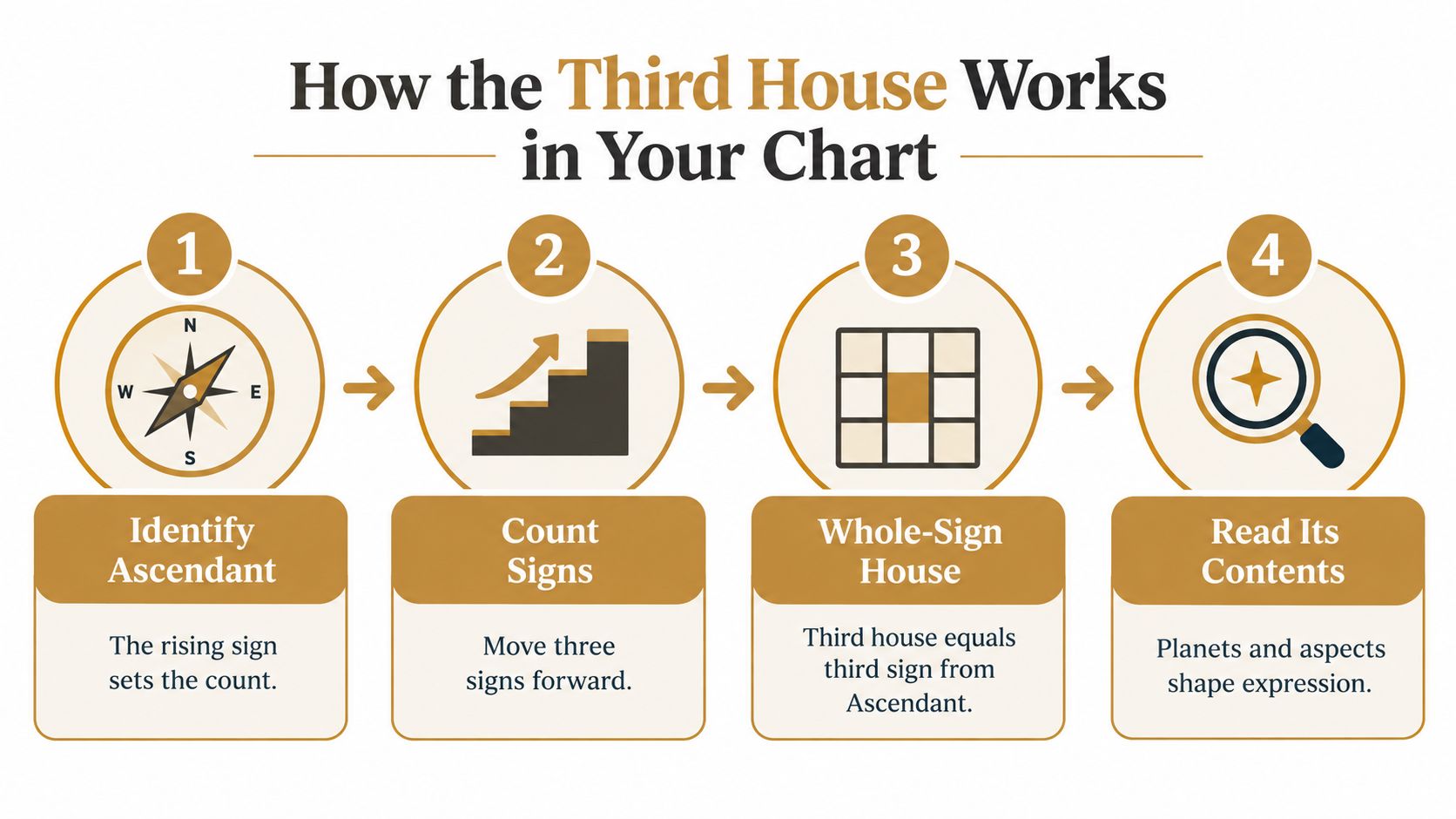
This fixed arrangement gives the house a definition that can be checked across charts. Interpretation still varies by tradition, especially when different house systems, ayanamshas, or divisional methods are used. But in the classical whole-sign framework, the positional rule is straightforward.
Locate the house before interpreting it
Use this order:
- Find the Ascendant. This establishes the first sign and house.
- Count forward by signs. The third sign from the Ascendant is the third house.
- Note the sign and its ruler. The ruler is commonly called the third-house lord.
- Read the occupants and influences. Planets placed there and relevant aspects modify expression.
This prevents a common error: treating one planet or one keyword as the whole reading. A third house with Mercury may emphasise learning or writing, but Mercury's strength, sign, house lordship, aspects, and dasha context still need examination.
Why upachaya changes the reading
The third house is an upachaya, meaning a growth house. Its results are traditionally understood as becoming stronger through time, repetition, and effort rather than appearing as a finished quality at birth. The idea is especially useful for explaining why someone may develop confidence after sustained practice instead of displaying it immediately.
Inherited talent and cumulative effort are different. A person may have quick verbal ability but poor follow-through. Another may begin with limited confidence, then become an excellent communicator through regular writing and direct experience. The third house helps a reader ask which part is available early and which part must be built.
A useful distinction: A chart may describe the material you start with. Repetition shows what you learn to do with it.
Planetary Influences and Dasha Timing
Planets change the way third-house themes appear. Traditional references commonly associate Mercury with communication and Gemini, while Mars is treated as a primary karaka, or significator, for courage and initiative. These associations explain why the house can feel both mentally agile and action-oriented, though they don't replace a full chart analysis.
Mars may bring directness, competitiveness, urgency, or a willingness to confront resistance. If poorly managed, that same force may show as impatience or conflict. Mercury may support learning, writing, correspondence, networking, and adaptable speech. Its difficulties may appear as scattered attention or over-analysis. These are interpretive possibilities, not fixed outcomes.
The third house is repeatedly described through the same core themes, including communication, siblings, courage, short travel, writing, and initiative, as summarised in this reference on the third house.
Planetary influences on the third house
| Planet | Primary influence |
|---|---|
| Mars | Direct effort, courage, physical initiative, and action under pressure |
| Mercury | Writing, speech, learning, correspondence, and practical networking |
| Saturn | Delayed confidence, disciplined repetition, and tested persistence |
| Jupiter | Teaching, counsel, broader meaning in communication, and guidance |
| Moon | Responsive communication, changing motivation, and emotional connection |
| Venus | Pleasant expression, artistic skills, and social ease |
| Sun | Self-expression, authority in one's voice, and personal initiative |
| Rahu | Unusual communication patterns, ambition, and experimentation |
| Ketu | Private thought, selective speech, and detachment from ordinary exchange |
The dasha system supplies timing. A dasha is a planetary period used in Jyotish to identify which planetary themes are active. A Mars period may bring a stronger push to initiate, compete, travel locally, or confront an avoided task. It may also expose impatience that needs discipline. A Mercury period may coincide with study, writing, commerce, networking, or a greater need to communicate clearly.
Timing does not mean the result is automatic. The planet's condition, the third-house lord, transits, and the chart's wider pattern must be considered together. A growth house may show durable development when a person uses the active period to practise. A dasha can open a theme, but repetition is what turns an opening into a skill.
For a more technical view of how multiple chart factors are assessed, this guide to Ashtakavarga chart analysis is relevant. Ashtakavarga is one layer, not a replacement for the full Parashari reading.
Remedies and Strengthening the Third House
A weak or strained third-house indication shouldn't be treated as a verdict. In a Parashari-informed approach, remedies work best when they translate symbolism into disciplined conduct. They don't erase the chart. They give you a practical way to engage with the quality under examination.
Build the skill the house describes
Choose an action that is small enough to repeat and specific enough to review.
- Write regularly: Keep a short journal, draft clear messages, or practise explaining one idea without unnecessary detail.
- Train the body: Physical training can give effort a structured outlet, especially when hesitation or scattered energy is the concern.
- Practise direct speech: Say what you need without aggression, apology, or elaborate justification.
- Maintain sibling ties: Where appropriate, make contact, repair a misunderstanding, or offer practical support.
- Take familiar routes with intention: Short journeys can become a way to practise independence and observation.
These are not magical shortcuts. They are forms of repeated effort that match the third house's upachaya logic.
Traditional Jyotish may also prescribe mantra, prayer, devotional observance, or other ritual disciplines after examining the full chart. Those practices should be approached with respect for the specific lineage and the person's belief system. A generic ritual cannot substitute for checking the Ascendant, planetary strength, house lord, dasha, and lived events.
The safest remedy is one you can perform consistently without fear or compulsion. If a practice makes you more attentive, measured, and willing to act, it has practical value even before you make a predictive claim about the chart.
Sample Readings and Interpretations
A sample reading should show how the same house can express differently. These examples are illustrative, not claims about named people or guaranteed outcomes.

Example of cumulative communication
Suppose a chart shows a third-house connection with Mercury, while the relevant Mercury periods and supporting factors are sound. A reader might investigate a pattern of learning, writing, editing, sales, or frequent correspondence. The person may not begin as a confident speaker. Their strength may emerge through repeated use of language in practical settings.
The reading becomes stronger when the person can confirm the pattern through lived events. Without that confirmation, it remains a chart-based possibility.
Example of effort under pressure
Consider a chart where Mars strongly influences the third house. The person may show initiative, quick reactions, or a readiness to handle demanding tasks. The same pattern might require work around bluntness, impatience, or unnecessary confrontation.
A responsible reading doesn't call this “good” or “bad.” It asks where effort is useful, where restraint is needed, and whether the active dasha supports constructive practice.
Example of delayed confidence
A Saturn influence may describe caution, reserved speech, or a slower route to self-assertion. Over time, that same discipline can support careful writing, reliable execution, and persistence through resistance. The timing and condition of Saturn still matter, and no single placement can describe a complete life.
The full chart decides how these themes interact with career, family, partnership, and transitions. Use them for personal reflection and self-understanding, not as professional advice or a substitute for qualified support.
Frequently Asked Questions
What is the third house in Vedic astrology?
The third house is Sahaja Bhava, the house of self-effort, courage, communication, younger siblings, short journeys, writing, and practical skills. It describes how intention becomes repeated action.
Why is the third house called an upachaya?
An upachaya is a growth house. In classical interpretation, its results can strengthen through time, practice, and tested effort rather than appearing fully formed at birth.
Does the third house only represent biological siblings?
No. Biological younger siblings are a central traditional signification, but some modern interpretations also consider peers, cousins, neighbours, or close circles when those relationships perform a similar social role.
Which planets are important for third-house matters?
Mars is commonly associated with courage and initiative, while Mercury is linked with speech, learning, writing, and communication. Their actual results depend on the complete chart, including sign, house, strength, aspects, lordship, and dasha timing.
How do dashas affect the third house?
A dasha activates the themes associated with its planet and its connections in the chart. A Mars period may emphasise initiative and confrontation with resistance. A Mercury period may emphasise study, writing, networking, or communication. These themes remain conditional on the wider chart and lived confirmation.
Conclusion - Making Your Move
The third house isn't a promise that you'll always be brave. It is a framework for examining how you act when confidence is incomplete.
Its classical meanings are practical: effort, communication, younger siblings, short journeys, manual skill, persistence, and initiative. Its upachaya classification adds an important correction to simplistic readings. You may inherit a tendency, but repeated action can change how that tendency functions in your life.
Dasha timing adds another layer. It can show when a planet's themes become more active, but it doesn't remove the need for effort or confirm an outcome by itself. A serious reading distinguishes what the chart indicates from what your history verifies.
That is the difference between using astrology as a passive prediction feed and using it as a structured way to ask better questions. If the third house is active, ask what you're willing to practise. If it feels difficult, ask whether the difficulty is permanent or untested. Then look at the timing before making a strong conclusion.
Anvaya reads the third house through declared classical compute, dasha timing, and Pramāṇa calibration against events you've lived. Visit Anvaya to generate a structured Samhita and examine your chart before you pay a rupee.