You're weighing a job offer, questioning a relationship, or carrying the same family question you've avoided for years. Another vague horoscope won't help. You want to know what was calculated, what the chart can reasonably show, and where uncertainty begins.
A Vedic astrology birth chart can offer that structure. It maps the sky at your birth into a calculated diagram, then uses placements and timing systems to examine areas such as work, partnership, family, and major transitions. It isn't a verdict on your life, and it shouldn't replace professional advice for medical, legal, financial, mental-health, or safety matters. It's a tool for personal reflection and self-understanding, not professional advice.
Table of Contents
- What a Vedic Birth Chart Actually Promises You
- Janma Kundali in Plain Language
- Rashi, Bhava, and Graha, The Three Layers
- How Parashari Computation Builds the Chart
- Birth-Time Uncertainty and Chart Verification
- Reading the Chart for Life Areas and Relationships
- Common Questions About Vedic Birth Charts
What a Vedic Birth Chart Actually Promises You
A janma kundali, or birth chart, makes a narrower promise than many horoscope apps suggest. It can organise the sky at a specific birth moment and provide a framework for asking whether particular life themes and periods are supported by the chart.
That framework depends on birth date, birth time, and birth location. A trained jyotishi may then examine career questions through the tenth house, relationships through the seventh, family through the fourth, and timing through planetary periods. The chart can help you ask better questions, such as whether a career transition has support in the current dasha, or whether a relationship reading needs more reliable birth data.
It doesn't rank you as fortunate or unfortunate. It doesn't reduce you to personality adjectives such as "ambitious" or "emotional." Most of all, it doesn't guarantee an outcome.
Practical rule: A chart can describe tendencies, conditions, and timing windows. It can't remove your agency or certify what another person will do.
A serious Vedic approach differs from personality-flattery content. A reader should begin with computation, explain the method used, and separate what the chart supports from what remains unclear. You can explore the distinction between systems in Vedic versus Western astrology.
Anvaya's stated principle is simple, math first, language second. We start with declared Vedic compute, then use Pramāṇa, or calibration against lived events, before making forward-looking statements. The result is intended to be a structured Samhita, not a stream of daily horoscope prompts.
Janma Kundali in Plain Language
A janma kundali is a calculated object. It isn't a personality quiz where your answers determine the result. The chart begins with three pieces of birth data.
Date sets the astronomical moment. It identifies the positions of the planets for that calendar date and anchors the relevant planetary periods.
Time fixes the Ascendant, or Lagna. The Lagna is the sign rising on the eastern horizon. It anchors the twelve houses, so an incorrect time can alter the structure used for interpretation.
Location supplies the local reference. Geographic position changes the local sidereal time used to calculate the horizon and house arrangement.
A Vedic birth chart maps the positions of the nine Jyotish planets across the twelve houses and zodiac signs at that moment, with the Ascendant as the organising point. You may see the result in a North Indian or South Indian diagram. The visual layout differs, but the underlying task is the same: place signs, planets, houses, and degrees consistently.
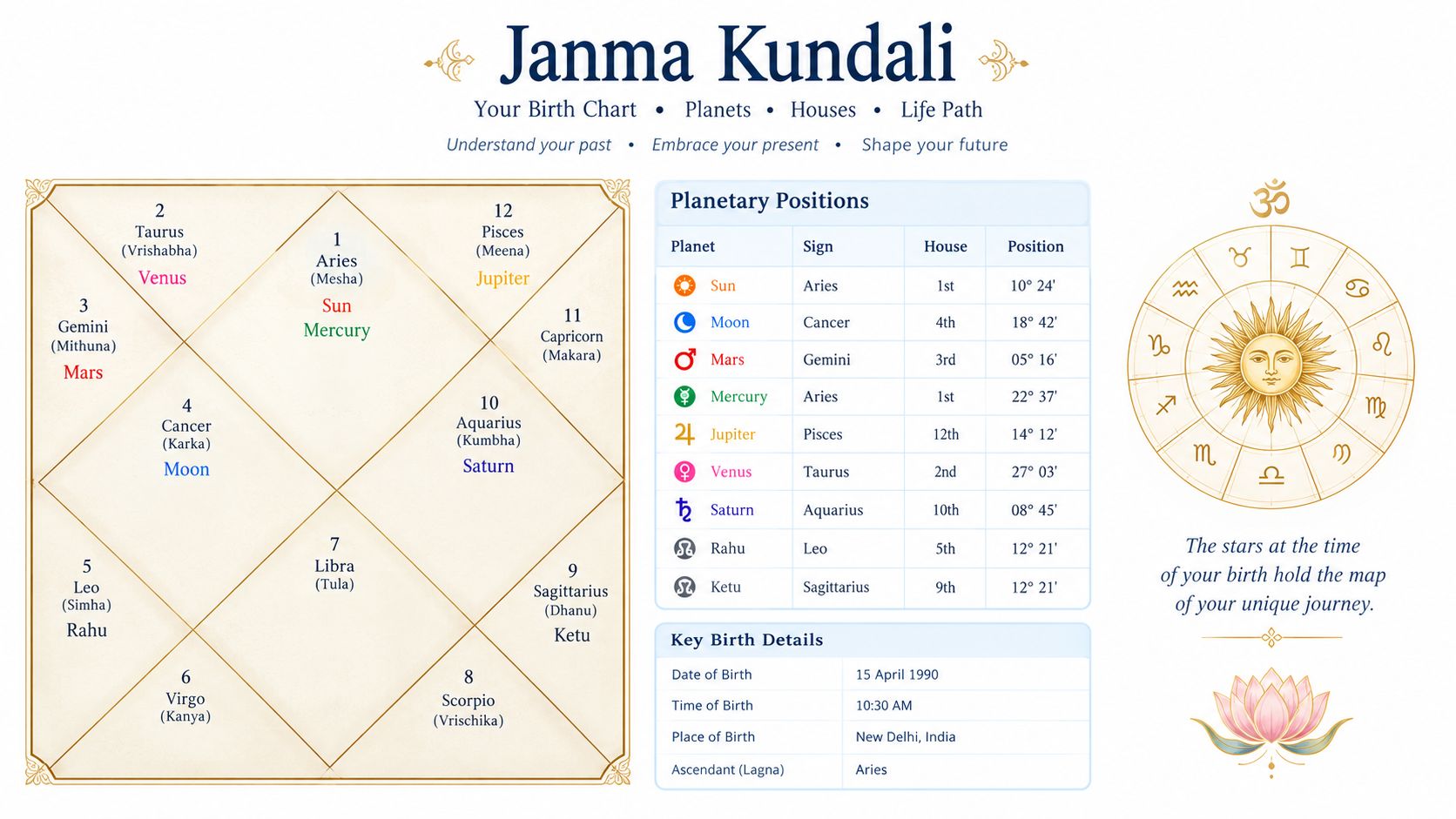
The same birth inputs should produce the same computed structure. Practitioners can still disagree about house conventions, ayanamsha, weighting, or interpretation, but they shouldn't be inventing different planetary positions from the same declared method.
That distinction matters. The chart is the computed map. The reading is the explanation built from it. A credible reading tells you which parts come from calculation and which parts involve judgement.
Rashi, Bhava, and Graha, The Three Layers
Read a chart through three layers at once.
Rashi means the zodiac sign occupied by a planet. It contributes the sign's qualities, its ruler, and the nakshatra context. Bhava means the house involved, the life area where the placement operates. Graha means the planet itself, including its condition, relationships with other planets, and capacity to deliver results.
Take a hypothetical example of the Moon in Taurus in the tenth house, conjunct Jupiter. The Moon describes one set of functions, Taurus provides the sign context, and the tenth house places the combination in public work, responsibility, or visible contribution. Jupiter modifies the picture through conjunction and its own qualities. No single phrase captures the whole placement.
Now change only the house. Moon in Taurus in the twelfth house raises a different set of questions around withdrawal, foreign environments, expenditure, or private work. Put the Moon alongside Saturn instead of Jupiter, and the emotional and practical reading changes again. These aren't interchangeable “Moon in Taurus” descriptions.
| Layer | Plain meaning | Question it answers |
|---|---|---|
| Rashi | The sign | What style or field does the planet operate through? |
| Bhava | The house | Where in life does it show up? |
| Graha | The planet | What function, condition, and relationships shape the result? |
Nakshatras add finer resolution. The system divides the ecliptic into 27 lunar mansions, each spanning 13°20′, creating 108 padas across the zodiac belt, as described in this nakshatra reference. The Moon's exact degree can therefore matter for timing, naming, and other classical applications.
How Parashari Computation Builds the Chart
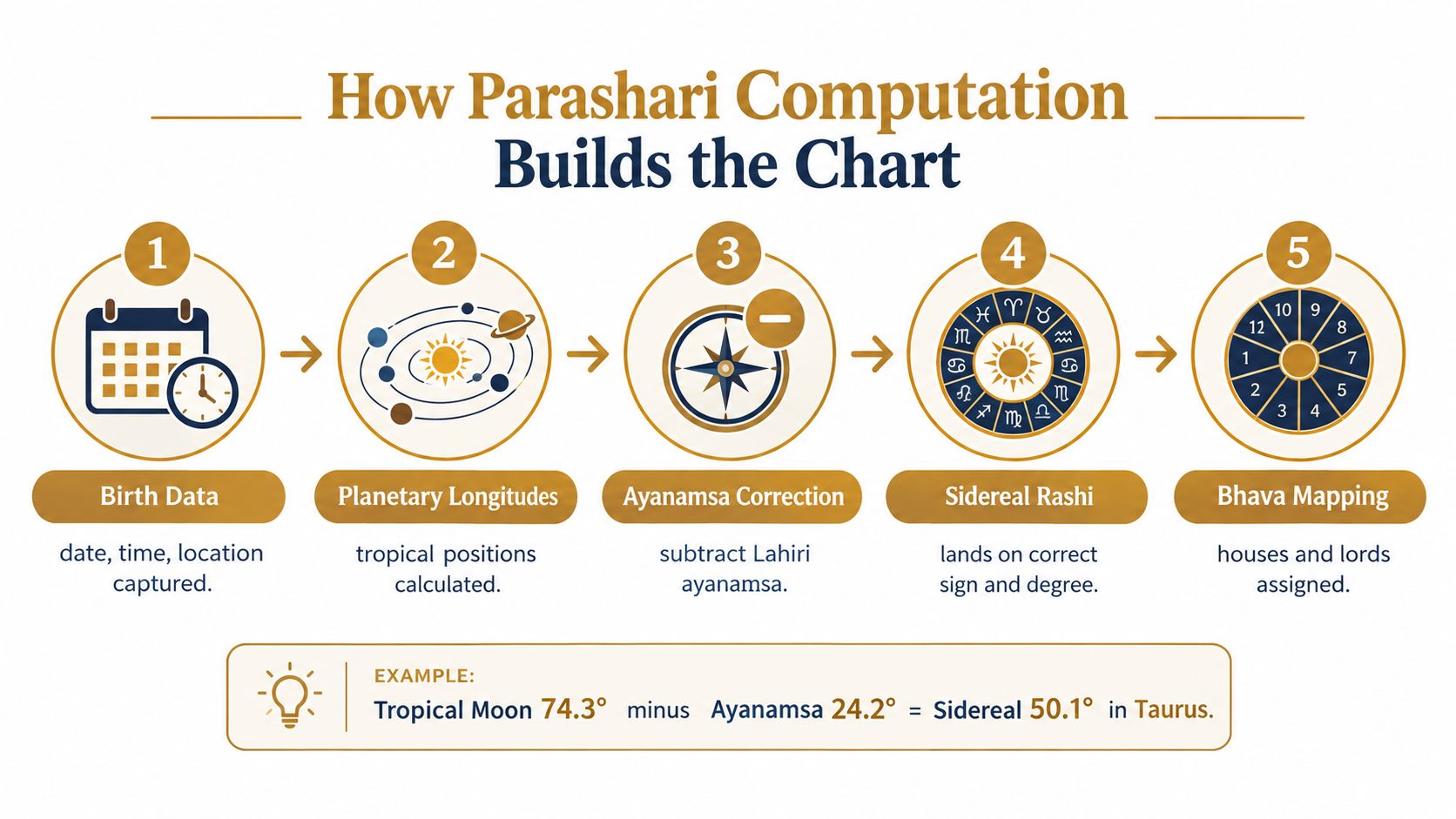
Parashari computation starts with the sky's coordinates at the birth moment. A sidereal chart adjusts the zodiac reference using an ayanamsha, the correction for the difference between the tropical reference and the stellar zodiac. Lahiri is one ayanamsha used in Vedic practice, but traditions can differ, so a reader should declare the setting rather than hide it.
The calculation then places the grahas by sign and degree, establishes the Lagna, and assigns the twelve houses. House methods vary across practitioners. Some use whole-sign houses, while others add bhava calculations that show where a planet falls within a house. The important point is reproducibility. You should know which convention produced the chart you're reading.
Parashari practice also uses Shodashvarga, the set of divisional charts. Each varga isolates a domain or refines the main D1 chart. The navamsa, or D9, is commonly used for marriage and underlying planetary strength. The dashamsha, or D10, is used for career. These divisions don't replace the main chart. They test and qualify it.
The timing layer uses Vimshottari Dasha, a 120-year planetary period cycle described as a standard part of Vedic analysis alongside yogas, shadbala, and ashtakavarga in this Parashari overview. Shadbala estimates planetary strength through several measures. Ashtakavarga organises planetary and transit support through computed points.
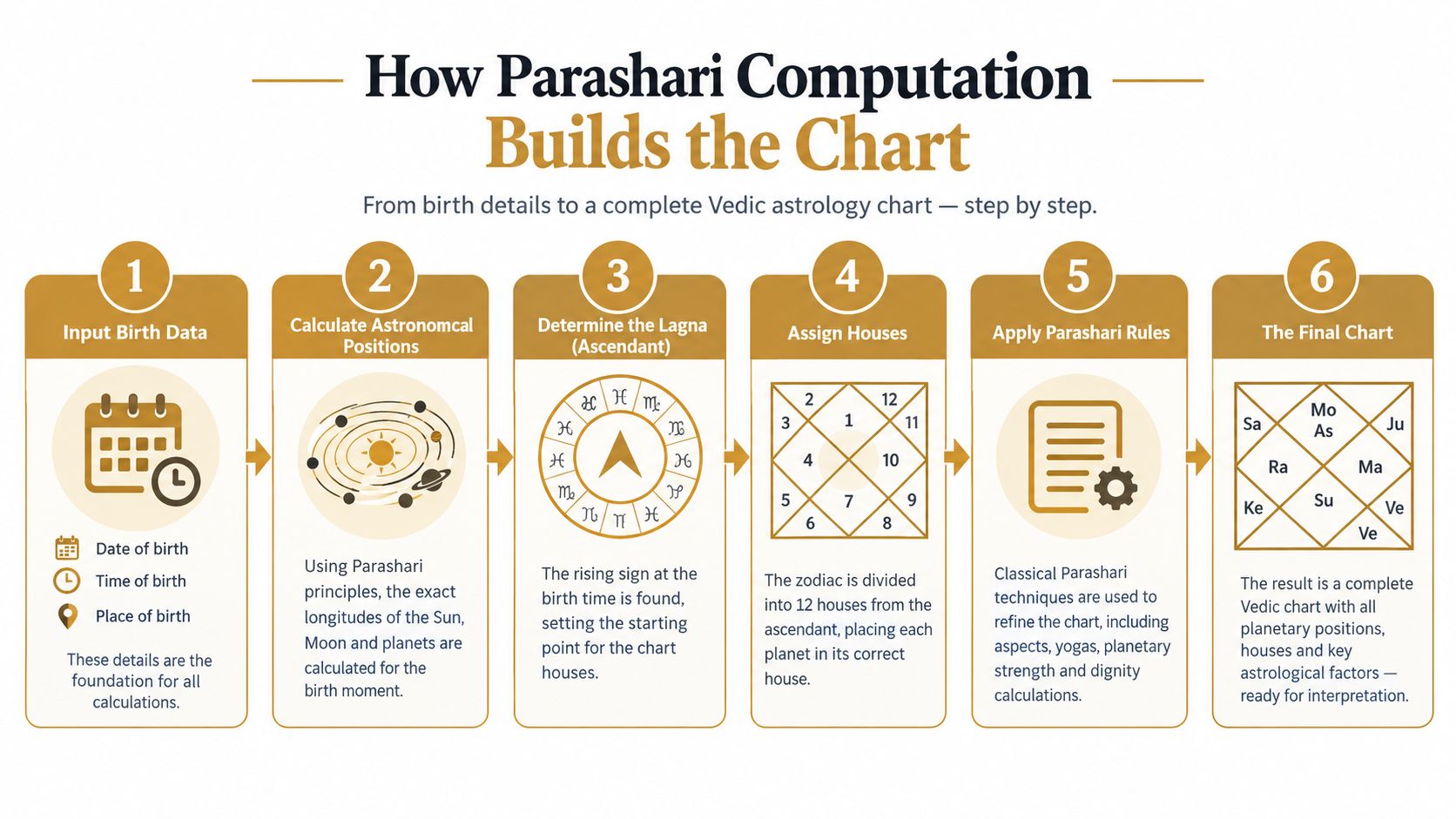
A full reading shouldn't treat these tools as decorative jargon. Each layer should answer a question: Where is the theme? How strong is it? When is it active? Does the lived record support the interpretation? Anvaya describes its declared method in its methodology overview.
Birth-Time Uncertainty and Chart Verification
Birth time is often the weakest input in an otherwise careful reading. Small errors can change the Ascendant, house boundaries, divisional placements, and dasha starting point. The further interpretation depends on time-sensitive components, the more confidence should be qualified.
A responsible rectification process doesn't begin by forcing a dramatic story onto the chart. It checks candidate charts against known events. One expert workflow tests whether the Ascendant, Moon's nakshatra, navamsa Lagna, and major dasha transitions align with events the person can verify. If they don't, the proposed time is treated as unreliable and narrowed through event-based back-testing, as explained in this birth-time rectification guide.
| Birth-time precision | Chart reliability | Verification method |
|---|---|---|
| Exact recorded time | Stronger basis for Lagna, houses, vargas, and dashas | Check chart structure against known events |
| Approximate time | Confidence varies by time-sensitive component | Compare several possible Ascendants and periods |
| No reliable time | Time-based claims become limited | Seek records, use a clearly labelled approximation, or consider a suitable alternative method |
Some readers use a noon-chart approximation or a location-based prashna, a question chart cast for the moment of inquiry. These can be useful within their own rules, but they aren't equivalent to a verified natal chart. If records may exist, asking a hospital or family office for documentation is often more useful than pretending an estimate is exact.
A reading that labels uncertainty is more trustworthy than one that hides it.
Reading the Chart for Life Areas and Relationships
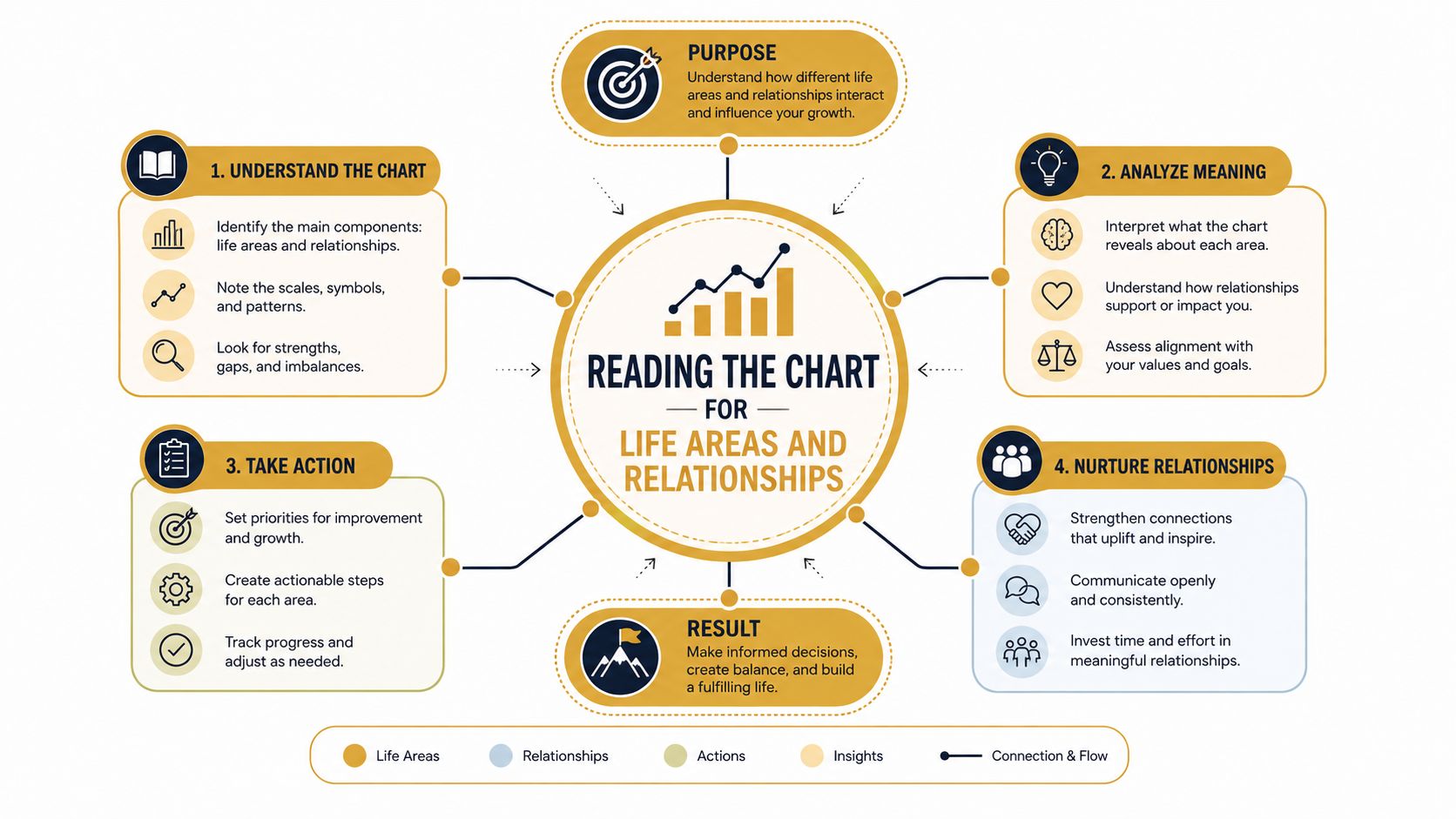
The same janma kundali can answer different questions because each question activates a different group of chart factors. Career analysis may begin with the tenth house and its lord, then consider supporting planets, relevant dashas, and the navamsa. Relationship analysis considers the seventh house, its lord, Venus, the Moon, and the relevant divisional context.
A practical reading might organise the enquiry like this:
- Career: Examine the tenth house, its lord, planetary influence, career-related divisional support, and active dasha periods.
- Resources: Consider the second and eleventh houses, their lords, and the periods in which those factors become active. This is reflection, not financial advice.
- Partnership: Study the seventh house alongside Venus, the Moon, the navamsa, and the timing sequence. Compatibility work requires both charts, not a single placement.
- Family and home: Look at the fourth house and relevant indicators, then test whether the current periods make that area more prominent.
Suppose a person is running a Venus mahadasha, or major planetary period, with an active seventh-house sub-period. That may justify examining relationships more closely. It doesn't prove that a marriage will occur, identify a guaranteed partner, or tell you to stay in an unsafe situation.
For couples, Sambandha compares two calibrated charts rather than selling a flattering description of either person. Classical matchmaking may include Ashtakoota Guna Milan and Mangal Dosha checks, but those checks need context. A score or combination shouldn't erase observed behaviour, consent, communication, or practical compatibility.
Common Questions About Vedic Birth Charts
Is a Vedic chart different from a tropical Sun-sign column?
Yes. Vedic astrology commonly uses a sidereal zodiac, which applies an ayanamsha correction to align positions with a stellar reference. The sidereal zodiac is offset from the tropical zodiac by roughly 24 degrees in the current era, and that figure shifts slowly over centuries, as explained in this Vedic astrology foundations article. A tropical Sun-sign column uses a different reference and usually gives a broad sign-based description.
That difference can move a planet or Ascendant into another sign. A Sun-sign description therefore cannot stand in for a Vedic chart, which also considers the Ascendant, houses, Moon's nakshatra, planetary strength, and timing systems. Computed chart mathematics provides the structure. Personality-flattering content may sound familiar without testing that structure.
How long does a first reading take?
A competent first reading needs time to construct the chart, check the birth details, and discuss the question. A typical consultation may take 60 to 90 minutes, though a fixed duration does not determine quality. A narrow question may need less time; a relationship or family enquiry often requires more context.
Can a free chart generator do the job?
Free tools can calculate the Lagna, planetary positions, and Vimshottari dasha when the birth data and settings are correct. They are less reliable for interpreting bhava chalit, which shows house-adjusted positions, and divisional charts without an informed reader.
Use these tools to inspect the chart's structure, not to treat a list of placements as a finished interpretation. Check the ayanamsha, house method, timezone handling, and birth location. A small input error can change the chart's angles or timing sequence.
Does software replace a human practitioner?
Software can calculate consistently and preserve the inputs used. A practitioner still has to assess family context, distinguish a precise event from a remembered approximation, and decide how much weight competing indications deserve. Good practice makes uncertainty visible and invites verification instead of manufacturing confidence.
When should you revisit a chart?
Revisit it around a mahadasha transition, a major transit, or a significant lived event that can test an earlier interpretation. Daily rechecking rarely adds clarity. Panchang and Muhurta are better suited to day-level and event-level questions.
Before booking a consultation, gather your recorded birth date, exact birth time if available, birthplace, major life-event dates, and the question you want answered. Decide what level of evidence and uncertainty you expect before you book a consultation.
Anvaya takes your birth date, time, and place through a declared classical compute stack, then uses Pramāṇa questions to calibrate the chart against events you have lived. If you want a persistent, plain-language Samhita rather than another flattering horoscope feed, visit Anvaya to see your chart.