

You might notice it first in small things. You reply to a sibling before they even ask, you keep the family group chat moving, and you'd rather send three clear messages than one long one. If that sounds familiar, Mercury in the 3rd house may already be visible in the way you think, speak, write, and move through daily life.
This placement is not just about “being chatty.” In classical Vedic astrology, it connects Mercury with the house of communication, siblings, short journeys, and the immediate environment. It can show quick learning and a strong need to exchange ideas, but it can also show strain if the mind is overstretched. The chart matters, the sign matters, and timing matters. That's why a serious reading has to separate broad symbolism from the actual condition of Mercury in your birth chart.
Table of Contents
- Understanding Mercury in the 3rd House
- Mercury in the 3rd House Communication and Siblings
- Mercury in the 3rd House Career Implications
- Assessing Strength and Timing for Mercury in the 3rd House
- Practical Examples of Mercury in 3rd House in Charts
- Conclusion and Next Steps with Your Chart
Understanding Mercury in the 3rd House
In the natural zodiac, the 3rd house is linked with Gemini, and Mercury rules Gemini. That's the basic reason astrologers treat this as Mercury's natural ground or own sign territory in whole-sign style reading. When a planet sits in a house that matches its core function, the placement usually feels easier to express. Mercury here tends to work through words, short exchanges, questions, notes, and everyday contact.
Classical texts preserve that idea, but they do it with nuance. A cited reading from Saravali says Mercury in the 3rd house can make a person skillful, willing to toil hard, and also fickle-minded. Phala Deepika adds a brighter tone, linking the placement with bravery and good brothers and sisters, while still warning about fatigue and dejection. Modern summaries keep both sides together, because the older tradition never treated this placement as one-note. AstroSage's summary of Mercury in the third house preserves that mixed classical legacy.

What the placement usually points to
The house itself covers siblings, neighbors, short trips, and the local environment. That is why Mercury in the 3rd house often shows up in people who ask questions fast, learn by repetition, and stay mentally active through daily contact. A practical way to think about it is this. If Mercury is a messenger, the 3rd house is the neighborhood where the messenger walks all day.
Practical rule: if Mercury is strong here, the chart often favors people who think by speaking, writing, or exchanging ideas in real time.
That does not mean every person with this placement becomes a writer or speaker. It means the chart is pointing to a mind that prefers movement, message, and response over silence and isolation. The result can be useful in ordinary life, but only if the rest of the chart supports focus and follow-through.
Mercury in the 3rd House Communication and Siblings
A strong Mercury in the 3rd house often looks very ordinary from the outside. The person is the one who replies fast, keeps track of practical details, and stays current with what is happening nearby. Jagannath Hora's Mercury in 3rd house reference ties this placement to quick learning, frequent speaking or writing, curiosity, reporting, and strong communication habits. That's a good shorthand, but the lived form is usually more specific than that.
Daily communication habits
You may see it in the person who prefers text over waiting, voice notes over long silence, and short calls over vague promises. They often process life in small updates. They don't need a grand speech to stay in touch, they need a steady stream of exchange.
It can also show in how someone handles facts. Mercury in the 3rd house tends to ask, “What happened?” and “What's next?” before it asks for emotional depth. That can be a strength in practical family life, local work, and information-heavy settings. If Mercury is not well supported, the same habit can become scattered attention, restless checking, or too many unfinished conversations.
Siblings, cousins, and the immediate circle
The 3rd house is also the house of siblings and close community, so this placement often brings those relationships into daily life. Sometimes the person becomes the messenger, organizer, or informal fixer in the family. Sometimes the sibling bond is close because of shared routines, shared errands, or shared humor rather than heavy emotional talk.
For a broader family-reading context, you can also look at Anvaya's family, children, and parents atlas. The key point is simple. Mercury here often makes family communication faster, but not always deeper. Speed and closeness are not the same thing.
If the chart supports it, the person may be the one who keeps everyone connected. If it does not, the same placement can still produce constant messages without much real clarity.
Mercury in the 3rd House Career Implications
In career terms, this placement usually helps where work depends on short-form communication. That includes sales, customer support, journalism, content creation, teaching, reporting, and coordination-heavy roles. Numerologist's discussion of Mercury in the third house makes the same larger point, the placement is often treated as positive, but it works best in roles that reward quick exchange rather than slow isolation.

Where it tends to fit
Think of jobs where the day is built from messages, calls, drafts, edits, follow-ups, and updates. Mercury in the 3rd house can feel at home there because the work matches the placement's natural rhythm. Sales teams need fast adaptation. Customer support needs clear language. Journalists need speed and accuracy. Content creators need a steady stream of ideas and packaging.
This is also why many people with this placement do well in environments where they can learn on the go. They often improve by doing, not by waiting for the perfect theory. That can be a real advantage in digital-first work, where communication moves quickly and roles change often.
Where the strain shows up
The same pattern can become tiring if the role demands long, quiet concentration without much interaction. A highly technical job may still suit the person, but only if the chart shows enough stability and depth elsewhere. If not, Mercury's restlessness can turn into shallow switching, unfinished drafts, or boredom with repetitive detail.
Key distinction: high mental activity is not the same thing as solid competence. A person can sound sharp and still need help with depth, pace, or consistency.
For a useful contrast, see Anvaya's Mercury in the tenth house reading. Public visibility and communication skill are not identical. The 3rd house is more about daily exchange, while the 10th house is about public role.
Assessing Strength and Timing for Mercury in the 3rd House
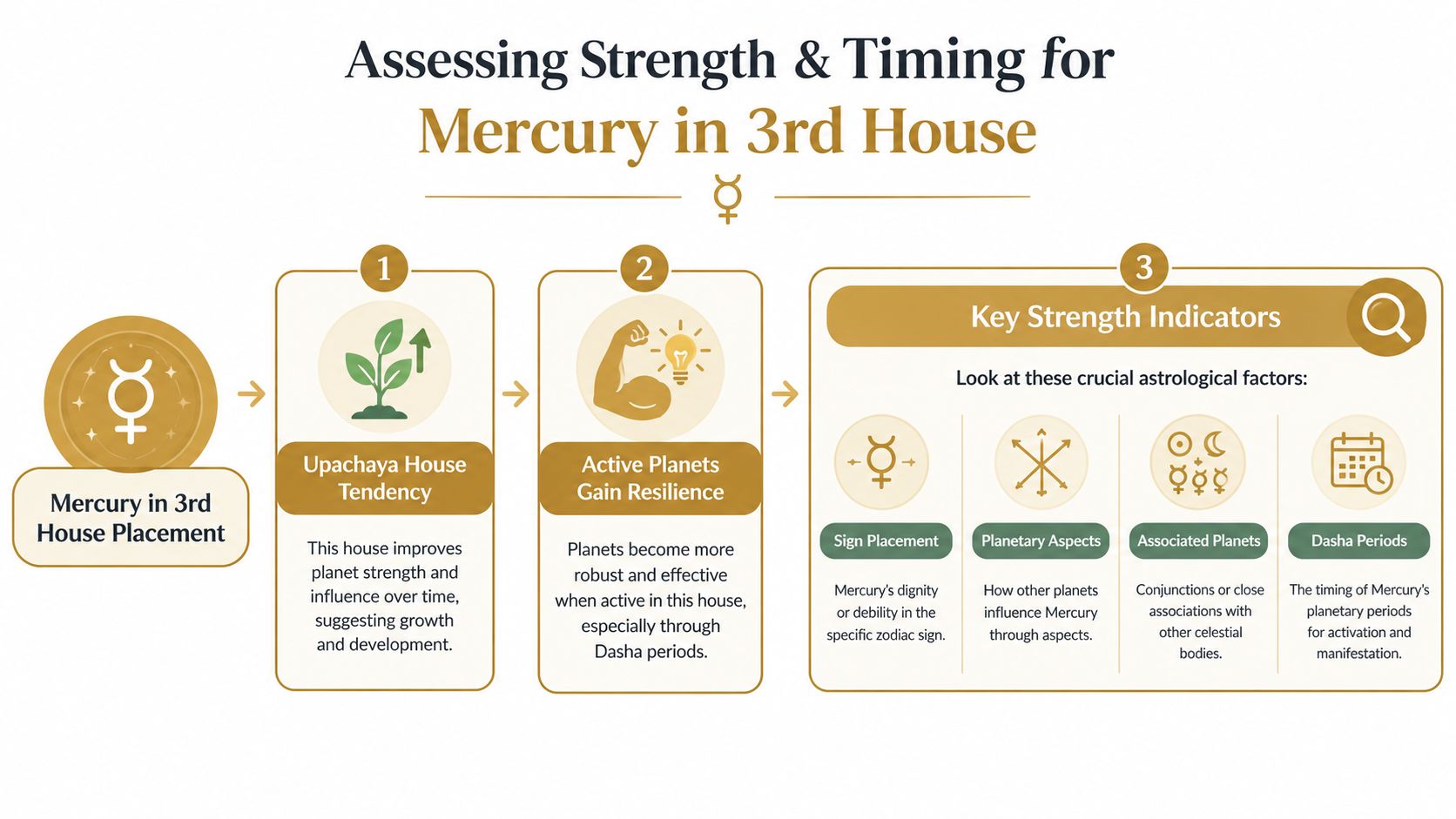
The 3rd house is an Upachaya house, which means it tends to improve over time. Astromedha's note on Mercury in the 3rd house frames this clearly, active planets here can grow stronger with use. That matters because Mercury often gets better when the person uses it. Writing, speaking, learning, negotiating, and asking better questions can all sharpen the placement.
What to check first
Start with the sign Mercury occupies. A Mercury placed in a sign it likes usually acts cleaner and more coherent than one under strain. Then look at aspects, conjunctions, and the broader condition of the chart. A Mercury that is close to harsh influences may still speak a lot, but the speech can become tense, distracted, or hard to sustain.
Next, check the dasha period, meaning the planetary timing cycle active in the chart. If Mercury's period is running, or if a supportive sub-period is active, communication themes often come forward more clearly. That is when writing projects, interviews, pitch calls, language work, or study habits may feel more available.
How to read timing without overclaiming
Do not assume every Mercury period is productive in the same way. The house placement can stay the same while the chart's timing changes the expression. A strong Mercury period may help you start conversations, publish, or make practical plans. A weaker one may still bring activity, but more scattered than structured.
For timing tools and a practical entry point, see Anvaya's guide to when is a good time to start. The principle is simple. House placement shows the style, strength shows the condition, and dasha shows the timing.
Practical Examples of Mercury in 3rd House in Charts
One chart can show how this placement opens doors in a very specific way. A person with Mercury in the 3rd house in Sagittarius found that a favorable Mercury dasha made travel writing feel natural. The work fit the placement because the person was already built for quick observation, short updates, and repeated contact with new places. The timing did the rest. The same person might have struggled earlier, before the Mercury period made the skill easier to use.
Another chart shows the harder side. Mercury in the 3rd house can still produce excellent ideas while getting tangled by Saturn's pressure. In that case, the person may draft strong articles, but finishing them takes too much effort. The mind is active. The output is delayed. That is a classic difference between idea flow and execution flow.
These examples also show why sibling and local ties matter. In one chart, a brother or sister may become a practical contact for work, referrals, or editing support. In another, the local community becomes the first audience for the person's ideas. Mercury in the 3rd house rarely stays abstract for long. It wants a real channel.
Conclusion and Next Steps with Your Chart
Mercury in the 3rd house is one of the clearest communication placements in Vedic astrology, but it is not a one-line label. It can show writing, speaking, quick learning, sibling ties, and frequent exchange, while also bringing restlessness if the chart does not support focus. The sign, aspects, and dasha together decide whether the placement feels fluent or scattered.
If you want this read in a way that respects chart math and lived events, a structured Samhita is the right next step. You get a reading that starts with the birth chart, checks the signal against real past patterns, and then speaks carefully about timing. That is more useful than guessing from a single placement.
Anvaya gives you a Samhita built from classical Vedic compute, then calibrates it against real events before it says anything forward-looking. If Mercury in your 3rd house matters in your chart, visit Anvaya and see how a grounded reading can separate noise from signal before you pay a rupee.