

You've found Mercury in your child's fourth house, and the descriptions sound reassuring: intelligence, good education, a comfortable home. You want to know whether that means strong grades and a calm family life. A careful Mercury 4th house reading starts with a less comfortable answer: the placement alone can't establish either.
Table of Contents
- Why One Placement Reads Differently Across Two Charts
- What Mercury and the Fourth House Mean in Daily Life
- How Lordship Changes the Result by Ascendant
- How to Check Mercury's Strength in the Fourth House
- Timing Mercury Through Dasha and Transit
- Case Examples and What Classical Texts Say About Remedies
- Test Each Claim Against Your Own Dated Events
Why One Placement Reads Differently Across Two Charts
The ascendant comes first. The ascendant is the sign rising at birth, and it sets the houses Mercury rules. Near a sign boundary, a small birth-time difference can change that framework, so a recorded time deserves more weight than a family estimate.
Say two parents bring charts with Mercury in the fourth house. One chart has Cancer rising; the other has Leo rising. The planet occupies the same house, but it carries different house responsibilities into it.
That distinction matters more than a flattering description of Mercury as intelligent or helpful. A jyotishi, meaning a practitioner of Vedic astrology, should name the ascendant and Mercury's lordship before discussing likely themes.
What a responsible reading starts with
Start with the date, time and place of birth. Declare the calculation settings too. Our default Parashari framework uses the sidereal zodiac, which references the stars, with Lahiri ayanamsha, the adjustment used to calculate sidereal positions.
Then test the chart against past events. A dated school change or move offers a clearer check than asking whether someone is curious, articulate or attached to home.
Key principle: A placement is a lens for reflection, not a verdict on a child's future. Interpret the chart before attaching a story to the person.
Carry these questions into any reading:
- Which ascendant is it? Confirm the foundation before interpreting the placement.
- Which houses does Mercury rule? Identify the subjects it brings into domestic life.
- How strong is Mercury? Separate capacity from a simple good-or-bad label.
- Which period is running? Ask when the proposed theme would be relevant.
What Mercury and the Fourth House Mean in Daily Life
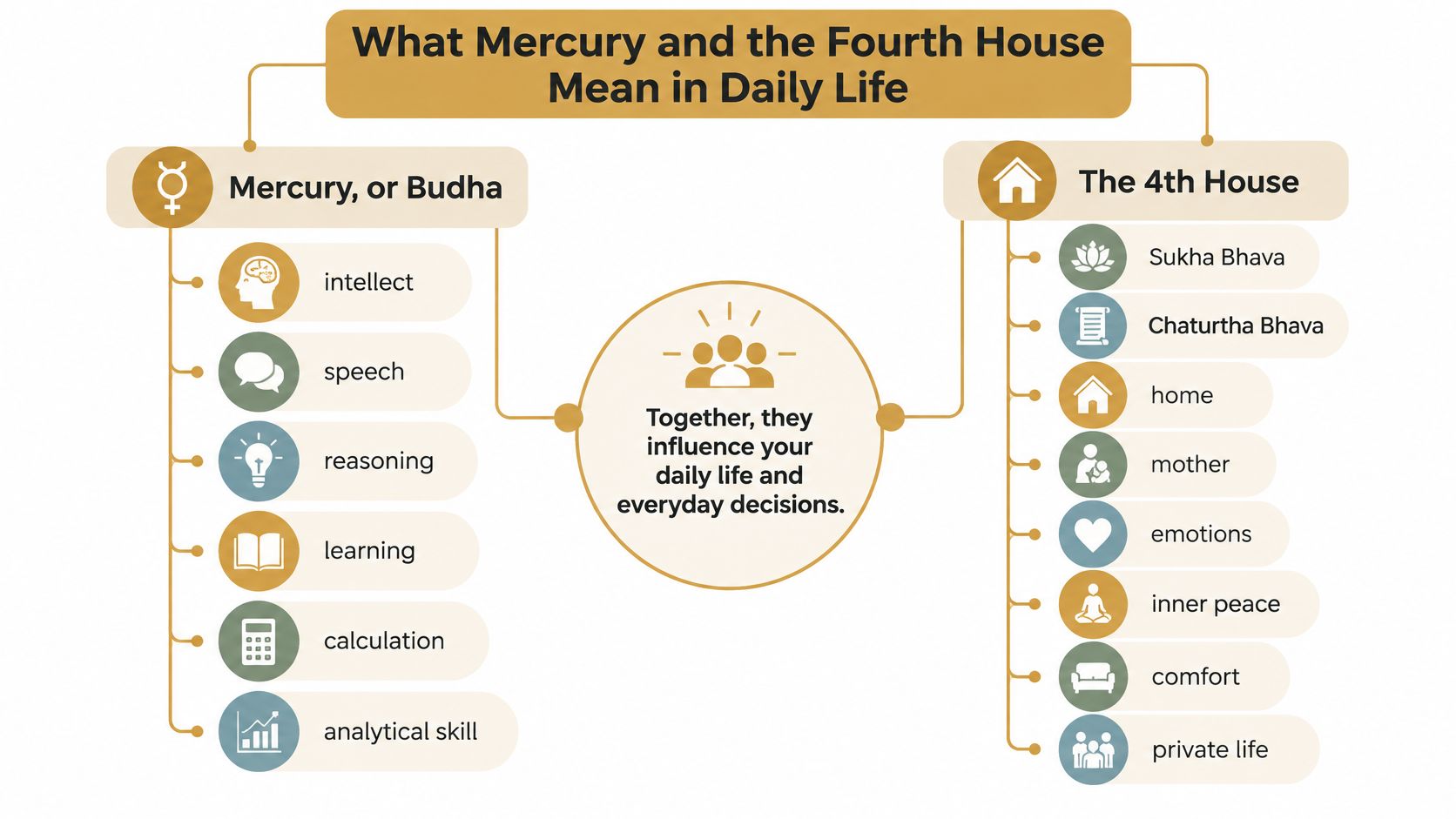
Mercury, or Budha, represents intellect, speech, reasoning, learning, calculation and analytical skill. The fourth house, called Sukha Bhava or Chaturtha Bhava, concerns home, mother, education, emotional security, property, vehicles and domestic happiness.
Think of the fourth house as the floor plan and Mercury as the mind working inside it. The house identifies the setting. Mercury describes a style of thinking, speaking and handling information within that setting.
What the classical descriptions mean
AstroClock's classical overview summarises themes attributed to Saravali, Phaladeepika and Brihat Parashara Hora Shastra: learning, intelligence, wealth, conveyances, refined surroundings and happiness connected with the mother, while identifying the fourth among the angular houses alongside the first, seventh and tenth.
An angular house is called a kendra. That means it occupies a structurally prominent position in the horoscope. Prominence isn't the same as an automatically favourable result.
These are traditional textual claims, not results from controlled statistical studies. They don't establish that this placement causes higher education, greater wealth or a happier home.
Thinking and speaking at home
If the chart supports it, Mercury here may symbolise a home where questions, explanations and discussion matter. Someone might prefer talking through a domestic problem, comparing options or writing down what needs doing.
The corresponding strain is over-analysis. A discussion can become an argument about wording rather than an exchange about what each person needs. Quick thinking may look useful in one context and unsettled in another.
Neither pattern should be assigned from the house placement alone. A quiet person can still express Mercury through reading, detailed records or private study rather than frequent conversation.
| Possible theme | Constructive expression | Strain to check |
|---|---|---|
| Analytical thinking | Breaking a household problem into manageable parts | Repeatedly reconsidering the same choice |
| Speech | Explaining needs clearly | Correcting others or using sharp wording |
| Adaptability | Adjusting a study space or routine | Changing plans before testing them |
| Curiosity | Asking how things work | Gathering information without reaching a conclusion |
These are interpretive possibilities, not a personality test. Sign, lordship and planetary associations determine whether a theme deserves attention.
Education and the learning environment
Mercury's symbolism can connect learning with the domestic setting. A supportive expression might involve a study corner, books shared within the family, or a preference for explaining lessons aloud.
Writing, teaching and negotiation are also Mercurial activities. Their presence in a reading doesn't establish an occupation or academic outcome. The useful question is narrower: does the person's actual learning history fit the proposed pattern?
For a child, avoid turning this placement into an expectation of exceptional grades. School performance involves teaching, opportunity, interests and circumstances that a planetary placement cannot replace.
Documents, living space and practical detail
Property and vehicles belong to the fourth house's traditional subject matter. Mercury adds the symbolism of records, numbers, comparison and communication.
A hypothetical expression is someone who enjoys organising household documents or understanding how a room could function better. That is different from predicting ownership, an inheritance or a profitable transaction.
The mother is another sensitive subject. This placement doesn't let a reader infer her character, wellbeing, or relationship with the child without examining the broader chart and respecting what happened.
A symbolic association with the mother is not permission to make confident claims about another person's life.
At Anvaya, we explain why a placement may relate to patience, responsibility or timing rather than labeling a planet bad. That respects the reader's intelligence and makes the reasoning open to examination.
A useful interpretation keeps its parts visible:
- Name Mercury's role. Is the proposed theme about speech, learning, reasoning or records?
- Name the house domain. Is the discussion about education, home, mother or domestic assets?
- Name what the chart adds. Which sign, lordship or association supports that specific interpretation?
How Lordship Changes the Result by Ascendant
A planet's natural reputation doesn't settle its functional role. Lordship means the houses a planet rules for a particular ascendant. Those houses bring their subjects into the house the planet occupies.
The Cancer-ascendant Parashari interpretation describes competing indications from Mercury's third- and twelfth-house ownership, including intelligence and happiness alongside difficult marriage symbolism and reduced maternal or property happiness.
The marriage and property language below records classical symbols. It is not a forecast of separation, loss or any other personal outcome.
Mercury in the fourth house by ascendant
| Ascendant | Houses Mercury Rules | Classical Reading for the Fourth House | Reading Note |
|---|---|---|---|
| Cancer | Third and twelfth | Effort and intelligence, a difficult marriage indication, reduced maternal happiness and property loss | Classical symbol, not a forecast |
| Leo | Second and eleventh | Wealth and gains through home, land, relatives or maternal connections | Requires adequate dignity and support |
| Capricorn | Sixth and ninth, with the sixth-house rule considered here | Reduced happiness through the mother, changeable thinking, possible hostile speech, substantial wealth | Mixed result; weigh against the running dasha and include ninth-house ownership |
The Capricorn distinction is important. Mercury rules both Gemini and Virgo, so a complete reading must consider both relevant houses. A passage discussing sixth-house ownership isn't a complete account of Mercury's function for that ascendant.
Write a reading that can be checked
Use a compact line: ascendant, Mercury's houses, the traditional indication, then the evidence still needed. For Cancer rising, that might read: Mercury connects initiative and expenditure with domestic matters; examine whether education or residence events support that interpretation.
For Leo rising, the emphasis shifts towards accumulated resources and gains. That doesn't justify promising prosperity. It identifies a traditional connection to investigate.
Classical passages and practitioners can differ in emphasis. Some describe a single lordship in isolation; others weigh the planet's combined responsibilities. Don't combine every favourable line and discard the difficult ones.
Confirm your ascendant from a reliable birth record before treating any row as relevant to your chart.
How to Check Mercury's Strength in the Fourth House
Read the placement only after checking Mercury's condition. Strength describes its capacity within the interpretive system; it doesn't turn every house it rules into an uncomplicated benefit.
The Leo-ascendant Parashari interpretation makes its favourable domestic-resource reading conditional on dignity and support, and calls for checks including Shadbala, divisional placement, associations and planetary periods.
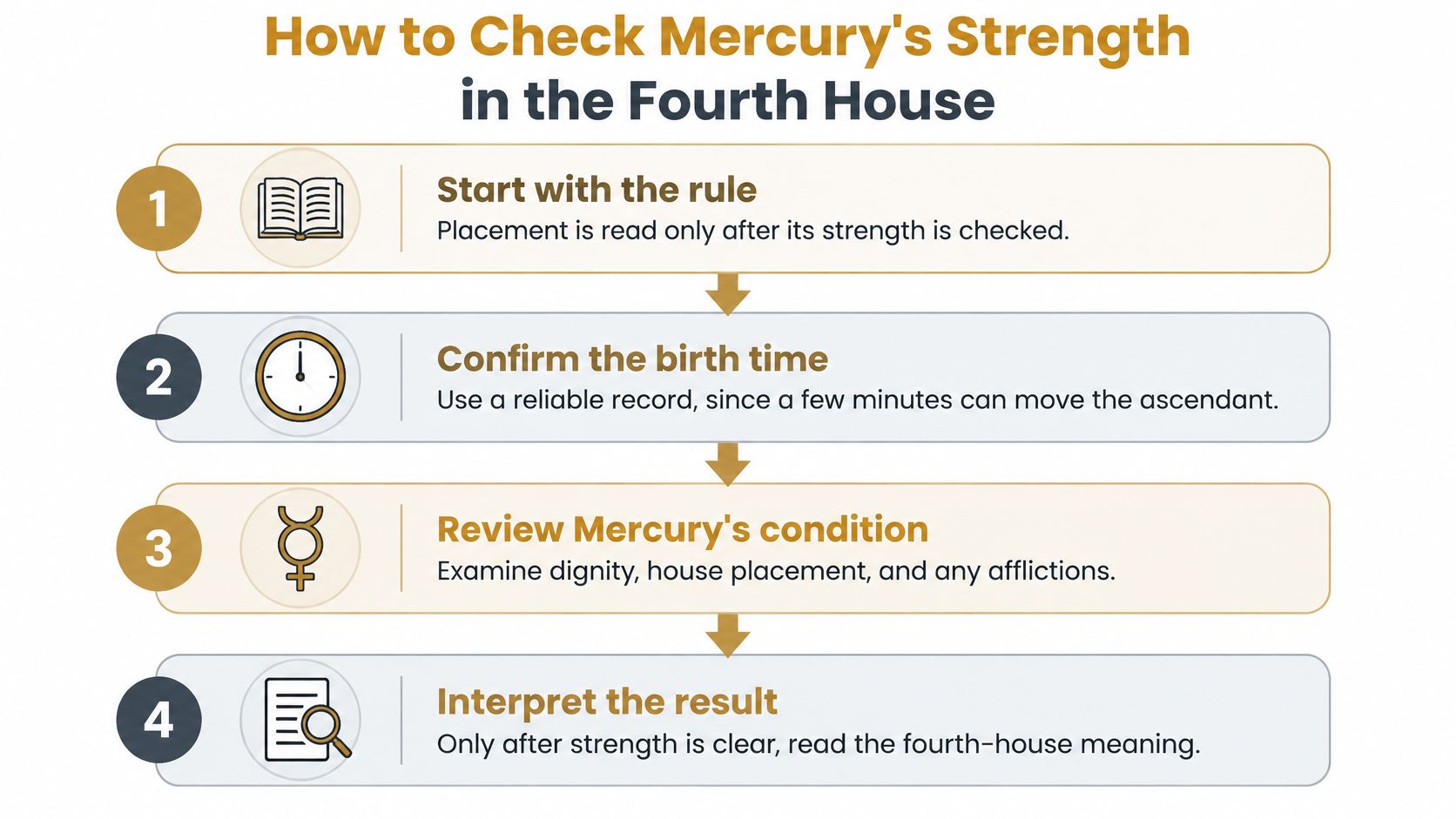
A practical inspection sequence
Confirm the birth record. Note whether the time comes from a record or memory. If the ascendant is close to a boundary, keep that uncertainty visible.
Place Mercury by sign. Mercury is exalted in Virgo, debilitated in Pisces, and rules Gemini and Virgo. Friendly and neutral signs require a more qualified assessment than either extreme suggests.
Inspect Shadbala. This is the six-part planetary strength measure. Compare Mercury's total with the threshold stated by the software, retaining the units and calculation settings rather than copying an unexplained score.
Review Ashtakavarga support. This system assigns supportive points called bindus. Distinguish Mercury's individual contribution from an aggregate total; they're not interchangeable.
Check Navamsha. This divisional chart provides another view of planetary dignity. Don't use a favourable divisional position to erase contrary evidence in the birth chart.
Inspect combustion and retrogression. Combustion concerns proximity to the Sun; retrogression is apparent backward motion from Earth. Neither should become an automatic failure label.
Read conjunctions and aspects. Conjunctions are planets placed together; aspects are the influences recognised by the chosen classical rules. Name the planets involved and explain what changes.
Write a bounded verdict. Use wording such as supportive for learning themes, mixed for domestic ease, or uncertain because the birth time is unresolved. Avoid a single score pretending to answer every question.
Strength checks for Mercury in the fourth house
| Check | What It Measures | What to Look For |
|---|---|---|
| Shadbala | Six-part planetary strength | Mercury's total against the stated threshold, interpreted with a margin |
| Ashtakavarga | Supportive points associated with signs and houses | Mercury's bindus for the occupied sign, distinguished from aggregate support |
| Navamsha | Condition in the divisional chart | Mercury's sign and dignity |
| Dignity and avastha | Sign status and planetary condition | Exaltation, debilitation, own-sign placement or a weak state |
| Combustion and retrogression | Proximity to the Sun and apparent backward motion | Angular separation from the Sun and calculated retrograde status |
A favourable sign with weak Shadbala gives conflicting evidence, not permission to choose the nicer result. Functional lordship still matters: greater capacity doesn't mean every subject Mercury carries is easy.
The contrast with Mercury in the second house also helps keep planetary symbolism separate from house subject matter.
Keep a dated worksheet with the birth-time source, calculation settings, checks completed, unresolved conflicts and provisional verdict. That makes later revision traceable.
Timing Mercury Through Dasha and Transit
A natal placement describes a standing configuration. Timing asks when its traditional themes might become relevant. Don't treat Mercury in the fourth house as a permanent prediction of domestic ease or difficulty.
Vimshottari dasha is a planetary-period system used in classical Parashari reading. A mahadasha is the main period; an antardasha is a subperiod within it. Use the calculated schedule for the actual birth chart rather than estimating from age.
Start with the longer period
During a Mercury period, a jyotishi would examine Mercury's ownership, placement and condition together. Education or residence might be relevant, but so might the subjects of the houses Mercury rules.
A Mercury subperiod inside another planet's main period needs both planets interpreted. It isn't a smaller copy of a standalone Mercury reading. Their relationship and respective house responsibilities affect the hypothesis being tested.
| Timing Layer | Usual Length | What It Adds |
|---|---|---|
| Mercury mahadasha | The fixed Mercury allocation in the selected Vimshottari calculation | Main period in which to examine Mercury's combined themes |
| Mercury antardasha inside another mahadasha | A proportional share of the parent period, calculated by the system | A narrower window to test against dated events |
| Mercury transit, or gochara | A short passage whose duration changes with apparent motion | A possible short trigger within the running period |
| Mercury retrograde | The interval between calculated retrograde and direct stations | An optional reflective window, not a verdict |
Use transits as context
Gochara means transit, the current movement of a planet relative to the birth chart. The explanation of gochara in Vedic astrology helps distinguish those moving positions from the natal placement.
The dasha is the season; the transit is the weather. A brief transit should not outweigh the larger timing framework because it is easy to notice on a calendar.
A timing claim needs a defined window and a defined event. A broad statement about change is too easy to fit after the fact.
Retrograde motion isn't evidence that a move, examination or conversation will go badly. If you use it for reflection, keep the interpretation modest and check the actual dates.
A better hypothesis is conditional: if a Mercury-linked period coincides with a documented education transition, that is something to examine. It is not proof that Mercury caused the event.
Case Examples and What Classical Texts Say About Remedies
A Capricorn ascendant with Mercury in the fourth house can be described in more than one way. The reading should begin with the rule being applied, not a label such as “intelligent” or “unhappy at home.” The Capricorn-ascendant Parashari interpretation discusses Mercury as lord of the sixth house and gives a mixed description, including reduced maternal happiness, intelligence, changeable thinking, hostile speech and substantial wealth.
Apply the rule without turning it into a verdict
In classical interpretation, the sixth house includes service, competition, conflict, illness and debt. These are traditional categories, not forecasts about a reader's health or finances. A complete Capricorn reading must also account for Mercury's ninth-house ownership.
Take a hypothetical person with a dated school change and a later move. Compare those events with the calculated Mercury periods, then check whether Mercury's condition, including combustion, dignity and other associations, supports the proposed interpretation. A matching event may be relevant to the reading, but it does not establish that Mercury caused it.
The interpretation can remain mixed. Learning symbolism may be strong while the domestic reading remains uncertain. Each domain needs its own reasoning; a placement does not have to produce one uniformly positive or negative result.
- Name the rule. State which house ownership is being interpreted and include relevant responsibilities that might otherwise be overlooked.
- State the evidence. Identify the planetary condition and timing that support the proposed reading.
- Accept a miss. If the suggested period does not fit the dated event, keep that mismatch in view.
With Cancer rising, the analysis changes. Weigh the relevant initiative-related and expenditure-related symbolism on its own terms. Mercury occupying the same house does not make the Capricorn interpretation transferable.
What remedy language does and doesn't establish
Upaya means a remedial practice. Some Parashari traditions discuss mantras, charitable acts or other practices in connection with planetary difficulty. Traditions and practitioners differ on whether a particular practice is necessary or effective.
That literature does not establish that a ritual changes the outcome of a placement. Nor does a difficult phrase in a text, by itself, show that a reader has an urgent problem or should buy something. Remedial passages can be studied as part of a tradition's literature without treating them as instructions.
Uncertainty in a chart is a reason to qualify the reading, not to frighten the reader.
A careful case reading leaves its limits visible. It does not turn incomplete evidence into a diagnosis, a judgement about someone's family or a promise of a fix.
Test Each Claim Against Your Own Dated Events
Choose a small set of past events, such as a school change, a move and a family transition. Record their dates before inspecting the timing. Mark each proposed correspondence as matched, partly matched or not matched, and retain misses alongside matches.
Traditional placement descriptions don't provide population evidence that Mercury here produces better education or property ownership. Likewise, the Pew Research Center survey on astrology consultation concerns public engagement, not validation of this placement.
Questions readers often ask
Does Mercury in the fourth house guarantee academic success?
No. It provides traditional learning symbolism, not an academic forecast.
Can this placement describe my mother accurately?
Not by itself. Don't infer her character or wellbeing from a single placement.
Is a strong Mercury always favourable?
No. Capacity and functional lordship answer different questions.
Does a matching past event prove astrology works?
No. Coincidence and flexible interpretation remain possible explanations.
Keep the reading open to examination
Our chart-analysis approach follows declared compute, then Pramāṇa, calibration against lived events, then a plain-language reading with stated confidence. You provide birth details, the math runs, chart-derived past-event questions test the interpretation, and your Samhita opens.
We ask about events before making forward claims; we don't sell your story back to you. This is for personal reflection and self-understanding, not professional advice.
Anvaya offers a structured, living Samhita rather than an isolated Mercury description. To see how planetary strength, lordship and timing fit together, visit Anvaya and see a sample reading.