

Meta description: Understand Mercury in the 2nd house through speech, learning and wealth potential, with practical strength checks and a clear account of what one placement can't tell you.
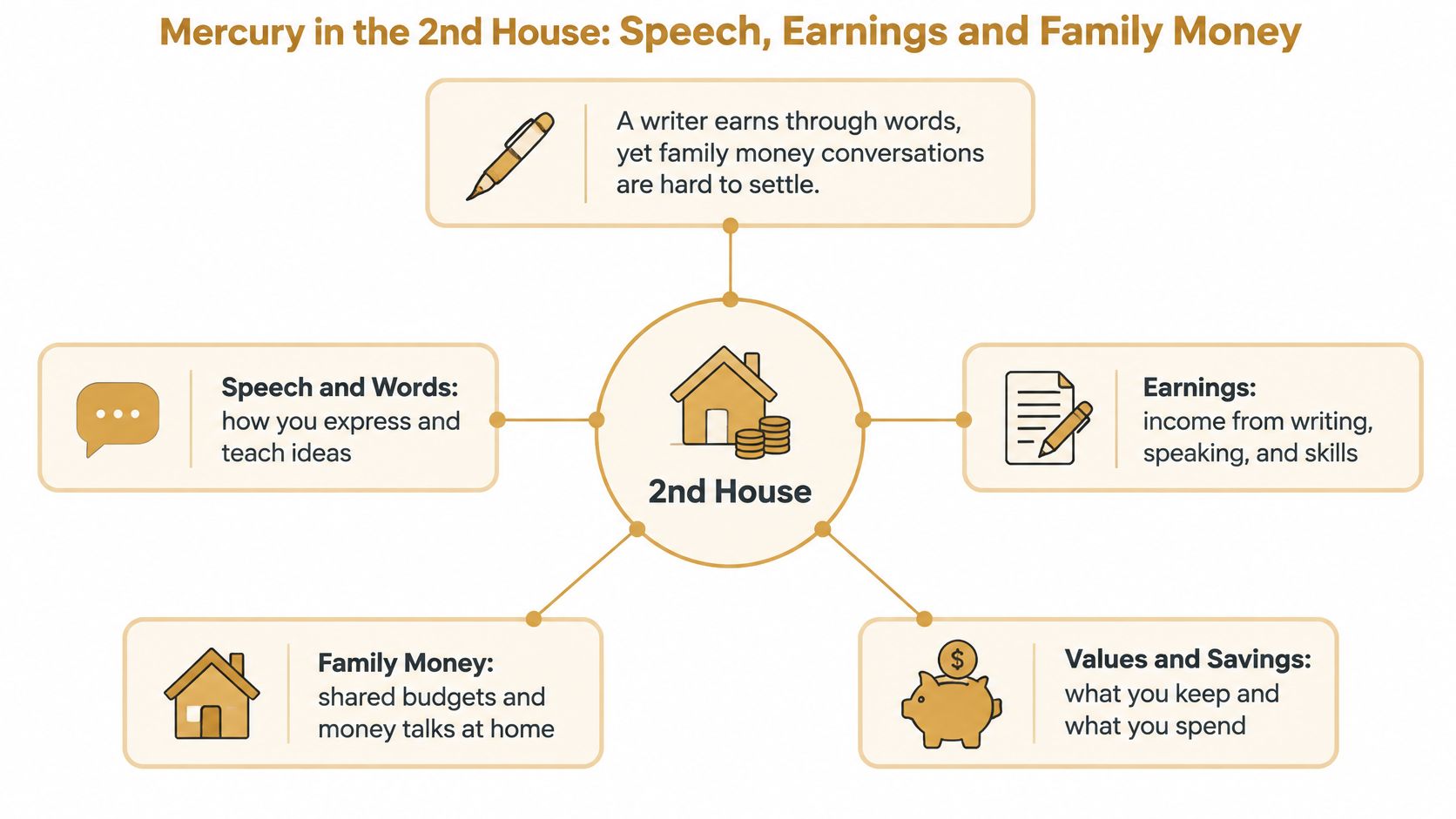
A person with Mercury in the 2nd house might earn through writing, yet find that conversations about family money are hard to settle. Both can belong in a reading of the same placement. Neither, on its own, tells you what that person's whole life will be like.
In classical Parashari astrology, a house gives the setting, a planet brings its significations, and the rest of the chart changes how that combination works. The useful question isn't whether Mercury in the 2nd house is “good.” It's what the placement points toward, which chart factors support that reading, and whether its timing matches events the person has lived.
Table of Contents
- Where Mercury Meets the Second House
- Conditions, Combinations and Aspects That Shape the Placement
- Strength Checks That Shape the Placement
- Speech, Learning and Family Money in Practice
- How Mercury Dasha and Transits Time the Placement
- What Classical Texts Say About Remedies
- Check the Placement Against Your Own Life
Where Mercury Meets the Second House
Think of the second house as the part of the chart associated with stored resources, family, speech and food. Mercury signifies intellect, language, calculation, learning and commerce. Put together, those meanings point to mental and verbal skills directed toward second-house topics. Classical summaries describe articulate speech and the possibility of acquiring wealth through intelligence, but that isn't a fixed profession or income promise, as the traditional summary of Mercury in the second house also makes clear.
| 2nd house domain | Mercury signification | Combined reading |
|---|---|---|
| Accumulated wealth | Intellect, calculation, commerce | Income from skill, analysis or trade |
| Speech | Language, clarity, argument | Articulate, pleasing or sharp speech |
| Family | Conversation, negotiation, communication | Family discourse and shared money talk |
| Learning | Intellect, study, teaching | Cultivated and scriptural learning |
| Food and sustenance | No direct Mercury link in most texts | Enjoyment of food, the weakest overlap |
The food row needs a careful reading. The second house includes food and sustenance, and classical summaries may connect this placement with enjoyment of fine food. But Mercury has no direct food link in most accounts, so this pairing is less direct than the links with speech, learning or calculation.
Key principle: The overlap describes where a person's intelligence and words may be directed. It doesn't establish a career, wealth level or communication outcome by itself.
Conditions, Combinations and Aspects That Shape the Placement
Think of the second house as a room and Mercury as the person who moves in. The room's condition matters, and so do the furniture and other people already there. In a classical Parashari reading, houses are counted by whole signs from the ascendant. A different house system can place Mercury in a different house, so the calculation method matters before interpretation begins.
Mercury is treated as conditionally benefic in the classical framework. In simple terms, its results are read in light of its associations and strength, not as automatically helpful or harmful. The Brihat Parashara Hora Shastra treats benefic influence in the second house as supportive of wealth, while its broader approach makes clear that a planet's house position needs to be judged within the full chart. The text of the Brihat Parashara Hora Shastra doesn't supply a modern probability, percentage or guaranteed income figure for this placement.
Start with conjunctions and aspects
A conjunction means planets occupy the same sign. Mercury sharing a sign with Jupiter or Venus is typically read as supportive of second-house matters. Sharing a sign with Saturn, Mars, Rahu or Ketu is usually read as adding friction, restraint or an unusual route through money and speech. These are broad interpretive tendencies, not settled predictions. Traditional authors don't agree on every combination, and the result changes with the planets' strength and role in the chart.
An aspect is a planetary influence on another house or planet. Mercury has a seventh-house aspect, so from the second house it aspects the eighth house. Benefic aspects from Jupiter or Venus onto the second house may add support to its themes. But an aspect isn't a standalone verdict. The sign receiving it, the planets involved and the rest of the chart all matter.
Check the second house lord
The second house lord is the planet that rules the sign in the second house. Check its placement, strength and connections with Mercury, including whether it shares a sign with Mercury. Then consider Mercury's functional role for the ascendant, meaning which houses it rules in that chart. The same planet can support some areas while complicating others, depending on those responsibilities.
Classical descriptions of refined speech, learning and wealth through intelligence are strongest when Mercury is well placed and supported. They're not proof of a specific job or a promise of financial success. The traditional summaries of Mercury in the second house also note modifiers such as sign dignity, combustion, retrogression, divisional placement and dasha timing.

Anvaya doesn't reduce a placement to “good” or “bad.” We explain why a planetary placement may influence patience, responsibility or timing, and what other chart factors shape that interpretation. The next step is to check Mercury's strength, then see whether the proposed pattern matches the person's lived experience.
Strength Checks That Shape the Placement
Once you've confirmed that Mercury is in the second house, check several conditions together. A single label such as “strong” or “afflicted” leaves out too much. Use this table as a way to organise the reading, not as a scoring system.
| Condition | Classical rule | Effect on the reading |
|---|---|---|
| Exalted | Mercury in Virgo | Clear speech and sharp calculation |
| Own sign | Mercury in Gemini or Virgo | Steady, self-directed intellect |
| Moolatrikona | Virgo, 15 to 20 degrees | Focused and strong expression |
| Debilitated | Mercury in Pisces | Scattered judgment, weaker discernment |
| Combust | Within about 14 degrees of the Sun, texts vary | Signification overshadowed |
| Retrograde | Apparent backward motion | Revision, repeated study or delayed speech |
| Navamsa (D9) | Mercury's sign in the navamsa chart | Confirms or softens the natal reading |
Exaltation and debilitation describe traditional sign-based conditions. Mercury is exalted in Virgo and debilitated in Pisces. The chart's other factors still matter. A sign label doesn't describe every result a person may experience.
Combustion means a planet is close to the Sun. The approximate degree range in the table is a working reference, not an exact rule shared by every authority. Retrograde refers to a planet's apparent backward motion from Earth. In a reading, it can suggest revision or repeated study, but it isn't automatically a mark against Mercury.
The navamsa, or D9, is a divisional chart used to add detail to a natal reading. Practitioners look at Mercury's sign there as a confirmation or softening factor. Degree thresholds and technical rules can differ between authors, so check the computed chart rather than memorising a single rule.
These checks can support or complicate one another. Mercury might occupy a sign associated with strength while also being combust, or its natal condition may be softened by its D9 placement. The practitioner's task is to weigh the factors and explain what they support, not to treat one row as the final answer.
Speech, Learning and Family Money in Practice
The examples below are hypothetical. They show how a practitioner can test an interpretation without turning a house placement into a fixed prediction.

Case one: the writer. Mercury is in the second house and is steady by sign and supported by the rest of the chart. The person earns through teaching and writing. Their family also asks them to explain household money questions in a clear, organised way. A reading could connect these patterns to Mercury's learning, language and calculation meeting second-house themes. The useful question is whether those skills show up consistently, not whether the placement guarantees a writing career.
Case two: the student. Mercury is combust, and the student finds that study feels difficult to organise at one point in life. Later, a dasha change coincides with a shift in study habits and progress. That scenario invites the practitioner to examine timing as well as strength. It doesn't prove that combustion caused the difficulty or that a particular dasha will produce the same result for someone else.
Case three: family money arguments. Mercury shares a sign with Saturn, and family conversations about money repeatedly become tense. A careful reading might examine communication patterns, caution, delay and the roles of other planets. It shouldn't treat disagreement as inevitable or conclude that the placement alone determines family relationships.
A related comparison is Jupiter in the second house, where the same house is read through a different planet's significations.
Wealth potential and wealth realization aren't the same claim. Mercury may describe skills that could be used in earning, such as teaching, writing, accounting or trade. Whether wealth is realised depends on other houses, planetary combinations, dasha periods and the choices made in life. Astrology doesn't calculate a guaranteed income from this placement.
Speech also needs careful language. A reading might discuss communication style, family discourse or verbal conflict. A literal speech difficulty is a medical matter for a qualified professional. An astrological interpretation can't diagnose it or replace professional assessment.
How Mercury Dasha and Transits Time the Placement
A Mercury placement describes a potential; dasha and transit timing show when its themes may become more active. These layers help organise a reading, but they cannot establish that a particular event will happen.
Begin with the dasha arithmetic
In Vimshottari dasha, Mercury's mahadasha lasts 17 years. A Mercury antardasha within another planet's mahadasha takes 17/120 of that main period. For example, within a 20-year Venus mahadasha, Mercury's antardasha lasts about two years and ten months, or roughly 2.8 years.
The length changes with the mahadasha it falls within. A practitioner can use that window to check whether themes such as study, speech or commerce match the person's dated experience. The calculation gives a period to examine, not a prediction by itself.

Read transits against the natal chart
Mercury crosses a sign in roughly two to four weeks, so its transit is brief and needs to be considered alongside the natal chart. Jupiter takes about a year to pass through the second house, a slower timing window practitioners may examine for wealth and family themes. These are interpretive timings, not guarantees. For an introduction to gochar in Vedic astrology, consider how transits are read in relation to the birth chart.
| Timing layer | Typical length | What to check |
|---|---|---|
| Mercury mahadasha | 17 years | Whether Mercury's natal condition matches dated events in that period |
| Mercury antardasha | 17/120 of the mahadasha length | Short windows for speech, study or commerce themes |
| Mercury transit through the second house | About two to four weeks | Brief activation, interpreted against the natal chart |
| Jupiter transit through the second house | About a year | Slower timing for wealth and family themes |
| Second house lord dasha | Depends on the chart | Whether the lord's period aligns with the placement |
Read the dasha lord and second house lord together, then compare the active period with dated events. This helps distinguish a period that calls for attention from a claim that a particular outcome is certain.
Anvaya's reading includes a dasha change computed from the chart alone, which can point to major life events such as a career shift. Its timing windows can be compared with past events to assess whether the reading fits lived experience. A dasha period offers a framework for that comparison, not proof that a specific event will occur.
What Classical Texts Say About Remedies
Upaya means measures that classical texts describe as ways to ease a planet's difficult results. For Mercury, Parashari and other texts describe measures such as mantra, charity connected with the planet and gemstone use. Some texts also name particular items. This is a neutral description of traditional material, not a recommendation.
Anvaya doesn't recommend these measures in this article. Practitioners disagree about whether they work or how they should be understood. A remedy doesn't alter the birth chart, and no classical text makes a remedy a replacement for understanding the placement.
A more useful question is whether the reading's named patterns match lived experience. Does the person communicate carefully, explain ideas for family members, or find that money conversations return to the same points? Those observations can help a reader assess whether a symbolic interpretation is relevant, without claiming that a remedy will change an outcome.
Check the Placement Against Your Own Life
A reading becomes more useful when you can compare its claims with events you remember. Start by checking the birth data, then make a short timeline of events connected with speech, study, income or family money.
| Check | Dated event to recall | Question to ask |
|---|---|---|
| Birth time | Not an event, but the source of the data | How confident am I in the time, and where did it come from? |
| Speech | A dated conversation or public talk | Did speech style shift during a Mercury window? |
| Income or study | A dated earning, exam or project | Did a Mercury or second house dasha line up with it? |
| Family money | A dated household money decision | Did family discourse change in a matching period? |
| Dasha match | The active Mercury or second house lord period | Does the period fit the events, or do other factors fit better? |
First, confirm the birth time and where it came from. House placement and planetary strength can be sensitive to the chart calculation, so uncertain birth data should be treated as a limit on confidence. Then list three to five dated events. You don't need to force every memory into an astrological pattern.
Next, check which dasha and transit windows were active around those dates. Ask whether the strength checks and combinations point toward the pattern you actually remember. Note the events that don't fit, too. A reading that only explains confirming examples isn't a fair test.
How Anvaya checks a reading
Anvaya follows four steps: you provide birth details, the math runs, the chart meets your life through past-event questions, and your Samhita opens. The chart is computed from birth data using declared methods, then calibrated against events you've lived through Pramāṇa. We ask about events rather than announcing them, so a person can judge whether the chart's proposed timing fits their experience.
This method doesn't make astrology a substitute for evidence in other fields. It helps keep the reading clear about what the chart supports and what remains uncertain. For more on the approach, see Vedic astrology chart analysis and the Anvaya blog.
This is for personal reflection and self-understanding, not professional advice.
Frequently asked questions
Is Mercury in the second house always good for wealth?
No. It can indicate skills connected with earning, such as calculation, language, teaching or commerce. Realised wealth depends on the wider chart, including the second house lord, other wealth-related factors and timing. The placement alone doesn't promise a particular income.
Does Mercury in the second house guarantee a career in writing?
No. Writing is one possible expression of Mercury's language-related significations, but the placement doesn't specify a fixed profession. Read it with the full chart and the person's circumstances.
Does an afflicted Mercury mean someone has a speech disorder?
No astrological placement can diagnose a speech disorder. A literal speech difficulty is a matter for a qualified professional. A chart reading concerns symbolic themes such as communication style, family discourse or verbal conflict.
What does Mercury retrograde in the second house mean?
Retrograde Mercury isn't automatically negative. In a symbolic reading, it may point to revision, repeated study or a communication style that takes time to form. The rest of the chart shapes whether that interpretation fits.
Which chart should I check after the birth chart?
Practitioners may use the navamsa, or D9, to add context to a natal reading. They also consider planetary strength and the active dasha. No single divisional chart or strength check should decide the whole interpretation.
Can a Mercury dasha predict an exact event?
A dasha marks a period to examine, not a guarantee that an event will happen. A responsible reading compares the timing with the natal chart and with events the person has already lived. Forward-looking claims remain conditional.
Anvaya computes a Vedic birth chart using declared methods, then calibrates it against events you've lived through before making a forward claim. If you want to see how that approach handles Mercury in the second house, visit Anvaya and explore a Samhita built around your chart.