A marriage meeting goes well until someone pulls out two reports. One says Manglik, the other doesn't. The family starts asking the usual questions, and most of them are the right ones. Which chart did the tool read. Did it check the right reference point. Was the birth time exact, or guessed. A mangal dosha calculator is only useful if you know how it reached its result.
That matters because this label isn't a single switch. In classical Vedic astrology, Mars can be checked from different anchors, and different tools don't always use the same rule set. A careful reading looks at the house placement, the reference point, the cancellation factors, and whether the birth time is stable enough to trust the result. Anvaya's approach is built around that kind of declared compute, then calibration against lived events through Pramāṇa, so the reading stays honest about what it knows and what it doesn't.
Table of Contents
- Why Two Mangal Dosha Reports Sometimes Disagree
- What the Six-House Rule Actually Checks
- Why the Calculator Checks Lagna, Moon, and Venus
- Severity Grading and Cancellation Rules Explained
- Step-by-Step Use of an Online Mangal Dosha Calculator
- Birth-Time Accuracy and Chart-First Validation
- Reading the Result Like a Practitioner
Why Two Mangal Dosha Reports Sometimes Disagree
A disagreement between two reports usually doesn't mean one of them is “right” and the other is “wrong.” It often means they're checking different things. One calculator may read Mars only from the Lagna, another may also check the Moon and Venus, and a third may apply cancellation rules that soften the label.
That's why two families can look at the same birth details and still get different outputs. The calculator is not an oracle. It's a rule engine. If the developer coded different reference points, different house logic, or a different way of handling exceptions, the result changes accordingly. A public calculator page that shows the six-house test and multi-reference checks makes that plain, because the same chart can be flagged from one view and not from another, and that is part of the method rather than a contradiction. Anvaya's synastry methodology follows the same basic logic of reading chart relationships through declared rules instead of vague impressions.
What usually causes the mismatch
- Different reference points. One tool may check only the ascendant, while another checks the Moon and Venus too.
- Different severity labels. Some calculators call a chart Manglik, while others separate mild, moderate, and severe forms.
- Different cancellation logic. A chart may look flagged at first glance, but still soften after cancellation rules are applied.
- Birth-time drift. A small error can move Mars into a different house and change the answer.
Practical rule: when reports disagree, don't argue from the label first. Ask which chart anchor, house rule, and cancellation rule each tool used.
What the Six-House Rule Actually Checks
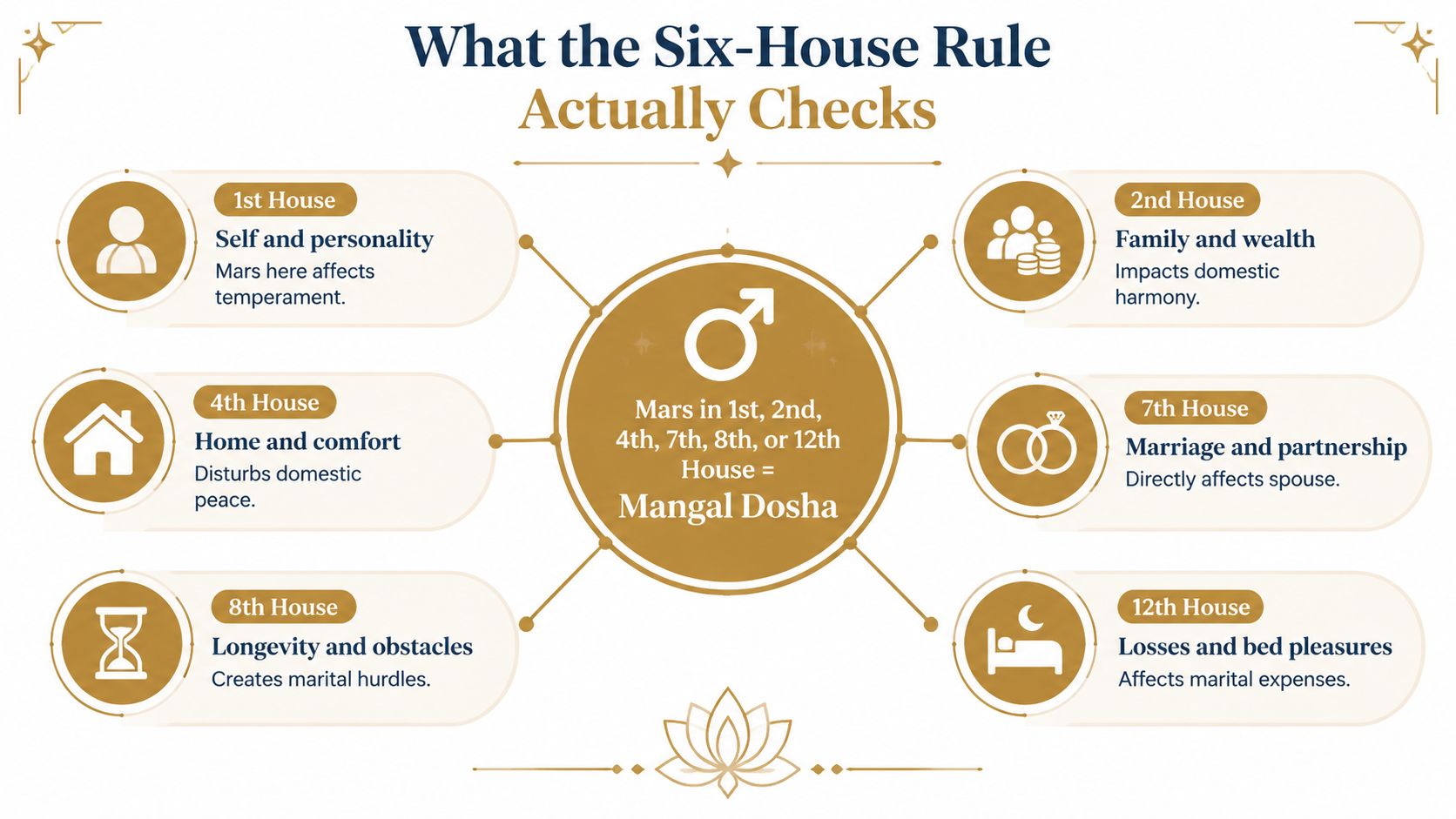
The classical screen is simple to state and easy to misuse. Mars in the 1st, 2nd, 4th, 7th, 8th, or 12th house is treated as Manglik in many calculator traditions, and those houses are chosen because they are tied to self, family, home, spouse, longevity, and private life. The calculator's job is to check whether Mars falls in one of those houses from the reference point it was built to use. Drik Panchang's calculator page reflects that standard six-house logic in public-facing form.
How the houses read in plain English
- 1st house. The self, body, and how you come into relationships.
- 2nd house. Family pattern, speech, and domestic continuity.
- 4th house. Home, comfort, and inner peace.
- 7th house. Marriage, spouse, and partnership.
- 8th house. Shared burdens, vulnerability, and longevity themes.
- 12th house. Bedroom matters, loss, and private expenses.
The point isn't that every placement creates the same outcome. It's that the calculator uses this house map as a screening rule, not a diagnosis. Some traditions also vary on whether they include or exclude certain houses, which is why the same keyword can mean slightly different things across tools. A serious calculator should show the house set it used, not hide it.
Why the Calculator Checks Lagna, Moon, and Venus
A single birth chart can produce more than one answer because it can be read from more than one reference point. Lagna, or ascendant, is the chart's physical starting point. The Moon gives a second lens, often preferred in marriage-related judgment. Venus is brought in when the focus is specifically on married life and relationship balance.
Here's where people get confused. Mars may sit in the 8th from Lagna and still fall outside the six-house set from the Moon or Venus. That doesn't mean the chart is inconsistent. It means the calculator is seeing different arcs of the same sky. A tool that checks only one reference point can miss a broader classical reading, while a tool that checks all three can give a more complete picture.
| Reference Point Used in Mangal Dosha Calculations | Houses Counted | Typical Use | Sensitivity |
|---|---|---|---|
| Lagna | 1st, 2nd, 4th, 7th, 8th, 12th | Broad chart screen | Can change with small birth-time shifts |
| Moon | Same house set from the Moon sign | Marriage-related judgment in classical practice | Often changes the result when Lagna and Moon differ |
| Venus | Same house set from Venus | Focus on married life and relationship tone | Useful as a cross-check, not a solo verdict |
A good calculator doesn't hide the reference point. It shows whether the result came from Lagna only or from a wider set of checks.
That's the core reason two tools disagree. They may both be using valid astrology logic, but not the same logic. In a marriage context, that difference matters more than the label itself.
Severity Grading and Cancellation Rules Explained
A responsible reading treats Mangal Dosha as a spectrum, not a verdict. Some traditions grade the placement more gently when Mars sits in the 2nd or 12th house, more strongly in the 4th house, and more severely in the 1st, 7th, or 8th house. A calculator that only says yes or no is flattening information that the chart is giving in layers. Shubh Divas's Mangal Dosha guide reflects that kind of graded reading.
When the label softens
Cancellation logic matters because the raw placement isn't the whole story. Traditional rules often soften the dosha when Mars is in its own sign, when Mars is exalted, when Jupiter aspects or joins Mars, or when both partners are Manglik. Dekho Panchang's explanation of cancellation rules presents that classic line of reasoning clearly.
A chart can also be softer if Mars is supported rather than isolated. That doesn't erase the placement, but it changes how seriously the label should be taken. The right reading is usually “flagged, then checked,” not “flagged, therefore final.”
| Factor | Effect on Reading |
|---|---|
| Mars in 1st, 7th, or 8th house | Usually read as stronger and more tense |
| Mars in 4th house | Often read as moderate |
| Mars in 2nd or 12th house | Often read as milder |
| Mars in own sign or exalted | Can soften or cancel the surface result |
| Jupiter's influence | Often reduces the harshness of the reading |
| Both partners Manglik | May reduce mismatch in matching contexts |
The useful habit is not to stop at the label. Ask whether the chart shows cancellation, support, or a stronger Mars pattern elsewhere. That gives you a cleaner reading than a blunt yes/no answer.
Step-by-Step Use of an Online Mangal Dosha Calculator
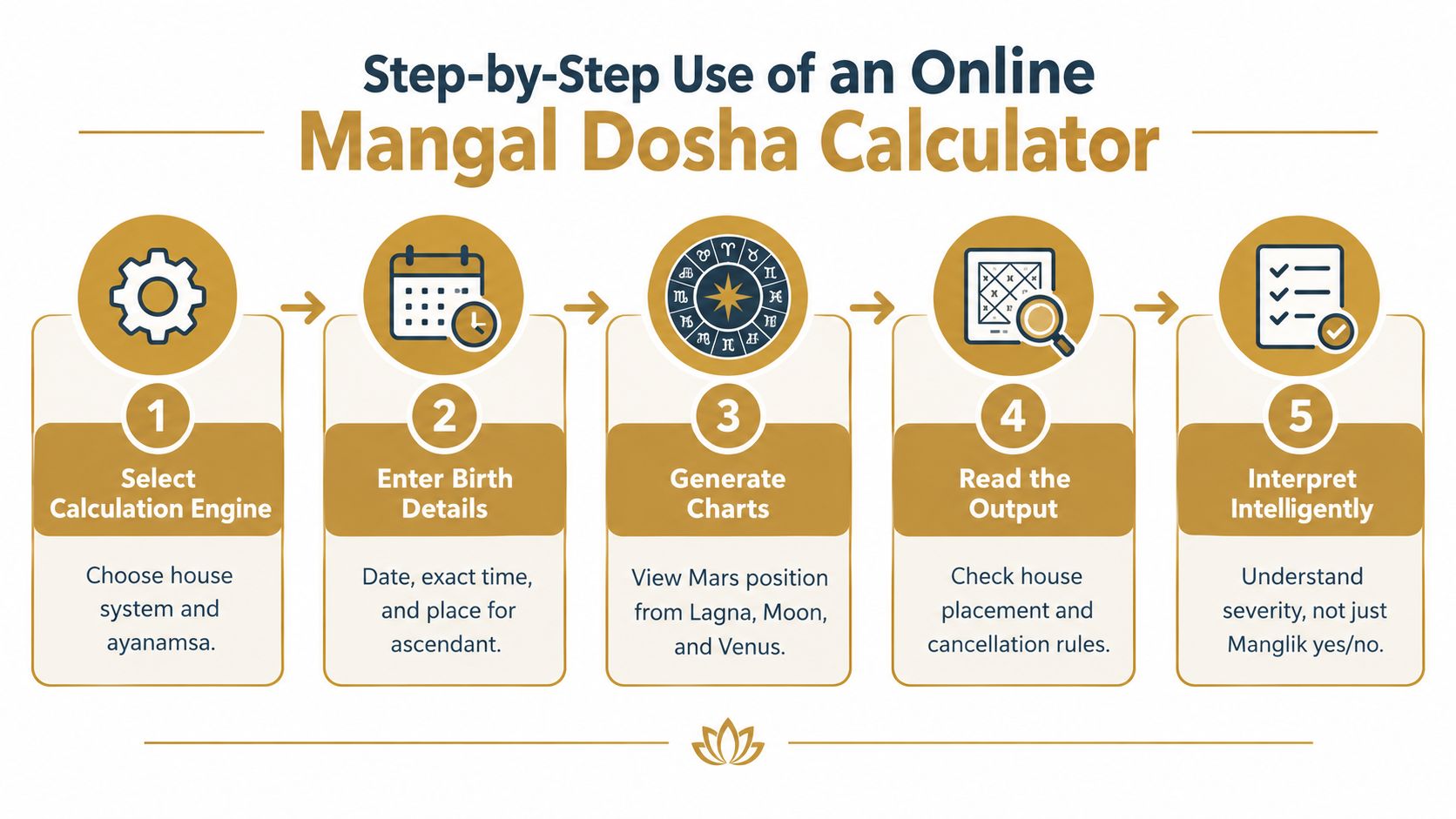
The fastest way to misread a calculator is to enter the birth details and trust the first line that appears. A better method is slower and more exact. Start by checking whether the tool lets you choose the calculation engine or reference style, because some calculators default to Lagna-only while others let you include Moon or Venus as well.
The five inputs that matter most
- Choose the engine carefully. If the tool offers a house system or ayanamsa setting, don't ignore it. The result depends on how the chart is computed.
- Enter exact birth details. Date, time, and place all matter, because the ascendant is time-sensitive.
- Select the reference point. Lagna, Moon, or Venus changes the reading.
- Read the output field, not just the label. Look for the house placement and any cancellation note.
- Cross-check if the result matters. A second tool or a manually drawn chart helps confirm the answer.
Anvaya's dashboard guide is useful if you want to understand how a structured reading presents chart layers instead of a single blunt score.
The logic behind the caution is simple. Mars falls into the six-house Manglik zone in roughly half of charts by construction, so the label is too common to behave like a strong standalone predictor. A result that common needs context, or it becomes noise. That's why false positives can create unnecessary family anxiety, rushed remedies, or rejected matches when the fuller chart doesn't support that level of concern.
A calculator is most useful when it answers a narrow question, not a life verdict. It tells you whether the chart triggered a Manglik screen. It doesn't prove what marriage will feel like, how two people will adjust, or whether other marriage factors are favorable.
Birth-Time Accuracy and Chart-First Validation
The biggest hidden problem in Mangal Dosha work is not Mars itself. It's the birth time. If the ascendant is wrong, Mars can move into a different house and the label can flip. One calculator page notes that even a 10-minute birth-time error can change ascendant and dosha status, which is a real warning sign for anyone treating the output as final. JyotishHub's calculator page highlights that sensitivity clearly.
What to check before you trust the verdict
- Use the original record. Hospital paper, family record, or any document that preserves the time more reliably than memory.
- Watch for rounded times. “Around 6 AM” is not the same as 6:03 AM.
- Confirm the ascendant first. Don't read the dosha before you know the chart is steady.
- Compare the three viewpoints. Lagna, Moon, and Venus should all be visible if the tool is being serious.
- Treat doubtful times as tentative. If the chart shifts with small changes, the answer needs caution.
A clean chart-first habit prevents overconfidence. First, confirm Mars's sign and degree in the kundli. Then check the ascendant cusp. Only after that should you read the Manglik result. If the chart boundary looks unstable, the calculator's answer should stay provisional.
Serious reading differs from casual app output. The calculator is not wrong for giving a result. It's incomplete if it doesn't tell you how sensitive that result is to time precision.
Reading the Result Like a Practitioner
A practitioner doesn't stop at “Manglik” or “not Manglik.” The reading comes together from four things, the confirmed birth time, the reference point used, the severity grade, and any cancellation that applies. If Mars is deep in the house, the reading usually deserves more attention than if it is just near a cusp and can slip with a small correction.
That's also where real life matters. Ask a simple question, would this label change a marriage decision that already looks steady on temperament, family fit, and practical compatibility. If the answer is no, the label may be worth noting but not centering. If the answer is yes, then you should revisit the kundli carefully and not rely on one screen alone.
A serious result is not the same as a frightening result. It is simply a result that has enough structure to deserve a second look.
Mars also has real-life expressions beyond marriage language, such as decisiveness, conflict, energy, and directness. If those patterns are visible in the chart and in lived behavior, the dosha label should be read with more context, not less. If they aren't visible, the label should not be forced into the story.
For readers who want a structured, chart-first workflow, How Anvaya reads a chart shows how a reading can stay tied to declared method rather than guesswork. That kind of process is what keeps the result usable. It turns the calculator from a scary answer into a starting question.
If you want a careful Mangal Dosha reading that starts with birth data, checks the chart cleanly, and stays honest about uncertainty, visit Anvaya. We read the chart first, then calibrate against lived reality, so you get a structured Samhita instead of a vague horoscope feed.