
A family sees 28 out of 36 on a guna milan report and starts planning the wedding. Another couple receives 17 and assumes the relationship should end. Both reactions treat the score as something it was never designed to be: a complete verdict on a marriage.
Guna Milan for marriage is a structured screening method. It compares the partners' Moon signs and birth stars through eight weighted factors. That makes it more useful than a vague personality label, but less complete than a full birth-chart analysis. The number can identify areas that deserve attention. It can't replace judgment, conversation, chart strength, or an examination of doshas and timing.
Practical rule: Read the total score first, then ask which factors produced it and what the full charts confirm.
Table of Contents
- Why Guna Milan for Marriage Is Just the First Step
- The Core Concept of Ashtakoota and the Eight Kootas
- Key Aspects of the 36-Point Scoring System
- Real-World Examples of Score Interpretation
- Moving Beyond the Score to Full Chart Calibration
- Frequently Asked Questions About Vedic Matchmaking
Why Guna Milan for Marriage Is Just the First Step
The most popular advice says that 18 out of 36 means “yes” and anything below it means “no.” That shortcut is easy to share, but it removes the reasoning from the practice. A couple can cross the customary line with weaknesses in a high-weight factor, while another can fall short because of low scores in areas that carry less weight.
The classical system has value because it imposes structure. It doesn't ask whether two people “feel compatible” in a general sense. It compares specific Moon-based indicators. Yet a structured filter is still a filter. It isn't a complete reading of marriage, shared responsibilities, family conditions, or the timing of a major commitment.
Public calculators and daily horoscope apps often present compatibility as a single score with little explanation. Serious Jyotish work asks different questions:
- What is being measured? The standard score is based on Moon signs and birth stars, not every factor in both birth charts.
- Where are the weak points? The total can hide a difficult Nadi, Bhakoot, or temperament pattern.
- Does the broader chart support the conclusion? Individual chart strength, partnership indicators, doshas, and dasha periods still matter.
- Can the couple discuss the practical friction? Astrology can frame a conversation, but it can't have that conversation for you.
The Ashtakavarga chart analysis follows the same useful principle: a computed layer becomes meaningful only when you understand what it measures and how it fits into the wider chart.
A high score doesn't guarantee emotional maturity. A low score doesn't prove that a relationship will fail. Use the number to decide what deserves closer examination, not to outsource a life decision to a calculator.
The Core Concept of Ashtakoota and the Eight Kootas
Ashtakoota Milan, also called Guna Milan, assigns points across eight compatibility dimensions. The traditional maximum is 36 points. The factors are Varna, Vashya, Tara, Yoni, Graha Maitri, Gana, Bhakoot, and Nadi, with point weights from 1 through 8 respectively, as described in this overview of the Ashtakoota matching system.
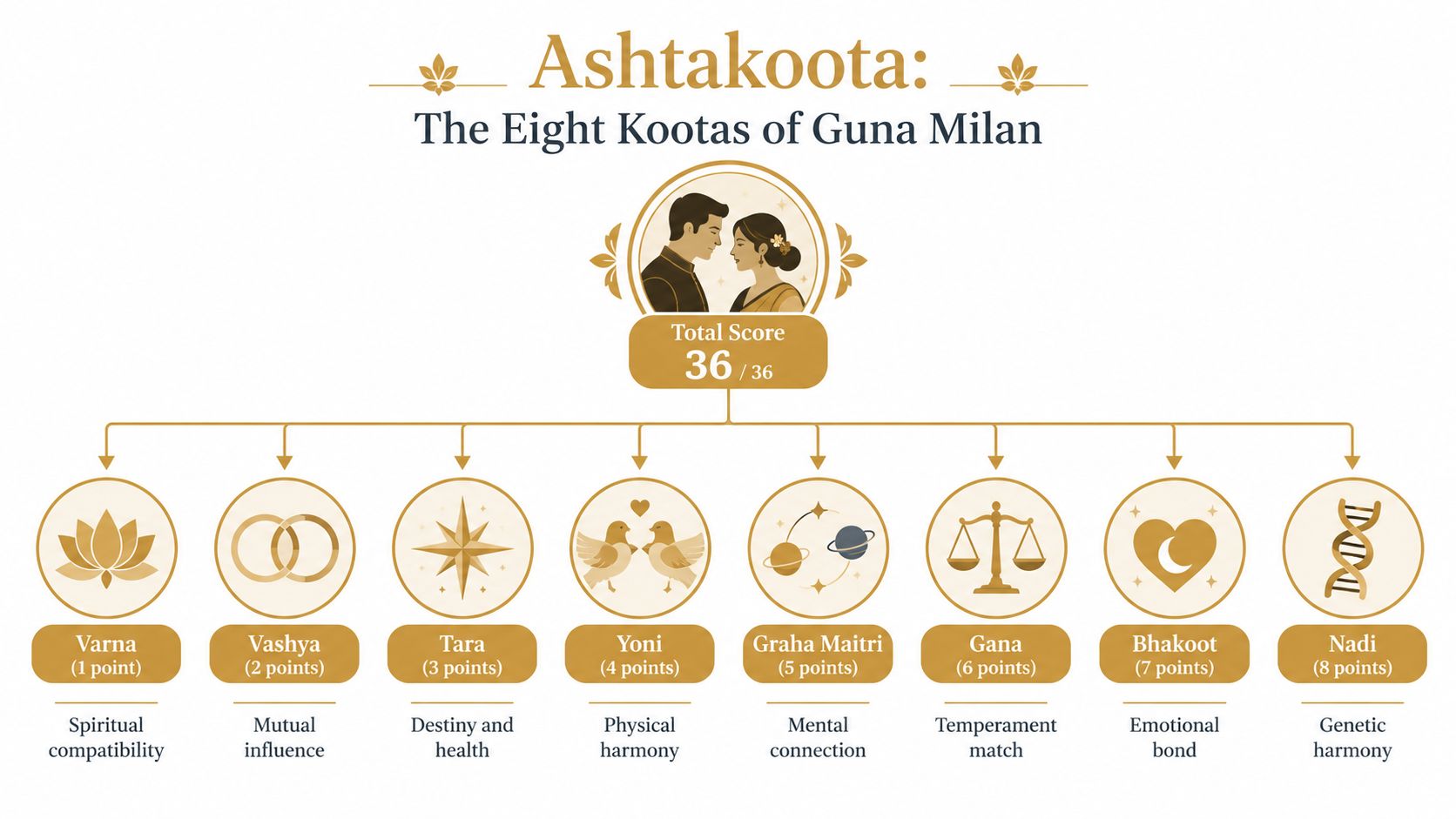
The names matter less than the questions behind them. Each koota looks at a different layer of partnership fit.
The lower-weight factors
- Varna, 1 point: This is traditionally linked with values, orientation, and a person's sense of purpose. It carries the smallest weight, so a low result here shouldn't dominate the whole reading.
- Vashya, 2 points: This concerns mutual influence and responsiveness. In plain language, it asks how naturally the partners affect one another and negotiate space.
- Tara, 3 points: Tara compares the birth stars and is traditionally associated with support, vitality, and the way each person's life pattern interacts with the other's.
- Yoni, 4 points: Yoni addresses physical and intimate compatibility. It shouldn't be reduced to a crude label about attraction. It points to how physical rhythms and instinctive responses may align.
These factors can describe meaningful differences, but they do not all carry the same decision weight. A mismatch in Vashya is not equivalent to a difficult pattern in Nadi just because both appear on the same report.
The higher-weight factors
- Graha Maitri, 5 points: This examines the relationship between the Moon-sign rulers. Practically, it relates to mental rapport, friendship, and how easily the partners understand one another.
- Gana, 6 points: Gana concerns temperament. It helps distinguish patterns such as calm, social, intense, reactive, or duty-focused ways of responding. The useful question is whether those differences can be handled without constant disrespect.
- Bhakoot, 7 points: Bhakoot is connected with emotional bonding, family direction, and the way the partnership may organise shared life. Its position in the scoring system makes it a major part of the assessment.
- Nadi, 8 points: Nadi carries the highest individual weight. Traditional interpretations connect it with constitution, biological compatibility, and progeny-related concerns. A Nadi issue requires examination of the full chart and applicable cancellation principles, not an automatic fear response.
The system is therefore not one broad “chemistry” score. It's a weighted combination of different questions. Two couples with the same total may have very different profiles because their points come from different kootas.
Key Aspects of the 36-Point Scoring System
The mathematics becomes clearer once you stop treating all points as equal. Bhakoot carries 7 points and Nadi carries 8, so the final two factors together carry 15 of 36 points, or about 41.7% of the total, according to this traditional weighting explanation. A couple may look comfortable in temperament and mental rapport, yet still need close analysis because the highest-weight factors are strained.
The usual bands are also more nuanced than a simple pass or fail.
| Score Range | Classical Interpretation |
|---|---|
| Less than 18 | Usually not recommended, or requires deeper scrutiny |
| 18 to 24 | Acceptable |
| 24 to 32 | Very good |
| 33 to 36 | Excellent |
In many modern explanations, 18 out of 36 is the customary minimum, exactly half of the maximum score. A near-perfect result means reaching at least 33 points, or 91.7% of the total, so it shouldn't be treated as the normal expectation. The bands and weighting are summarised in this guide to Vedic Guna Milan.
What broad samples can and cannot tell you
A 2026 observational study reported that, among 50,000 random pairs, 79.1% reached the classical minimum of 18 and the average score was 24, as reported by the marriage compatibility research site. The average therefore sits at 66.7% of the full scale and at the boundary of the acceptable and very good bands used in many score charts.
That result is a useful benchmark, not a marriage prediction. It suggests that the 18-point line is not especially restrictive in a broad random sample. It also shows why anxiety over failing to reach a very high number can be misplaced. The score distribution alone doesn't tell you whether a particular Nadi or Bhakoot pattern is relevant in a given pair of complete charts.
A total score tells you how many points were awarded. It doesn't tell you why those points were awarded, or what the missing points mean in lived partnership.
The calculation should lead to diagnosis. Review the individual kootas, verify the birth data, and then move to full-chart analysis before making a serious decision.
Real-World Examples of Score Interpretation
Consider two reports placed side by side. The first has a comfortable total, but the partners disagree about family boundaries, money habits, and how conflict should be handled. The second has a middling total, yet both people communicate clearly, share expectations about family life, and understand where their temperaments differ.
The number doesn't erase those facts. It gives a traditional framework for examining the chart-based side of the relationship, while the couple's actual conduct shows whether they can build a workable life together.
When a high score still needs scrutiny
A high total can conceal a concentrated weakness. If many points come from lower-weight factors, the number may look reassuring while Bhakoot or Nadi deserves careful review. The right response isn't panic. It's to ask whether there are cancellation factors, supportive placements, or individual chart strengths that change the traditional interpretation.
Dosha analysis belongs here. A practitioner may examine Mangal Dosha, the seventh house and its ruler, Venus, Saturn, the Navamsa, and the dasha sequence. These are not decorative additions to the report. They address parts of marriage that the Ashtakoota total does not measure directly.
When a middling score is not a verdict
A lower or moderate total should identify topics for conversation and deeper chart work. It might point to different emotional rhythms, physical expectations, family priorities, or styles of influence. Those differences may be manageable, but only if both people understand them and are willing to work with them.
Broader relationship research also matters. A recent study reported no significant difference in marital satisfaction between arranged and choice marriages, leaving a clear gap between social category and relationship quality, as discussed in this study on marital satisfaction. That finding doesn't validate or invalidate astrology. It supports a practical conclusion: the form of the match and the score alone don't explain how a marriage functions.

Before you pay a rupee for a detailed consultation, ask whether the report explains the individual factors, checks the complete charts, and separates observation from prediction. It should help you ask better questions, not pressure you into a decision.
Moving Beyond the Score to Full Chart Calibration
Ashtakoota matching compares the partners' Moon signs and birth stars. It doesn't read the full horoscope in the same way as a broader chart analysis, as explained in this description of Moon-based matching. That distinction changes how you should interpret the result.
The Moon-based score can describe emotional and instinctive compatibility. A full chart review asks how each person approaches partnership, responsibility, intimacy, family, work, and change. It also asks whether the relationship is being considered during a period that supports commitment, or during a period marked by instability and competing obligations.
The checks that should follow the total
A serious practitioner should examine:
- Individual chart strength: A person's ability to sustain partnership can't be inferred from the combined score alone.
- Marriage indicators: The seventh house, its ruler, Venus, and relevant divisional charts help show how each person handles commitment and connection.
- Dosha patterns: Mangal Dosha and other concerns need context. Traditional cancellation rules may alter the practical reading, and traditions don't always apply those rules identically.
- Dasha synchronisation: Vimshottari or other dasha sequences can show whether important relationship periods overlap constructively. Timing remains conditional, not guaranteed.
- Shared life direction: Family expectations, location, work, finances, and children are practical subjects the couple must discuss directly. Astrology can frame reflection, but it can't replace those conversations.
How calibration changes the reading
An isolated report gives you a computed outcome. Calibration tests whether the underlying chart calculation corresponds with events the person has already lived. That step matters because accurate birth details and correct computation are foundational. If the chart doesn't describe known life periods with reasonable clarity, forward-looking claims deserve restraint.
Anvaya presents this approach through Sambandha, its two-chart relationship analysis, while connecting each person's reading to a calibrated Samhita. Its method is described in Anvaya's chart calibration methodology. The sequence is declared compute, comparison, Pramāṇa calibration against lived events, and plain-language interpretation.
That doesn't turn astrology into certainty. It makes the limits visible. The useful output isn't “your score is good, therefore marry.” It's a structured account of where the charts align, where they require attention, and how much confidence the method can reasonably support.
Frequently Asked Questions About Vedic Matchmaking
Is 18 out of 36 enough for marriage?
18 out of 36 is the customary minimum threshold, but it isn't sufficient by itself. Review which kootas produced the score, then examine doshas, individual chart strength, marriage indicators, and timing. A score below the threshold also isn't an automatic prohibition. It means the match needs more scrutiny before anyone draws a conclusion.
Is a low Nadi score an automatic dealbreaker?
No. Nadi has the highest weight in Ashtakoota, so a difficult Nadi result deserves careful attention. It should then be checked against the full charts, traditional cancellation principles, and the broader condition of both partners' marriage indicators.
Avoid casual reassurance and avoid fear. Different lineages interpret Nadi concerns and cancellation conditions differently. Ask the practitioner to show the rule being applied and explain why it applies to these two charts.
What should you do if two astrologers give different answers?
Start with the inputs and method. Confirm the birth date, exact time, place, ayanamsha, calculation settings, and whether both practitioners used the same Moon and birth-star framework. Then ask each astrologer to separate computed facts from interpretation and future-facing judgment.
A report that offers only a conclusion is difficult to audit. You should be able to see which kootas are weak, which doshas are present or cancelled, and what evidence supports the timing statement.
Does Guna Milan apply to modern partnerships?
It can offer a traditional compatibility lens to any couple who chooses to use it, but its categories don't answer every modern relationship question. Couples still need direct conversations about equality, family involvement, location, work, privacy, finances, intimacy, and caregiving.
Use the score diagnostically. If it shows a difference in temperament or emotional rhythm, discuss that difference in concrete terms. Don't assume an old label can describe the whole relationship.
Should Mangal Dosha be checked separately?
Yes. Mangal Dosha is not the same as the Ashtakoota total. Its interpretation depends on the complete chart, the placement and strength of Mars, relevant houses, and possible cancellation or balancing factors. A calculator can flag a pattern, but a practitioner must explain its context.
You can use a Mangal Dosha calculator and explainer as an initial reference, then request a full chart review before treating the result as meaningful.
What should a useful matchmaking report contain?
It should state the birth data and calculation basis, show the eight koota results, explain the weighting, identify doshas, and compare the relevant partnership indicators in both charts. It should also distinguish what the chart shows from what remains uncertain.
For personal reflection and self-understanding, use the report to improve the questions you ask each other and the practitioner. It isn't professional medical, legal, financial, or mental-health advice, and it shouldn't be used as a substitute for those services.
Anvaya's Sambandha work compares two calibrated Samhitas instead of stopping at a single guna milan total, with chart-first computation, Pramāṇa checks, and plain-language interpretation of uncertainty. If you want to examine compatibility, doshas, and timing before making a major decision, visit Anvaya and generate your Samhita.