A 32-year-old marketing manager recently entered her birth date, time, and place into an astrology chatbot. The answer was warm, polished, and full of phrases about big shifts, renewed confidence, and a powerful Venus year.
She read it twice. Then she noticed what was missing: no reference to her actual chart, no dated window, and no way to check what the system had calculated. The language sounded personal, but the method remained hidden.
That gap defines the actual problem with an AI astrology reading. Fluent prose isn't the same as a reading grounded in a specific kundali, a specific dasha, and a specific moment. If the chart layer is wrong or invisible, the interpretation may be little more than a well-written horoscope.
Table of Contents
- The Reading That Said Nothing About You
- What an AI Astrology Reading Actually Is
- How AI Astrology Differs From a Classical Parashari Reading
- Trust Signals That Separate a Real AI Reading From a Horoscope App
- Honest Limits of an AI Astrology Reading
- Reading a Dasha Window With an AI Tool
- Privacy, Data, and What You Are Really Giving the Algorithm
- Frequently Asked Questions
The Reading That Said Nothing About You
The marketing manager wasn't asking for entertainment. She was considering a change in role and wanted to understand whether the timing supported a transition. Instead, the chatbot offered encouragement that could have applied to almost anyone facing uncertainty at work.
There was no mention of her lagna, the Ascendant calculated from her birth time and location. No graha placements appeared. The answer didn't identify a mahadasha or antardasha, and it gave no explanation of which houses were active. Even the phrase “Venus year” had no visible calculation behind it.
A serious reader should be able to ask simple questions:
- What did the system compute?
- Which dasha or transit supports this statement?
- What dates define the window?
- What would count as a wrong interpretation?
Without those answers, the reader can't distinguish a chart-specific conclusion from generic emotional language.
Practical rule: If an AI reading can't show the chart facts behind its interpretation, treat the prose as unverified.
This doesn't mean software has no place in Jyotish. It means the order matters. Math first, language second is a more honest model than text first, chart second. The system should calculate the birth chart, expose the relevant placements, and only then turn those findings into plain English.
That is the standard serious users should apply to any tool, including a Vedic astrology platform. The question isn't whether the answer sounds good. The question is whether the answer could have been produced only from your chart.
What an AI Astrology Reading Actually Is
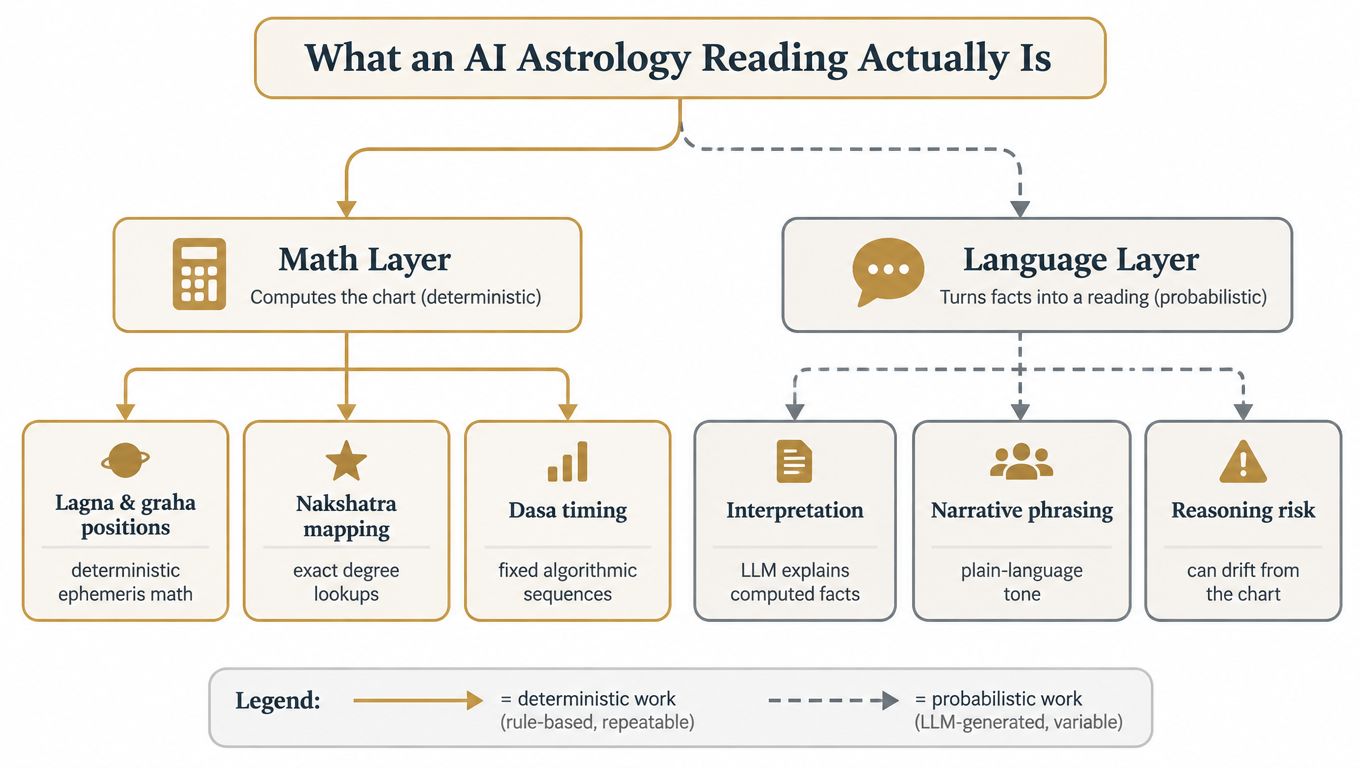
An AI astrology reading has two separate layers. Keeping them separate is the basic safeguard against attractive nonsense.
The math layer
The math layer calculates the chart. It uses birth date, exact time, and place to determine the lagna, graha positions, nakshatras, house cusps, dasha balance, and current transits. In a Vedic system, this normally means working with sidereal coordinates and a declared ayanamsha, rather than mixing calculation standards.
This layer should behave like a calculator. Given the same inputs and method, it should return the same chart. It shouldn't improvise a planetary position because a sentence sounds better that way.
The calculation engine also needs a real astronomical ephemeris and timezone-aware birth-data normalization. Without those foundations, the system can fabricate placements or produce vague interpretations that can't be audited, as explained in this technical discussion of AI astrology architecture.
The language layer
The language layer is the narrator. It receives computed facts such as “Saturn occupies this house” or “the current sub-period activates these lords” and renders them into readable prose. A language model can be useful here because classical chart analysis contains dense terminology and several interacting factors.
But eloquence belongs to the narrator, not the calculator. A beautifully phrased explanation doesn't prove that the underlying chart is correct.
Some tools, including Anvaya's Samhita, expose the chart alongside the narrative so readers can compare the computed placements with the interpretation. That separation helps you see whether the prose is actually attached to your kundali.
An AI reading isn't intuition, psychic channeling, or a zodiac-sign horoscope generator. It is a delivery system for computed astrological information. The useful question is therefore not “Does the AI understand me?” It is “Did the system compute the right chart, and did it interpret those facts without adding unsupported claims?”
How AI Astrology Differs From a Classical Parashari Reading
A classical Parashari reading and an AI-assisted reading may begin with the same sidereal birth chart. They differ in who performs the calculations, who weighs competing indications, and how the result reaches you.
| Dimension | AI Astrology Reading | Classical Parashari Reading |
|---|---|---|
| Calculation | Software computes placements, houses, dashas, and transits quickly | A jyotishi calculates or reviews the chart and applies a chosen method |
| Interpretation | Language system converts computed factors into structured prose | Jyotishi applies judgment, context, training, and questioning |
| Follow-up | Limited by the product's interaction design and available inputs | Human reader can ask clarifying questions and notice contradictions |
| Structure | Repeatable chapters, windows, and saved outputs | Often conversational, shaped by the consultation |
| Main strength | Speed, consistency, and broad mechanical coverage | Nuance, discernment, and lived human judgment |
| Main risk | Hallucinated yogas, incorrect lordships, or confident ambiguity | Missed factors, forgotten steps, inconsistency, or personal bias |
A practising jyotishi may bring additional tools to a Parashari analysis. Karakamsha considers the soul-significator framework used in Jaimini practice. Ashtakavarga can add a strength-based way to weigh transits. Prashna may provide a separate horary cross-check when the question and moment are suitable. These methods involve judgment, and traditions don't always apply them in the same way.
AI is good at mechanical repetition. It can review a large set of computed factors without tiring and present the same structure to different users. It may also surface a combination that a busy human reader would overlook.
A human reader, however, can see the querent, ask why a question matters, and notice when the stated problem doesn't fit the first interpretation. That context can't be reduced to a placement list. A person may also reconcile contradictory yogas through experience, while an AI system may smooth the contradiction into confident prose.
A human can forget a step or let mood affect emphasis. AI can invent specifics while sounding certain. Neither format deserves automatic trust.
For a plain-language explanation of how the birth chart fits into this process, see Anvaya's guide to the Vedic astrology birth chart. The sensible approach is to use software for transparency and repeatability, then preserve room for human judgment where interpretation remains genuinely ambiguous.
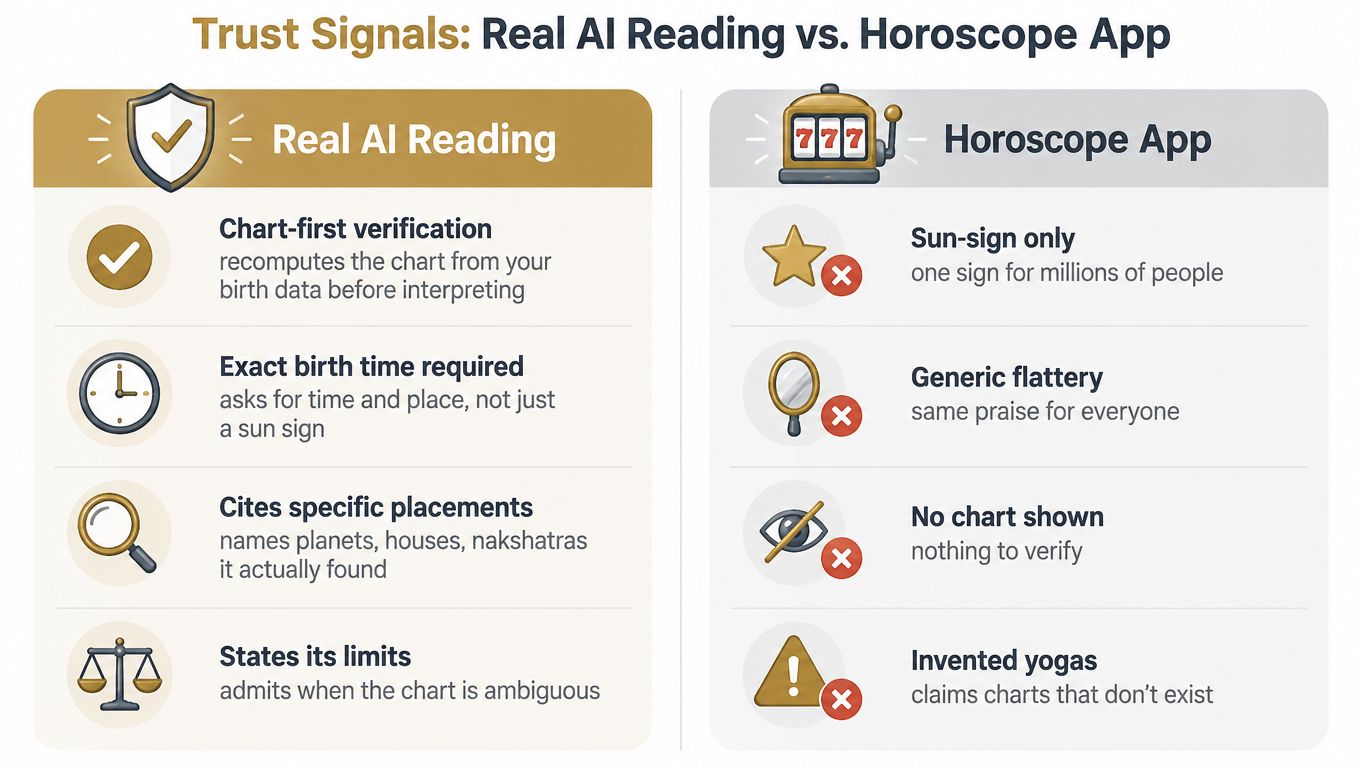
Trust Signals That Separate a Real AI Reading From a Horoscope App
The first trust signal is chart-first verification. A serious system recomputes the chart from your birth data before interpreting it. It should show enough of the result for you to inspect degrees, nakshatra, pada, house placement, and dasha balance.
A generic horoscope app usually starts with a sign or a prewritten theme. A chart-first system starts with an input record and a calculation method.
Four pressure-tests for any tool
1. Look for visible calculations.
The reading should name the placements it uses. “You may feel more ambitious” is weak. “The current period activates the tenth house and its lord” is testable, provided the chart shows those facts.
2. Ask how uncertainty is displayed.
Confidence indicators are more useful than unconditional prose. A statement may carry a score such as 0.72, but a number alone doesn't make it scientific. The product should explain what the score represents and why an interpretation received it.
3. Demand dated outputs.
A forward claim should attach itself to a defined window rather than float indefinitely. Dated outputs let you return later and compare what was said with what happened. They also prevent a system from changing its claim after the event.
4. Edit the inputs.
Birth time and location shouldn't be locked behind a mystery interface. If you correct the time or place, the lagna, houses, dasha balance, and transit triggers may change. A trustworthy tool should let you see that change instead of preserving a fixed story.
The next test is calibration. Before making a forward claim, the system should ask chart-derived questions about past periods. Those questions should come from the chart, not from information the user has already volunteered. Anvaya describes this approach in its calibration methodology.
A reading that says “you've always been a natural leader” is easy to accept and hard to test. A reading that identifies a specific earlier dasha window and asks whether a particular kind of change occurred gives you something concrete to examine.
The wider market already has strong distribution. A 2024 nationally representative survey found that 28% of U.S. adults consulted astrology or horoscopes annually, according to U.S. online astrology market research. That level of adoption makes verification more important, not less. More people are receiving automated interpretations, but broad use doesn't establish accuracy.
Honest Limits of an AI Astrology Reading
An AI system can calculate correctly and still explain the chart badly. Language models generate likely language, so a loose prompt can lead them to invent a yoga, assign a lordship that isn't present, or describe a dasha period with no basis in the ephemeris.
That failure is especially dangerous because the sentence may sound calm and specific. Readers often notice a wrong calculation only after they have accepted the conclusion.
Where the method remains uncertain
Some ambiguity belongs to the astrology itself. When dasha periods overlap and a sub-period activates several houses, the result may support more than one expression. A responsible interpretation should describe the competing possibilities and the conditions that would distinguish them.
It shouldn't manufacture a single event merely because readers prefer a clean answer.
A chart can support a window without dictating one outcome.
Even a strong yoga doesn't guarantee an outcome. A wealth combination may describe capacity, opportunity, or recurring themes, but effort, environment, choices, and circumstance still matter. Vedic astrology can be used for personal reflection and self-understanding, not as professional medical, legal, financial, employment, or safety advice.
Input quality also matters. An incorrect birth time can alter the lagna, house structure, dasha starting balance, and transit triggers. The model can't repair information that was never accurate.
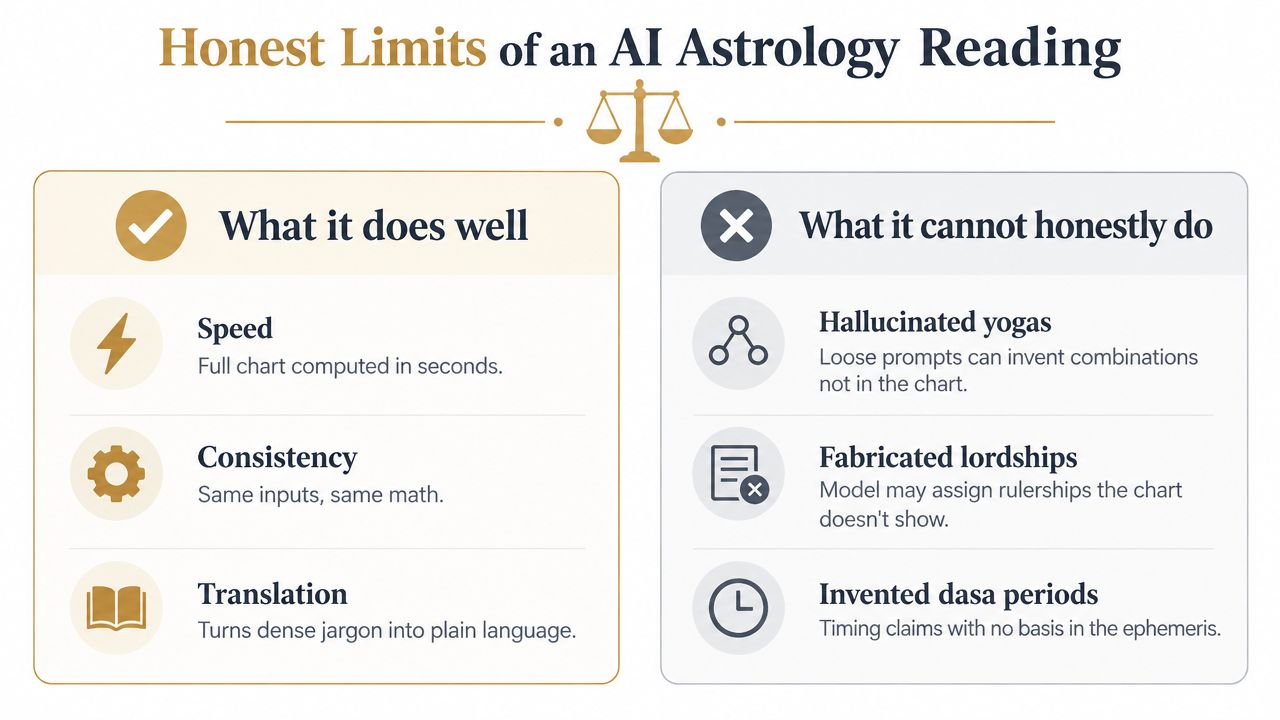
A useful system should state what it knows, what it inferred, and what remains unresolved. It should preserve the original output rather than rewriting history when later feedback arrives. Without that record, users can't tell whether the tool improved its calibration or just changed its story.
Reading a Dasha Window With an AI Tool
Suppose you're examining a career transition or a marriage-timing question. The first useful output isn't “yes” or “no.” It is a structured account of the active mahadasha, antardasha, relevant houses and lords, transits, and the period during which those factors overlap.
Vimshottari Dasha is a 120-year planetary period framework used in classical Jyotish. Its sequence is Ketu, Venus, Sun, Moon, Mars, Rahu, Jupiter, Saturn, and Mercury, with periods of 7, 20, 6, 10, 7, 18, 16, 19, and 17 years respectively, as summarized in this reference on Vimshottari Dasha). Classical summaries associate its use for ordinary births with Maharishi Parashara's Brihat Parashara Hora Shastra, with the core discussion commonly located in chapters 46 to 49 or 46 to 48, depending on the edition and reference tradition, as noted in this Parashari dasha source summary.
A dasha reading should assemble the math. It shouldn't invent a marriage, promotion, move, or other event. The output can describe what the period tends to activate and identify a conditional window. Your choices remain part of the interpretation.
| AI Output Field | Reader Verification Step |
|---|---|
| Active mahadasha and antardasha | Check the start and end dates against an independent dasha calculation |
| Activated houses and lords | Confirm that the named placements and lordships exist in the chart |
| Relevant transits | Check which natal points the transiting planets actually cross |
| Timing window | Record the dates and revisit them later rather than treating them as a single promised day |
| Past calibration question | Compare the same logic with a known earlier life period |
| Confidence and ambiguity | Ask which assumptions lowered confidence and whether the birth time is reliable |
Independent Jyotish material describes Vimshottari as a dominant predictive framework in classical and modern practice and as a nakshatra-based system intended for ordinary births, as discussed in this Jyotish reference on the 120-year framework.
The pressure-test is simple. Verify the dates, confirm the houses, inspect the transits, and ask whether the method would have identified a past event before you supplied the story. If it only becomes “accurate” after you explain what happened, the calibration is weak.
Privacy, Data, and What You Are Really Giving the Algorithm
Privacy isn't a footer question. It is part of the product.
An AI astrology reading usually involves two different kinds of information. Birth data includes your date, time, and place, which the system needs to calculate a chart. Personal context includes questions about relationships, work, family history, or health concerns. The first is required for the mathematics. The second may improve relevance, but it also reveals more about you.
A serious tool should tell you what it stores, how long it keeps it, whether your account email is linked to the reading, and whether conversation transcripts are used to train future models. Look for retention defaults, deletion controls, export options, and a clear explanation of what happens when you remove a conversation.
Ask these questions before sharing context
- What is required? A chart calculator needs birth details. It shouldn't demand your entire life story before showing the calculation.
- What is optional? Context should be clearly separated from chart facts, so you know whether the interpretation changed because of the kundali or because you disclosed a concern.
- What remains after deletion? Removing a chat should have a defined effect. Check whether the chart record, derived outputs, and account metadata are treated separately.
- Who can access it? Privacy controls should explain whether staff, service providers, or shared users can view the record.
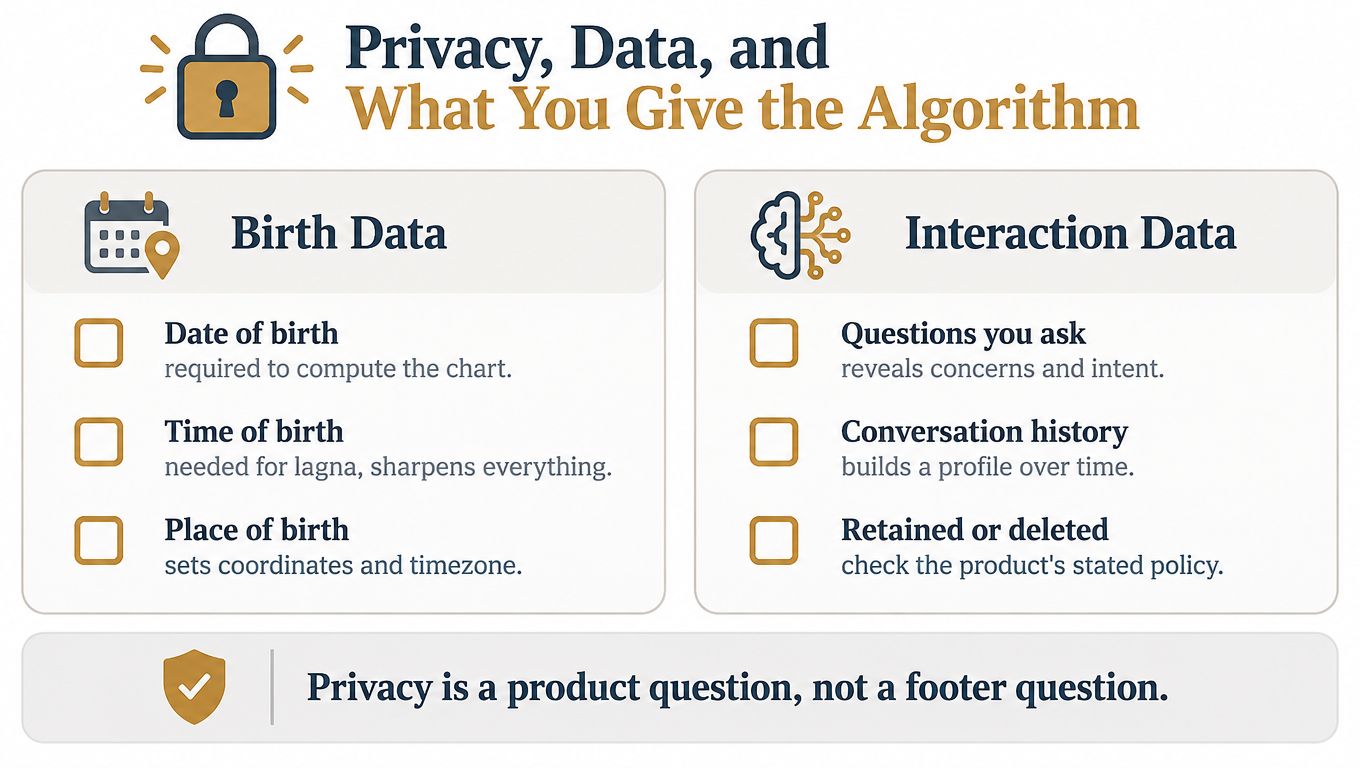
The clean mental model is this: the chart is the product, while your context is optional input. You should be able to run a reading, inspect the math, understand what was retained, and delete the conversation without losing control of your information. Anvaya publishes its position on these issues in its privacy information.
Don't share sensitive personal details merely to make a vague reading feel intimate. A chart-first system should earn your context by demonstrating that it can first say something grounded in the chart.
Frequently Asked Questions
Is an AI astrology reading accurate, and how can I check?
Accuracy has two parts. First, verify the calculation: birth data, sidereal settings, planetary degrees, house placements, nakshatras, and dasha dates. Then test the interpretation against dated past events.
A useful system should identify prior windows that you can confirm or reject before it makes forward claims. If the reading depends on information you gave it first, it may be reflecting your story rather than reading the chart.
Can an AI reading replace a human Vedic astrologer?
It can serve as a fast first pass for chart mechanics, structured timing, and plain-language explanation. It can't replace human judgment in every setting, especially where samskara, lived context, ethical responsibility, or a prashna-style question matters.
A human jyotishi can ask why the question matters and notice contradictions in the conversation. AI can support that work, but it shouldn't claim authority it hasn't earned.
Do I need my exact birth time?
You need the most reliable birth time available. Even a small error can affect the Ascendant and house structure. The commonly discussed four-minute Ascendant rule explains why a modest time difference can matter, especially near a sign boundary, but a correct time doesn't eliminate interpretive uncertainty.
Parashari timing can still produce overlapping or broad windows. Exact input improves the calculation. It doesn't turn conditional astrology into a guaranteed schedule.
Is my chart used to train AI models?
You need to ask the specific product. Separate the birth record from the conversation: one is required for chart computation, while the other may contain identifying context. Check the stated retention policy, whether transcripts are used for model training, how account deletion works, and whether prior readings remain stored.
A trustworthy product should answer these questions plainly rather than hiding them in general terms.
How should I judge a dasha prediction?
Check the exact dasha and sub-period dates, the activated houses, the relevant natal placements, and the transits used to define the window. Save the output and revisit it later. A prediction is easier to evaluate when it has a recorded basis and a defined time range.
Use it for reflection and self-understanding, not as professional advice or as a reason to surrender your own judgment.
Anvaya uses declared classical Vedic computation, chart-first Pramāṇa calibration, and a persistent Samhita that preserves dated interpretations for later review. If you want to inspect an AI astrology reading against your actual birth chart rather than receive a generic horoscope, visit Anvaya.