You have a birth certificate, a city, and a clock time that someone may have rounded. You enter them into a Jyotish chart calculator and get pages of confident prose. But where's the time-zone correction? Which sidereal setting did it use? Why does another calculator give you a different opening planetary period?
A longer reading isn't a more rigorous reading. Before trusting the language, check the calculation receipt, the rules behind it, and whether the chart supports specific observations about events you've already lived.
Table of Contents
- What a Jyotish Chart Calculator Should Return
- How Birth Data Becomes a Sidereal Chart
- Shodashvarga Dashas and Gochara Together
- What Holds When the Birth Time Is Rough
- How to Judge Two Charts From One Birth
- Test the Chart Against Your Own Life
What a Jyotish Chart Calculator Should Return
Start with the input receipt, not the interpretation. A calculator should preserve your local birth time exactly as entered, then show how it converted that time for astronomical calculation.
That receipt should include the historical UTC offset, any daylight-saving rule, latitude, longitude, and the source used to identify the birthplace. A familiar city name isn't enough. Places can share names, and today's time-zone rules may not describe the date of your birth.
Check the time before the planets
Civil clock time and Earth-rotation time aren't interchangeable. The IERS explanation of time services distinguishes UTC from UT1, the time measure tied to Earth's rotation.
For you, the practical issue is simpler. An incorrect offset can shift the calculated sidereal time by hours, while a small birth-time error can change a placement near a boundary. Sidereal time describes Earth's orientation relative to the stars and helps determine the lagna, the sign rising at your birthplace.
In classical Parashari work, houses are usually whole signs counted from that rising sign. Traditions disagree about house division, so a calculator must name its convention rather than treating it as universal.
Expect degrees, not just labels
The output should give sidereal longitudes for the Sun, Moon, Mars, Mercury, Jupiter, Venus, Saturn, Rahu, and Ketu. Each entry needs a sign, degree, and nakshatra, the named stellar division containing that position.
Those degrees support the later layers: divisional charts, planetary periods, and transits. A beautifully drawn chart without them is difficult to audit.
At Anvaya, we compute your birth chart from your date, time, and place of birth without asking you questions first. Interpretation comes after calculation and testing. This is for personal reflection and self-understanding, not professional advice.
What each chart layer depends on
| Layer | Main inputs | If time is off by minutes | What to read first |
|---|---|---|---|
| Planetary signs and degrees | Date, time, place, ayanamsha | Usually stays in the same sign | Sidereal degree and sign |
| Nakshatra of the Moon | Moon's sidereal degree | Stable unless the Moon is near a nakshatra edge | Nakshatra name and pada, its subdivision |
| Lagna and whole-sign houses | Time to the minute, latitude and longitude | Can change when the rising sign crosses a boundary | Rising sign and house count |
| Navamsa (D9) | Exact degree inside the sign | Its ascendant can change within a short interval | D9 lagna and planet signs |
| Other Shodashvarga charts | Exact degree and the varga rule | Finer divisions are more sensitive to small changes | Which of the sixteen are shown |
| Vimshottari starting balance | Moon's nakshatra and remainder | Balance shifts; the opening lord can change at a boundary | Opening lord and years left |
| Gochara | Current positions against the natal chart | Natal signs hold better than house-based comparisons | Transit sign and from-to dates |
Use this as a first-pass map of what deserves confidence, not as permission to treat every output as equally secure.
How Birth Data Becomes a Sidereal Chart
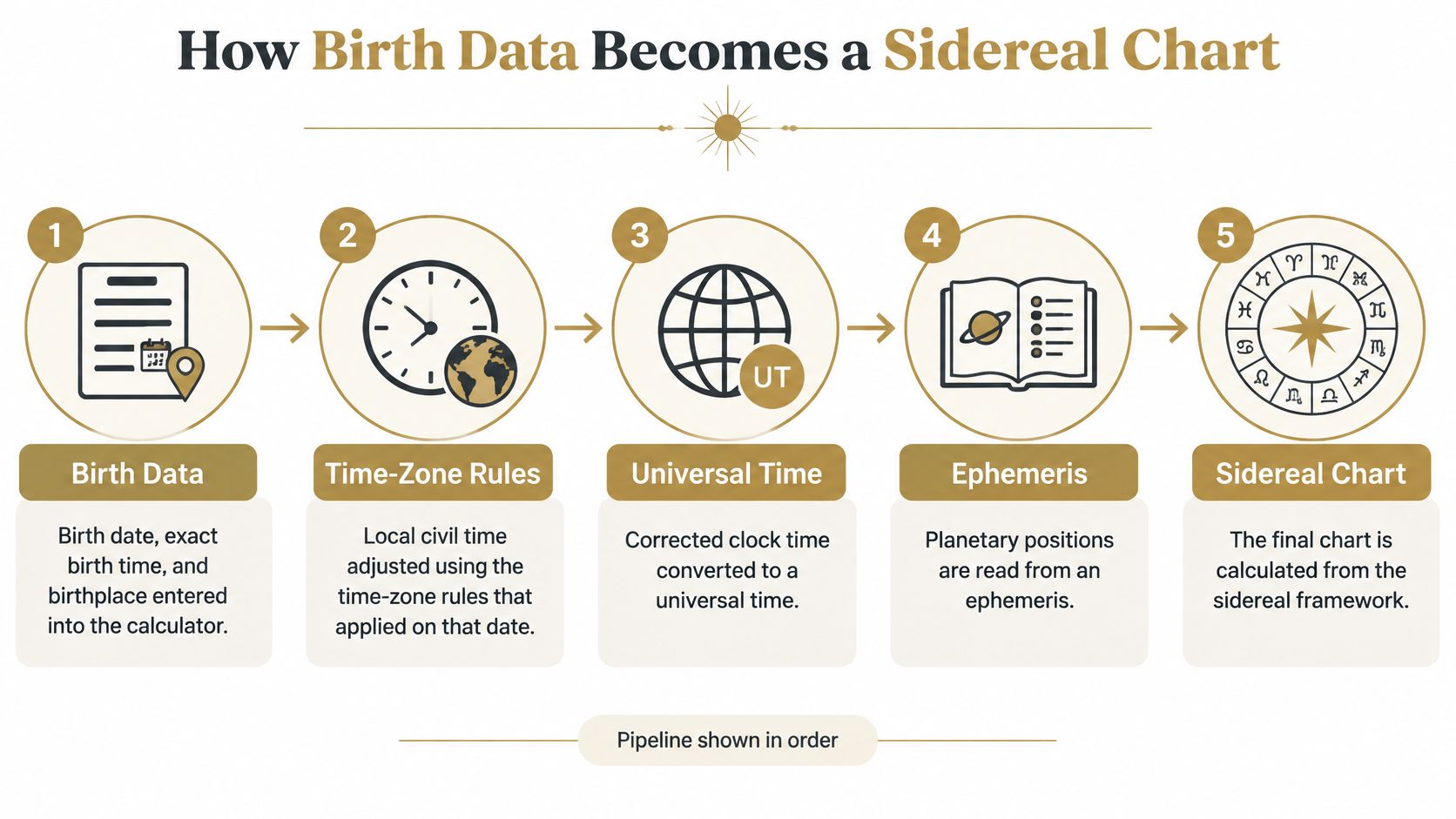
A calculator doesn't obtain a birth chart directly from a city and a clock reading. It performs a sequence of conversions, and each stage needs a declared rule.
The sequence should remain visible enough that another calculation can reproduce it.
From a local clock to planetary positions
The calculator first applies the time-zone rules that were in force at the birthplace on the birth date. It then converts the corrected civil time to a universal reference and uses the astronomical time scales required by its calculation library.
An ephemeris is a numerical model or table of celestial positions. NASA's DE440 and DE441 documentation gives DE440 a coverage interval of 1550 to 2650 and reports agreement between the models within about one metre over that interval.
For modern births, a model suited to the current era is a sensible choice. The longest available date range isn't automatically the best selection.
Accurate astronomy still doesn't establish accurate interpretation. It establishes where the calculated bodies were within the model's stated conventions.
Apply the sidereal reference explicitly
The next step converts tropical ecliptic longitudes to sidereal longitudes. The calculator subtracts the ayanamsha, the angular difference between the tropical reference point and the chosen sidereal reference, then normalises the result around the zodiac.
Astrodienst's technical explanation of ayanamsha describes this subtraction directly. It isn't a display preference.
The declared default here is the sidereal zodiac with Lahiri ayanamsha. Other ayanamshas exist, and traditions disagree about the reference. A tool should name its choice rather than imply that all sidereal charts use identical coordinates.
Once the sidereal positions are established, the calculator derives rashi, meaning zodiac sign; nakshatra; divisional placements; planetary periods; and transit comparisons. The birth-date and nakshatra explainer gives more context for the lunar layer.
Practical rule: A saved chart should preserve the settings that produced it, not merely the picture that appeared on screen.
The record should retain the ephemeris version, ayanamsha implementation, coordinate frame, reference epoch, and calculation timestamp. Otherwise, an updated library can produce a different boundary classification without making the reason clear.
A changed result deserves an explanation. It doesn't automatically mean your birth details are wrong.
Shodashvarga Dashas and Gochara Together
A divisional chart isn't another personality description. It mathematically reassigns a planet according to its exact position within the natal sign, using the rule for that division.
Shodashvarga means the classical set of sixteen charts. A claim of full coverage should identify the charts, preserve the underlying degrees, and state the rules used.
Know what full divisional coverage means
The classical set is:
- Foundation and early divisions: D1 Rashi, D2 Hora, D3 Drekkana, and D4 Chaturthamsa.
- Further divisions: D7 Saptamsa, D9 Navamsa, D10 Dasamsa, and D12 Dwadasamsa.
- Finer divisions: D16 Shodasamsa, D20 Vimsamsa, D24 Chaturvimsamsa, and D27 Bhamsa.
- Fine subdivisions: D30 Trimsamsa, D40 Khavedamsa, D45 Akshavedamsa, and D60 Shashtiamsa.
The D labels identify the divisions, not a ranking of importance. More charts don't justify more certainty.
A published discussion of classical divisional charts describes their use in assessing planetary strength and refining distinct areas of interpretation. They should support a coherent reading, not become separate sources of contradictory claims.
The D10 chart calculator guide explains one such specialised layer. Its interpretation still needs a stable calculation and the wider natal context.
Read the period balance, not just its name
Vimshottari is a planetary timing system with a complete 120-year cycle, as recorded in the Vimshottari dasha reference; its fixed sequence and durations are listed below.
Vimshottari lords and period lengths
| Order | Lord | Length in years | Share of the 120-year cycle |
|---|---|---|---|
| 1 | Ketu | 7 | 7 of 120 |
| 2 | Venus | 20 | 20 of 120 |
| 3 | Sun | 6 | 6 of 120 |
| 4 | Moon | 10 | 10 of 120 |
| 5 | Mars | 7 | 7 of 120 |
| 6 | Rahu | 18 | 18 of 120 |
| 7 | Jupiter | 16 | 16 of 120 |
| 8 | Saturn | 19 | 19 of 120 |
| 9 | Mercury | 17 | 17 of 120 |
The opening balance comes from the unused portion of the Moon's birth nakshatra. A calculator shouldn't print only a planet's name. It should show the major period, the sub-period, and the balance remaining in years and months, with its calendar convention declared.
Gochara means transits, the current sidereal positions considered against the natal chart. Practitioners often assess them from the Moon sign as well as the lagna.
A transit is a window for interpretation, not a verdict. It may become more relevant when the running planetary period supports the same theme, if the chart supports it at all.
For the daily lunar calendar rather than a personal transit reading, the Panchang provides a different kind of information.
What Holds When the Birth Time Is Rough
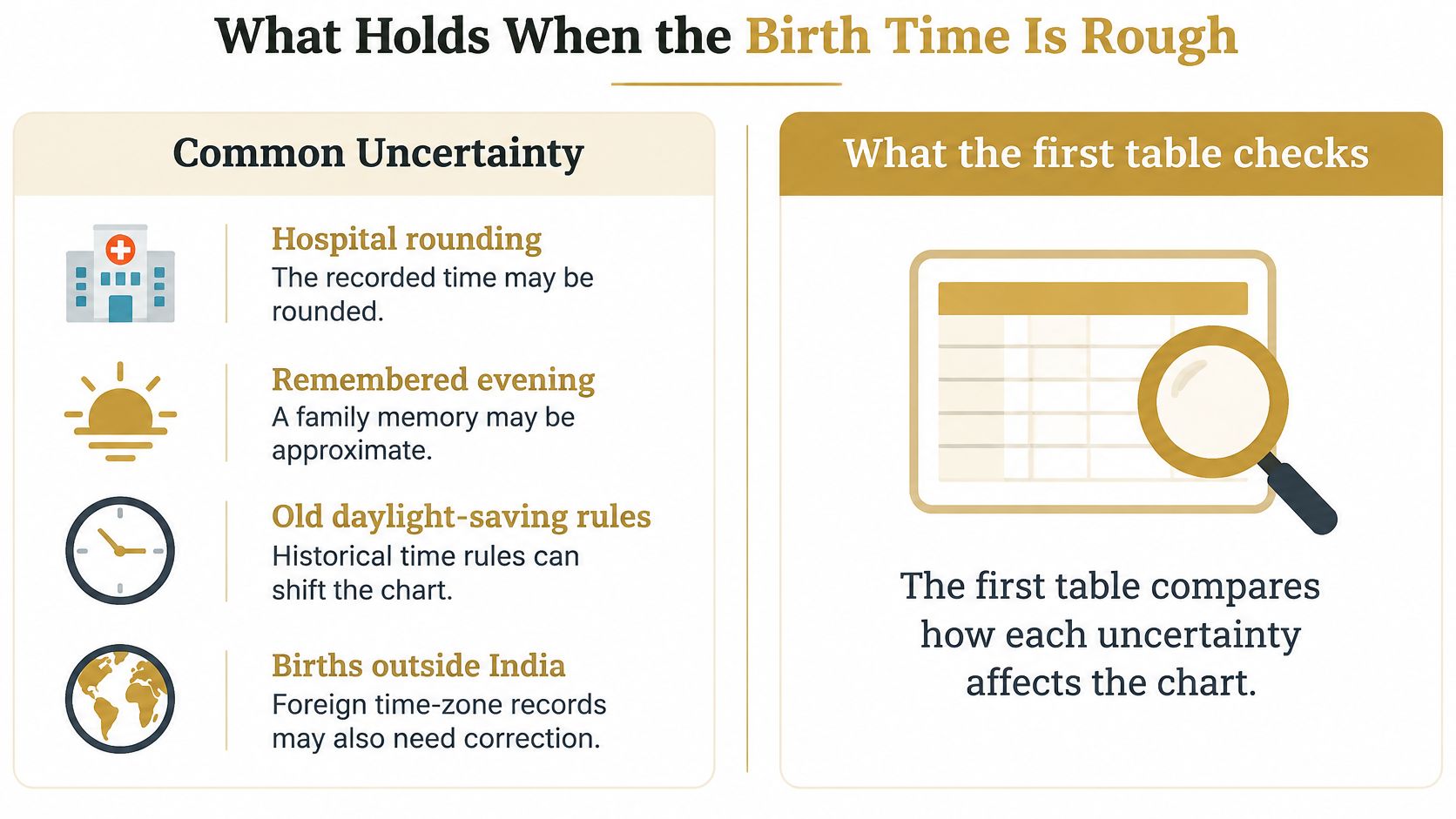
A hospital record may be rounded. A parent may remember an evening rather than a clock time. Historical daylight-saving rules can complicate a seemingly precise record, including births outside India.
Don't force all these situations into the same confidence label. A documented time with slight rounding and an unknown time require different limits.
Test a range rather than guessing a minute
Use a bracket around the recorded time. For example, if your family believes the record was rounded, compare a hypothetical run 15 minutes earlier and 15 minutes later; if the uncertainty covers an hour, test that whole interval instead.
- Preserve the original record. Keep the printed local timestamp, historical offset, coordinates, and geocoding source. Don't replace the original time with a preferred estimate.
- Calculate the plausible interval. Choose its width from the actual uncertainty, not from a desire to obtain a particular rising sign.
- Mark what stays unchanged. Retain stable planetary signs and check whether the Moon remains in the same nakshatra throughout.
- Withhold unstable fine divisions. If a divisional ascendant changes within the bracket, don't build a confident interpretation on it.
- Consider rectification only where it matters. Rectification means testing a proposed birth time against dated lived events. Personality adjectives aren't enough.
Guidance on birth-chart time sensitivity gives approximate changes of two hours for the ascendant, 13 minutes for the Navamsa ascendant, and 12 minutes for the Dasamsa ascendant. These are orientation estimates, not universal clockwork thresholds; actual boundary timing must be calculated.
Separate usable information from uncertain information
A stable natal sign chart can coexist with unstable divisional ascendants. That isn't a contradiction. Different calculations respond differently to the same uncertainty.
If the Moon stays securely within its nakshatra, the opening Vimshottari lord may remain usable while the precise balance shifts. If the bracket crosses a nakshatra boundary, the opening period itself needs caution.
Uncertainty should narrow the reading. It shouldn't invite the reader to choose whichever chart feels more flattering.
The calibration explainer describes how testing against lived events differs from collecting a life story and writing it back as interpretation.
An unknown birth time may still support sign-level discussion where the positions remain stable across the possible interval. It doesn't support exact house timing. Leaving that layer unread is more honest than assigning an arbitrary time and hiding the assumption.
How to Judge Two Charts From One Birth
Say you're comparing outputs for a fictional birth: 15 March 1992, at 10:20 in the morning, in Bengaluru. These are illustrative inputs, not a calculated chart.
Tool A declares Lahiri, prints IST as UTC plus 5:30, and displays the Moon at a hypothetical 10 degrees of its sign. It also gives an opening Vimshottari lord and a balance in years and months. Tool B prints a wheel, omits the ayanamsha, and gives a different opening lord.
Tool A is easier to audit. That doesn't yet prove its arithmetic or interpretation correct.
Compare the receipt before the prose
Start with the sidereal Moon position and nakshatra. A disagreement there can explain a different opening period, especially near a boundary. Don't compare descriptions of temperament while the coordinates remain unresolved.
Next, inspect the civil-time conversion. Applying a present-day offset to an older record, or omitting daylight saving for a diaspora birth, can change the rising sign while leaving most planetary signs unchanged.
Then check transcription and rounding. In this hypothetical case, entering 10:00 instead of 10:20 could leave the natal planetary signs intact while changing a divisional ascendant. Whether it does so must be calculated, not assumed.
Write down:
- Reference setting: The named ayanamsha and its implementation.
- Lunar position: The sidereal Moon degree and nakshatra.
- Timing result: The opening dasha lord and remaining balance.
Matching entries resolve an important part of the disagreement. They don't establish that every other setting matches, or that the interpretations are equally sound.
Use a screen-level checklist
The calculator workflow documentation illustrates why computational choices deserve attention alongside visible chart outputs. A useful comparison examines what each tool discloses, not how much text it generates.
Accuracy checklist for a Jyotish chart calculator
| Check | A pass looks like | A fail looks like |
|---|---|---|
| Time normalisation | Local time, offset, and place source are printed | Only a city name, no offset |
| Ayanamsha | Lahiri or another system is named | Sidereal chart with no zodiac note |
| Houses | Whole sign or another rule is named | Houses with no convention |
| Vimshottari | Lord, sub-period, and balance in years and months | A single period label |
| Shodashvarga | Sixteen vargas, with degrees retained | One decorative Navamsa and a claim of full vargas |
| Reproducibility | Ephemeris and timestamp stored | A new chart each visit with no record |
| Uncertainty | Boundary cases marked in plain language | Every line stated as exact |
| Forward claims | Past windows checked first | Future statements with no past test |
Don't average conflicting charts. Identify the differing assumption, rerun the calculation consistently, and preserve both receipts if the disagreement remains unresolved.
Key principle: Before anyone describes what may come next, check the chart against events you already lived. At Anvaya, that calibration is Pramāṇa. A past match is a test of the reading, not proof that a future claim will come true.
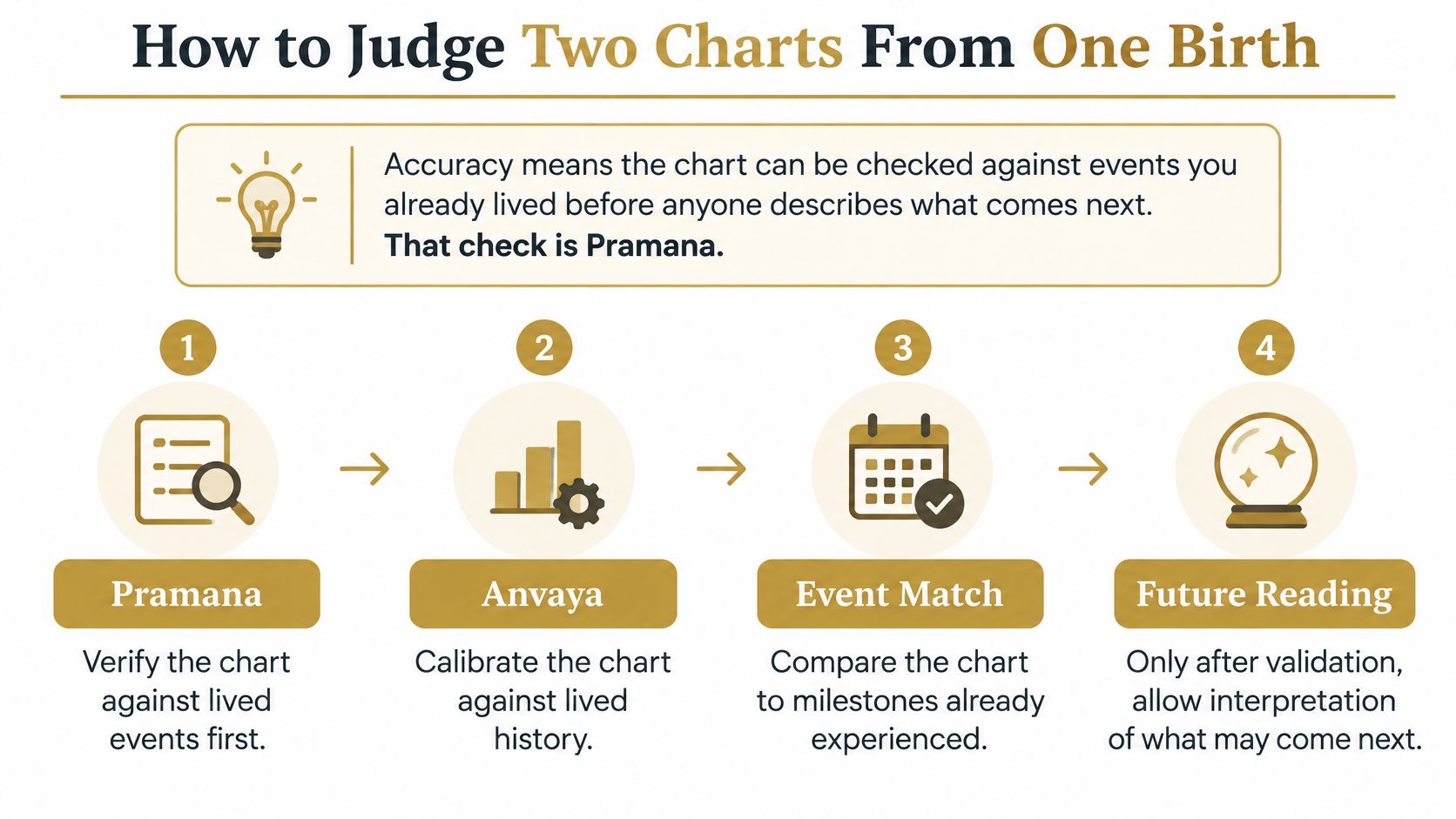
We calibrate against lived history before making forward claims. Only what the chart gets right enters the Samhita, the structured, living reading.
The useful test is specific enough to miss. A dated window and a recognisable event category can be checked; a flattering sentence about resilience usually can't. Record mismatches as mismatches rather than stretching them into agreement.
Test the Chart Against Your Own Life
If an uncertain birth time makes houses or fine divisions unstable, keep the interpretation to layers that remain consistent. You do not need to interpret every chart factor.
When calculation receipts agree, check the reading against dated events. A past match can support the chart's fit, but it does not make later windows certain. Keep forward claims conditional.
What happens before a reading opens
Anvaya's reading follows four steps:
- You provide birth details.
- The math produces your chart.
- Past-event questions test the chart against your life through Pramāṇa.
- Your Samhita opens.
Before payment, Anvaya gives you a few free cold-read questions based on your chart. Your answers help test whether the chart fits your lived history. If the chart cannot support something real, Anvaya tells you before you pay.
Frequently Asked Questions
Are Rahu and Ketu physical planets?
No. Rahu and Ketu are calculated lunar nodes, where the Moon's orbital path intersects the ecliptic, the Sun's apparent path. Jyotish charts retain their traditional names.
What should a saved chart calculation contain?
A saved run should record the original birth details, normalised time, ephemeris version, named ayanamsha, coordinate frame, and calculation timestamp. It should also specify house and divisional-chart rules. Without those details, later comparisons may not be consistent.
Which house system should a Parashari calculator use?
Parashari work often counts whole signs from the lagna. Traditions differ, so a calculator should state its rule and distinguish sign-based houses from separately calculated house boundaries.
When is silence the right astrological output?
Silence is appropriate when an unresolved boundary makes a claim unreliable, or when a statement would promise illness, death, divorce, money, or a fixed result. Naming a limit is more useful than presenting uncertainty as certainty.
Does chart arithmetic replace a practising jyotishi?
No. Arithmetic shows how positions and derived factors were calculated. Judgement still matters: interpretations should be tested, disagreements acknowledged, and limits stated when the chart gives no clear answer.
Anvaya combines chart computation, Pramāṇa calibration against lived events, and a plain-language Samhita. Use See my chart to begin with the calculation. A longer reading is not automatically a more rigorous one: check the ayanamsha, time-zone history, varga rules, and dasha balance, then test the chart against lived events before accepting forward claims.