Open almost any astrology app and it starts performing immediately. Sweeping statements. Confident labels. A personality summary that arrives before you’ve typed a single true thing about your life. It feels generous. It’s actually backwards.
You can’t trust an answer from a system that has never let you check its work.
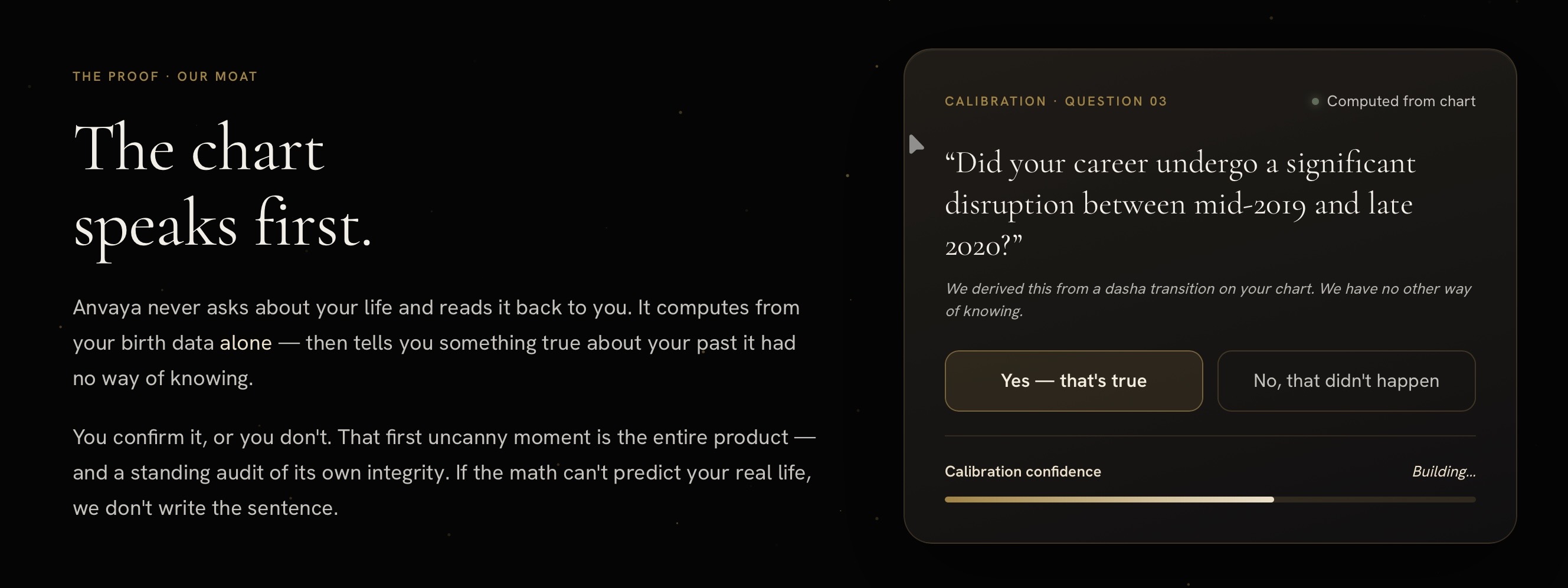
So Anvaya begins differently. Before your Atlas offers a single insight about your future, it runs calibration — a short sequence of specific, dated reads about your past, each one phrased so you can confirm it or shoot it down.
What a calibration question looks like
Not this:
“You are a creative soul who sometimes doubts yourself.”
That’s flattery. It’s true of everyone, which means it tells you nothing.
Instead, something like this:
“Between 2012 and 2015, your creative work and your thinking about family kept moving in starts and stops — projects begun and re-begun, plans left half-finished. Does that match how that stretch felt?”
You rate how closely it fits, from not at all to exactly. You can add context. You can flag it as unclear. And critically — you can tell it it’s wrong.
Why being able to say “no” is the point
A claim that can’t be wrong can’t be trusted. The moment Anvaya makes a specific, dated statement, it’s taking a risk in front of you. When it’s right, that’s worth something real, because it could have been wrong. When it misses, that’s worth something too: the model adjusts. We tune the math to your reality, not the other way around.
Watch what happens to your own skepticism across ten or fifteen of these. The first confirmed read is a coincidence. The third makes you sit up. By the tenth, you’re no longer wondering whether the system works — you’re wondering what it’s going to show you that you couldn’t see yourself. That shift isn’t marketing. It’s evidence accumulating in real time.
Calibration Confidence — the number that earns itself
As you confirm reads, your Atlas builds a Calibration Confidence score. It’s not a vanity metric; it’s the model’s honest assessment of how well it understands you yet. A higher score means future reads are anchored to more confirmed truth. You’ll see it climb as you go — and you’ll have earned every point of it, because each one came from something you verified about your own life.
We’d rather show you a model being right than tell you to believe one.
What we do with what you tell us
The reads you confirm become the foundation your Atlas reasons from. The ones you reject get downweighted or discarded. The context you add — “actually, that was the year my father was ill” — gets weighted, because your words carry signal a number can’t. Over time, this is what makes your Atlas feel less like a generic chart and more like something that actually knows you.
And it stays honest about its limits. Anvaya is private by architecture — your calibration trains only your model. It’s never sold, never used elsewhere.
How long it takes
Less time than you’d guess, and you don’t have to finish in one sitting. You can answer a few, leave, and pick up where you left off — your confidence score waits for you. Most people find they don’t want to stop, because watching a model get you right is, unexpectedly, a little addictive.
The quiet promise underneath
Everything Anvaya ever tells you rests on this first act of listening. We ask before we answer because the alternative — answering before we’ve earned the right to — is exactly what gave this whole field its bad name.
Calibration is us refusing to do that. It’s the difference between a fortune and a finding.