

Western tropical Capricorn runs from about December 21 or 22 to January 19 or 20, and Vedic Makara in the Lahiri system runs from January 14 to February 12. Those two answers are both correct, because they come from two different zodiacs with two different starting points.
That distinction matters if your birthday sits near a boundary, or if a Western chart calls you Capricorn while a Vedic chart does not. Say you were born on January 10. A Western date table calls you Capricorn at once. A Vedic chart may place the Sun in Sagittarius instead. Neither result is a typing error. Each system measures the Sun against a different zero point, and a date table is only a shortcut for that calculation. We do not start with personality adjectives. We start with birth data, a declared system, and the exact position of the Sun. Start there, and the Capricorn date range stops looking like a contradiction.
Table of Contents
- Capricorn Date Ranges in Each System
- Why Western Capricorn Dates Shift Each Year
- Why the Vedic Capricorn Date Comes Later
- Western and Vedic Signs by Birth Date
- How Birth Time and Place Settle a Cusp Birthday
- Frequently Asked Questions
- Confirm Your Exact Sign Before You Read Further
Capricorn Date Ranges in Each System
A birthday can fall under Capricorn in one system and outside it in another. The date range is a lookup whose boundaries depend on what the system measures: the tropical zodiac follows the solstice, while Vedic sidereal astrology places Makara against the stars. For a clear comparison, see this guide to Vedic and Western astrology.
Capricorn or Makara Date Ranges by System
| System | Begins | Ends | What the row measures |
|---|---|---|---|
| Western tropical | December 21 or 22 | January 19 or 20 | A zodiac sign beginning at the December solstice, so calendar dates can shift by year |
| Vedic sidereal, Lahiri ayanamsa | January 14 | February 12 | Makara, measured in the sidereal zodiac |
| Constellation Capricornus, IAU | January 21 | February 16 | A modern constellation area, not a zodiac sign |
The first row marks a season based sign. The second is a star based, or sidereal, sign. Capricornus is different: it is a mapped area of sky, useful in astronomy, rather than a sign used to read a Parashari chart. These rows answer different questions, so their dates should not be treated as competing versions of one boundary.
The tropical dates are reference values, not an unchanging calendar rule. For example, Shymea's 2026 Capricorn season calendar lists a season lasting 29.44 days, from December 21, 2026 to January 20, 2027. The calendar dates at the start and end can differ in another year, and a time zone can affect which date records the same moment.
Key principle: Name the system first, then read the date. A Capricorn date range has no meaning until you know which zodiac produced it.
Use the row for the system you want to check, then compare your birthday with its beginning and end. A birthday well inside a range is usually straightforward to classify from the table. Near either boundary, the date alone may not settle the sign: the birth year, time, and place are needed to identify where the Sun stood at that moment.
Why Western Capricorn Dates Shift Each Year
Take a birthday on December 21. Has the Sun entered Capricorn yet? Sometimes yes, sometimes no. The answer depends on the exact solstice moment in that birth year.
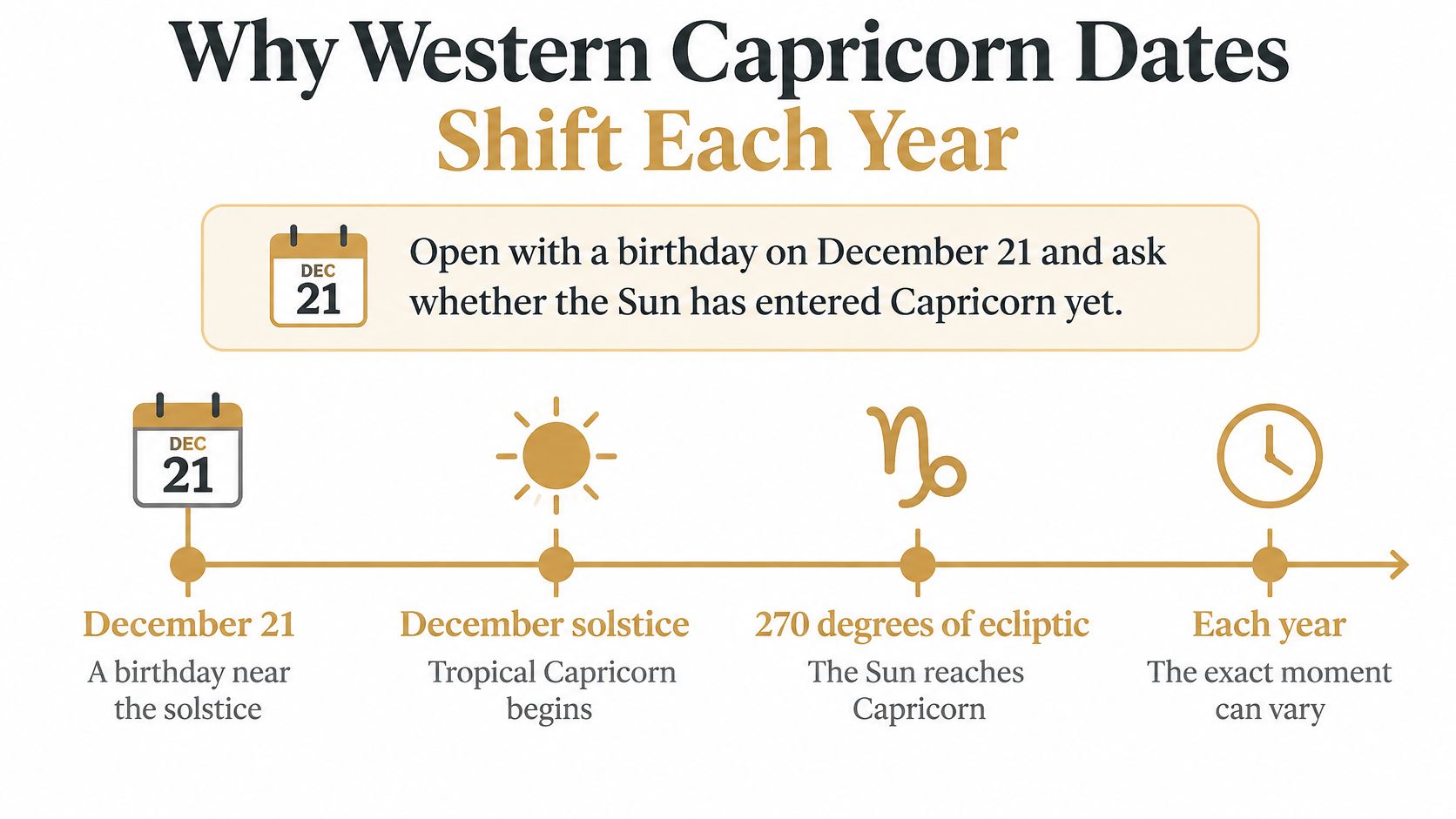
Tropical Capricorn begins at the December solstice. That means the moment the Sun reaches 270 degrees of ecliptic longitude, which is 0 degrees Capricorn. According to TropicalAstro's Capricorn reference, that date is December 21 in many years and December 22 in others, depending on the year and time zone, and the sign ends around January 19 or 20 after roughly 29 to 31 calendar days.
The mechanism has three steps.
- The Sun's apparent speed changes: Its motion along the ecliptic isn't perfectly even through the year, so sign lengths vary slightly.
- The solstice moment moves: It lands at a different clock time each year, which can push the calendar date from December 21 to December 22.
- The exit date follows: Capricorn ends when the Sun reaches 300 degrees, around January 19 or 20, not on a permanently fixed date.
That's why the familiar shorthand of December 22 to January 19 is useful but approximate. It's a rounded version of an astronomical threshold.
Time zones add one more layer. A solstice that occurs late on December 21 in New York can already be December 22 in UTC and in places further east. Two babies born at the same instant can carry different local calendar dates, while two babies born on the same local date can sit on opposite sides of the sign change. If you were born within hours of the boundary, check the Sun's position for your year, time, and place in an ephemeris. The date alone can't place it precisely.
Why the Vedic Capricorn Date Comes Later
A birthday near the Capricorn boundary can receive different labels in Western and Vedic astrology because the systems start their zodiac measurements from different reference points. The tropical zodiac is tied to the seasons, while the sidereal zodiac is aligned with the stars. They measure the same Sun, but place its position at different degrees.
The gap between those reference points is called ayanamsa. It changes gradually because of axial precession, the slow change in the direction of Earth's axis. As a result, the sidereal Sun reaches Makara later in the calendar year than the tropical Sun reaches Capricorn. In common date tables, Makara entry falls around January 14 or 15, though the exact boundary depends on the year and the sidereal convention used.
What the Ayanamsa Does
To convert a tropical longitude to a sidereal one, subtract the ayanamsa. Different ayanamsa conventions give slightly different results, so a Vedic date range is a lookup based on a chosen calculation, not a universal fixed table.
This explains why someone with a Western Capricorn Sun may have a Vedic Sun in Sagittarius, or Dhanu. The two labels come from different coordinate systems, each measuring the Sun from its own starting point. Neither label by itself settles the person's full chart.
“Capricorn date range” can therefore refer to tropical Capricorn, sidereal Makara, or the Sun's passage through the constellation Capricornus. The constellation is a region of the sky, while the zodiac signs are divisions used for astrological calculation. Wikipedia's Capricornus reference describes the constellation, not the calculation that sets a Vedic sign boundary.
For Parashari astrology, the relevant question is which sidereal convention is being used, then where the Sun falls using the birth date, time, and place. A date table can show the general shift between systems, but it cannot settle a boundary birthday on its own.
Western and Vedic Signs by Birth Date
The table below is a practical lookup: it shows how one birth date can fall under different Sun signs in the Western tropical and Lahiri Vedic systems. The boundary dates are approximate, so a row is a guide rather than a final calculation.
Western and Vedic Signs by Birth Date
| Birth date (approximate) | Western tropical sign | Vedic sign, Lahiri |
|---|---|---|
| November 22 to about December 15 | Sagittarius | Vrischika (Scorpio) |
| December 16 to December 21 | Sagittarius | Dhanu (Sagittarius) |
| December 22 to January 13 | Capricorn | Dhanu (Sagittarius) |
| January 14 to January 19 | Capricorn | Makara (Capricorn) |
| January 20 to February 12 | Aquarius | Makara (Capricorn) |
| February 13 to February 18 | Aquarius | Kumbha (Aquarius) |
Follow the Capricorn entries across both columns. From December 22 to January 13, the Western Sun is in Capricorn while the Vedic Sun remains in Dhanu. Between January 14 and January 19, the labels align: Western Capricorn corresponds to Vedic Makara. After that, the Western sign changes first. A person born from January 20 to February 12 is Western Aquarius but Vedic Makara, before Kumbha begins around February 13.
The table's date ranges reflect a moving boundary, not a fixed rule for every year and location. A published Lahiri sidereal table places Makara approximately from January 14 to February 12 and gives a Lahiri value for 2026 of about 24 degrees and 14 minutes. The difference between the systems is less than one complete 30 degree sign, which is why the Vedic sign is often one sign behind the Western sign, though the table's boundary dates still need care.
Parashari astrology uses Sanskrit sign names. The Rashi naming guide can help identify names such as Makara, Dhanu, and Kumbha. If your birthday is near a listed boundary, keep the sign provisional until birth time and place are considered.
- Confirm the system: Decide whether your question concerns a Western or Vedic sign.
- Check the boundary: Note whether your birthday is close to a date where the table changes rows.
- Label the result: Treat a near-boundary sign as provisional until the exact birth details are known.
How Birth Time and Place Settle a Cusp Birthday
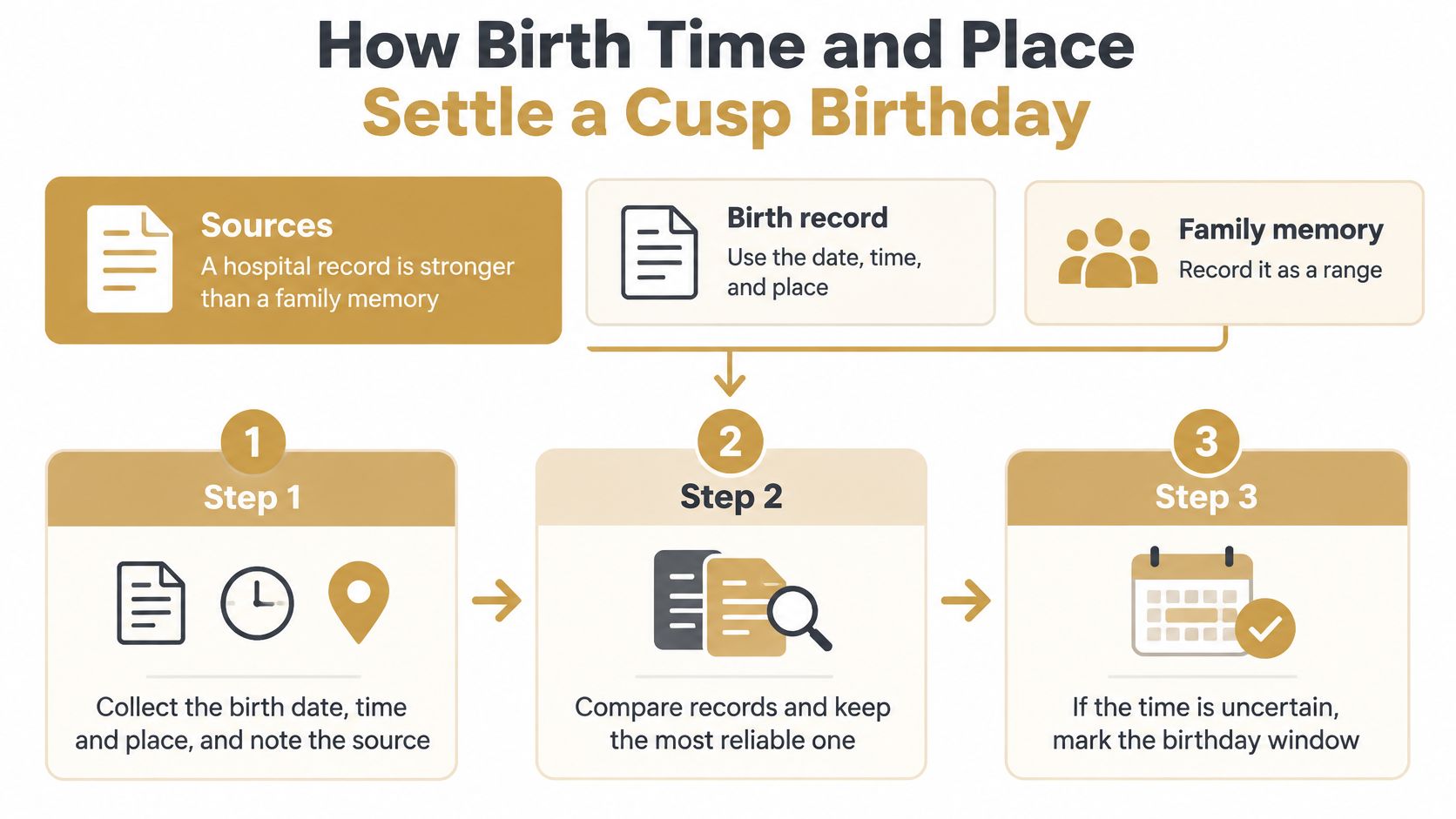
Start with your sources, not with a calculator. A hospital record is stronger than a family memory. If all you have is a memory such as "early morning", record it as a range, not as a precise time. False precision at this step creates false confidence later.
Boundary birthdays are common enough to take seriously. ZodiacSigns.it.com counts that from 1950 to 2050, the Sun entered Capricorn on December 21 in 77 years and on December 22 in 24 years when measured in U.S. Eastern Time. The starting date itself is a moving target, even before you change time zones.
Five Steps That Settle the Sun Sign
- Collect the data: Write down the birth date, time, and place, and note how confident you are in the time and where it came from.
- Convert to UTC: Use the birthplace time zone and its historical offset for that date, since offsets and daylight rules change over time.
- Compute the longitude: Find the Sun's sidereal longitude at that instant using the declared ayanamsa. Our Jyotish chart calculator guide explains what a serious calculator should declare.
- Test the error range: Check whether the Sun sits close to a sign boundary, and whether your possible time error could cross it.
- Label the result: Call it firm if the whole plausible time range stays in one sign, and provisional if it does not.
We follow the same logic at Anvaya. We compute your birth chart from your date, time, and place of birth, without asking you questions first. Then we check the chart against events you have already lived through Pramāṇa, our calibration step, before making any forward claim. Math first, language second.
An approximate birth time doesn't make a reading useless. It makes its timing bands wider, and the reading should say so plainly.
Unknown or approximate birth times may produce wider timing bands, and rectification features may be offered as a separate purchase. That's the honest consequence. A careful reading becomes more cautious when the data is thin, not more confident.
Keep the Sun sign in proportion, too. It's one placement among many. In Vedic practice, the Moon sign, called the Janma Rashi, and the Lagna, the rising sign, carry much of a Parashari reading. Settling whether your Sun is in Dhanu or Makara matters, but the Sun sign alone never settles a chart.
Frequently Asked Questions
Is Capricorn Always December 22 to January 19?
No. That range is a rounded shorthand for tropical Capricorn. The sign begins at the December solstice, which falls on December 21 or 22 depending on the year and time zone, and ends around January 19 or 20. The boundary moves, so a birthday near either edge needs more than a general date table to settle it.
When Does Vedic Capricorn Begin?
Makara is commonly placed from January 14 to February 12 under the Lahiri ayanamsa, roughly three weeks after tropical Capricorn begins. Some calendars give January 15 for a particular year or place. Other ayanamsa conventions can shift the entry by a day or more. The date range is therefore a lookup based on a stated convention, not a fixed boundary shared by every Vedic calendar.
Why Is My Western Capricorn Dhanu in a Vedic Chart?
The tropical and sidereal zodiacs measure from different starting points. Under Lahiri, their separation is about 24 degrees in 2026, so the sidereal Sun often falls in the sign before its tropical placement. For example, a January 5 birthday is typically Capricorn in the West and Dhanu in a Vedic chart. Each label follows the rules of its own zodiac; the difference does not by itself mean either calculation is wrong.
Does My Birth Date Alone Settle My Sign?
Sometimes, if the date is well inside the sign's range. Near a boundary, the Sun may change signs during the same calendar day, so the birth year, exact time, and place matter. The time must also be converted correctly to UTC for the calculation. Without those details, a date alone may leave the sign uncertain, and it is better to treat the result as provisional than guess.
Which Ayanamsa Should I Use?
Lahiri is one widely used ayanamsa in Vedic astrology, but other conventions exist. Since an ayanamsa sets the reference point for the sidereal zodiac, choosing a different one can shift a sign-entry date. When comparing date ranges or chart results, check which convention each uses. That makes clear whether a difference comes from the calculation's reference point or from an error.
Confirm Your Exact Sign Before You Read Further
Confirm your sign under the system you care about before you read anything into it: Western tropical, Vedic sidereal, or the constellation check. Use the tables and the three checks to locate your date. If it fell within two days of a boundary, collect your exact time and place before going further. Reading traits for the wrong sign wastes your time in any system.
For day to day Vedic context, our free Panchang shows tithi and nakshatra as the calendar is read. Our free tools also include Janma Akshara for birth syllables and the Lagna Kundali, Muhurta for timing windows, and Pravāha for suitability by age.
We start from the full chart and its calibration, not from a Sun sign date table. Our guide to the Vedic birth chart shows what that full chart contains. A date range can tell you where the Sun probably was. It can't tell you what the Moon, the Lagna, and the dashas are doing, and those carry the substance of a Parashari reading.
This is for personal reflection and self-understanding, not professional advice. If your birth details are firm, you're ready to see your chart as a whole, with the system and ayanamsa declared up front. If they're not firm, say so, and let the reading carry wider timing bands until the data improves.
One honest reading, before the noise finds you. If you want your Sun sign settled inside a full Parashari chart, computed from your date, time, and place and then calibrated against events you have already lived, visit Anvaya and see your chart. You'll get a Samhita built on declared math, with provisional points labeled as provisional.