You’ve probably had this small, nagging experience: you read your star sign, and it doesn’t fit. Not even a little. You’re a “fiery, impulsive” something, and you’re actually the most deliberate person you know. You shrug and decide astrology is nonsense.
Fair. But before you close the door — there’s a decent chance you were simply reading the wrong map of the same sky.
Same sky, two maps
Western and Vedic astrology look at identical heavens. The disagreement is about where to start measuring.
Western astrology uses the tropical zodiac, anchored to the seasons — specifically to the position of the sun at the spring equinox. It’s a calendar tied to Earth’s relationship with the sun.
Vedic astrology uses the sidereal zodiac, anchored to the actual fixed stars — the visible constellations, where they really sit right now.
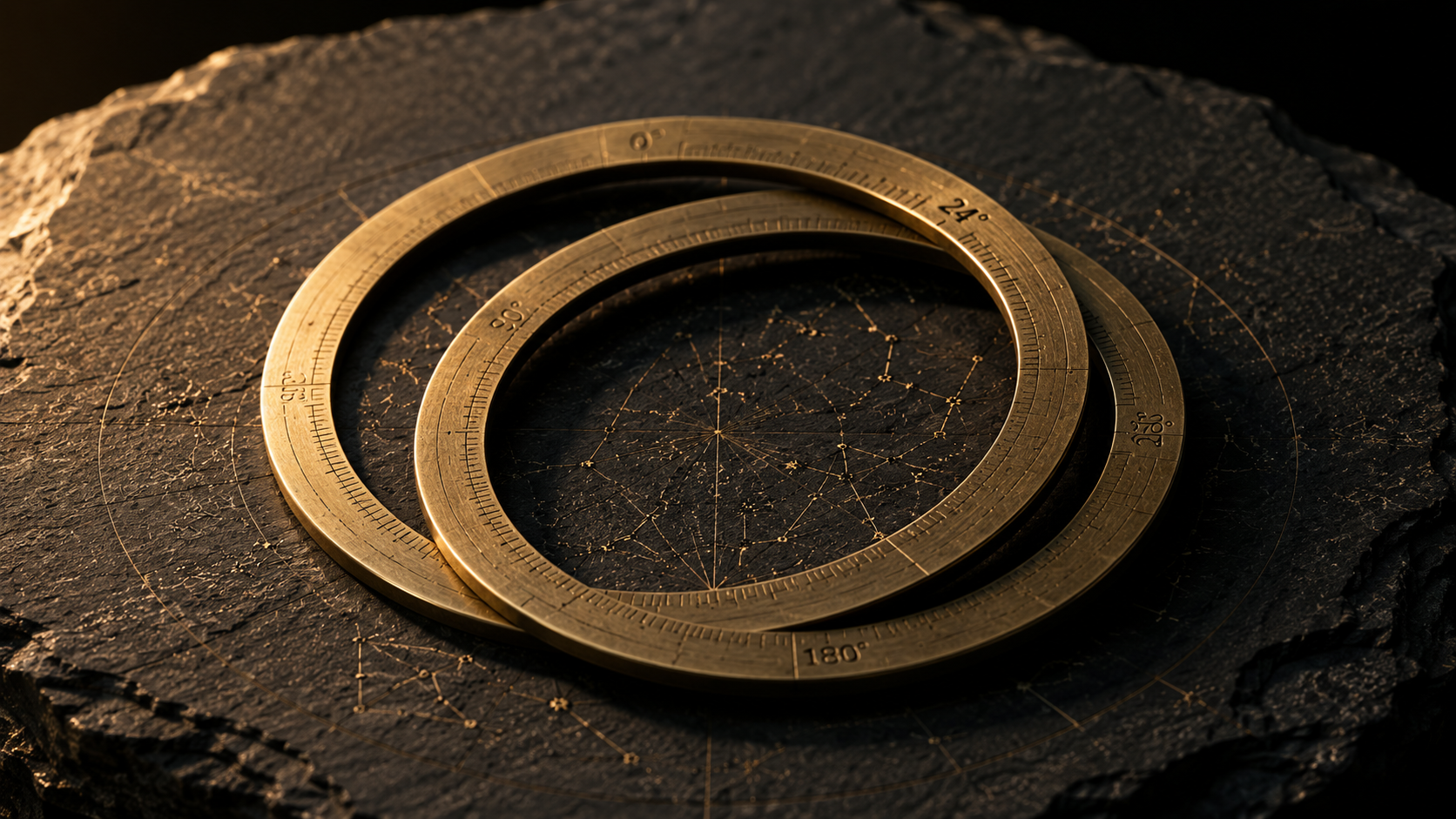
Here’s the catch. Because of a slow wobble in Earth’s axis (*precession*), those two starting points have drifted apart over the centuries. Today the gap is roughly 24 degrees. That drift has a name — the ayanamsa — and it’s the whole reason the two systems hand you different answers.
Why your Vedic sign is often one back
Twenty-four degrees is nearly a full sign. So for a large share of people, the Vedic (sidereal) sun sign lands one position earlier than the Western (tropical) one. The “Aries” who never felt like an Aries is, in Vedic terms, frequently a Pisces. Suddenly the description that always felt borrowed fits like it was cut for you.
This is the single most common “wait, that’s why” moment people have when they first meet Jyotish. It isn’t that one system is lying. It’s that they’re measuring from different zeros.
Western asks who. Vedic asks when.
The deeper difference isn’t the signs at all. It’s what each tradition spends its energy on.
Western astrology, especially in its modern popular form, leans hard into personality and psychology — who you are, your inner archetypes, your emotional wiring. It’s a language of identity.
Vedic astrology leans into timing. Its signature tool is the dasha system — long, calculated cycles that describe when particular themes in a life come forward and recede. Career. Marriage. Money. Health. Endings. Vedic astrology is less interested in labeling who you are and more interested in mapping the seasons you move through.
Western astrology asks who you are. Vedic astrology asks when.
That’s not a small distinction. A personality label is hard to test — almost anything can be made to fit it. A timing claim is the opposite: it can say this stretch of your life had this shape, and you can check that against your actual memory.
“Which one is right?” is the wrong question
People want a winner. The honest answer is that they’re different instruments built for different jobs, the way a thermometer and a barometer aren’t in competition.
The better question is: which one makes claims I can verify? On that test, Vedic timing has a real edge for practical use — because “when have I been in this kind of season, and what moved it?” is a question your own life can answer. A personality archetype mostly just asks you to nod.
What Anvaya uses, and why
Anvaya is built on the sidereal zodiac and dasha timing — for one plain reason. Timing is testable, and we refuse to tell you anything we can’t test. Personality labels feel profound and prove nothing. Dated seasons can be confirmed or rejected against your memory, which is exactly what calibration does before your Atlas says a word about your future.
So if you’ve spent years quietly convinced astrology “isn’t for you,” it’s worth one more look from the other map. Not because the stars will define you — but because the timing might finally describe something you lived through and never had language for.