
You're looking at a Navamsa chart because marriage has become a real question, not an abstract one. Perhaps a proposal is on the table, your family wants a compatibility check, or you're trying to understand why a promising relationship feels harder than the birth chart suggested. The first mistake is searching for one placement that can settle everything.
How to read a Navamsa chart for marriage requires more discipline. The D9 can refine the marriage promise, show how planetary indications mature, and help with timing. It can't replace the Rashi chart, override lived reality, or guarantee a particular spouse or outcome. A serious reading starts with accurate birth data, declared Vedic calculations, and honest uncertainty.
Table of Contents
- Why the Navamsa Cannot Stand Alone for Marriage
- How the Navamsa Is Constructed from Your Rashi
- Marriage Houses and Karakas the D9 Actually Uses
- Reading Planetary Strength and Influences in the D9
- Timing Marriage with Rashi, D9, and Dasha Together
- When Two Charts Disagree or Birth Time Is Uncertain
- Verifying a Navamsa Reading Against Your Lived Events
Why the Navamsa Cannot Stand Alone for Marriage
A reader sees Venus in the seventh house of the D9 and expects a happy marriage. Another sees Saturn there and assumes delay, distance, or failure. Both reactions are understandable. Neither is a complete reading.
The Navamsa, or D9, is mathematically the ninth divisional chart in the Parashari system. Each 30° zodiac sign is divided into nine equal portions of 3°20′, creating 108 Navamsa portions across the 12-sign zodiac. In classical practice, it refines the birth chart, especially the way planetary promises mature in spouse-related and partnership matters. The Parashari Navamsa framework gives it an important role, but not the role of an independent replacement for the D1.
The Rashi gives the promise
The Rashi chart, or D1, is where marriage promise is assessed first. A practitioner examines the seventh house, its lord, Venus, Jupiter, the Upapada Lagna, and supporting factors connected with family and fulfilment. The D9 then asks whether those indicators have durability, dignity, and a coherent expression in committed partnership.
A strong-looking D9 can't erase a missing or severely compromised indication in the D1. Likewise, a difficult D9 placement doesn't automatically cancel a workable marriage promise in the birth chart. It may describe effort, maturation, a slower expression, or a relationship area that needs conscious handling.
Practical rule: The D9 sharpens the Rashi. It doesn't rewrite it.
The same principle applies to timing. A chart can show potential without showing immediate activation. D1 promise, D9 maturity, and dasha activation must converge before a timing claim deserves confidence. Reading the D9 in isolation is attractive because it produces quick answers. It's also the method most likely to turn one placement into a verdict.
How the Navamsa Is Constructed from Your Rashi
Before interpreting marriage, verify that the D9 has been calculated correctly. The Navamsa isn't a second birth chart generated independently. It's derived from the exact planetary longitudes in the Rashi chart.
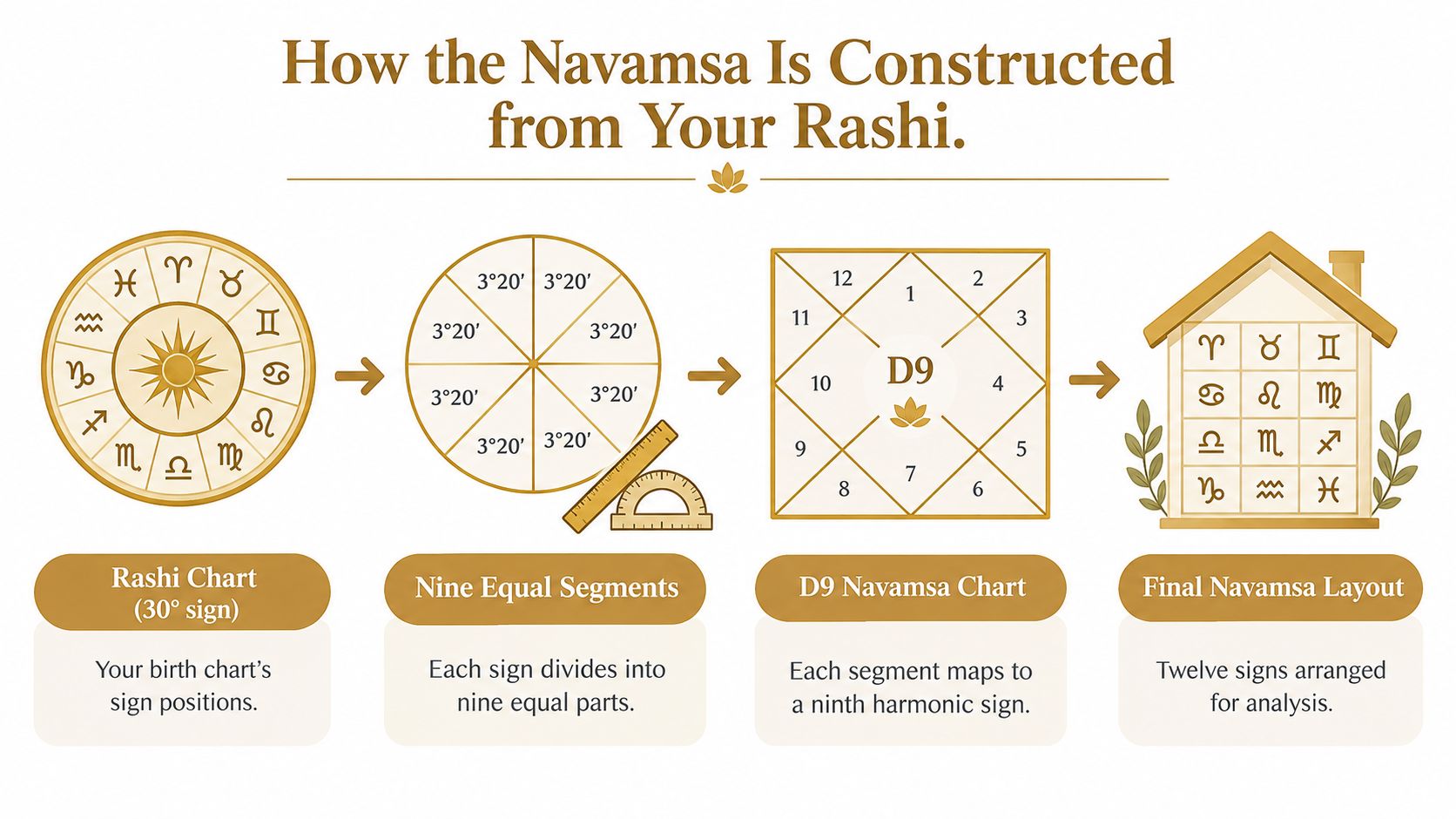
Each 30° sign is divided into nine portions of 3°20′. The portions run from 0°00′ to 3°20′, then 3°20′ to 6°40′, continuing until the ninth portion from 26°40′ to 30°00′. A planet near one of these boundaries can change Navamsa placement after a small degree or birth-time correction, which is why approximate data deserves a cautious reading. The Navamsa calculation rules explain the modality-based starting sequence.
Use the modality rule
The first Navamsa sign isn't always Aries. It depends on whether the original Rashi sign is movable, fixed, or dual.
| Sign modality | Signs | Starting Navamsa |
|---|---|---|
| Movable | Aries, Cancer, Libra, Capricorn | The sign itself |
| Fixed | Taurus, Leo, Scorpio, Aquarius | The ninth sign counted from the sign |
| Dual | Gemini, Virgo, Sagittarius, Pisces | The fifth sign counted from the sign |
Take a planet in the first 3°20′ of Pisces. Pisces is a dual sign, so counting begins from the fifth sign from Pisces, Cancer. That planet's first Navamsa is therefore Cancer. For later portions, count forward one sign for each portion occupied.
A dependable calculation should preserve planetary degrees to arc-minute precision and state the ayanamsha and house system used. If two software tools disagree, check the zodiac setting, ayanamsha, birth time, and divisional-chart construction before interpreting the difference. You can review the wider role of the birth chart through this guide to Vedic astrology birth charts.
Marriage Houses and Karakas the D9 Actually Uses
Marriage analysis becomes clearer when evidence is ranked. Don't give every placement equal weight because it appears in the same chart.
The first anchor is the D1 seventh house and seventh lord. They describe the basic partnership promise and the conditions surrounding committed relationship. Next, examine the D9 Ascendant, its lord, the D9 seventh house, and the D9 seventh lord. The D9 seventh house and its lord are primary spouse indicators, but they must be read with the D1 seventh house, seventh lord, and natural significator together, as outlined in this Navamsa marriage framework.
Primary evidence
- Seventh house and seventh lord: Start with their sign, dignity, conjunctions, aspects, and house relationships in D1 and D9.
- Venus: Venus is the natural significator of relationship matters in a male horoscope and remains a major relationship indicator across chart analysis.
- Jupiter: Jupiter is the traditional husband significator in a female horoscope and also shows wisdom, shared values, and guidance within partnership.
- Upapada Lagna: This is a derived point used to study the visible structure of marriage, spouse themes, and the social expression of partnership.
The D9 Ascendant matters because it establishes the house framework of the divisional chart. Its lord shows how the person tends to function inside marriage, not just how they appear before commitment.
Supporting evidence
The second house can add information about family continuity, speech, and the ability to sustain household life. The eleventh house can show support, fulfilment, and gains connected with partnership. These factors are useful, but they shouldn't overrule repeated testimony from the seventh-house ecosystem, Venus, Jupiter, and the Upapada.
Compatibility work also needs separate chart analysis before comparison. A structured Guna Milan reading can be one layer, but points should never be added mechanically as though each system were an independent proof. Read each person first. Compare only after both charts have a clear individual assessment.
Reading Planetary Strength and Influences in the D9
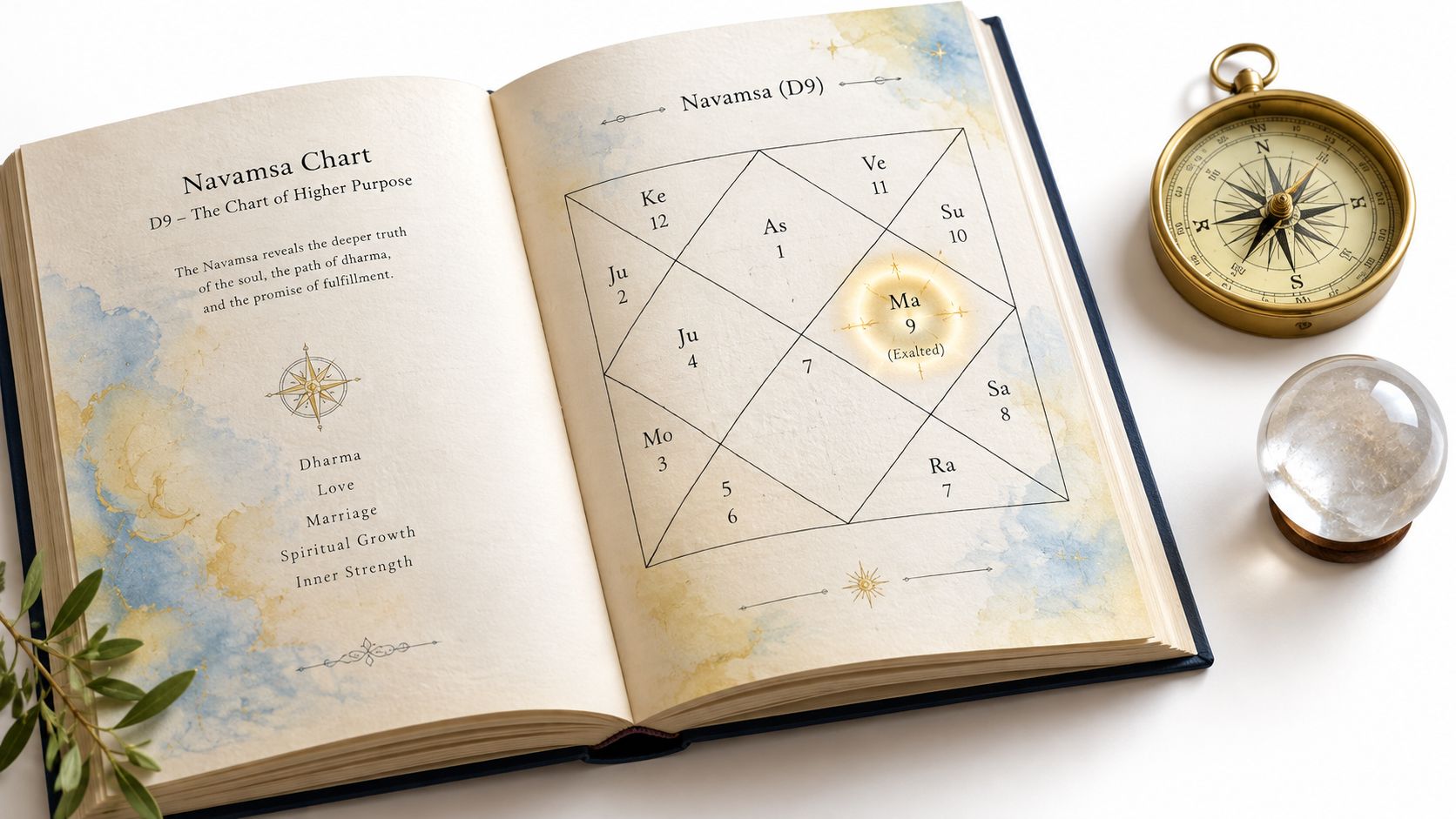
A planet's presence in the D9 seventh house doesn't tell you whether it will deliver smoothly. You need to assess dignity, rulership, association, and aspect.
A planet in its own sign or exaltation is traditionally treated as stronger. A debilitated planet may show strain, uneven expression, or an area that requires maturity. These conditions don't operate in a vacuum. The sign lord's condition, conjunctions, aspects, and relationship with the D1 placement can change the practical meaning.
Dignity is not decoration
Suppose Venus occupies the D9 seventh house. That placement deserves attention, but it doesn't guarantee harmony. Is Venus strong by sign? Who rules that sign? Is Venus joined by a planet that supports or strains it? Does the D1 seventh lord repeat the same theme? Do the relevant dashas activate it?
The reverse also matters. A difficult planet in the D9 seventh house may describe responsibility, restraint, conflict, or delay in some charts. It doesn't prove that marriage will fail. A well-supported Saturn can describe endurance and duty, while an afflicted benefic can struggle to deliver its softer promise.
A planet can also be a natural benefic or malefic while functioning differently for a particular Ascendant. Functional benefic and functional malefic status depends on house rulership, so a blanket rule such as “Jupiter always helps” is too crude for serious work. Yogas, including Raja Yoga or Parivartana Yoga, must be judged through the full chart rather than announced from a single combination.
A favourable Navamsa placement is evidence. It isn't a verdict.
The correct method is to read dignity and aspects together with placement, then compare the result with the D1. This technical Navamsa discussion also supports the safeguard against drawing conclusions from one supposedly favourable position without checking its ruler and associations.
Timing Marriage with Rashi, D9, and Dasha Together
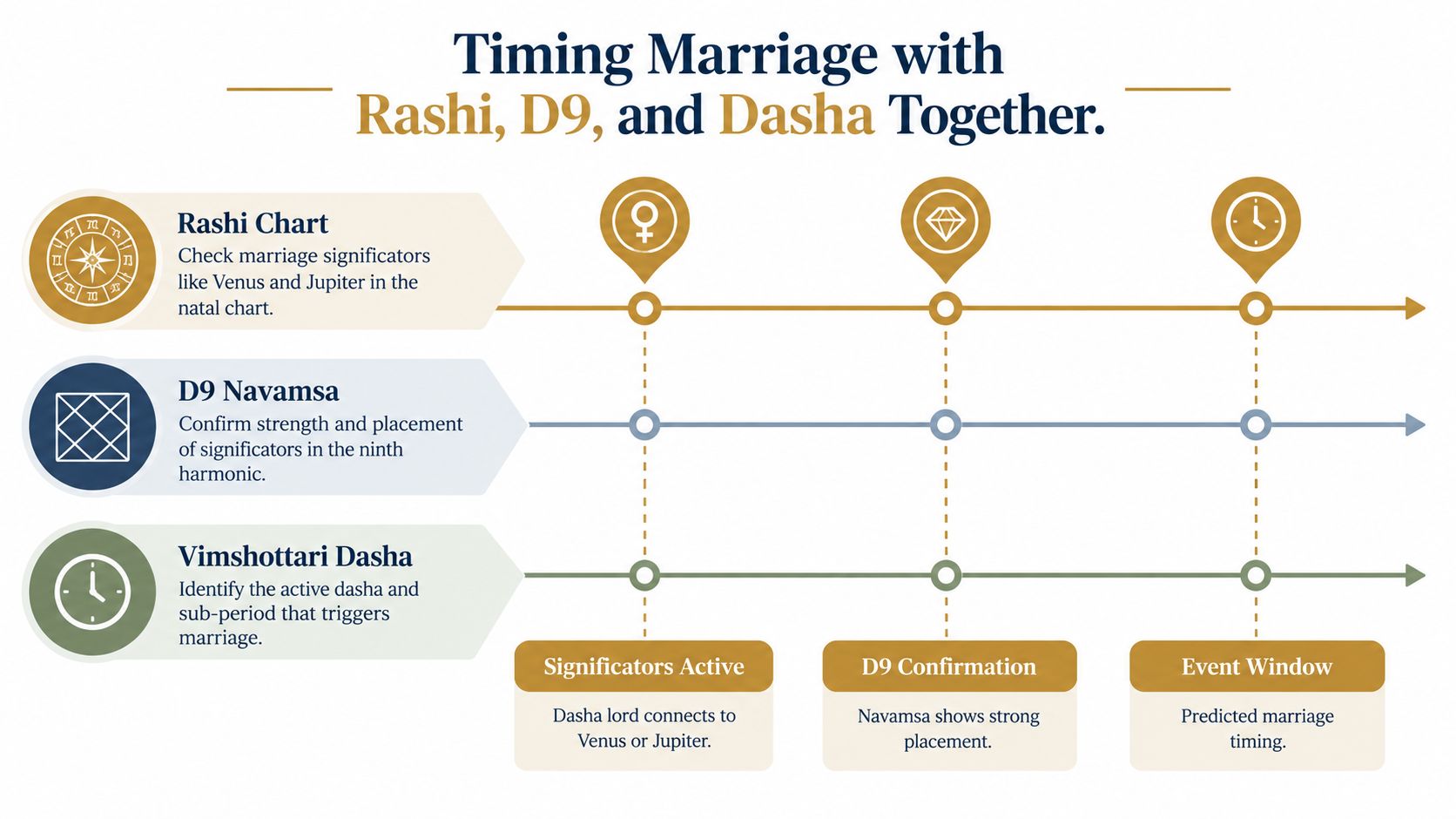
Marriage timing is not extracted from the D9 alone. It comes from an intersection of promise, maturity, and activation.
First, inspect the D1 for marriage significators. Then check whether the relevant planets have workable dignity and support in the D9. Finally, examine Vimshottari dasha and sub-periods. A Mahadasha or Antardasha connected with Venus, the seventh lord, the D9 seventh lord, or another clearly relevant significator may create a period for relationship developments, but the chart must support that possibility at more than one level.
A practical timing sequence
- Establish the promise: Read the D1 seventh house, seventh lord, Venus, Jupiter, and Upapada.
- Test maturity: Examine their D9 dignity, house position, rulership, and associations.
- Find activation: Check Vimshottari Mahadasha and Antardasha connections to marriage significators.
- Assess support: Use relevant transits involving the Moon, Venus, Jupiter, and the seventh lord as confirming or weakening factors.
A dasha may activate a relationship theme without producing a wedding. It can correspond with meeting someone, negotiating commitment, ending an unsuitable connection, or clarifying what the person wants. Timing language should remain conditional, especially when birth time or chart settings are uncertain.
For readers checking period sequences, a Vimshottari dasha calculator can help organise the timeline. It can't replace interpretation. No single planet, transit, or chart promises an exact date.
When Two Charts Disagree or Birth Time Is Uncertain
Popular rules often treat Saturn or Ketu in the D9 seventh house as automatic delay, or Venus affliction as proof of marital difficulty. The problem isn't that these placements are irrelevant. The problem is that fixed rules rarely explain what to do when the rest of the chart says something different.
Navamsa divisions are fine-grained. A small change in recorded birth time can move the Ascendant or a planet across a 3°20′ boundary. International records add practical complications such as time zones, daylight-saving conventions, calendars, and approximate birth times. A confident conclusion built on an unstable input is still unstable.
Rank evidence instead of counting warnings
When indicators conflict, use an evidence hierarchy:
- Start with repetition: Does the same relationship theme appear in the D1, D9, and relevant dasha?
- Check dignity: Is the planet supported, or are you reacting only to its house placement?
- Include the lords: Read the seventh lord, Venus, Jupiter, and their sign rulers.
- Test timing: Do dashas and transits activate the interpretation?
- Compare both people: In a two-chart analysis, assess each chart independently before examining connections.
Don't add ominous placements like votes against marriage. Three weak rules aren't automatically stronger than one well-supported indication. If the birth time is uncertain, calculate alternative scenarios and identify which conclusions remain stable across them.
Ask for confidence, not certainty. “Possible relational challenge” is a responsible statement. “Your marriage will fail” usually isn't.
A disciplined practitioner preserves the original assumptions, records the uncertainty, and avoids changing the chart without clear cause to fit a preferred answer. Rectification can be considered through dated past events, but it should be documented as a hypothesis rather than presented as a hidden correction.
Verifying a Navamsa Reading Against Your Lived Events
A reading becomes more useful when it can be checked against the past. Before making forward claims, identify dated relationship, family, or commitment events and test whether the chart's promised themes and dasha periods describe them with reasonable clarity.
Start with the chart's strongest claims, not with vague personality statements. A useful audit asks:
- What was the event? Record a specific relationship beginning, separation, engagement, marriage discussion, or major family transition.
- When did it happen? Use dated windows rather than broad memories.
- Which layer was active? Compare the D1 promise, D9 condition, and Vimshottari period.
- Did the same theme repeat? Repetition across chart layers carries more weight than a single placement.
- What remains uncertain? Mark conclusions that depend on a boundary degree, uncertain birth time, or disputed interpretive rule.
A confidence indicator doesn't mean a statement is true or false by itself. It tells you how much weight to place on the statement given the quality of the birth data, the agreement between chart layers, and the strength of past-event verification.
Compatibility scores should be treated as hypothesis-generating tools, not validated predictors of marital stability. A longitudinal study using Swedish marriage and divorce data from 1968–2001 found no consistent evidence that astrologically more compatible couples were overrepresented among marriages or had lower divorce risk, as reported in this published study on astrology and relationship outcomes.
Anvaya applies this chart-first principle through Pramāṇa, calibrating a declared Vedic compute against lived events before making forward claims. Its Samhita is a structured reading rather than a horoscope feed, so the reader can distinguish calculation, interpretation, and uncertainty. Astrology here is for personal reflection and self-understanding, not professional advice.
Generate a structured Samhita through Anvaya to examine your Rashi, Navamsa, and dasha together. You'll get a chart-first reading that separates stronger indications from uncertain ones, instead of turning one D9 placement into a marriage verdict.