
You've received the keys. Boxes fill the hallway, the kitchen is only partly unpacked, and relatives are already asking for the ceremony date. You're trying to decide when to have a housewarming, but the convenient weekend and the family's preferred auspicious day don't quite match.
You don't need to choose between practical sense and Vedic tradition. You need to ask the questions in the right order, then check what each answer supports.
Table of Contents
- The Housewarming Question Nobody Answers Properly
- Core Vedic Muhurta Factors for Griha Pravesh
- Practical Home Readiness Before the Ceremony
- Good Windows Versus Problematic Windows
- How Anvaya Helps You Pick and Validate a Date
- A Simple Decision Checklist for Your Housewarming
- Frequently Asked Questions About Housewarming Timing
- When should you have a housewarming after moving in?
- Can you have a housewarming before the home is fully furnished?
- What if you must move during Chaturmas?
- Does the homeowner's chart matter beyond the Panchang?
- How early should you send invitations?
- Can you reuse a Rahu Kaal time from another date?
The Housewarming Question Nobody Answers Properly
A possession date tells you when you receive the property. A moving date tells you when your belongings arrive. Neither automatically tells you when the household is ready to welcome people.
There's another distinction that families often leave unstated: a social housewarming and Griha Pravesh don't have to be the same event. For planning purposes, separate the gathering from the religious house-entry ceremony. Ask your officiating priest how your family's tradition handles the relationship between entry, occupancy, and celebration.
That conversation can prevent an avoidable disagreement. One person may be choosing a date for lunch with friends, while another is choosing the moment for the ceremonial threshold entry.
Separate readiness from ritual timing
Consider a hypothetical family whose furniture has arrived but whose renovation work isn't complete. Their relatives find a traditionally preferred date. The family now has two questions, not one:
- Can the home accommodate the intended event? This depends on the condition of the property, the guest list, and the household's capacity to host.
- Does the proposed ceremony time meet the chosen tradition's requirements? This depends on calendar factors, the local time window, and any personal chart checks.
A favourable calendar label doesn't answer the first question. A convenient weekend doesn't answer the second.
Key principle: Choose a feasible home and household window first. Then apply traditional timing checks within it. If the two don't overlap, reconsider the format or date rather than pretending the conflict doesn't exist.
There's no universal countdown
The familiar two-to-six-week rule is an etiquette suggestion, not an evidence-based deadline. Housewarming etiquette guidance allows room for a functional but unfinished home, rather than requiring every furnishing decision to be complete.
Our recommendation is to anchor the celebration to established residence, not the day you collect the keys. You should be able to explain why the date works in ordinary language before adding an astrological explanation.
That approach also respects honest uncertainty. Vedic timing is a traditional framework for selecting a moment. It isn't a guarantee about what life in the home will become.
Core Vedic Muhurta Factors for Griha Pravesh
Muhurta means a selected time window for an activity. For Griha Pravesh, traditional guidance combines several calendar factors. It doesn't treat an entire date as uniformly suitable.
Start with the lunar calendar
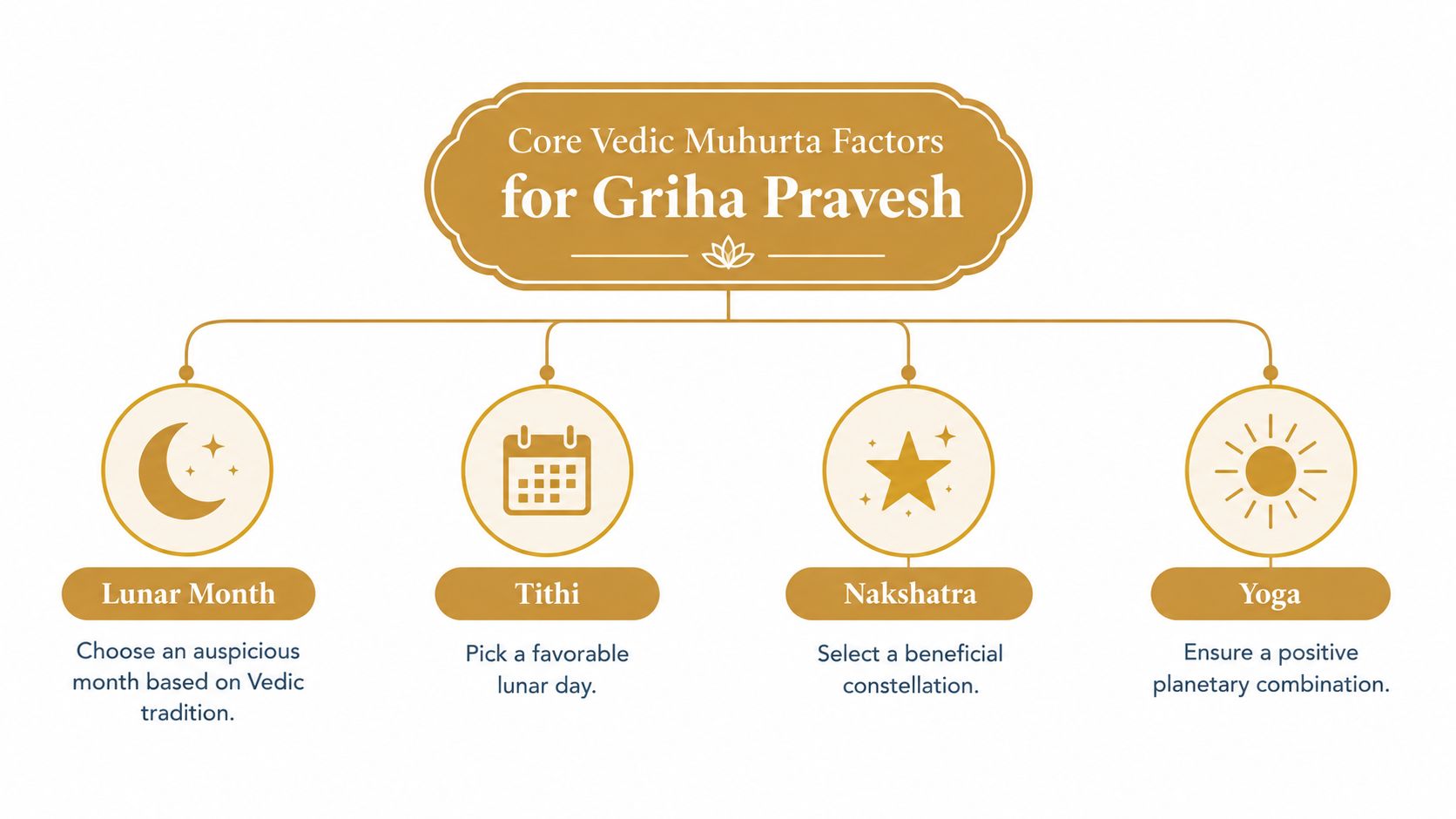
Tithi means lunar day. Commonly preferred Shukla Paksha tithis, in the waxing half of the lunar month, include Dwitiya, Tritiya, Panchami, Saptami, Dashami, Ekadashi, and Trayodashi. Chaturthi, Navami, and Chaturdashi are called Rikta, meaning empty, while Amavasya is generally avoided in the traditional Griha Pravesh selection guidance.
Treat those as traditional preferences, not claims that an excluded day causes harm. A shortlist still needs other checks.
The lunar month provides another filter. Magha, Phalguna, Vaishakha, and Jyeshtha are commonly favoured. Some traditions also use Kartika and Margashirsha, while Paush, Chaitra, Adhik Maas, and Chaturmas are commonly avoided, according to this overview of traditional house-entry months.
Those lunar months don't map to fixed Gregorian dates. Regional practice can differ, so don't choose by an English month name alone.
Check the remaining factors together
- Nakshatra means lunar mansion. It identifies the Moon's position within the traditional stellar divisions. Ask which nakshatra applies during the proposed entry window and whether your tradition accepts it.
- Weekday is another selection factor. It belongs in the combined assessment, not above every other consideration.
- Yoga is an additional Panchang factor. The infographic is a simplified map, not a complete ceremony-selection checklist.
- The usable interval matters. A favourable month and acceptable lunar day don't make every hour suitable.
A Panchang of the day is a starting point for reading these calendar components. It isn't, by itself, a complete personal recommendation.
Traditional timing checklists also call for checking Rahu Kaal, a period commonly excluded for auspicious beginnings, and Disha Shool, a direction-related traditional restriction. The house-entry timing guidance also calls for matching the proposed window with the homeowner's birth chart and current planetary transits.
Confirm these checks for the property's location. Ask which ceremony action must occur within the selected interval, rather than assuming the invitation's start time is enough.
Practical Home Readiness Before the Ceremony
A calendar calculation cannot establish whether a renovated room is ready for occupancy. Keep building-related questions with the relevant professionals, and keep the astrological assessment within its own scope.
For hosting purposes, begin with what you can observe and what still needs confirmation.
Establish what's ready and what isn't
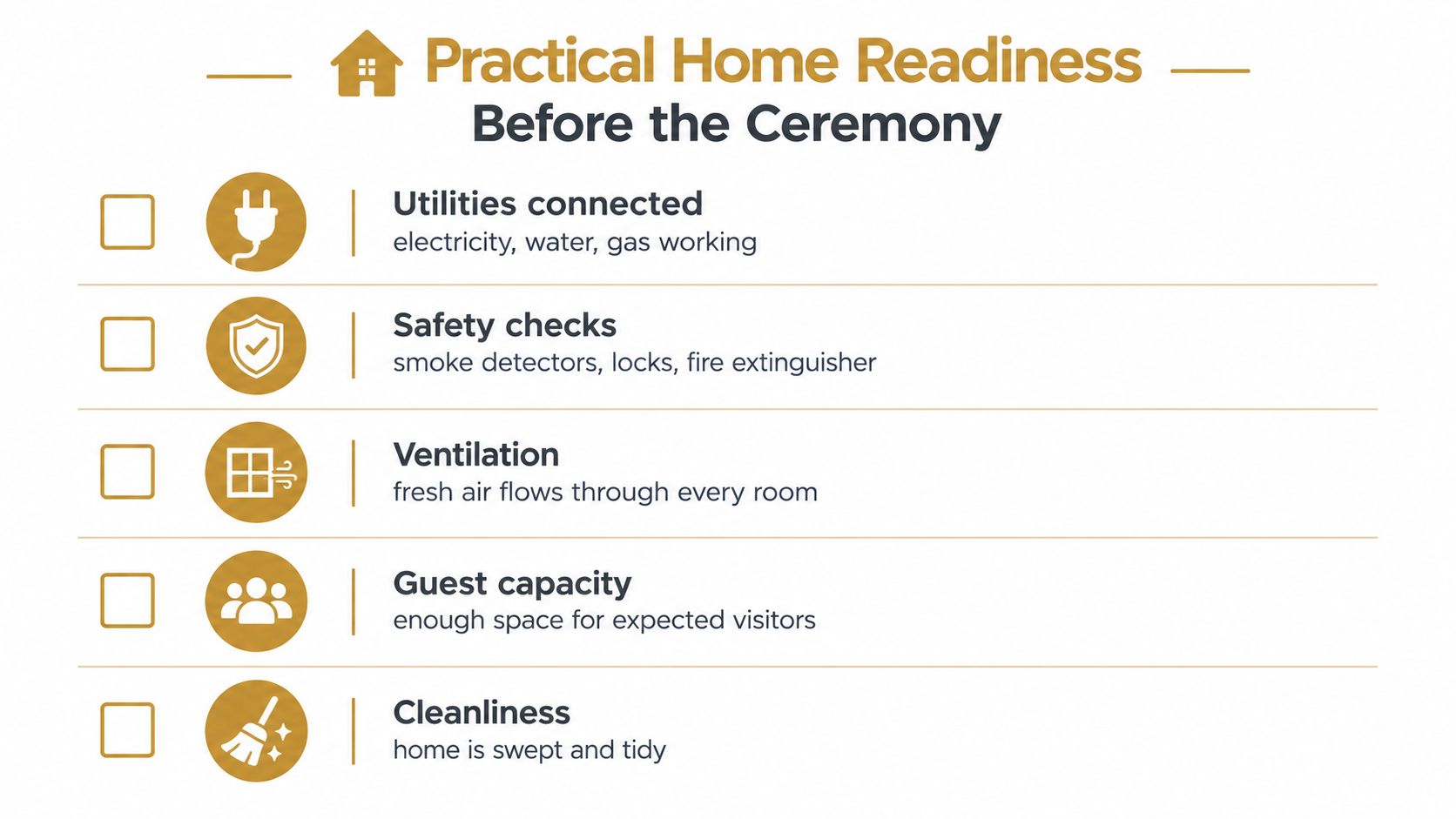
Use a simple planning inventory:
- Essential services: Confirm that the household has working utilities, a usable bathroom, and suitable arrangements for food and drinking water.
- Guest movement: Consider entrances, stairs, seating, and access needs before deciding how many people to invite.
- Unfinished areas: Identify rooms or work zones that won't be part of the gathering.
- Household capacity: Ask whether you have the time and energy to host, not just enough floor space.
Guest needs can change the appropriate time of day. Arrival in daylight, accessible transport, building rules, weather, and quiet hours may matter more than a popular weekend slot. A guest-focused housewarming planning guide also highlights the importance of assessing the particular property and guest list.
Give renovation questions their own assessment
Freshly completed work deserves more scrutiny than a missing sofa. Building Science Corporation's moisture-control guidance explains why wet construction materials need appropriate drying before enclosure and why trapped moisture can contribute to mould and material damage.
New cabinetry and pressed-wood furniture raise a separate indoor-air question. The EPA's formaldehyde guidance identifies these products as potential residential sources and explains that emissions depend on factors including temperature, humidity, and air exchange.
Neither a pleasant smell nor an auspicious date is professional confirmation of indoor-air conditions. If construction moisture, strong chemical odours, or ventilation performance remain unresolved, ask the appropriate contractor or indoor-environment professional before committing to a gathering.
Match the event to the transition
A local move into a ready property may involve fewer coordination demands than establishing a first household or combining families after marriage. The U.S. Census Bureau's account of why people move distinguishes housing-related moves, marital-status changes, and establishing a household as different relocation circumstances.
Your planning should make the same distinction. Don't borrow another household's timetable without checking whether its situation resembles yours.
Good Windows Versus Problematic Windows
The following are hypothetical planning examples, not recorded outcomes or predictions. They show how practical and traditional considerations can agree, or conflict.
In the first example, a family has settled into a functional home. They shortlist a date in Magha on Tritiya, then confirm the remaining calendar and personal-chart checks with their practitioner.
In the second, a family chooses a convenient date during Chaturmas on Amavasya. Renovation concerns remain unresolved, and the invitation list was set before anyone considered the home's capacity.
Good vs Problematic Housewarming Windows
| Factor | Good Window | Problematic Window |
|---|---|---|
| Home condition | Essential rooms are functional and outstanding work is understood | Fresh finishes and unresolved work are treated as minor details |
| Lunar month | Magha fits the family's traditional preference | Chaturmas conflicts with the family's stated practice |
| Tithi | Tritiya passes the initial traditional filter | Amavasya conflicts with the chosen selection rules |
| Entry interval | The actual threshold entry fits the confirmed muhurta | Only a broad ceremony start time has been chosen |
| Personal context | The homeowner's chart has been considered | A generic calendar label is treated as a personal assessment |
| Guests | Attendance matches the available space and access | The guest list exceeds what the home can comfortably accommodate |
The first window is better supported, not guaranteed to produce a better life. It passes the stated planning tests. The second needs revision because the family hasn't resolved either its practical concerns or its own traditional requirements.
Don't let one favourable label decide everything
A named yoga can attract attention because it offers a simple answer. But the appropriate question is what that factor contributes to the whole assessment. A reading on Sarvartha Siddhi Yoga can help you investigate the term without treating it as a replacement for all other checks.
An unfinished home and an unready home aren't the same thing. Missing artwork is a different problem from unresolved construction work.
Our editorial recommendation is to distinguish essentials from presentation. If only decoration remains, you may prefer a modest welcome gathering to an indefinite delay. If important readiness questions remain unanswered, reducing the scale or choosing another date is the clearer decision.
How Anvaya Helps You Pick and Validate a Date
You can work through date selection with a practitioner, a local Panchang, or digital timing tools. The useful test is whether you can inspect the inputs, understand the result, and identify what still needs human confirmation.
The platform shown below offers Muhurta, Watch Windows, and Right Now alongside a persistent Samhita, or structured living reading.

Use each tool for a distinct question
- Muhurta supports the event window. Start with the property's location and candidate dates. Review the local Panchang context and excluded periods, including Rahu Kaal, rather than relying on a favourable-day label.
- Watch Windows adds personal timing context. It presents upcoming windows in relation to the active dasha, meaning the planetary period used in Vedic astrology, and transits, meaning current planetary positions.
- Right Now supports a current-moment check. It offers a live view tied to the chart's active timing context. It doesn't replace advance ceremony planning.
Keep the distinction clear: a general calendar window and an individual birth-chart assessment answer related but different questions. Neither can confirm the physical condition of a property.
Verify the reading before accepting its implications
Our method is declared compute → Pramāṇa → plain-language reading. Pramāṇa means calibration against lived events. We begin with birth data and chart-derived questions, rather than asking for your story and returning it as an apparent discovery.
The Samhita preserves a structured reading, confidence indicators, and prior outputs for review. That matters when you're assessing a timing claim: you should be able to distinguish what was calculated, what was calibrated, and what remains uncertain.
Math first, language second means the explanation follows the declared calculation. It doesn't mean that mathematical precision proves an astrological outcome.
Verification question: Can you explain why this window was selected, which inputs it depends on, and what could change the recommendation?
Before confirming invitations, record the property location, local time, proposed threshold-entry interval, and any questions for your officiant. If birth details are uncertain or traditions disagree, retain that uncertainty in the decision. A tool should help you examine a choice, not make disagreement disappear.
A Simple Decision Checklist for Your Housewarming
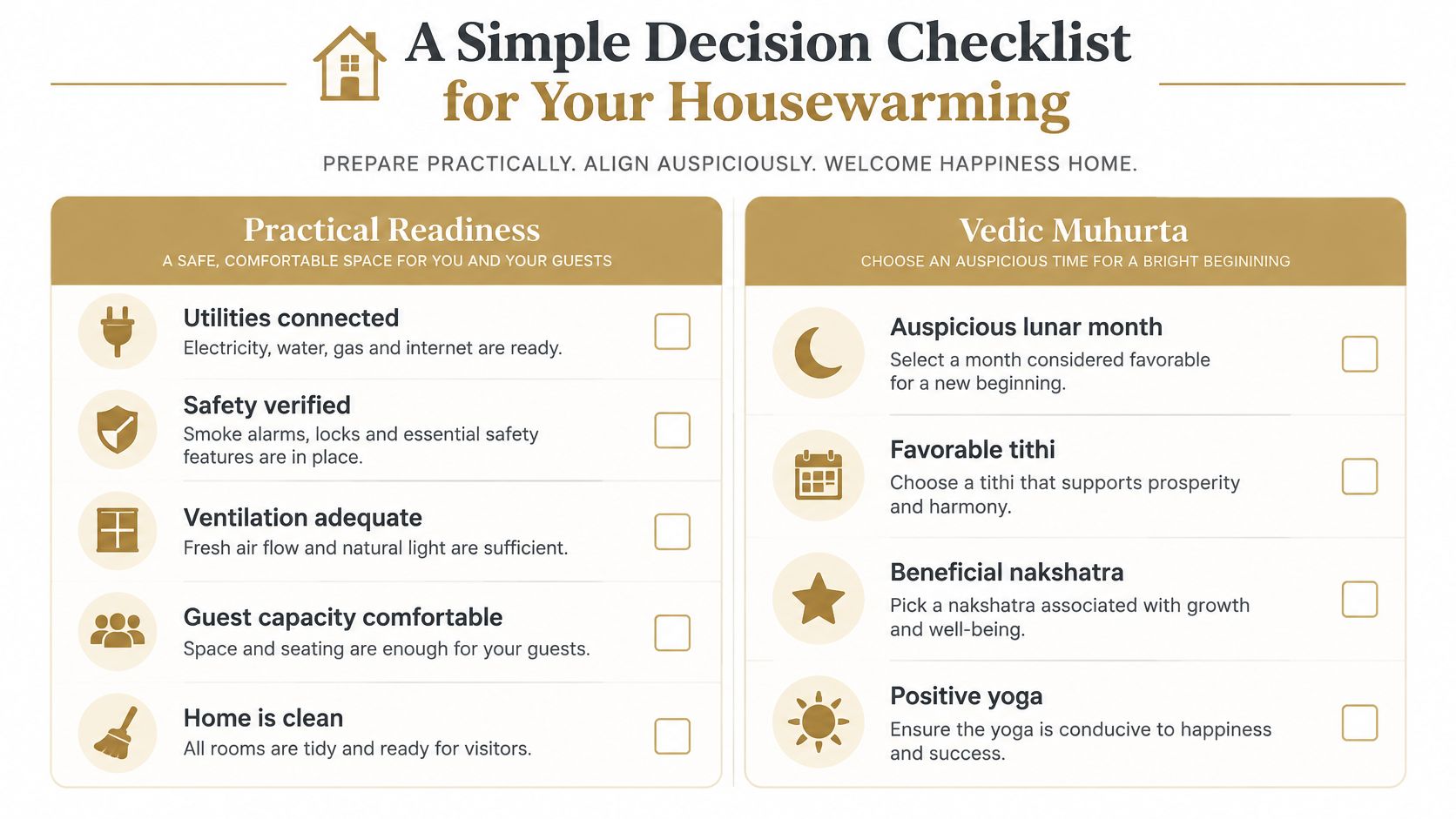
Choose a date you can explain both practically and traditionally. Use this checklist as a decision record, rather than treating a single favourable factor as permission to ignore everything else.
Establish the household window
- Define the event. Decide whether you're arranging ceremonial entry, a social gathering, or both. Agree on this before comparing dates.
- Record readiness. Note which essentials are operational and which unresolved matters require professional confirmation.
- Check attendance needs. Account for access, travel, household energy, building conditions, and the intended number of guests.
- Choose a workable format. A small ceremony and a later social gathering may be easier to coordinate than a single large event.
Validate the traditional window
- Apply your tradition consistently. Check lunar month, tithi, nakshatra, weekday, and the other Panchang factors your practitioner uses.
- Confirm local exclusions. Review Rahu Kaal and how Disha Shool applies to the planned activity.
- Consider the personal chart. Ask how the homeowner's birth chart, active dasha, and current transits affect the interpretation.
- Identify the required action. Confirm when the threshold entry must happen and leave room for preparation before that moment.
- Keep a written record. Save the selected interval and its assumptions so relatives, hosts, and the officiant share the same plan.
The final question is simple: Does this date work for this household, in this home, under the tradition we've chosen? If the answer depends on an unresolved assumption, confirm it before treating the date as settled.
This guidance is for personal reflection and self-understanding, not professional advice. Building, health, and other professional questions belong with qualified professionals. The final decision rests with your household.
Frequently Asked Questions About Housewarming Timing
When should you have a housewarming after moving in?
Choose the earliest workable period after the home and household are ready to host. If you're also arranging Griha Pravesh, confirm its timing separately under your family's tradition.
Can you have a housewarming before the home is fully furnished?
Yes, incomplete decoration needn't prevent a gathering. Base the decision on essential facilities and guest comfort, rather than whether every room looks finished.
What if you must move during Chaturmas?
Discuss necessary occupancy and ceremonial entry separately with your officiating priest. Practices differ, so don't assume a general avoidance rule answers your family's specific circumstances.
Does the homeowner's chart matter beyond the Panchang?
Traditional selection guidance considers both. A general Panchang provides calendar context, while the personal assessment considers the homeowner's chart and current timing.
How early should you send invitations?
Wait until the practical date and ceremony interval are confirmed, then allow guests sufficient planning time. Give travelling relatives more notice, and state clearly whether they're invited for the ritual, the gathering, or both.
Can you reuse a Rahu Kaal time from another date?
Don't assume it applies. Check the relevant local calculation; this explanation of Rahu Kalam on Tuesday provides focused background.
Generate your Samhita at Anvaya to begin with a structured birth-chart reading and Pramāṇa calibration against lived events. For housewarming planning, use that personal context alongside Muhurta, Watch Windows, and Right Now, then confirm the ceremony details with your officiant and the practical arrangements with your household.