

Tuesday Rahu Kalam is traditionally the seventh of eight equal segments between local sunrise and sunset, so it's a location-specific interval, not a universal fixed clock time. On a reference day with sunrise at 06:00 and sunset at 18:00, it runs approximately from 15:00 to 16:30 local time.
You may be checking this because a contract signing, travel plan, meeting, or ceremony is set for Tuesday afternoon. A quick search gives you “3:00–4:30 p.m.”, but that answer may not fit your city or date. The useful question is not only what time is Rahu Kalam on Tuesday, but how do you calculate the correct window from your local sunrise and sunset?
Table of Contents
- The Tuesday Timing Problem Most Articles Miss
- How the Eight-Segment Calculation Works
- Why the Same Tuesday Looks Different by City and Season
- What Rahu Kalam Actually Governs and What It Does Not
- How to Decide What to Do on a Tuesday with Rahu Kalam
- Calculate Your Tuesday Rahu Kalam Window Step by Step
- Common Mistakes and How to Avoid Them
The Tuesday Timing Problem Most Articles Miss
You have a Tuesday appointment in Mumbai, London, New York, or Singapore, and someone suggests avoiding Rahu Kalam. A quick search returns a familiar afternoon range. That table may look precise while assuming daylight conditions your city does not have on that date.
The weekday placement follows a traditional convention, but the clock window comes from local daylight. Sunrise starts the calculation, sunset ends it, and the interval between them is divided into eight equal parts. Tuesday uses the seventh part. The seventh-segment convention is detailed in the calculation section below. Its length and clock position therefore depend on the date, location, time zone, and daylight-saving status.

The familiar time is only a reference
The commonly repeated 15:00 to 16:30 example assumes 12 hours of daylight, from 06:00 to 18:00. It is a reference case, not a universal Tuesday appointment. Earlier sunrise, later sunset, or both change the length of each segment and shift the seventh segment accordingly.
A city comparison makes the issue clear. Two people can observe the same Tuesday while using different sunrise and sunset times. Seasonal daylight changes create another difference, especially at locations far from the equator.
The Sanskrit term muhurta means a traditional choice of an appropriate time for an activity. Rahu Kalam may be considered as one optional input in that choice. It does not replace medical, legal, travel-safety, or other practical guidance, and an urgent obligation should not be postponed solely because a general table marks that period.
Practical rule: Treat a static Tuesday table as an approximation. For a meaningful decision, use the local date, sunrise, sunset, time zone, and daylight-saving status.
Once those inputs are available, the calculation becomes a transparent time-division exercise rather than a guess based on a copied clock range.
How the Eight-Segment Calculation Works
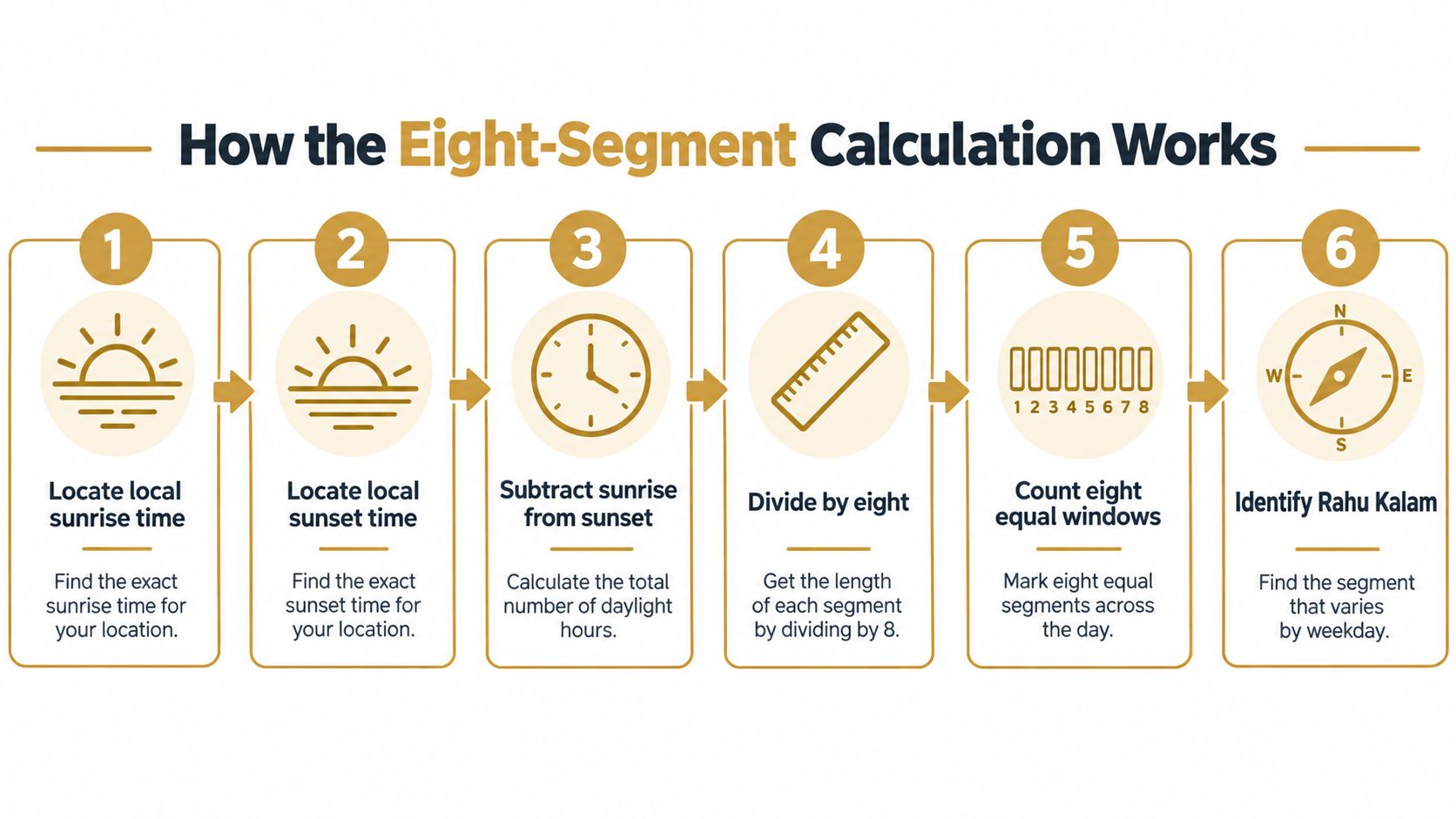
Rahu Kalam uses a straightforward division of daylight. Find the interval between local sunrise and sunset, divide it into eight equal parts, and identify Tuesday's seventh segment under the stated convention, as described in this reference on Rahu Kalam timing.
Follow these steps:
- Record local sunrise for the relevant date and place.
- Record local sunset for that same date and place.
- Calculate daylight by subtracting sunrise from sunset.
- Divide daylight by eight to find the duration of one segment.
- Count from sunrise. The seventh segment is Tuesday's Rahu Kalam.
- Convert the result to local clock time without separating it from the date and location.
A worked example
Suppose sunrise is 05:45 and sunset is 19:15. Daylight lasts 13.5 hours, or 810 minutes. Dividing 810 minutes by 8 gives 101.25 minutes per segment.
Count the segments from sunrise:
- Segment 1, 05:45 to 07:26
- Segment 2, 07:26 to 09:08
- Segment 3, 09:08 to 10:49
- Segment 4, 10:49 to 12:31
- Segment 5, 12:31 to 14:12
- Segment 6, 14:12 to 15:54
- Segment 7, approximately 15:54 to 17:35
- Segment 8, 17:35 to 19:15
Small differences can appear because the segment length includes a quarter of a minute. The calculation therefore produces an approximate local window of 15:54 to 17:35 for this example, rather than a universal Tuesday time.
The weekday assignment remains fixed in this convention. The segment duration changes with the local daylight interval. Rahu Kalam is an optional muhurta, meaning a traditional choice of timing, not a substitute for medical, legal, or safety guidance.
Why the Same Tuesday Looks Different by City and Season
A Tuesday doesn't have one global sunrise or sunset. Mumbai, London, New York, and Singapore can all have different daylight intervals on the same civil date. Since Tuesday Rahu Kalam is the seventh part of each location's daylight, the resulting clock window can differ materially across those cities.
Season also changes the result. If daylight lasts 13.5 hours, each segment lasts approximately 101.25 minutes, so the seventh segment is longer than the 90-minute segment in the 12-hour example. A summer window can therefore be longer and later than a winter window, depending on the location and the local sunrise and sunset used. A detailed discussion of location and seasonal variation explains why Rahu Kalam is better represented as a local interval than as a fixed clock range.
The inputs that change the answer
| Input | Effect on Window |
|---|---|
| Local date | Determines that day's sunrise and sunset |
| City or coordinates | Changes the local daylight interval |
| Sunrise time | Sets the beginning of the first segment |
| Sunset time | Sets the end of the eighth segment |
| Daylight duration | Determines the length of each segment |
| Time zone | Converts the solar calculation into local clock time |
| Daylight-saving status | May shift the displayed civil time |
| Sunrise convention | Can vary between apparent sunrise and a traditional Panchang calculation |
For international users, a city-specific tool should show its inputs rather than display a bare answer. That transparency helps you see whether the result reflects the correct date, time zone, and daylight-saving status.
Near seasonal transitions, check the calculation instead of relying on memory. Locations with unusually long or short daylight also deserve care because a standard Indian clock range can create false precision. A local Panchang calculation for your city is more useful when it shows how the interval was produced.
What Rahu Kalam Actually Governs and What It Does Not
Many Tuesday guides present long lists of activities to avoid, including travel, contracts, purchases, business launches, ceremonies, and sometimes medical procedures. That can make Rahu Kalam sound like a period in which every action is prohibited. The narrower traditional idea is usually about initiating important or auspicious activities, not stopping every ordinary action.
That distinction changes how you handle real life. Starting a new venture, opening a business, signing an agreement, or beginning a ceremony may be treated differently from attending a recurring meeting, completing work already underway, or responding to an obligation created earlier.
Start, continue, or respond
Consider the action's status before you look at the clock:
- Optional beginning: If a new activity is important, auspicious, and easy to move, some practitioners prefer to begin outside the calculated window.
- Existing commitment: A recurring meeting or previously arranged obligation isn't automatically the same as a new beginning.
- Ongoing activity: A journey or project that started earlier is different from initiating it during Rahu Kalam.
- Time-critical submission: A legal or work deadline may leave no practical choice. The timing concern shouldn't encourage you to miss an essential deadline.
- Prescribed medication or essential care: Don't delay treatment or medication because of a traditional timing window.
- Emergency: Safety and urgent action take priority.
These are practical distinctions, not guarantees about results. Traditions differ in how strictly they apply Rahu Kalam, and many families follow local customs that add context. This discussion of what Rahu Kalam does and doesn't govern supports the narrower distinction between avoiding optional starts and treating every activity as forbidden.
Rahu Kalam is a traditional electional-timing consideration. It isn't a substitute for professional medical, legal, financial, or safety guidance.
Use this guidance for personal reflection and self-understanding, not professional advice. If an activity is urgent or essential, act responsibly. If it's discretionary and can be moved without harm, you can use the calculated window as one traditional consideration.
How to Decide What to Do on a Tuesday with Rahu Kalam
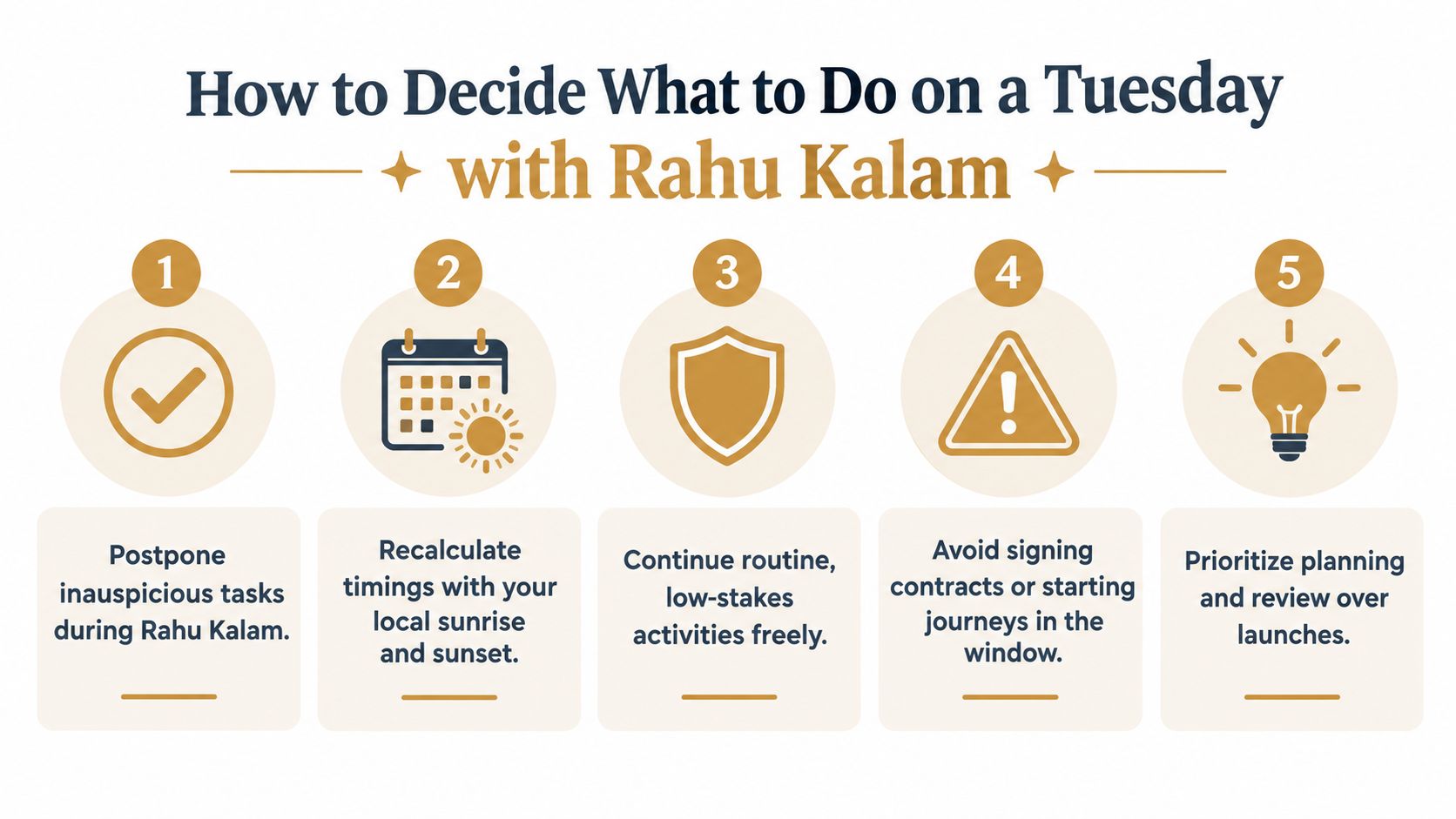
A calm decision process works better than a long list of taboos. Start with the local calculation, then ask what kind of activity you're planning.
A practical order of priority
First, confirm the window. Check the local date, sunrise, sunset, time zone, and daylight-saving status. Don't assume that a familiar afternoon range applies to your city.
Next, classify the activity. Is it a new auspicious beginning, an ordinary continuation, a response to an existing obligation, or an emergency? The traditional concern is strongest for an optional important start.
Then, decide whether moving it is practical. If rescheduling is easy and the activity carries personal or ceremonial importance, you may choose a time outside Tuesday Rahu Kalam. If postponement creates harm, risk, or a serious deadline problem, don't force the situation into a ritual rule.
Rahu Kalam is often listed beside Yamaganda and Gulika. These are separate traditional timing periods, each calculated through a weekday-based division of daylight. Their presence on the same calendar doesn't mean you must automatically combine every avoidance rule and make the entire day unusable.
A useful hierarchy: verify the local interval, separate optional beginnings from unavoidable actions, then consider additional timing rules only if the activity is genuinely discretionary.
For a deeper explanation of choosing a start time, you can read when a good time is selected for a new activity. The aim is not fear. It's clarity about which parts of the decision are mathematical, which are traditional, and which belong to ordinary practical judgment.
Calculate Your Tuesday Rahu Kalam Window Step by Step
A calendar entry can look precise while resting on the wrong location or time setting. Before using a Tuesday Rahu Kalam result, treat the displayed interval as a calculation to verify, not a fixed answer copied from a generic list.
Check these details:
- Confirm the city, local date, time zone, and daylight-saving status.
- Compare the displayed sunrise and sunset with a reliable local almanac.
- Check that the interval represents daylight divided into eight equal parts.
- Verify that Tuesday is assigned to segment seven in the convention being used.
- Confirm that the final times appear in the local clock time shown by your calendar.
This workflow tests the inputs and the result without repeating the arithmetic. If sunrise or sunset is rounded, keep the window approximate. Fractional hours should be converted into minutes before you schedule an optional activity.
A Panchang, a traditional almanac, can perform the calculation, but its convenience does not remove the need to inspect its settings. The Panchang of the day is a useful starting point if it shows the selected place and date. Check whether it uses local time, reflects daylight-saving status where relevant, and follows the sunrise convention that fits your practice.
Use the result as an electional-timing consideration for a discretionary start. It cannot replace medical, legal, safety, or other practical guidance.
Common Mistakes and How to Avoid Them
The first mistake is treating 15:00 to 16:30 as the answer for every Tuesday. That range belongs to the reference case where daylight runs from 06:00 to 18:00. Your city and date may produce a different seventh segment.
The second mistake is applying an Indian clock range to an international location without recalculation. Local sunrise, local sunset, time zone, and daylight-saving status all affect the displayed answer. A static table can be convenient, but it can't show the local inputs unless it's built for that purpose.
Four guardrails for practical use
- Recalculate locally: Use the date and place of the activity.
- Check the segment: Confirm that Tuesday is assigned to segment seven in the convention you're following.
- Separate starts from continuations: Don't treat a recurring meeting or ongoing task as identical to a new auspicious beginning.
- Protect essential action: Don't delay emergencies, prescribed care, safety decisions, or unavoidable deadlines.
A related mistake is combining Rahu Kalam, Yamaganda, and Gulika as if every period carries the same rule. If you follow more than one tradition, learn what each period is intended to indicate instead of stacking vague prohibitions.
Rahu Kalam can be meaningful within a family or spiritual practice. It should still be held with proportion. Use it for personal reflection and self-understanding, not as professional medical, legal, financial, or safety advice.
A careful approach keeps both parts in view: the math must be local, and the decision must distinguish an optional beginning from an essential action.
Anvaya builds a structured Samhita from declared Vedic chart calculations, then uses Pramāṇa to calibrate the reading against events you've lived. If you want a more rigorous way to explore timing, birth-chart context, and classical muhurta without daily horoscope noise, visit Anvaya and generate your Samhita.