
People often treat Sarvartha Siddhi Yoga like a free pass. A date shows up in the Panchang, and the advice follows quickly, start the work, book the ceremony, make the purchase, travel now. That sounds neat, but it flattens muhurta into a slogan. A serious reader has to ask a harder question, does the yoga fit the chart, the task, and the timing pressure in front of you?
At Anvaya, we start from a simpler principle, math first, language second. A timing rule matters only if it survives the rest of the chart. That is true for Sarvartha Siddhi Yoga too. It can be useful, but it is not a blanket promise, and it's worth checking it against the rest of the timing stack before you pay a rupee of attention to it.
Table of Contents
- Why Sarvartha Siddhi Yoga Is Overpromised
- How Sarvartha Siddhi Yoga Actually Forms
- How Often the Yoga Appears and What That Means
- When the Yoga Helps and When It Should Be Ignored
- Practical Rules and Exclusions for Using the Yoga
- Integrating the Yoga into a Broader Timing Strategy
Why Sarvartha Siddhi Yoga Is Overpromised
The public pitch around Sarvartha Siddhi Yoga is usually too broad. It is often described as a near-universal success window for starting work, travel, buying assets, or ceremonies, and that framing is catchy because it is easy to sell. But a good yoga is not the same thing as a good time for every native. Muhurta is always conditional on the rest of the Panchang and on the person using it.
The generic promise is real, but incomplete
Classical and modern listings do treat this yoga as auspicious, even as an “all-purpose success” window. That much is fair. The problem starts when that general meaning gets treated as the whole answer, because timing in Vedic astrology is rarely that simple.
A serious timing judgment has to ask whether the yoga is being used as a fallback convenience or as a true confirmation. If the chart already looks clean, Sarvartha Siddhi Yoga can support the decision. If the chart is under strain, the yoga doesn't erase the strain. It just means the day has one supportive factor inside a larger pattern.
Practical rule: Use Sarvartha Siddhi Yoga as a positive factor, not as a verdict.
Why this matters for real decisions
This gap matters most when the decision is time-sensitive. If you're choosing a wedding slot, a move, or a business start, you're not just asking whether the day is “auspicious” in the abstract. You're asking whether the window is good enough after you check the dasha context, tithi quality, weekday support, and any obvious exclusions.
That is also why generic calendar pages can mislead. They give the date, but they rarely explain what happens when the person's own chart does not cooperate. For a broader view of how classical astrology works as a system, see Anvaya's foundation note on whether Vedic astrology is real. The important part is not proving a slogan. The important part is knowing when a timing label helps.
How Sarvartha Siddhi Yoga Actually Forms
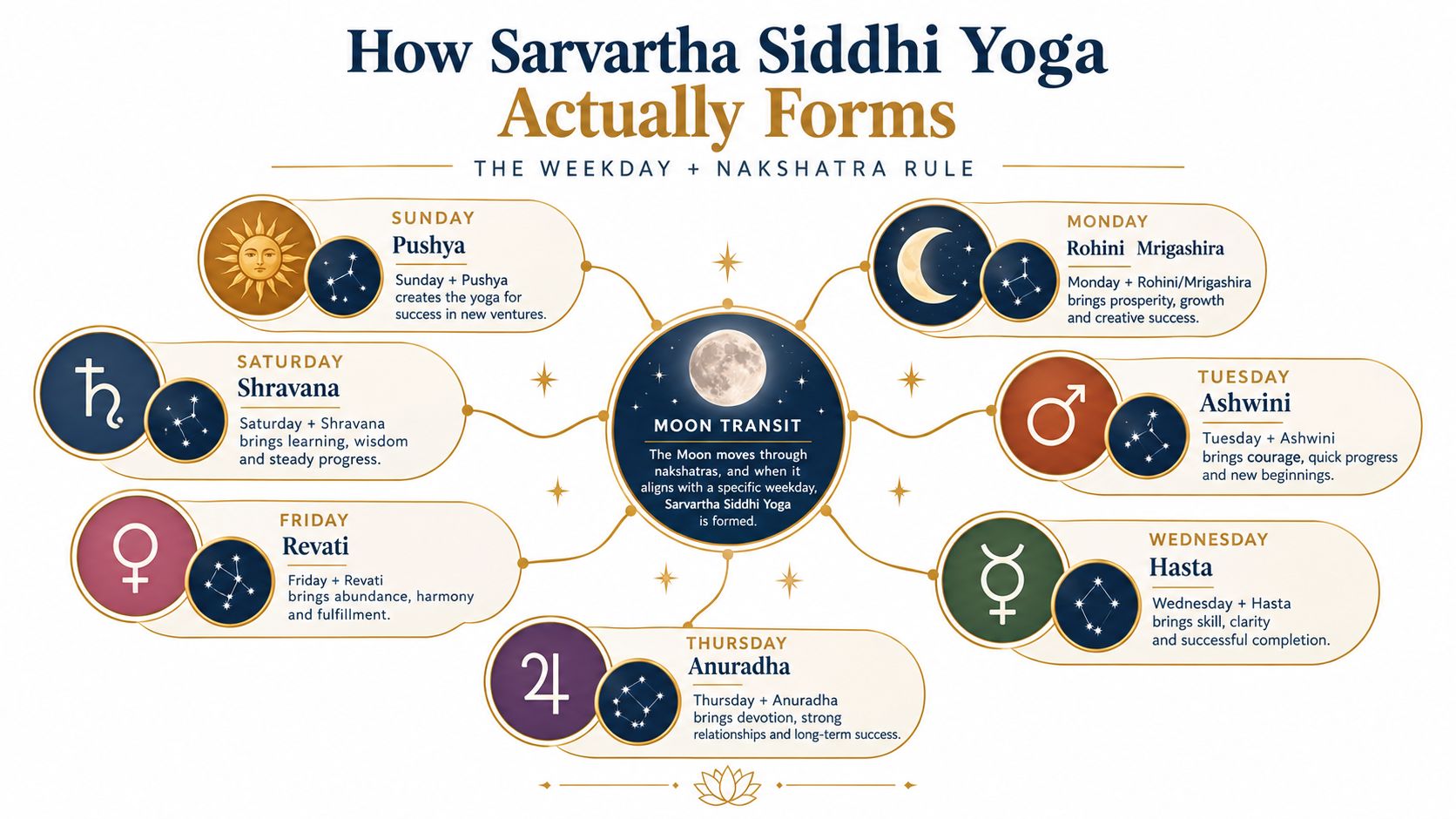
Sarvartha Siddhi Yoga is not a planet-to-planet aspect. It is a weekday-plus-nakshatra rule. The yoga forms only when the Moon is transiting one of a small set of nakshatras on a specific weekday, and the active window runs from sunrise until that nakshatra ends, not for the whole civil day. That makes it operationally precise, which is exactly why you can't treat it loosely.
The rule in plain English
The basic logic is simple. First, check the weekday. Then check whether the Moon is in a nakshatra that belongs to that weekday's qualifying list. If both line up, the yoga is active until the nakshatra changes.
A concrete example helps. Monday can qualify with Rohini, Mrigashira, Pushya, Anuradha, or Shravana. Sunday can qualify with Hasta, Pushya, Ashlesha, Uttara Phalguni, Uttara Ashadha, or Uttara Bhadrapada. The same pattern is described in published Panchang tables and dated listings from a classical calendar source, which also shows that modern calendars publish exact windows for specific dates such as 5 June, 6 June, 11 June, 12 June, 15 June, 18 June, 3 July, 7 July, 9 July, 13 July, 19 July, and 24 July in a 2026 listing. See the Drik Panchang Sarvartha Siddhi Yoga date-time listing for the published calendar structure.
Why the window is shorter than a day
The chart work matters because the yoga starts at sunrise and ends when the qualifying nakshatra ends. That means the usable period can be much shorter than a normal day. A Monday does not automatically become auspicious for the full twenty-four hours just because one nakshatra matches. You have to check the Moon's timing carefully.
This is the point most casual explanations miss. The yoga is a timing rule, not a mood. If you skip the exact interval, you're no longer using the yoga, you're just assuming it.
How Often the Yoga Appears and What That Means
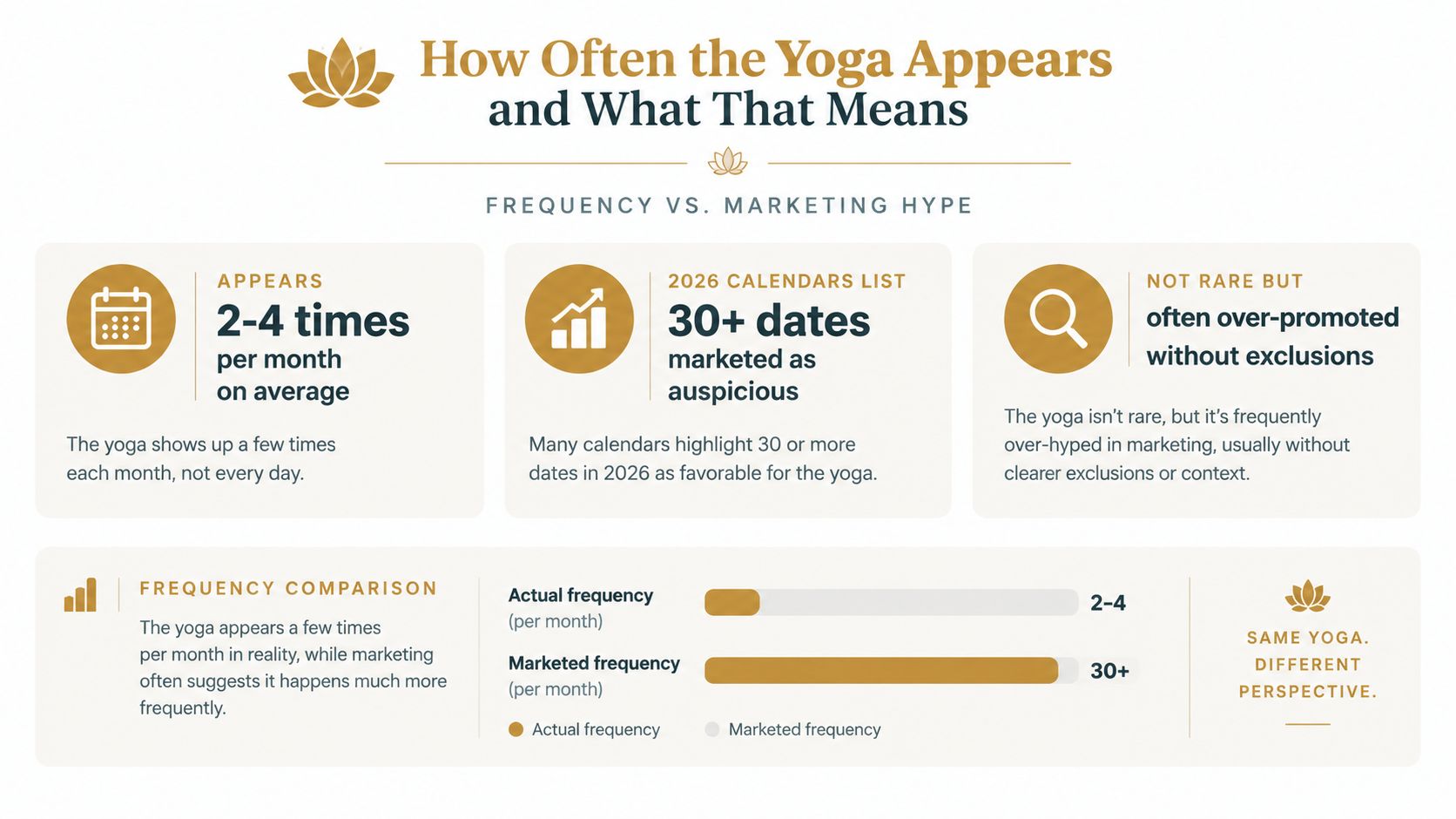
The modern calendar market tends to talk about Sarvartha Siddhi Yoga as if it were scarce. That impression doesn't hold up well. Current Panchang publishers track it as a recurring date-based muhurta, and one 2026 guide says it can appear multiple times every month, sometimes as many as eight to ten days in a 30-day period. That frequency changes how you should think about waiting for it.
Frequent does not mean trivial
A yoga that appears often is not useless. It just isn't rare in the way promotional language sometimes suggests. One 2026 astrology listing even pinpoints an exact Delhi window, from 05:27 AM to 11:46 AM on 3 July 2026, which shows how granular these listings have become. For reference, the published 2026 material also notes June dates on different weekdays, including Thursday, Friday, Saturday, Monday, and Thursday again, which underlines that this is a repeating calendrical pattern, not a once-a-year event. See the Times of India astrology listing for that published example.
That frequency has a practical consequence. If you wait for Sarvartha Siddhi Yoga every time, you may delay work that was already ready to go. If the task has a deadline, waiting only makes sense when the rest of the chart is also supportive. Otherwise, you're buying a label, not an outcome.
Opportunity cost still matters
Many readers get stuck. They ask whether the yoga is “good enough,” but they forget to ask what they lose by waiting. If the ceremony date is fixed, if the travel is already booked, or if a business decision can't be postponed, then the yoga's calendar value drops. A good muhurta should help you decide, not trap you in endless delay.
The right question is not whether the yoga exists. It's whether waiting for it improves the actual decision.
When the Yoga Helps and When It Should Be Ignored
Sarvartha Siddhi Yoga works best as a supportive layer, not as a substitute for chart-specific timing. That matters because the same transit can feel clean for one person and weak or blocked for another, depending on dasha, tithi, and the rest of the chart. A general muhurta cannot override every personal constraint.
Supportive for one native, weak for another
In practical reading, you check whether the native's period is already open for the kind of action they want to take. If the dasha supports initiative, the yoga can add confidence. If the dasha is strained, the yoga may only soften the edge, not remove it. The same is true when tithi or other Panchang factors look unsettled.
That is why a chart-aware reading is more honest than a generic date list. A general-purpose yoga may confirm a timing choice, but it shouldn't automatically replace the rest of the assessment. A good muhurta is a stack of converging signals, not a single green light.
For a cleaner decision framework, see Anvaya's guide on when a time is actually good to start. The core idea is simple, the chart should support the choice before the calendar gets credit for it.
When to treat it as secondary
There are moments when Sarvartha Siddhi Yoga should stay secondary. If the dasha is visibly weak, if the task itself is poorly matched to the weekday, or if another obvious Panchang factor is off, the yoga doesn't deserve to lead the decision. It becomes one more support, not the deciding factor.
This is especially important in family decisions. Couples and parents often want one auspicious label to settle a tense timing discussion. That's understandable, but it's not how careful muhurta works. The better reading is slower and less dramatic. It checks whether the day is suitable, then checks whether the person's chart is ready to use the day well.
Practical Rules and Exclusions for Using the Yoga
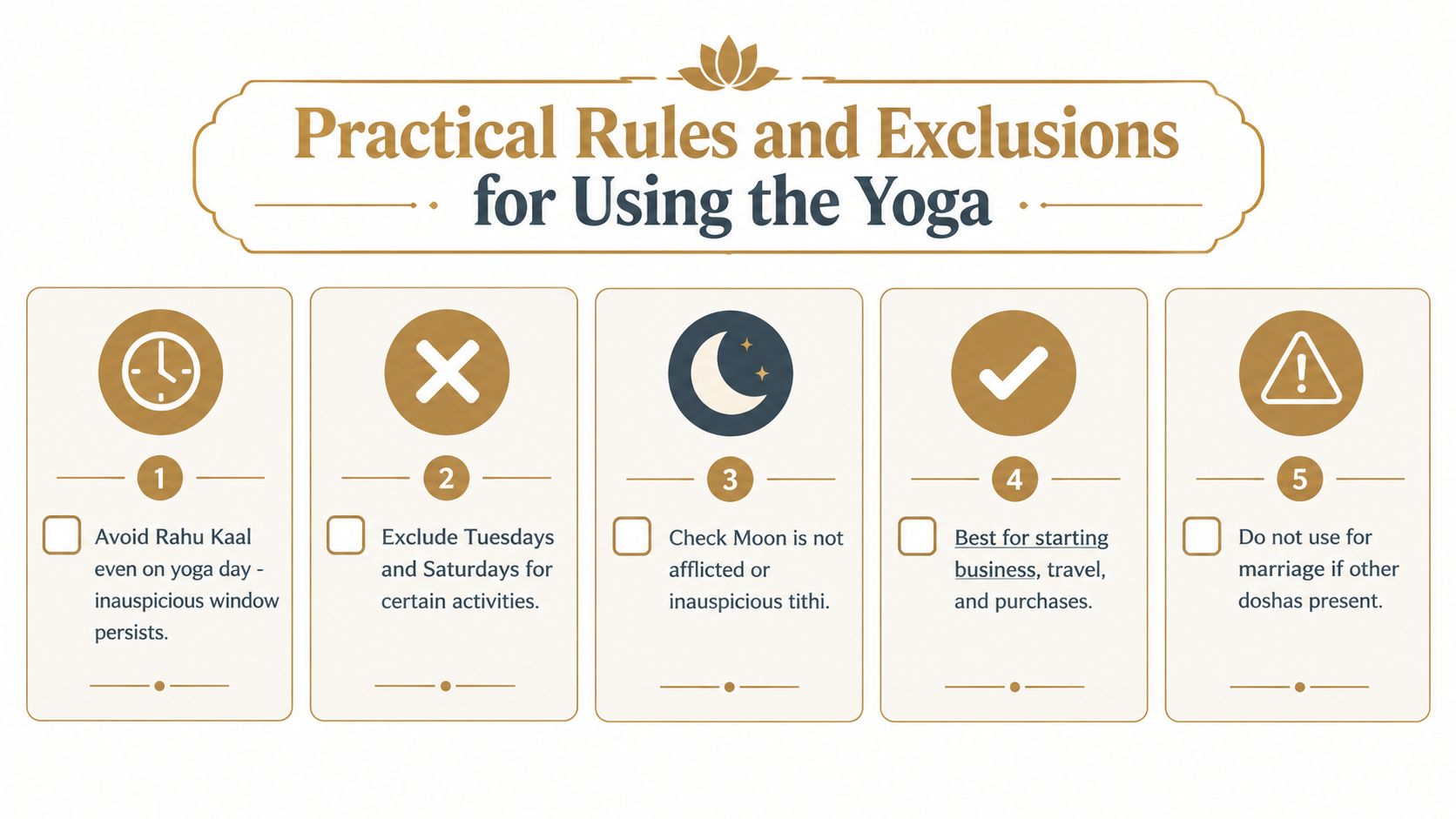
The basic rules around Sarvartha Siddhi Yoga are simple, but they matter. Some traditions say you still need to avoid Rahu Kaal during the day, even if the yoga is active. Others add weekday-specific exclusions, such as avoiding vehicle purchases on Tuesday and iron materials on Saturday. The yoga is auspicious, but it doesn't cancel every other rule in the Panchang.
Start with the exclusions, not the excitement
If you're using the yoga for a serious task, begin by checking the exclusions. A day can look promising on paper and still contain a bad window for the specific action. That's why the timing sequence matters. First the day, then the bad periods, then the actual usable slot.
Published guidance also notes that some actions should still be avoided on certain weekdays. One source explicitly flags Tuesday for vehicle buying and Saturday for iron materials. Another reminds readers to keep Rahu Kaal out of the final slot. These are not glamorous rules, but they're the ones that keep people from overstating the yoga.
A simple working checklist
- Check the weekday match first. The yoga only exists when the weekday and nakshatra align.
- Respect Rahu Kaal. If the day has an avoided period, don't force the task into it.
- Watch the task-specific fit. A day that works for one action may not suit another.
- Do not treat the yoga as a marriage fix. If other doshas are present, the day still needs broader review.
- Use it where the chart already agrees. Business starts, travel, and purchases tend to be the most straightforward uses when the rest of the timing supports them.
That last point matters most. Sarvartha Siddhi Yoga is not a magic patch. It works best when it sits inside a clean timing field.
Integrating the Yoga into a Broader Timing Strategy
Sarvartha Siddhi Yoga belongs inside a broader Panchang reading, not above it. If you're serious about timing, you weigh it against weekday quality, nakshatra condition, dasha context, and the task itself. That is the difference between using a muhurta and chasing a label.
A useful way to think about it is this, the yoga can confirm, but it shouldn't be forced to compensate. When the rest of the chart supports the move, it adds confidence. When the rest of the chart is off, it becomes a weak excuse for urgency. That is why calibrated timing works better than blind reliance.
For readers who want a structured way to compare timing factors, our Panchang score method note shows how we keep the logic visible instead of hiding it inside a vague blessing.
If you want a cleaner answer than “this date looks good,” Anvaya gives you a declared chart reading, chart-first calibration, and plain-language timing notes you can use. Generate a Samhita if you want the yoga weighed against your own dasha context before you make the call.