A couple can score well on a kundli match and still feel uncertain about marriage. Another couple can receive a modest score yet find that their values, timing, and relationship patterns fit better than the number suggests. The popular advice, “18 points means yes,” is too simple for a serious decision.
Vedic astrology compatibility works better as a layered diagnostic. It begins with Ashtakoota Guna Milan, then checks Mangal Dosha, the marriage structure in both birth charts, and whether the partners enter supportive marriage periods at the same time. A chart can raise useful questions, but it can't decide consent, character, communication, or whether two adults should marry.
Table of Contents
- Why Vedic Compatibility Is More Than a Score
- Ashtakoota and the Eight Kootas Explained
- Mangal Dosha as a Separate Filter
- What Ashtakoota Misses in the Birth Charts
- Dasha Alignment and Shared Marriage Timing
- A Sambandha Workflow for Couples and Families
- Practical Questions Couples Actually Ask
Why Vedic Compatibility Is More Than a Score
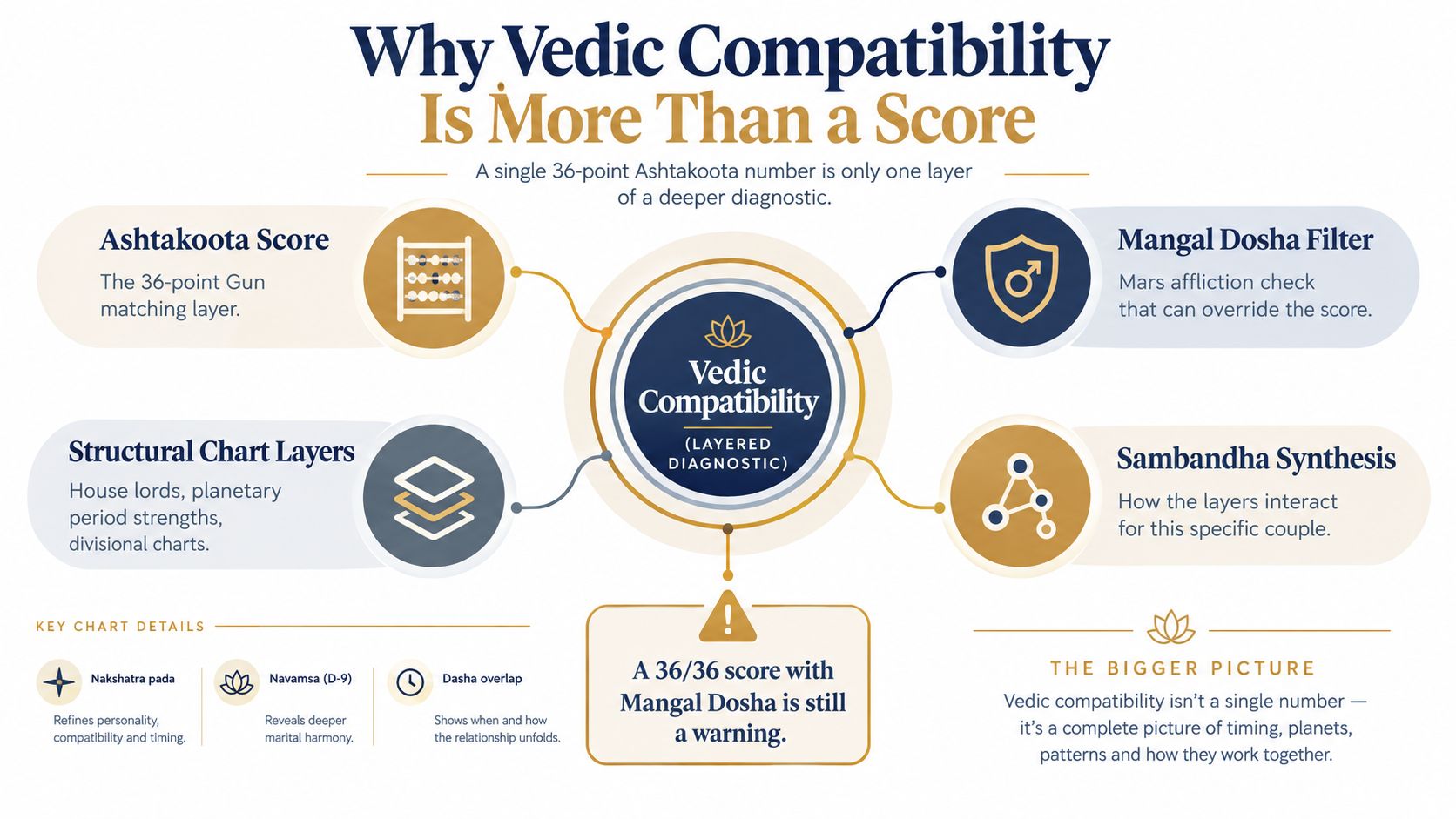
The 36-point Ashtakoota score is a screening tool, not a verdict. The commonly used threshold is 18 out of 36, but crossing that line doesn't prove that a marriage will be harmonious. In the same way, one high reading in a health checkup deserves investigation but doesn't diagnose a person, one low koota or one perfect score needs context.
Classical compatibility analysis compares two people through eight kootas, then adds separate checks for factors that the score doesn't fully capture. These include Mangal Dosha, the seventh house, the Navamsa chart, cross-chart planetary relationships, and dasha timing. A stronger assessment asks whether these layers support one another or produce contradictions.
The score is the first question
Ashtakoota uses the Moon sign and birth nakshatra to rank several relationship dimensions. It can help a family or couple identify areas that deserve discussion. It can't describe the full condition of either birth chart.
Mangal Dosha sits outside the 36-point total. That matters because a couple may receive a high Guna Milan score and still require a separate Mars analysis. The structural layers then examine the marriage houses and divisional charts, while dasha analysis asks whether both people have supportive marriage windows at the same time.
Practical rule: A compatibility reading becomes more useful when every important finding is tested against the other layers instead of being treated as final on its own.
The classical background of Ashtakoota Guna Milan places the framework within a longer Vedic suitability tradition. The method was formalized in medieval texts such as Muhrta Chintamani, while earlier Dharma Shastra and Smriti traditions also discussed pre-marriage suitability. Its continued use doesn't make the score infallible. It shows why the framework remains a central reference point for Hindu matchmaking.
Ashtakoota and the Eight Kootas Explained
Think of the eight kootas as eight lenses, not eight mystical labels. Each lens asks a different question about how two people may relate. Their weights total 36 points, with Nadi carrying the largest individual weight at 8 points.
The traditional model includes:
| Koota | Max Points | What It Measures |
|---|---|---|
| Varna | 1 | Broad social and value compatibility |
| Vashya | 2 | Mutual influence and ease of relating |
| Tara | 3 | Supportive nakshatra relationship and general flow |
| Yoni | 4 | Instinctive and physical chemistry |
| Graha Maitri | 5 | Intellectual affinity and temperament friendship |
| Gana | 6 | Basic temperamental fit |
| Bhakuta | 7 | Emotional rhythm, family welfare, and the relationship between signs |
| Nadi | 8 | Health and genetic harmony in the traditional framework |
What the points mean
Varna has a small weight, so it shouldn't dominate the reading. It is better understood as a broad indication of values and social orientation than as a modern measure of status.
Vashya considers how the partners influence one another. One person may naturally lead in some areas, while another may resist control. That isn't automatically harmful, but the pattern deserves honest conversation.
Tara examines the relationship between the birth nakshatras. Readers often use it to consider support, ease, and the general flow between the two charts.
Yoni is about instinctive chemistry. It isn't a guarantee of intimacy or attraction. It offers one traditional lens for understanding how natural responses may differ or align.
Graha Maitri considers mental affinity and friendship between the planetary rulers involved. A couple may disagree often and still think well together, or they may share interests but struggle to feel understood. This koota helps separate those possibilities.
Gana describes temperament. It can point to differences between a more direct, sensitive, practical, or socially oriented style. Temperament is a tendency, not a fixed personality verdict.
Bhakuta looks at the relationship between the partners' signs. A useful analogy is the daily rhythm of two families. Do their emotional patterns, household expectations, and ideas of togetherness move in a compatible direction?
Nadi carries 8 points, the highest weight in the system. Traditional readings give it special attention because it relates to health and genetic harmony. A Nadi concern can therefore matter even when the total score looks strong. As the Ashtakoota scoring model makes clear, point totals don't erase the meaning of a high-weight category.
Common score bands treat results below 18/36 as not recommended, 18–24 as acceptable, 24–32 as very good, and 32–36 as excellent, though guides vary slightly in how they label the upper ranges. The number ranks a pattern. It doesn't promise a particular home life.
Mangal Dosha as a Separate Filter
Mangal Dosha, also called Kuja Dosha, is assessed outside the Ashtakoota score. This is one of the most common sources of confusion. A couple can score well on Guna Milan and still receive a Manglik flag because Mars is being evaluated through a different compatibility question.
The practical question is not “Is Mangal Dosha present?” It is, “How strong is the indication, from which reference points is it seen, and is there balancing evidence in both charts?” Traditional schools may examine Mars in relation to the Lagna, Moon, and Venus, but methods differ. Because traditions don't apply every rule identically, a careful reading should state the calculation method.
Some chart-based analyses report Mangal status in a large share of charts. One analysis of 100,000 charts found about 50.1% Manglik from the Lagna and 75.0% when measured from either the Lagna or the Moon, as described in this compatibility analysis of Mangal Dosha. That prevalence explains why many practitioners treat it as a filter to investigate rather than a rare warning.
Cancellation and reduction are part of the reading
Mangal Dosha isn't a simple yes or no condition. Traditional cancellation or reduction rules consider the sign and support around Mars, as well as whether both charts carry a comparable indication.
| Condition | Effect on Dosha |
|---|---|
| Mars is in its own sign | May reduce or cancel the concern under some traditions |
| Mars is exalted | May reduce or cancel the concern under some traditions |
| Jupiter aspects or conjoins Mars | May provide mitigating influence |
| Mars is placed in Sagittarius or Pisces | May be treated as a mitigating condition in some rules |
| The seventh lord occupies a kendra | May reduce the marriage concern under specified traditions |
| Both partners have Mangal Dosha | The matching condition may be treated as balanced |
A plain-language guide to Mangal Dosha cancellation shows why the entire chart must be read together. Presence raises questions about conflict, assertion, and relationship strain. Absence removes that specific question, but it doesn't guarantee patience, mutual respect, or shared values.
For a calculation that clearly separates this check from Guna Milan, see the Mangal Dosha calculator guide. Use any calculator as a starting point, then confirm the inputs and the school of interpretation before making a family decision.
What Ashtakoota Misses in the Birth Charts
Ashtakoota compares Moon-based compatibility. It doesn't, by itself, read the whole marriage architecture in either birth chart. That distinction is the difference between a useful screening report and a full two-chart assessment.
The seventh house shows the marriage structure
The seventh house is the primary house examined for partnership and marriage. A practitioner studies the sign there, the planet ruling it, planets placed in it, and the condition of those planets. This can add information about the tone of partnership that a koota number cannot express.
For example, two people may have a strong score for mental affinity but show very different relationship needs through the seventh house. One chart may seek steadiness and regular reassurance. The other may show a stronger need for independence or a different pace of commitment. Neither pattern is automatically a rejection. It tells the couple what must be discussed.
Navamsa adds a deeper relationship layer
The Navamsa, or D9 chart, is a divisional chart used in Vedic astrology to examine the deeper strength and expression of marriage-related factors. Comparing both Navamsas can clarify whether the promise seen in the main birth charts has support at a more refined level.
Cross-chart Venus and Mars also deserve attention. Venus relates to affection, attraction, and the way a person values connection. Mars relates to desire, assertion, and conflict. Their relationship across two charts can support or complicate a high Ashtakoota result.
| Layer | What It Adds | When It Overrides the Score |
|---|---|---|
| Seventh house | The structure and tone of partnership in each chart | When marriage indicators are consistently strained |
| Seventh lord | The condition of the planet governing partnership | When its weakness conflicts with a high Moon-based score |
| Navamsa | Deeper support for marriage-related themes | When the D9 weakens an otherwise attractive promise |
| Venus and Mars | Attraction, affection, assertion, and conflict dynamics | When cross-chart interaction creates a clear structural problem |
A detailed explanation of compatibility beyond Ashtakoota also presents the 36-point model as incomplete without the seventh house, Navamsa, and cross-chart Venus and Mars analysis. It notes that empirical surveys found no statistically significant link between Manglik status and adverse marital outcomes. That supports a measured use of Mangal Dosha, as a screening heuristic rather than a standalone prediction.
Compatibility is therefore layered, not summed. A strong score can identify a promising baseline. It can't overrule every structural difficulty in the charts.
Dasha Alignment and Shared Marriage Timing
A structurally compatible pair still needs a workable time window. Dasha alignment asks whether both people are moving through periods that support commitment, marriage, and the practical formation of a shared household.
A Mahadasha is a major planetary period. An Antardasha is a sub-period within it. Together, they provide a clock for interpreting when a chart's relationship themes may become more active. This doesn't mean a dasha forces an event. It means the period may be more or less supportive if the underlying chart already contains that potential.
Read the two clocks together
A practitioner may examine periods connected with Venus, Jupiter, the seventh lord, or the natal Moon when assessing marriage timing. These planets and lords are not automatically positive in every chart. Their condition, house placement, dignity, and relationship with other factors still matter.
Periods ruled by Saturn, Rahu, or difficult relationship houses may coincide with delay, distance, pressure, or a need to resolve existing obligations. That doesn't make marriage impossible. It changes the questions. Is the couple ready to handle responsibility? Are external commitments slowing the process? Does the period support clarity, or does it encourage rushed decisions?
Transit, or gochara, supplies another timing layer. Jupiter or Saturn moving over relevant partnership points may support an active marriage period, but transit alone shouldn't be treated as proof. It must align with the dasha sequence and the natal chart.
A score describes potential fit. Dasha alignment asks whether both people can act on that fit at the same time.
The Vedic astrology birth chart guide is useful for understanding why timing can't be separated from the individual chart. A couple may have a moderate score and still find a practical opening when both charts show supportive periods. Another couple may have an attractive score but face a long mismatch in readiness, location, family duties, or commitment timing.
A Sambandha Workflow for Couples and Families
A serious two-chart reading should produce a conversation, not a sentence such as “approved” or “rejected.” A Sambandha-style workflow keeps the calculation, interpretation, timing, and lived context in the right order.
Start with a reproducible baseline
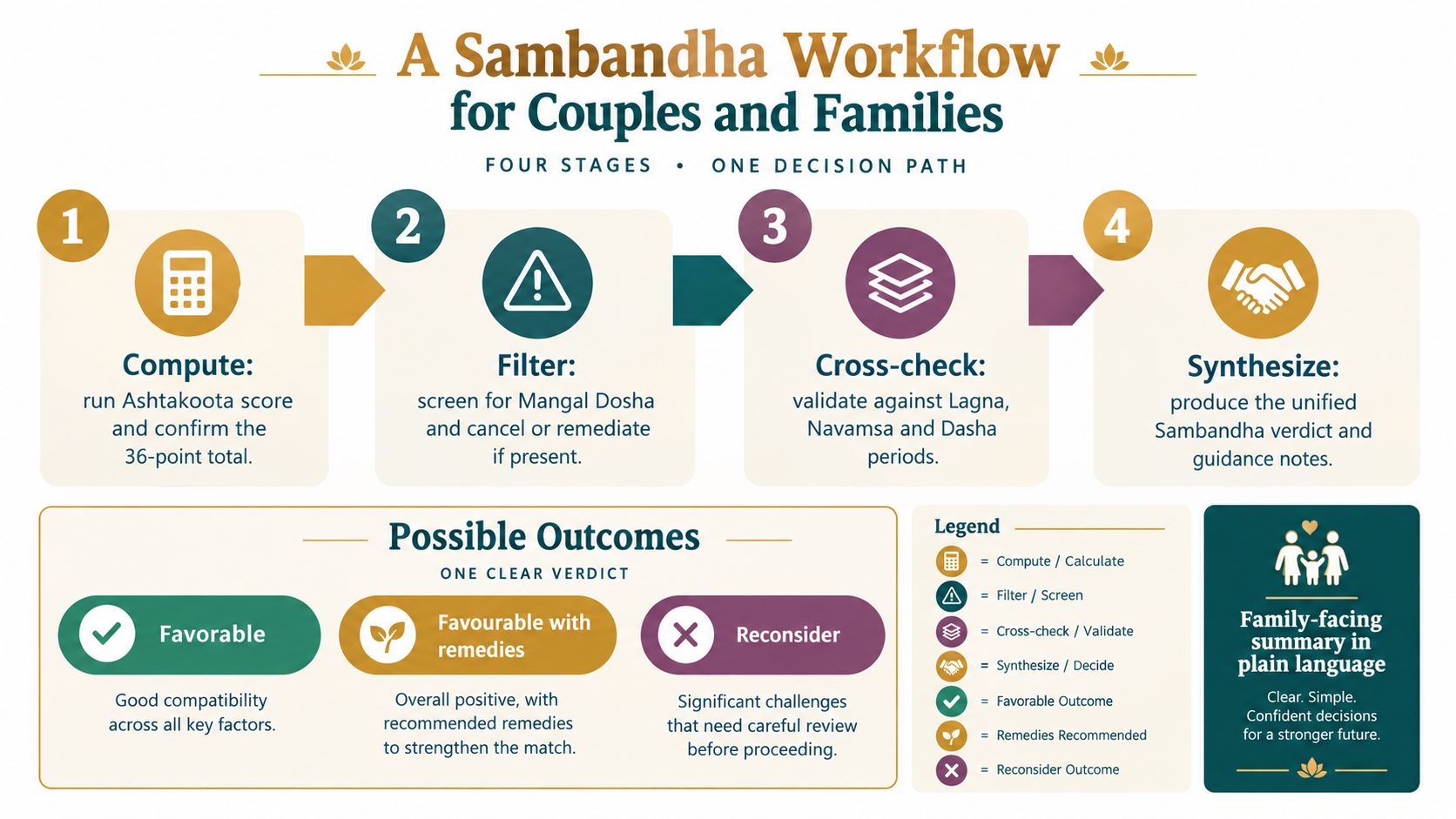
First, compute. Confirm both birth dates, birth times, and birth places. Run the Ashtakoota calculation and record the individual koota scores, not just the final total. This makes it possible to see whether the result depends heavily on one category.
Second, filter. Check Mangal Dosha separately and document the reference points and cancellation rules used. A transparent report should show why a flag was raised and what evidence reduces it.
Third, cross-check. Read the Lagna chart, seventh house, seventh lord, Navamsa, Venus and Mars relationships, and dasha periods. If one layer conflicts with another, keep the conflict visible. Don't hide it behind an average score.
Fourth, synthesize. Bring the astrological findings into a plain-language discussion about family expectations, location, work, money, communication, intimacy, and existing commitments. These are not details to ignore while waiting for a planetary answer. They're the lived context in which any relationship must function.
The two charts should be treated as decision support for reflection and self-understanding, not professional advice. Astrology can't provide medical, legal, financial, employment, or safety advice, and it can't replace direct consent or careful conversations between the people involved.
A structured relationship analysis methodology can help families compare findings without turning the process into a contest between relatives. The final output should distinguish a favorable pattern, a pattern that needs further discussion or traditional remedies, and a pattern that calls for caution. It should also state where the chart is unclear.
Practical Questions Couples Actually Ask
Should a low Guna Milan score end the relationship?
Not automatically, but it should slow the process and invite a fuller review. A result below the conventional threshold is a reason to inspect the individual charts, Mangal Dosha, Navamsa, and timing rather than a complete answer by itself.
What if only one partner has Mangal Dosha?
Ask how the condition was calculated, how strong it is, and whether the chart contains cancellation or mitigating factors. Matching status between partners is one traditional consideration, but it shouldn't be treated as a fear-based verdict. Research on layered compatibility also frames the 18-point rule as a screening threshold rather than the final decision.
Do same-nakshatra pairings always cause problems?
No universal conclusion should be drawn from the nakshatra name alone. The relevant koota details, pada, Moon placement, individual marriage factors, and the broader chart must be read together. Different schools may also apply rules differently.
What if the families disagree with the report?
Ask everyone to return to the inputs and method. A useful report should show the score, the Mangal Dosha logic, the structural findings, and the timing basis in language that both families can understand. If the disagreement remains serious, a second opinion from a practitioner who will explain the calculation is reasonable.
How often should a couple revisit compatibility?
Don't reopen the analysis every time anxiety appears. Revisit it when the birth data was uncertain, when a major life decision changes the context, or when the couple needs a clearer timing discussion. Recurring fights, financial stress, and health concerns deserve direct attention from appropriate professionals, regardless of the koota score.
The value of a compatibility reading lies in surfacing blind spots before commitment. It should help two adults ask better questions, not hand one person authority over the other.
Anvaya offers a classical birth-chart Samhita, Pramāṇa calibration against lived events, and Sambandha analysis for two calibrated charts, including compatibility checks and shared timing. Visit Anvaya to see how a compute-first, plain-language reading can support a more grounded conversation about compatibility.