
A man reads another list about the Taurus rising man and finds the same adjectives again: calm, loyal, attractive, stubborn. Yet those words don't explain why he takes so long to make a decision, why he stays with a plan after others have changed direction, or why a relationship can feel safe to him and restrictive at the same time. The problem isn't always the description. Often, it's the starting point.
In Vedic astrology, that starting point is the ascendant, or lagna. It describes the sign rising on the eastern horizon at birth and gives the chart its house structure. Taurus rising, or Vrishabha lagna, therefore has a different meaning from having the Sun in Taurus. A serious reading begins with the chart mechanics, then tests the interpretation against the person's lived experience.
Table of Contents
- The Taurus Rising Man Starts with the Ascendant, Not the Sun Sign
- What Vrishabha Lagna Actually Means in Chart Mechanics
- Temperament, Body and Decision Style of a Taurus Rising Man
- Career, Money and the Slow-Compounding Work Pattern
- Relationships, Loyalty and the Line Between Steady and Stuck
- Appearance Claims and What They Are Really Telling You
- Timing the Taurus Rising Man with Dasha, Transits and Muhurta
- A Chart-First Reading of a Taurus Rising Man
The Taurus Rising Man Starts with the Ascendant, Not the Sun Sign
Consider a man who has read a dozen Taurus Sun descriptions. He recognises the references to patience and comfort, but they don't quite fit the timing of his life. He may be steady in work yet restless in relationships, reserved in public but forceful at home, or slow to commit but difficult to move once committed. A Sun-sign paragraph can't explain those differences because it isolates one placement from the chart's operating structure.
The ascendant is more immediate. It marks the first house, which Vedic astrology uses as the reference point for the body, outward behaviour, initial presentation, and the way a person meets circumstances. Because it also determines the sequence of all other houses, changing the ascendant changes the chart's entire frame.
A Taurus Sun can describe one part of identity. Taurus rising describes the lens through which the whole chart is encountered. That doesn't make it a complete personality verdict. It makes it the first diagnostic layer.
Why a lagna-first reading matters
A careful jyotishi usually asks questions in an order rather than collecting attractive adjectives. First comes the lagna, then its ruler, then the Moon, and then the Sun. The lagna gives the baseline. The lagna lord, meaning the planet ruling the ascendant, shows where that baseline receives support, pressure, visibility, or redirection.
For Taurus rising, Venus rules the ascendant. Its sign, house, dignity, conjunctions, aspects, and timing condition the way Taurus qualities appear. A well-supported Venus may express as refinement, stable preferences, and a measured approach to attachment. A pressured Venus may show the same need for security through rigidity, over-indulgence, or difficulty adjusting.
Key principle: Taurus rising is a starting condition, not a finished personality template.
The rest of this article uses that premise. It treats steadiness, sensuality, loyalty, and stubbornness as possible expressions of a fixed-earth ascendant ruled by Venus. The full chart still decides how strongly those signals appear and when they become visible.
What Vrishabha Lagna Actually Means in Chart Mechanics
Vrishabha is the Sanskrit name for Taurus. Lagna means the ascendant, the sign rising in the east at the moment of birth. So Vrishabha lagna means Taurus occupied that eastern horizon, making Taurus the first sign of the house sequence.
That position matters for three connected reasons.
- The element is earth. Earth symbolism points toward tangible experience, routine, resources, the body, and results that can be maintained. In a Taurus rising man, this can create a preference for what feels usable and durable over what is merely exciting.
- The modality is fixed. A fixed sign is associated with holding, consolidating, and continuing. It tends to resist unnecessary change. The benefit is endurance. The difficulty is delayed adaptation.
- The ruler is Venus. Venus brings themes of value, attraction, pleasure, aesthetics, relationship, and material refinement into the ascendant's basic expression.
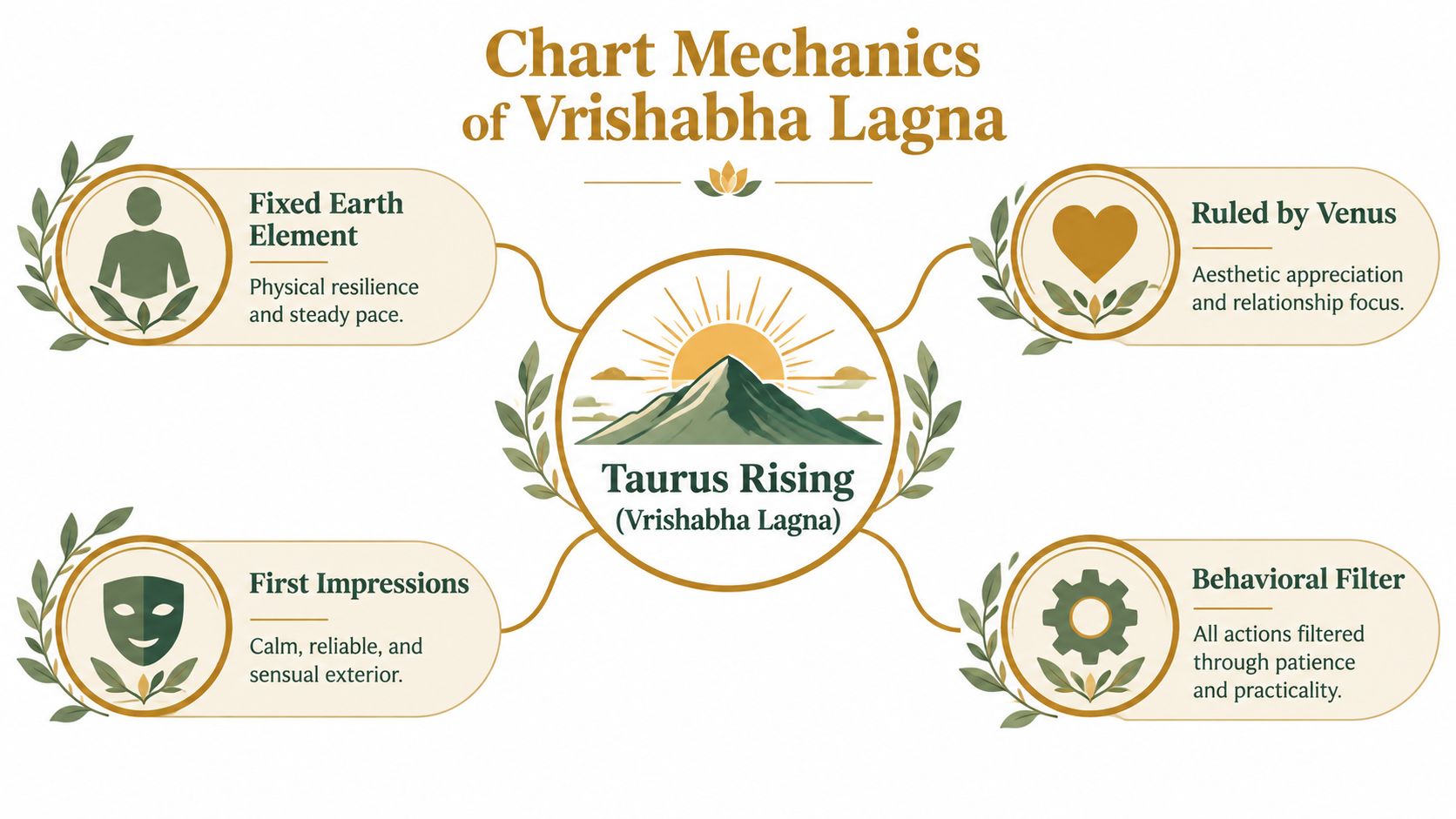
The ascendant as a behavioural filter
The lagna isn't only a label attached to appearance. It conditions the way a person approaches the world. A Taurus ascendant may pause before acting, assess comfort and risk, and prefer to build certainty through repetition. The man may not be opposed to change in principle. He may only require a reason that feels concrete enough to justify the disruption.
The lagna lord adds the next layer. Venus shows what sustains the person's sense of coherence and what kinds of experiences attract him. If Venus is connected to resources, he may focus strongly on financial stability. If connected to communication, creative skill or social exchange may become more prominent. If under strain, the search for comfort may become avoidance.
This is why a Taurus rising man shouldn't be reduced to “calm and sensual.” Those words describe the broad symbolism. The chart must show where Venus operates and what modifies it.
Temperament, Body and Decision Style of a Taurus Rising Man
The default pace is usually deliberate. A Taurus rising man may dislike being hurried because speed can feel like a loss of control over quality, comfort, or consequences. He often wants to know what a decision will cost, what it will preserve, and whether the result will last.
That produces an accumulation-driven decision style. He may save information, compare options, revisit a choice, and then commit firmly. This can look passive to people who equate movement with progress. In practice, the man may be building internal certainty before making an external move.
What the body symbolism can and cannot say
Astrology references repeatedly associate Taurus rising with a solid or sturdy frame, broad shoulders, a notable neck, fuller facial features, and measured movement. Other descriptions mention a grounded physique, a calm face, and deliberate mannerisms. These are recurring qualitative motifs, not census findings or reliable predictions about every individual. The traditional symbolism of Venus-ruled signs is more useful when treated as a starting language than as a checklist.
The neck is often given special emphasis because Taurus is associated with that region in traditional body correspondences. Venus can add pleasant features, vocal appeal, or a composed presentation. But a full chart can alter the result through planets in the first house, the condition of Venus, the sign occupied by the ascendant, and divisional confirmations.
A reader should therefore separate three levels of confidence:
- Recurring signal: a grounded presence, steady pace, and preference for sensory stability.
- Possible expression: a strong neck, fuller features, pleasing voice, or solid body.
- Unsupported certainty: claiming that every Taurus rising man is muscular, conventionally attractive, or dressed in earthy colours.
When steadiness becomes resistance
The same structure that supports patience can resist interruption. A Taurus rising man might continue a routine after it has stopped serving him because the cost of changing it feels greater than the cost of tolerating it. Venus may seek peace, while the fixed ascendant protects familiar conditions.
The condition of Venus matters here. If Venus is combust, meaning too close to the Sun and traditionally weakened by that proximity, its results may become less straightforward. Other house placements, conjunctions, and aspects can also redirect the expression. The ascendant offers the baseline, but it doesn't remove the need for chart-specific judgment.
Career, Money and the Slow-Compounding Work Pattern
A Taurus rising man often works best when effort can accumulate. He may prefer a craft that improves through repetition, an asset that gains usefulness over time, or a role where trust grows through consistent delivery. He doesn't need a slow industry, but his natural rhythm usually favours durable construction over constant reinvention.
Possible fields include design, music, hospitality, agriculture, real estate, finance, luxury goods, food, and other work connected with value, quality, materials, or sensory experience. These aren't career prescriptions. Venus may support artistic or commercial themes, but the tenth house, its lord, relevant aspects, and the active dasha must be examined before making a serious statement.
Why the chart can favour accumulation
Taurus occupies the first house, so fixed-earth symbolism colours the person's approach to effort and resources. Venus, as the ascendant lord, links self-development with questions of value. He may ask whether a job provides security, whether the product has quality, and whether the work can be sustained without damaging his private life.
This can create sensible resource habits. He may prefer saving before spending and feel uncomfortable with unsecured obligations. Yet those tendencies change when Venus is combust, retrograde, or placed in the sixth, eighth, or twelfth house. Those conditions don't automatically produce financial difficulty. They show that the simple Taurus template can't be used without modification.
A practical reading checks:
- the second house, connected with resources, speech, and stored value;
- the tenth house, connected with public work and contribution;
- Venus's sign, dignity, house, and associations;
- the current mahadasha, the major planetary period active in the life sequence.
Speed isn't the only measure
A Taurus rising man can work in a volatile field if the rest of the chart and the dasha support experimentation. His fixed-earth baseline may still show up in how he handles volatility. He may build a stable operating method, protect a reliable income stream, or insist on quality while others chase novelty.
The useful question isn't “Is he ambitious?” It is “What kind of effort can he repeat when the initial excitement has gone?” That question tests the actual Taurus mechanism. It also leaves room for the tenth lord, planetary strengths, and timing to change the outcome.
Relationships, Loyalty and the Line Between Steady and Stuck
A Taurus rising man may take commitment seriously, but the reason needs careful explanation. Venus rules his ascendant, so attraction, pleasure, affection, and shared value are close to the way he experiences identity. The fixed quality of Taurus then tends to preserve what has been chosen.
This can look like loyalty. He may not leave impulsively, and he may commit fully to familiar routines with a partner. He often values physical closeness, dependable conduct, a comfortable home, and an agreed way of living. Those preferences can support a long relationship when both people continue to participate actively.
Loyalty is not possession
The difficult edge appears when preservation becomes control. A man may call his refusal to adapt loyalty, while his partner experiences it as emotional inertia. He may describe constant monitoring as care, while the other person experiences possessiveness. These aren't minor language differences. They show the difference between protecting a bond and treating it as property.
The seventh house, the house of partnership, is where the ascendant's self-pattern meets another person. For Taurus rising, that axis deserves more attention than generic claims about being faithful. A serious jyotishi examines the seventh lord, Venus's dignity, planets influencing the seventh house, and the role of Saturn or the lunar nodes.
The chart may show a person who:
- Builds slowly: commitment develops through repeated reliability.
- Protects continuity: shared routines and material security matter.
- Resists rupture: separation or renegotiation may take time.
- Needs conscious flexibility: stability can become stagnation if no one updates the agreement.
Steadiness is valuable only when it leaves room for truth, growth, and mutual choice.
A Taurus rising man isn't automatically a good or bad partner. The ascendant shows a pattern of holding. The full chart shows what he holds, how he responds to pressure, and whether he can distinguish love from fear of losing familiar ground. For personal reflection and self-understanding, this can be useful. It isn't professional relationship, legal, or mental-health advice.
Appearance Claims and What They Are Really Telling You
Online descriptions of the Taurus rising man often repeat a stock image: broad shoulders, a strong neck, steady eyes, a calm voice, and an attractive or composed face. These descriptions have historical continuity in astrology writing, but they aren't body measurements gathered from a population. They shouldn't be presented as proof.
In classical interpretation, appearance is read through the ascendant, its ruler, planets in the first house, and the relevant divisional context. Venus may suggest pleasant features, visual harmony, or a refined bearing. Earth symbolism may suggest solidity and a grounded presence. Neither factor fixes a particular height, weight, jawline, or clothing style.
Read the symbol, then test the chart
A more responsible approach asks:
- Is Venus strong, weakened, combust, or closely joined with another planet?
- Which sign and house does Venus occupy?
- Do planets in the first house alter the expression?
- Does the navamsa, a key divisional chart, support or complicate the natal signal?
The answer may be a sturdy physical presence, but it may also be a quiet voice, a deliberate gait, or an instinct for presentation. Appearance claims are best treated as symbolic shorthand. They become more meaningful only when they agree with the rest of the chart and with lived observation.
Timing the Taurus Rising Man with Dasha, Transits and Muhurta
The Taurus ascendant gives a baseline. Dasha adds sequence. In Vedic astrology, a dasha is a planetary period that brings particular houses and significations to the foreground. Gochar means transit, the movement of planets through the sky in relation to the birth chart. Muhurta is the selection of a suitable time for an action.
A timing reading layers these tools rather than treating Taurus rising as a calendar prediction.
Start with the active planetary period
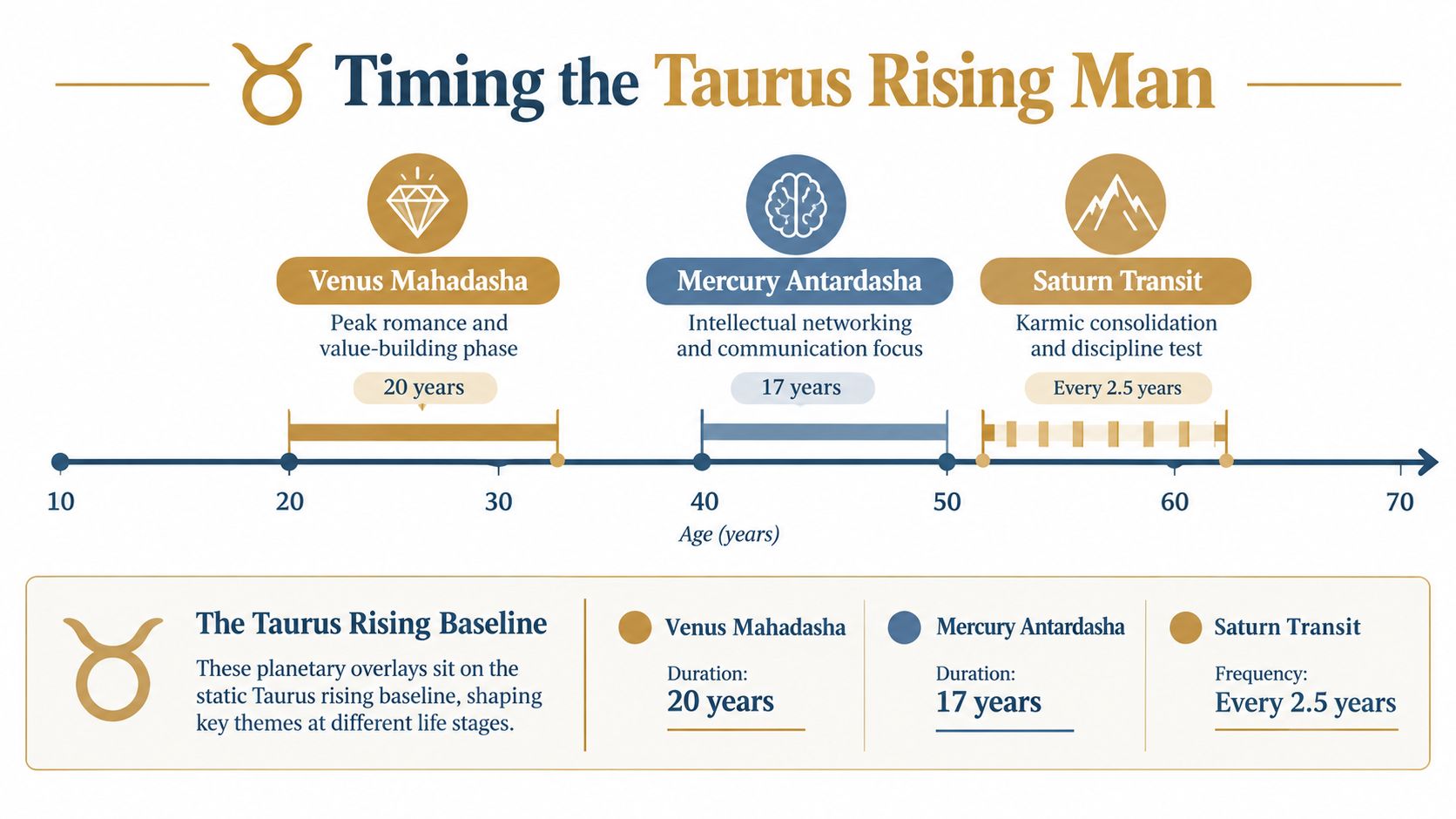
A Venus mahadasha, or major Venus period, may bring the ascendant lord's themes into stronger focus. Depending on Venus's house and condition, that could involve relationships, resources, aesthetics, comfort, agreements, or questions of value.
Mercury may activate the houses it rules for Taurus rising and bring attention to learning, communication, trade, analysis, or practical coordination. Saturn may emphasise responsibility, endurance, delay, structure, and the consequences of established habits. These meanings remain conditional on house placement, dignity, aspects, and the sub-period.
A worked example makes the method clearer. Suppose a Taurus rising man is running Mercury-Saturn, meaning a Mercury major period with a Saturn sub-period, while Saturn returns to a sensitive position near the ascendant. The familiar Taurus steadiness might harden into inertia, heavier obligations, or a need to rebuild routines. A Venus sub-period could make the same period more relational, conciliatory, or focused on restoring value and comfort. The chart doesn't guarantee either result. It supplies a framework for testing the period against events.
Use transits and muhurta as overlays
Jupiter and Saturn transiting the ascendant, Venus, or relevant house can change the practical emphasis without replacing the natal structure. A transit may open a question, create pressure, or make an existing pattern harder to ignore. The dasha usually helps identify why that period matters, while the transit helps describe the current trigger.
For a person who prefers deliberation, muhurta can also provide a disciplined way to choose dates for a business launch, marriage proposal, ceremony, or other commitment. The point isn't superstition or guaranteed success. It is to avoid treating timing as an afterthought.
For a practical daily reference, you can consult Anvaya's Panchang of the day, then interpret any timing choice within the full birth chart rather than using a generic auspicious-time rule.
A Chart-First Reading of a Taurus Rising Man
A serious reading doesn't begin with “You are loyal and sensual.” It begins by confirming the birth data and checking whether Taurus rises. A small time error can change the ascendant, so the chart's foundation must be treated as a calculation, not an assumption.
Once Vrishabha lagna is established, the sequence becomes more precise.
- Verify Venus. Check its sign, house, dignity, conjunctions, aspects, and relationship with the Sun. This shows how the ascendant lord can function.
- Read the first house. Examine planets placed there and the condition of the ascendant. This describes the body's presentation and default approach.
- Study the seventh house. Assess partnership through the seventh lord, Venus, and planets affecting that axis. Steadiness in relationship is tested here.
- Study the tenth house. Look at vocation, public responsibility, and the tenth lord before making career claims.
- Add timing. Use dasha and transits to identify when a latent pattern may become active.
- Calibrate the interpretation. Compare the chart's stronger signals with events the person lived.
That final step is Pramāṇa, Anvaya's term for life-proof and calibration. The method is declared compute first, then questions based on the chart, then a plain-language reading that distinguishes stronger signals from uncertainty. The reasoning moves from chart to life, not from a user's story back into a flattering chart narrative.
A Samhita is therefore not a horoscope feed or a personality report assembled from sign adjectives. It is a structured reading that keeps the chart, timing, and evidence connected. For a deeper explanation of this difference, read what a birth chart actually reveals.
If you want to know whether Taurus rising genuinely describes your life, Anvaya can generate a structured Samhita from your birth details and calibrate its claims against lived events. Upload your kundli for a lagna-first reading that explains Venus, the relationship axis, career indicators, and timing without reducing you to a generic Taurus template.