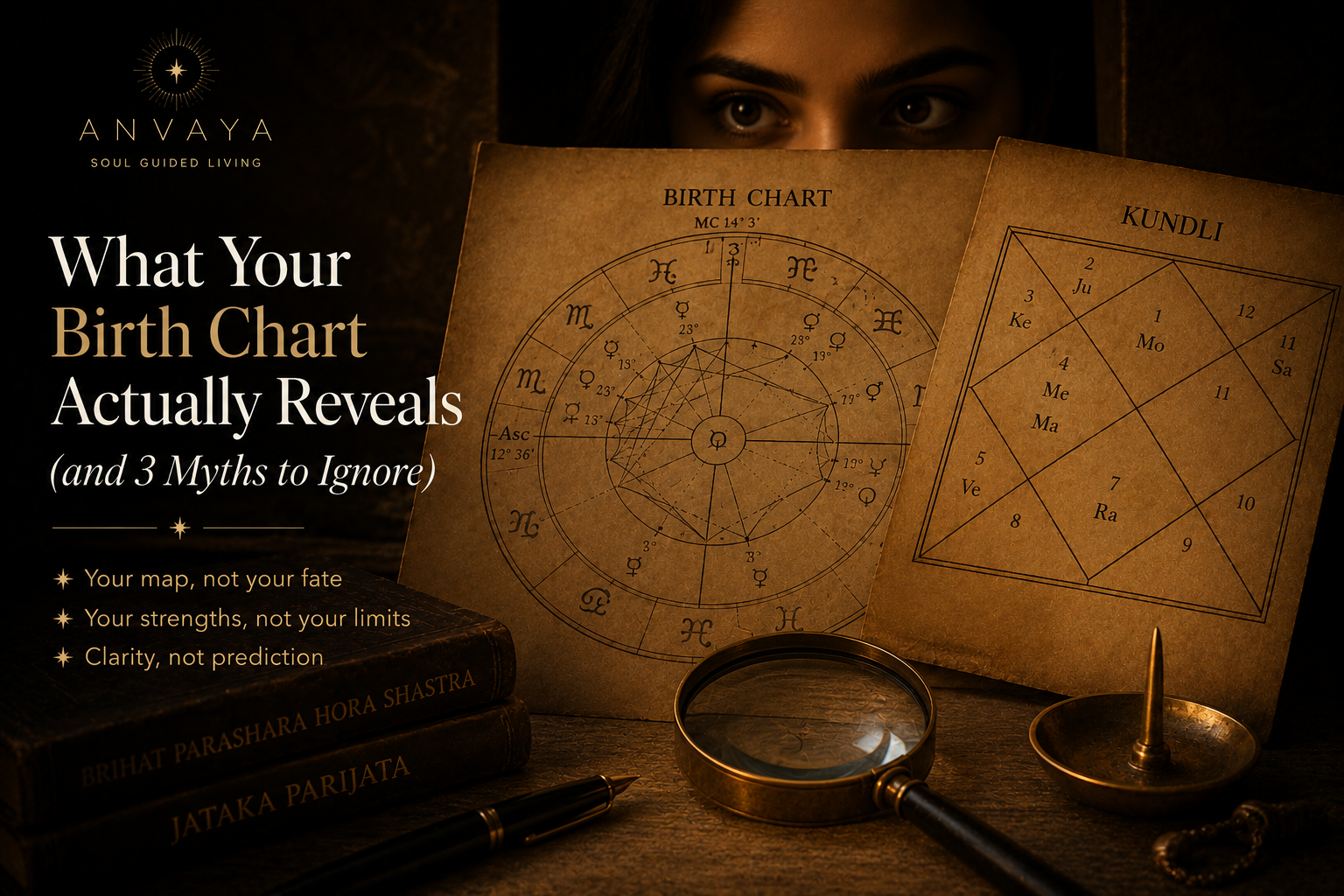
A birth chart — your kundli, your natal chart — is one of the most intimate objects in any wisdom tradition: a snapshot of the sky at the exact moment and place you arrived. People come to it longing to be understood. Too many leave it slightly haunted, because somewhere along the way they were taught to read a map as a sentence.
Let’s set that straight, because a birth chart, understood properly, is a profoundly useful and kind thing.
What a birth chart actually is
It is a map, not a verdict. A map of the terrain you were born into — your natural tendencies, the themes likely to be loud in your life, the timing of your seasons. A map tells you the mountains are to the north and the river runs east. It does not tell you that you will drown. The same chart underlies a thousand different lives, depending on how each person travels it.
Hold that one distinction and most of the fear simply dissolves.
What it genuinely reveals
Read honestly, a birth chart illuminates three things:
Tendencies, not certainties. Where your nature leans — toward boldness or caution, toward connection or independence, toward building or exploring. Leanings you can work with, not chains.
Themes that will recur. The arenas where your life will keep doing its most important work — perhaps relationships, perhaps purpose, perhaps the long renegotiation of security and freedom.
Timing. This is the chart’s most practical gift: through dasha cycles, a sense of when particular themes intensify and ease. Less “who you are forever,” more “what season you’re standing in now.”
That’s it. Tendencies, themes, timing. Everything beyond that is interpretation — and the three biggest misinterpretations are worth naming so you can put them down for good.
Myth 1: Your chart predicts fixed events
It doesn’t. A responsible reading describes conditions and probabilities, not scheduled events. Anyone telling you a specific catastrophe is fated on a specific date has left the realm of honest practice. Your chart maps the weather of your life. It does not write the headlines.
Myth 2: Your chart is your personality destiny
A chart shows leanings, and leanings are starting points, not ceilings. A tendency toward anxiety can become, with awareness, a tendency toward depth and preparation. A pull toward independence can mature into healthy interdependence. The chart describes the raw material. You remain the one shaping it.
A birth chart shows you the clay you were given. It never claimed to be the sculpture.
Myth 3: A “bad” chart is a curse
There is no such thing as a cursed chart. Placements that look “difficult” are very often the source of a person’s greatest depth, resilience, and gift. The struggles a chart points to are usually the exact terrain where your strength gets forged. Difficulty in a chart is an invitation to growth, not a sentence to suffering — and reading it as a curse is the one interpretation guaranteed to do you harm.
How to read yours without fear
Approach your chart the way you’d approach a thoughtful, honest mentor: curious, a little skeptical, ready to take what’s useful and leave what isn’t. Ask it for tendencies and timing, not fortunes. And test what it says against your actual life — the parts that ring true, keep; the parts that don’t, discard.
Anvaya: your chart, calibrated and alive
A static chart read once and filed away is where most people stop — and it’s the least useful version. Anvaya treats your chart as a living instrument. It calculates it precisely, then does the thing fortune-tellers never do: it tests its reading against your memory, keeps what you confirm, and sharpens over time. Your chart stops being a mysterious document someone interprets at you, and becomes a calibrated map you can actually navigate by — fear nowhere in the picture, clarity in its place.