You've checked your chart and found Rahu in the 9th house. One page calls it broken luck. Another promises success abroad. You may be wondering which description applies, especially if you're reconsidering your studies, your beliefs, or your relationship with a teacher.
Neither description is a chart reading. The useful question is narrower: which ninth-house theme does your chart support, and what in your lived record would count against that interpretation? A careful reading separates the themes before trying to interpret them.
Table of Contents
- What to Check Before You Read the Ninth
- Two Ideas That Do Not Point the Same Way
- Where the Classical Books Part Company
- Timing Rules and Two Worked Sketches
- Choices This Placement Cannot Make
- Check Your Ninth House Before You Act
What to Check Before You Read the Ninth
Ninth-house themes and the first checks
| Theme | Compute first | Support looks like | Weak or inactive looks like |
|---|---|---|---|
| Dharma and belief | Jupiter, ninth lord, Rahu's dispositor | Jupiter steady and ninth lord well placed | Ninth lord in the eighth and debilitated |
| Higher learning | Ninth lord, planets with Rahu, Navamsa | Benefic support plus a relevant dasha | Weak ninth lord and no period activation |
| Teachers | Jupiter and planets joined to Rahu | Teacher significators in strength | Afflicted Jupiter during a Rahu period |
| Father | Sun and the ninth house | Sun dignified and not heavily afflicted | Sun or ninth lord badly placed, still conditional |
| Long-distance travel | Ninth lord, Rahu's period, the whole chart | Period plus other travel factors together | Natal Rahu in the ninth with nothing else |
| Pilgrimage, publishing, or law | Ninth lord and Jupiter in rashi and Navamsa | Both supported when a period opens the topic | Interest in the topic without timing |
These rows are separate interpretive possibilities, not a checklist of things that must happen. Dharma means your understanding of right conduct and responsibility. Higher learning concerns sustained study, while teachers, the father, pilgrimage, publishing, law, and long-distance travel each need their own supporting factors.
The Parashari explanation of Rahu in the ninth treats the node's results as conditioned by its sign, associations, dispositor, and house strength. A dispositor is the planet that rules the sign Rahu occupies. That planet's condition matters because Rahu isn't read independently of its surroundings.
Follow the chart in a fixed order
Start with Rahu's sign. Identify its dispositor, then record that planet's house and condition. Next, examine the ninth lord, meaning the planet that rules the sign occupying your ninth house.
Check whether that lord occupies the eighth house and whether it is debilitated, meaning placed in a sign traditionally associated with reduced strength. The stricter conditional rule combines those factors with Rahu in the ninth. It doesn't turn Rahu's placement alone into a judgment of weaker fortune.
Then assess Jupiter for learning and guidance, and the Sun when interpreting the father. Examine conjunctions, planets occupying the same part of the chart, and aspects, the relationships planets form across houses. Finally, check whether a Vimshottari dasha, a planetary timing period, has activated the relevant factors.
Key principle: A house placement suggests a topic. The surrounding chart qualifies it. Timing and lived events determine whether that interpretation deserves attention.
Use a Jyotish chart calculator to establish the placements before attaching language to them. Keep the birth details and calculation settings visible, rather than copying a placement from an unexplained screenshot.
A theme without a strength assessment or relevant period remains a hypothesis. Keep every row in your working notes, but retain only the interpretations the chart supports.
Two Ideas That Do Not Point the Same Way
A student may grow up where higher education, religious observance, and respect for elders belong together. Later, a teacher from another tradition prompts new questions. The student can value family practices while reconsidering how those practices fit. Curiosity does not automatically mean rejection.
The ninth house can be read as a map of inherited ideas about a good life. Rahu marks pressure to redraw the route. A changed course, however, does not mean the whole map has been discarded.
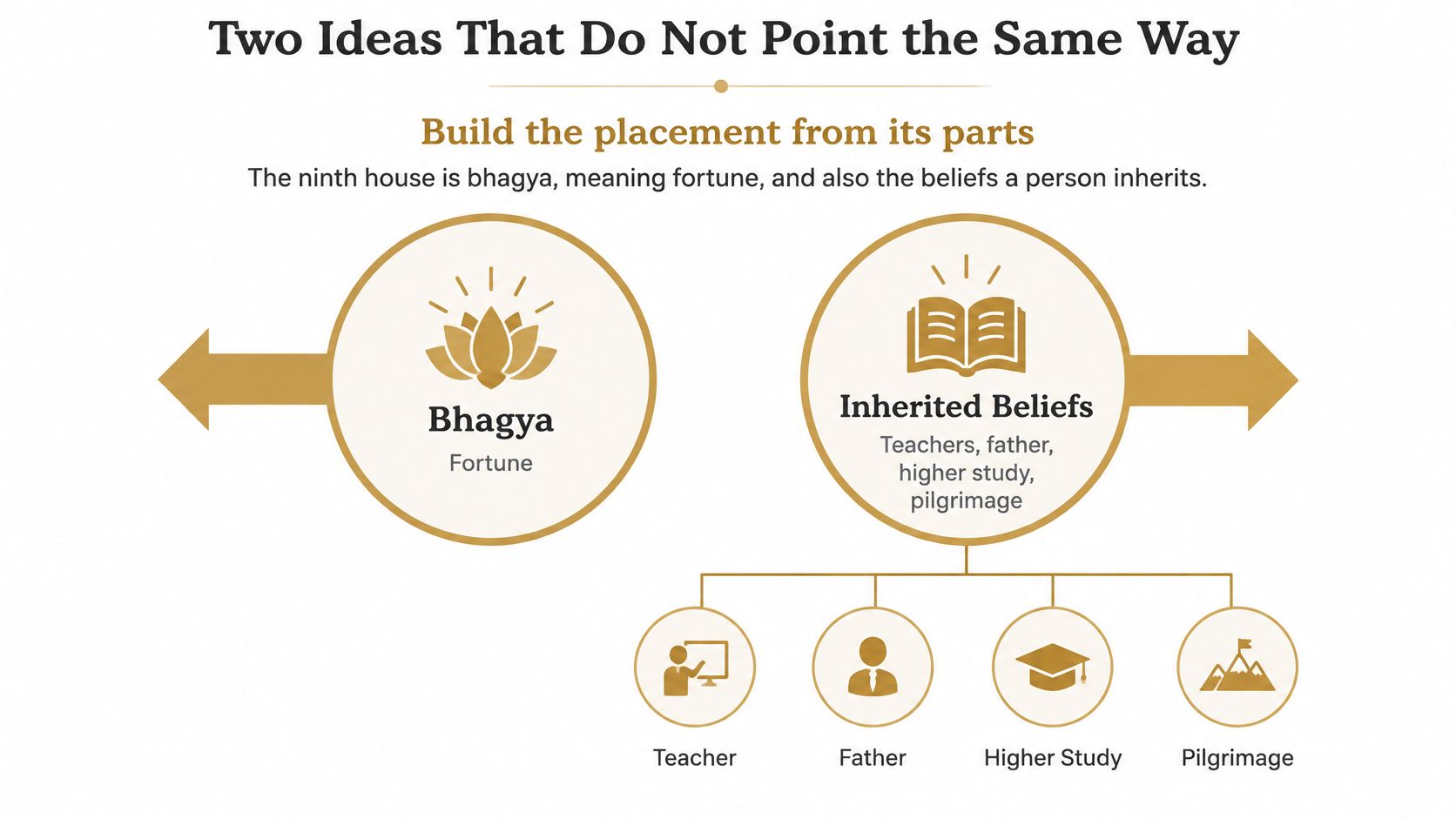
The older term bhagya means fortune. The ninth house also relates to inherited beliefs, teachers, the father, higher study, and pilgrimage. These themes can overlap, but they are not interchangeable. A change in belief does not by itself prove a change in fortune, conflict with a father, or travel abroad.
Separate the sky from the interpretation
Rahu isn't a physical planet. It is the ascending lunar node, the point where the Moon's orbit crosses the ecliptic, the Sun's apparent annual path. The astronomical account of lunar nodes explains that Rahu and Ketu, the descending node, sit 180 degrees apart. Their nodal line regresses through the zodiac by approximately 19.35 degrees per year, completing a cycle in about 18.6 years, close to 18 years and 7 months.
This apparent backward motion follows the slow change in the orientation of the Moon's orbital plane. Jyotisha treats Rahu as a shadow graha, a calculated astrological factor rather than a luminous body.
The geometry is measurable. Interpretations of belief, character, and fortune are a different kind of claim. The astronomical cycle alone does not establish whether those interpretations are accurate for an individual.
Curiosity isn't rejection
A foreign teacher, a difficult teacher, a move abroad, and a private change of belief are separate possibilities. Ninth-house symbolism may be used to discuss each, but one possibility does not establish the others.
- Unfamiliar learning: You might study another tradition while continuing your family's practices.
- Changed authority: You might question one teacher without rejecting the subject they taught.
- Private reassessment: Your beliefs might change without travel, public disagreement, or family conflict.
Declare the zodiac type and ayanamsha used before comparing charts. An ayanamsha is an adjustment that establishes the sidereal reference, and different calculation choices can produce different placements.
The Anvaya astrology foundations offer a place to explore the broader method: calculate consistently, separate symbolism from observation, and treat a recurring sky position as a prompt for interpretation, not a personal forecast. The chart must still support whichever ninth-house theme is being considered.
Where the Classical Books Part Company
How named texts treat Rahu in the ninth
| Source | What it stresses | Limit to keep |
|---|---|---|
| Brihat Parashara Hora Shastra | Weaker fortune with Rahu in the ninth, ninth lord in the eighth, and ninth lord debilitated | Don't drop the extra conditions |
| Phaladeepika | Contrary speech, leadership of a group or town, weak religious merit | Separate public role from conduct |
| Bhrigu Sutras, as commonly summarized | Distance from established practice and dependence on others | Name the source and don't treat it as Parashara |
| Chamatkar Chintamani | Good qualities, pilgrimage, and kindness | A kinder line is still not a promise |
Rahu in the ninth isn't one rule across Jyotisha. These texts don't offer identical descriptions, and a responsible reader shouldn't smooth their differences into a reassuring slogan.
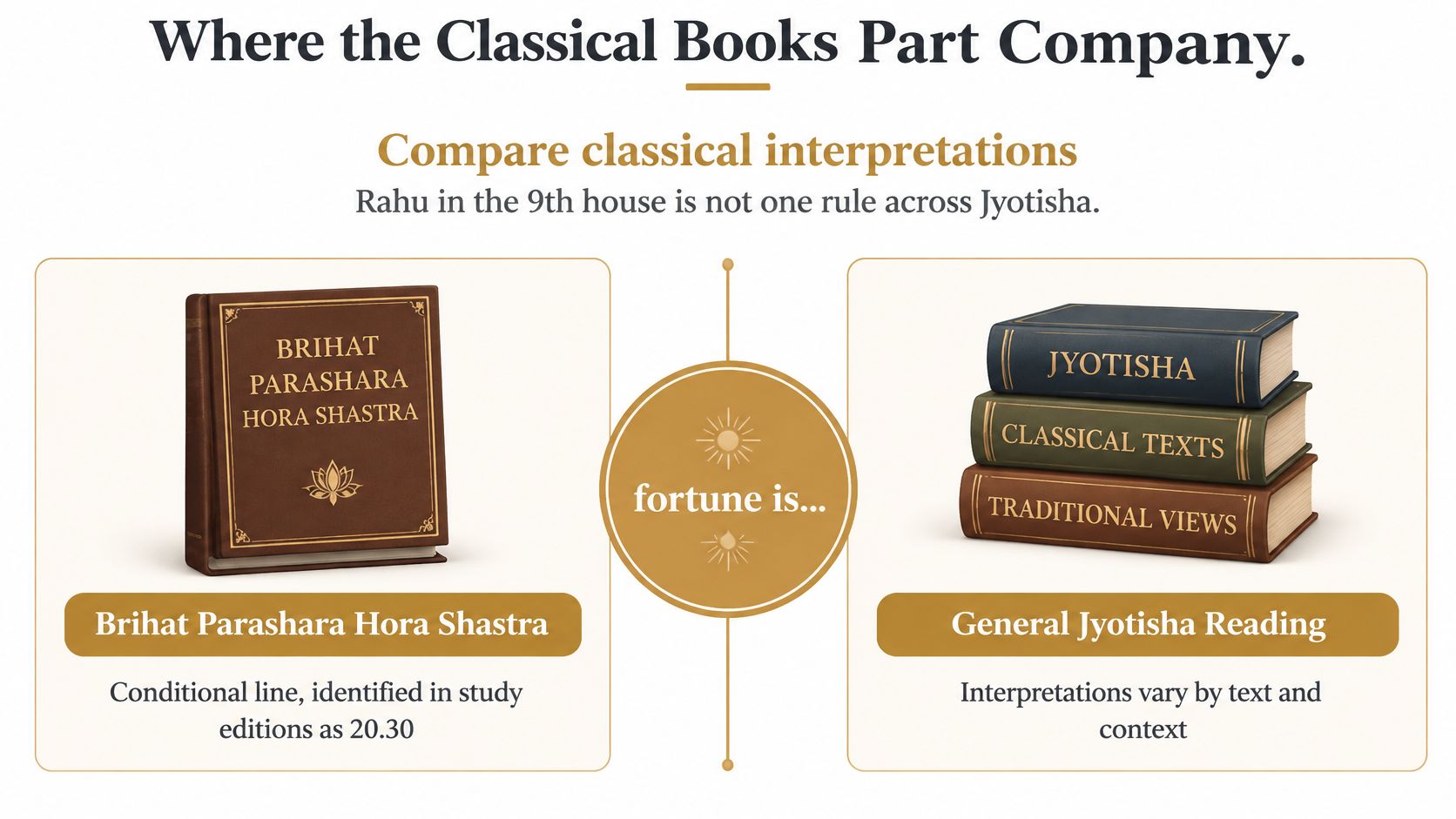
The conditional passage identified as Brihat Parashara Hora Shastra 20.30 in the verse-specific study edition joins Rahu in the ninth with the ninth lord in the eighth and that lord's debilitation. Remove a condition and you no longer have the configuration described by that passage.
That distinction matters in practice. A reader who sees Rahu in the ninth and immediately announces poor fortune has substituted a keyword for the stated rule. The lord's placement and dignity aren't optional details.
Public position isn't ethical conduct
Phaladeepika's treatment of the placement combines contrary speech, leadership over a community, village, or city, and an unfavorable religious or ethical assessment. It doesn't describe only deprivation. It puts prominence and questions of conduct beside each other.
This is an important distinction. A person may challenge accepted views and gain an audience. Neither fact establishes whether their conduct is thoughtful, fair, or consistent with their stated principles.
Nor should historical moral language become a label placed on a reader. A classical description is something to interpret within its tradition, not permission to declare someone unrighteous from a single placement.
Keep the traditions identifiable
Comparative summaries of the Bhrigu Sutras emphasize distance from established practice and dependence on others, while Chamatkar Chintamani offers the kinder associations of good qualities, pilgrimage, and kindness. Those lines cannot all be reduced to either good luck or bad luck without losing their differences.
A favorable classical sentence isn't a guarantee. An unfavorable one isn't a personal verdict.
Parashari work still requires the ninth lord, Jupiter, the Sun where relevant, planetary strength, and timing. The useful response to disagreement is to name the tradition being applied and preserve its conditions, not select whichever sentence sounds most appealing.
House context also matters. An interpretation of Rahu in the second house can't be transferred here because both descriptions mention speech. The topic, supporting planets, and interpretive rule must remain tied to the actual chart.
Timing Rules and Two Worked Sketches
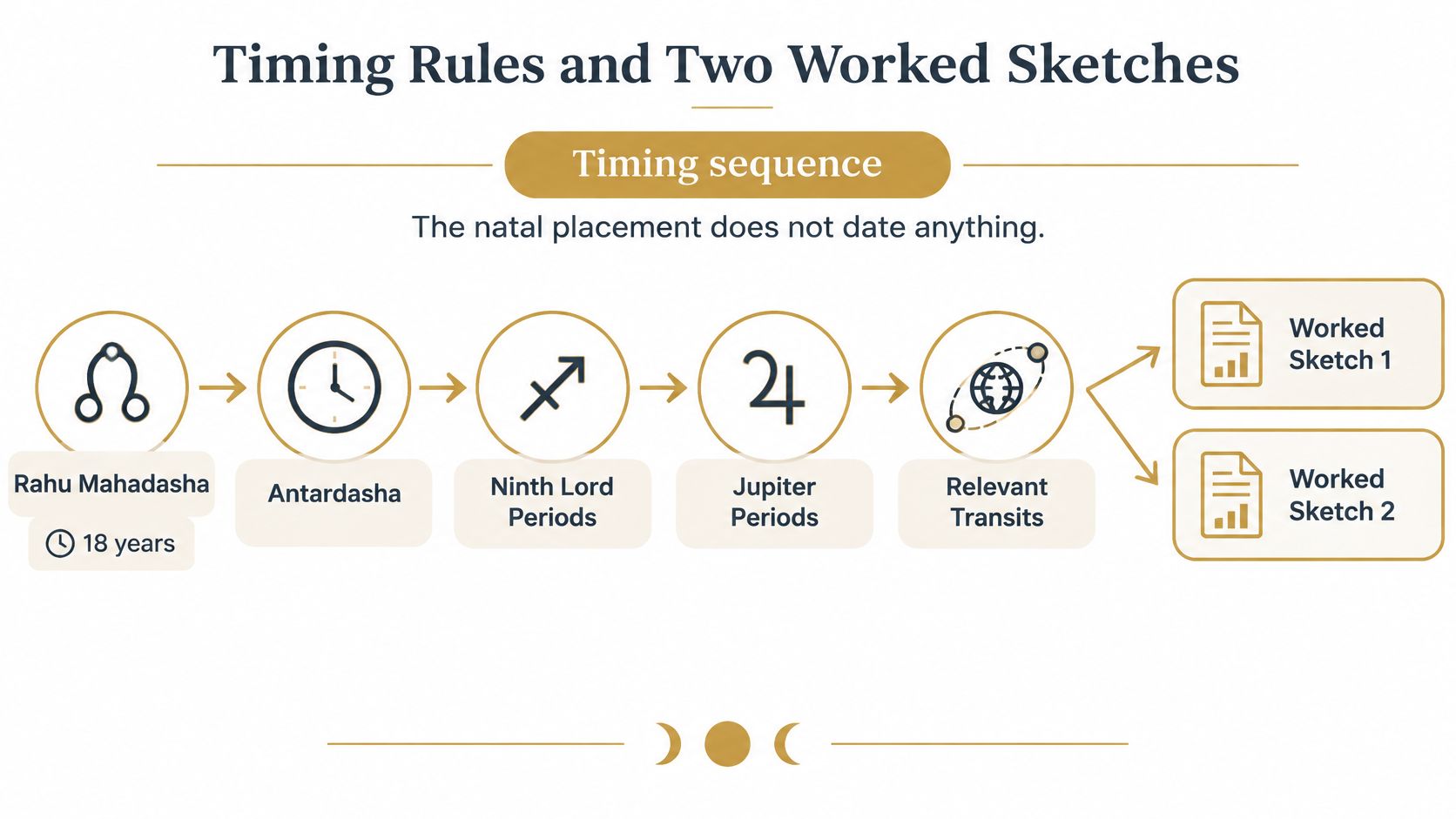
The natal placement doesn't date an event. It gives a starting configuration. Within the traditional method, timing requires planetary periods, their subperiods, relevant transits, and the condition of the planets involved.
A mahadasha is a major planetary period. An antardasha is a subperiod within it. Don't confuse either with the astronomical nodal cycle: these are different systems used for different purposes.
The timing sequence below shows the layers a practitioner would examine, rather than a single date-producing switch.
Use a timing record that can be checked
Possible topics include higher study, a move, pilgrimage, publishing, philosophical or legal study, an unfamiliar mentor, or reassessment of inherited belief. These are candidate interpretations, not a list of outcomes to promise.
Use the following sequence once, consistently:
- Freeze the natal configuration. Record the rashi chart, meaning the main birth chart, with Rahu's sign, dispositor, conjunctions, and the ninth lord's condition. Don't alter the starting interpretation after hearing the person's story.
- Check the Navamsa. This divisional chart is traditionally used when assessing dharma and planetary strength. Compare the relevant planets without using it to manufacture support that the main chart lacks.
- List the dated periods. Record Rahu, ninth-lord, and Jupiter periods, including relevant subperiods. Use a dasha calculator with the same birth data and declared settings.
- Ask about dated events. Test for something specific enough to check: beginning a course, meeting a teacher, submitting a publication, moving, or changing a stated belief.
- Keep misses beside matches. Mark each interpretation as supported, weakened, or still open. An event outside the proposed window shouldn't become a successful timing claim.
The order matters. If you hear the life story first and then choose a fitting interpretation, you haven't tested the original claim.
Worked sketch A with supported learning factors
Consider a hypothetical composite chart, not a real person. Rahu occupies the ninth, Jupiter is strong, the dispositor has support, and the ninth lord is outside the eighth. The working hypothesis is unconventional higher learning, rather than general good fortune.
The practitioner records that hypothesis before asking questions. The proposed event is a sustained course, a publication, or contact with a teacher outside the person's established learning environment during a relevant period.
A useful question would ask whether such an event occurred in the computed window. It wouldn't ask whether the person is curious, independent, or interested in other cultures. Those descriptions are too broad to distinguish this chart from many others.
Suppose the person completed an unfamiliar course, but it began outside the proposed period. The learning theme has some support; the timing claim does not. Both results belong in the record.
Suppose instead that the dated event concerns the father's guidance, with no educational change. The original study interpretation weakens. A father-related interpretation may deserve separate examination, but it must be recorded as a revision, not presented as what was predicted all along.
Worked sketch B with a damaged ninth-house framework
Now take another hypothetical composite. It has the combined classical conditions, together with a weak Sun. The proposed theme is difficulty around dependable guidance or paternal support, not a prediction of loss.
The practitioner should define what would count. A dated disagreement over education might be relevant. An ordinary difference in taste wouldn't justify a strong claim about paternal strain.
| Record field | What belongs in it |
|---|---|
| Claim | Difficulty relying on paternal guidance in the computed period |
| Chart factors | The recorded ninth-house configuration and Sun's condition |
| Event | A specific account, not a personality adjective |
| Date | The event's actual timing |
| Assessment | Supports, weakens, or leaves the claim open |
| Alternative | A teacher-related explanation, if independently supported |
If the person reports steady paternal support throughout the window, preserve that contradiction. Don't redefine support as hidden conflict to rescue the interpretation.
Calibration isn't scientific validation
This is Pramāṇa in practice: the chart-derived claim comes first, then lived events are used to test it. We preserve the claim, confidence, confirmations, and contrary evidence rather than rewriting the earlier reading.
A match can justify examining a theme more closely. It doesn't make every later statement about that theme reliable.
The scientific limit remains explicit. BBC Earth's review of astrology testing describes controlled chart-to-profile matching that performed around chance, including a later test with less than one-third of matches correct.
Retrospective calibration can make a reading more accountable, but it doesn't turn astrology into a scientifically validated forecasting model. Repeated, specific matches may raise confidence within the reading process. They don't remove uncertainty or justify guarantees.
Choices This Placement Cannot Make
Should you choose a degree, move countries, trust a teacher, or pursue a legal dispute because Rahu occupies your ninth house? No chart placement can make those decisions for you. A symbolic interpretation isn't evidence that a particular action is suitable.
The fact that people use such systems for decisions doesn't establish their reliability. Deseret's coverage of Pew's survey findings reports that 13% of Americans aged 18 to 29 rely at least a little on these practices when making major life decisions, compared with 7% of adults overall.
Watch for a claim that fits everything
Confirmation bias becomes especially easy when the wording is elastic. A foreign opportunity could mean an overseas degree, an online class, a visiting colleague, or a holiday. If every outcome qualifies, the claim can't meaningfully fail.
A careful reader should require a defined topic, a dated period, relevant chart support, and a genuine opportunity for contradiction. Keep an alternative interpretation alongside the preferred one rather than searching only for confirmation.
- For education: Separate symbolic interest from the actual course content, entry requirements, and your reasons for studying.
- For relocation: Distinguish an attraction to unfamiliar places from a workable personal plan.
- For teachers: Don't treat a chart interpretation as evidence that a particular person deserves trust or obedience.
- For specialist matters: Keep astrology separate from the qualified professional assessment appropriate to the issue.
These are boundaries on the reading, not a substitute decision system. This is for personal reflection and self-understanding, not professional advice.
Don't turn uncertainty into a remedy sale
Classical practice includes upaya, a term used for remedial observances. That historical context doesn't establish that an observance can fix this placement or ensure a desired result.
We don't prescribe gemstones, rituals, or other shortcuts as corrections to Rahu in the ninth. Nor should a difficult interpretation become a claim about a curse.
If the chart gives mixed indications, say that plainly. An honest unresolved reading is more useful than confident language that pressures you to act.
Check Your Ninth House Before You Act
Anvaya's process begins with birth data, not personality adjectives. We use declared computation, then calibration against lived events, then a plain-language reading.
The process has four steps:
- You provide birth details: Your birth date, time, and place establish the calculation.
- The math runs: We compute the full kundli, or birth chart, dasha timeline, divisional charts, planetary strengths, and yogas, meaning named planetary configurations, in seconds.
- The chart meets your life: Chart-derived past-event questions test the interpretation before forward claims are made.
- Your Samhita opens: The structured, living reading preserves the interpretation and its confidence for later review.
This order matters particularly when a placement has competing explanations. We don't collect your account of a difficult teacher and then sell it back as something the chart independently identified. We tell you something true about your life before you tell us a thing. We never sell your story back to you.
The sample reading's structure illustrates how a persistent reading differs from a horoscope feed. The reasoning behind putting computation before prose is set out in Anvaya's story.
Our readings, timing suggestions, compatibility analyses, and chart-question responses are informational and entertainment content. They aren't medical, mental-health, psychological, legal, financial, investment, employment, or safety advice.
Frequently Asked Questions
Does Rahu in the ninth house always mean foreign travel?
No. Travel requires support from other chart factors and a relevant timing period. Studying an unfamiliar system without leaving home is not evidence of a travel prediction.
Does this placement always cause conflict with the father?
No. Examine the Sun, the ninth lord, and the dated relationship record. A difference in beliefs doesn't by itself establish a damaged relationship.
Which planetary period can emphasize ninth-house topics?
Within the traditional method, Rahu's major period or subperiod, the ninth lord's periods, or Jupiter's periods may emphasize them. The interpretation still needs support from the planets involved and the rest of the chart.
Can classical astrology books disagree about the same placement?
Yes. Some emphasize difficulty or distance from established practice; others include leadership, pilgrimage, or kindness. Name the text being applied and retain its conditions rather than combining the most convenient phrases.
Anvaya computes the chart, checks chart-derived claims against lived events, and builds a Samhita with confidence made explicit. For Rahu in the ninth, that means testing the relevant theme rather than accepting a foreign-travel promise or a father-conflict verdict. Visit Anvaya to generate your Samhita.