
You check your chart after a tense family conversation. Money has come in through an unusual source, but one poorly chosen sentence has turned dinner into an argument. You want to know whether Rahu in the 2nd house explains the pattern, and whether it points to more than one part of life.
A single placement can't answer that. In classical Jyotisha, the second house covers wealth, speech, family, food, and values. Rahu there is a starting point for interpretation, not a verdict. If you have your birth chart open, note Rahu's sign and the planets connected to it. If you're new to Jyotisha, expect a method-based reading with conditional conclusions, not a fixed prediction.
Table of Contents
- What Rahu in the 2nd House Feels Like in Real Life
- What the Classical Verses Actually Say
- The Many Meanings of the Second House
- Why the Same Placement Gives Different Lives
- Wealth, Speech, and Family in Practice
- When This Placement Actually Activates
- A Side-by-Side Look at the Cited Classical Works
- Verifying Your Own Chart Before Trusting Any Claim
What Rahu in the 2nd House Feels Like in Real Life
The same themes can appear through very different experiences. One person may notice income arriving through an unconventional or foreign-linked channel. Another may find that a conversation escalates because their words sound sharper or more evasive than they intended. Someone else may notice tension around shared meals, family expectations, or what counts as security.
These examples point to the second house's range. In Jyotisha, it's associated with accumulated wealth, speech, food, family lineage, and the mouth or face. Rahu is traditionally read through themes of amplification and irregularity. Put together, the placement can bring unusual intensity to those areas, but it doesn't tell you on its own which one will stand out.
Start with the life domain, not the adjective. “Persuasive,” “secretive,” or “wealthy” isn't a complete reading. Ask what happened, when it happened, and whether more than one chart factor supports that interpretation.
A responsible reading then checks how Rahu is placed and what modifies it. Its sign and sign lord, conjunctions, aspects, the condition of the second-house lord, and the operating planetary period all matter. Without those checks, the same placement could be turned into a generic claim about money or speech that doesn't fit the person's actual life.
The classical material itself gives more than one kind of result. It includes difficult possibilities, such as anger or strain, alongside favorable possibilities, such as wealth connected with authority and eventual happiness. That mix is a reason to test the chart against lived events before making a forward claim.
What the Classical Verses Actually Say
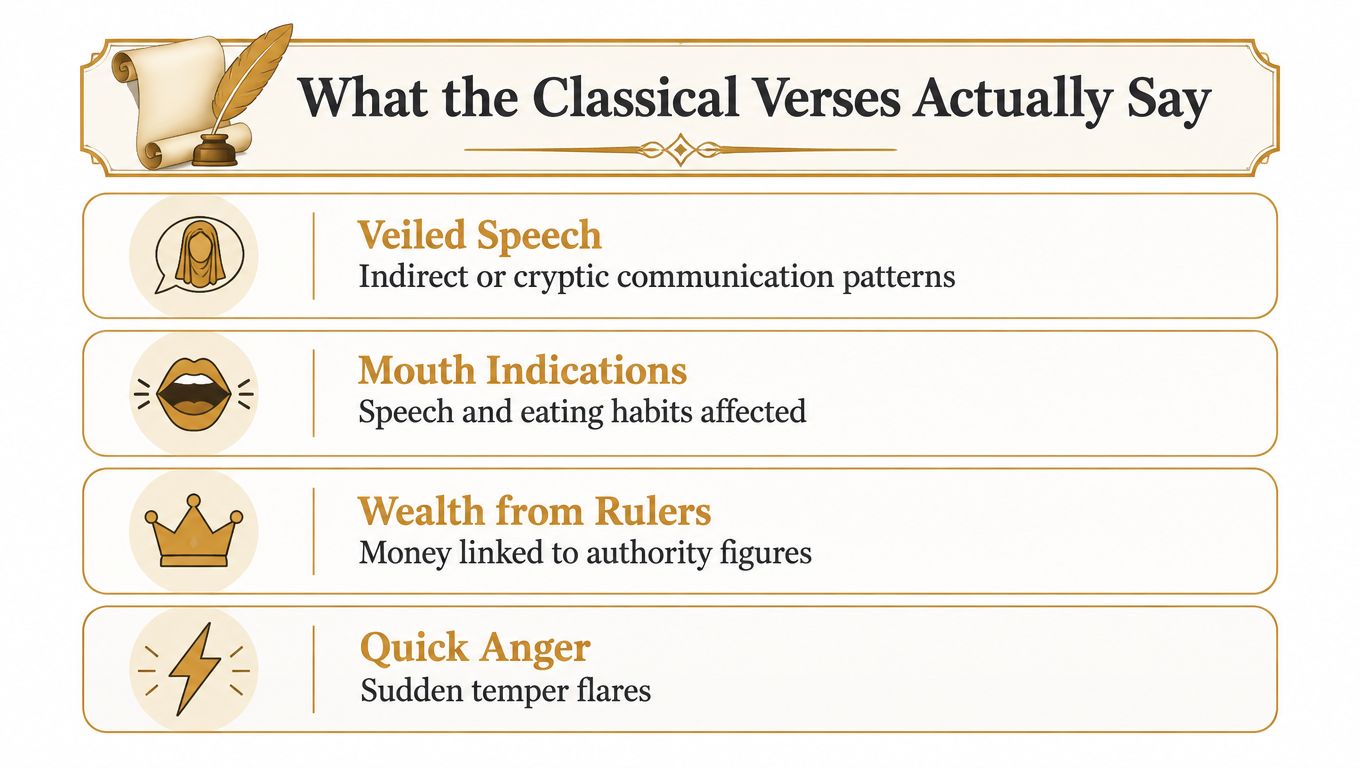
Classical Jyotisha doesn't give one uniform sentence for Rahu in the second house. The commonly cited Phaladipika verse describes several possibilities together: veiled or indirect speech, mouth-related ailments, wealth connected with a ruler or authority, quick anger, and eventual happiness. The translated themes are mixed. The verse doesn't reduce the placement to either a promise of riches or a warning of misfortune.
Phaladipika's wording is a traditional symbolic description, not a medical finding or a guarantee of financial gain. “Wealth from a ruler” can be read as a possible connection to official or powerful patrons, but whether that becomes relevant depends on the rest of the birth chart. The same caution applies to references to the mouth and speech.
Other classical summaries emphasize different details. Jatakabharana links Rahu in the wealth house with talkativeness. Sarvartha Chintamani describes particular risks when Rahu is joined or aspected by other malefic planets. Here, a malefic means a planet traditionally considered capable of bringing strain or difficulty in a given context. These accounts don't cancel one another. They show why a reading must consider planetary relationships rather than relying on the house placement alone. A compilation of classical summaries for Rahu in the second house brings together material from eight verses across four classical works.
A cited rule from Brihat Parashara Hora Shastra is narrower still. It concerns a combination in which the second and eleventh lords occupy trika houses, meaning the sixth, eighth, or twelfth; Mars is in the eleventh; and Rahu is in the second. Under that full combination, the source describes possible wealth loss through raja-danda, meaning royal or governmental punishment. It's a conditional risk signature, not a claim about everyone with Rahu in this house. The cited compound rule and its conditions should be read with all its conditions intact.
The Many Meanings of the Second House
Before judging Rahu, first understand what the house signifies. The second house is known as Dhana Bhava, meaning the house of accumulated wealth, and Kutumba Bhava, meaning the house of family or household. Neither label covers everything the house can represent.
Its traditional domains include:
- Accumulated wealth: resources gathered and held, not just the promise of income.
- Family lineage: household ties, inherited customs, and the values passed through family.
- Speech: how words are used, including tone and style.
- Food: what a person takes in and patterns around eating.
- Face and oral anatomy: the face and mouth, including speech-related organs.
- Early values: ideas about what matters, often shaped within the family.
- Family expansion through marriage: included in some predictive systems.
Rahu in the 2nd house therefore touches several connected but distinct areas. A change in how someone earns isn't automatically a change in family life; a difficult conversation isn't proof of financial trouble. Keep each domain separate when assessing a chart, even when they interact in lived experience.
For comparison, Jupiter in the 2nd house raises a related question: what does the same house signify when a different planet occupies it? That contrast helps keep the focus on the house's many domains, rather than treating any single planet as a one-word prediction.
Why the Same Placement Gives Different Lives
“Rahu in the second house” is a chart coordinate, not a finished interpretation. Classical-style summaries place particular weight on the planets joined to Rahu, the planets aspecting it, and the strength and position of the sign lord, also called the dispositor. The dispositor is the planet that rules the sign Rahu occupies.
A careful reading then checks the second-house lord, the condition of the house itself, and whether the relevant planetary periods are active. A strong dispositor may provide a steadier channel for Rahu's themes. A weak or afflicted one may make the same themes less settled. Benefic influence, meaning support from planets regarded as constructive in context, can also change the tone.
Consider two people with Rahu in the same house. In one chart, Rahu's sign lord may be well placed and supportive planets may influence the house. The reader might test whether income changes or speech-related opportunities fit the person's history. In another chart, difficult planetary connections may deserve more attention, especially around the same house's family or financial themes. Those are questions to verify, not outcomes to assume.
Reading order matters: Check conjunctions, aspects, and the dispositor before settling on an interpretation. Then assess the second lord and the timing. The house number alone can't tell you which expression will be most visible.
This method avoids the common mistake of treating every chart with the same placement as a duplicate. The placement is shared; its sign, planetary links, house conditions, and timing may not be.
Wealth, Speech, and Family in Practice
Start with wealth, but distinguish accumulated resources from income flow. The second house is linked with what is gathered, while other parts of the chart help assess earning channels and gains. Rahu here may fit an unconventional or foreign-linked source of income, or a strong focus on material security. It doesn't guarantee wealth, and it doesn't establish financial instability on its own.
For speech, the classical descriptions invite questions about indirect wording, talkativeness, anger, and influence. A person may communicate in a way that feels unusually strategic or specialized. The practical test is not whether a label seems flattering or alarming. It's whether dated events show a consistent pattern, such as a conflict that turned on phrasing or a recurring gap between intention and how others heard the words.
Family and food need the same care. The second house includes household ties, values, and eating routines, so any strain may show up in ordinary domestic rhythms. A change in family expectations or meals may be more relevant than a dramatic claim about permanent rupture. Don't treat a symbolic indication as proof of a specific family outcome.
Timing helps distinguish a general placement from an active period. Rahu's own planetary period, a sub-period involving Rahu, or a period involving its dispositor may bring the house's themes into focus. Transits can be considered as part of that timing, but they shouldn't replace the chart's underlying conditions.
For an audit, write down dates and observable events rather than broad impressions:
- Income: a notable change in source or structure.
- Speech: a public or family dispute linked to wording.
- Household: a shift in family arrangements, shared routines, or food habits.
- Values: a clear change in how resources or family obligations are handled.
Use this material for personal reflection and self-understanding, not as professional advice on money, speech disputes, or family relationships.
When This Placement Actually Activates
A placement can be present in a birth chart without being equally prominent throughout life. In Jyotisha, the timing system called dasha tracks planetary periods; an antardasha is a sub-period within a larger planetary period. Rahu's major period, often called Rahu Mahadasha, may bring its themes forward over a sustained span. A Rahu antardasha can bring a more focused episode, while also combining Rahu's themes with those of the planet whose sub-period is running.
A period ruled by Rahu's dispositor can also make the placement relevant. Jyotishis may consider gochara, the current movement of planets through the sky, alongside these periods and the birth chart. A transit over Rahu, the second house, or its lord may be examined as a possible trigger, but timing isn't established by a transit alone.
When testing a period, look for dated events that match the chart's specific claims: a change in income source, a conflict linked to wording, a shift in diet or substance exposure, or a documented mouth, dental, throat, or right-eye concern. Health indications must be assessed through correlated chart factors and actual medical evidence. Astrology is not a diagnosis.
The classical sources also differ in emphasis, so use timing to test the chart, not to force a single reading. Phaladipika gives a mixed account of speech, mouth indications, authority-linked wealth, anger, and happiness. Jatakabharana highlights talkativeness; Sarvartha Chintamani points to conditions involving malefic association or aspect. The cited Parashara rule is a specific combination involving additional house lords and Mars, not a general outcome for the placement.
If you're comparing periods against your own history, a Vimshottari dasha calculator can help you examine the timing framework. The calculation is a starting point. The chart's full context and events you can independently verify still matter.
A Side-by-Side Look at the Cited Classical Works
This comparison is a reading aid, not a ranking. It shows why you shouldn't merge different texts into a single absolute rule.
| Classical Work | Primary Emphasis | Conditional Add-ons | What It Does Not Claim |
|---|---|---|---|
| Phaladipika | Veiled speech, mouth indications, anger, and a mixed possibility of authority-linked wealth and happiness. | Results require the wider horoscope to be considered. | That Rahu in the second house guarantees poverty, wealth, or illness. |
| Jatakabharana | Talkativeness when Rahu occupies the wealth house. | The broader chart modifies the expression. | That every person with the placement speaks in the same way. |
| Sarvartha Chintamani | Risks associated with Rahu's relationship to other malefic planets. | The specific conjunction or aspect matters. | That the house placement alone proves a particular outcome. |
| Brihat Parashara Hora Shastra rule | Possible wealth loss through raja-danda, meaning royal or governmental punishment. | The second and eleventh lords must be in trika houses, Mars in the eleventh, and Rahu in the second. | That all people with Rahu in the second face punishment or financial loss. |
The sources share interest in speech and the mouth, but they don't make the same claim about wealth. Phaladipika includes a favorable possibility tied to authority; the cited Parashara rule describes a risk only under a compound set of conditions. The distinction is essential: a conditional rule must retain every condition when you apply it.
Verifying Your Own Chart Before Trusting Any Claim
A single placement cannot deliver a verdict on honesty, illness, or guaranteed wealth. Classical method asks you to build the reading in layers, then test each layer against what the chart contains.
Begin with chart mechanics. Identify Rahu's sign and its dispositor, the lord of the sign Rahu occupies, because that dispositor steers how Rahu expresses itself. Record planets conjoined with or aspecting Rahu, then assess the second lord and the influences reaching the second house. Next, examine the Vimshottari dasha, the planetary period system, for Rahu's period or its dispositor's period. Chart first, story second: mark the past periods the chart flags as sensitive before asking whether life fits the placement.
Then test those windows against dated records. Did an income source change during a flagged period? Did a family or public conflict hinge on the exact words used? Did food routines or household arrangements shift? Where an interpretation suggests mouth, dental, throat, or right-eye concerns, treat them as questions to compare with documented history, never as a diagnosis.
The raja-danda combination cited in the classical-verses section shows why this care matters. It applies only under its full set of conditions, so verify each condition in your own chart before reading the verse as "Rahu in the second causes legal trouble."
Confidence grows only when several chart layers converge and the person's dated experience confirms the reading. That is what separates a horoscope blurb from a Samhita, a structured reading that ties calculations to lived evidence. A Vedic birth chart reading serves you better when it opens with chart-first questions and names what remains uncertain.
For personal reflection and self-understanding, not professional advice: check the math, test it against your past, and keep uncertainty visible.
Anvaya's Samhita reads a Vedic birth chart through declared calculations, then uses Pramāṇa to calibrate the reading against lived events before making forward claims. If you want to examine Rahu in the 2nd house in its full chart context, visit Anvaya.