

You open your birth chart and notice that one planet is marked debilitated. The label feels final. You start wondering whether it explains a difficult career phase, a strained relationship, or a pattern of delayed progress.
Classical Vedic astrology asks a better question before reaching that conclusion. Is the planet unsupported, or do other chart factors cancel or reduce its debility? Neecha Bhanga Raja Yoga is the name given to a specific pattern in which a debilitated planet receives structural support. It can describe recovery, resilience, and progress after difficulty, but it isn't a guaranteed success formula.
Table of Contents
- When a Debilitated Planet Is Not the End of the Story
- What Neecha Bhanga Raja Yoga Actually Means
- The Classical Conditions That Cancel Debilitation
- Simple Cancellation Versus Full Raja Yoga
- Timing and Activation Through Dashas and Transits
- Common Misconceptions and Overhyped Claims
- How to Evaluate Your Chart Honestly
When a Debilitated Planet Is Not the End of the Story
A reader named Arjun sees that Saturn is debilitated in his birth chart. He knows Saturn is associated with discipline, responsibility, and long-term effort, so he assumes the placement means permanent delay. He begins reading online interpretations that promise either failure or sudden success, depending on which page he opens.
Neither reaction is careful enough.
In Jyotish, debilitation describes a planet placed in a sign where its natural qualities don't operate comfortably. It doesn't mean the planet stops working. It also doesn't prove that every area connected with that planet will fail. A serious astrologer checks the surrounding structure of the chart before judging the result.
That check includes the planet ruling the sign where the debilitation occurs, the planet ruling the sign of exaltation, angular houses, planetary aspects, conjunctions, and support in the Navamsa chart. Classical Parashari rules provide the framework. The birth chart supplies the particular facts.
Practical rule: Never interpret a debilitated planet from its sign alone. First test whether the chart contains a valid cancellation condition.
This is why Neecha Bhanga Raja Yoga matters. It changes the question from “Is this planet weak?” to “How much support does this planet receive, and when can that support operate?” The answer may show partial relief, meaningful recovery, or a stronger form of transformation. It may also show that a technically valid condition isn't strong enough to produce the dramatic outcome promised by popular astrology.
The useful standard is conditional. If the chart supports the yoga, the planet may express better than its debilitation initially suggests. If the timing also supports it, the person may experience growth through the very area that once created difficulty. A chart can describe a pattern of effort and recovery, but it can't prove a guaranteed rank, income, relationship outcome, or public status.
What Neecha Bhanga Raja Yoga Actually Means
The name contains the method. It has three Sanskrit elements, each describing a different stage of interpretation.
Neecha means debilitation
Neecha refers to a planet in a sign where its natural qualities are considered weakened or uncomfortable. The planet still acts, but its expression may become less direct, less stable, or harder to access.
For example, the astrologer doesn't stop at “this planet is debilitated.” They ask what the planet governs, which house it occupies, whether it has useful relationships with other planets, and whether the rest of the chart gives it support.
Bhanga means cancellation
Bhanga means breaking, cancelling, or neutralising the debility. In this context, cancellation doesn't erase every difficulty. It means that specific structural conditions reduce the weakness or help the planet function more effectively.
The support can come from the ruler of the debilitation sign, the ruler of the exaltation sign, a conjunction, an aspect, or reinforcement in a divisional chart. These aren't vague blessings. They're placements that can be checked directly in the birth chart.
Raja Yoga means a kingly union
Raja yoga describes a combination associated in classical Jyotish with authority, influence, or enhanced results. The phrase shouldn't be read as a literal promise of royalty. It points to the possibility that a planet's recovered strength may support progress, responsibility, recognition, or leadership in the areas it represents.
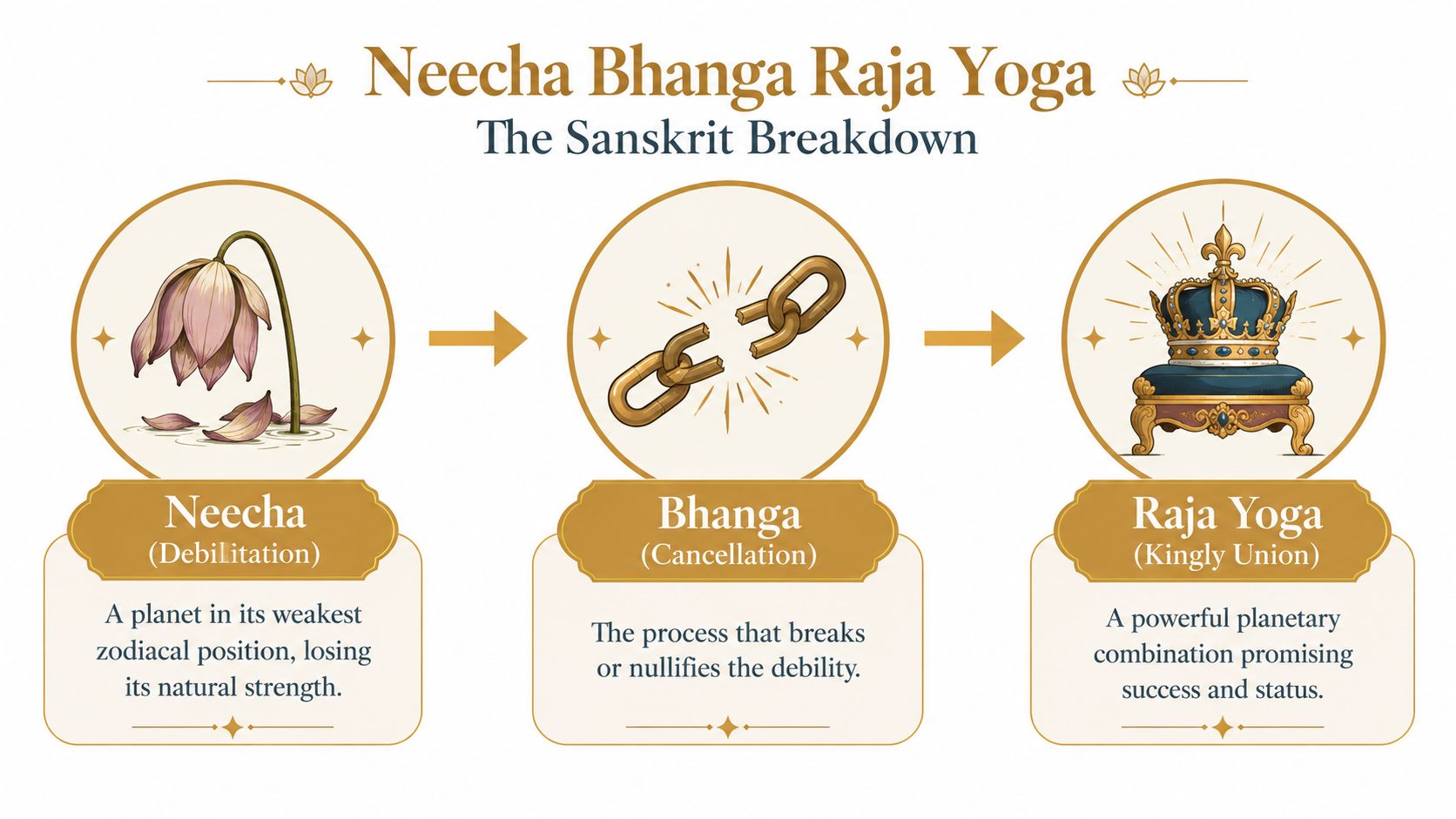
Put together, the phrase describes a debilitated planet whose weakness is cancelled through chart structure, allowing it to produce stronger results after difficulty. The historical basis comes from the classical Sanskrit astrology tradition, with its significance discussed in texts such as Phaladeepika and Saravali, as summarised in this classical overview of Neecha Bhanga Raja Yoga.
That history matters because the idea isn't a modern motivational slogan. Its central logic is specific: strength can emerge through the correction of weakness. The yoga therefore often gets associated with resilience, recovery, upward movement, and authority that develops through pressure. It doesn't mean instant success, and it doesn't make every debilitated planet exceptional.
The Classical Conditions That Cancel Debilitation
The most cited rules focus on kendras, the angular houses of the chart. These are the first, fourth, seventh, and tenth houses from the Ascendant, also called the Lagna, or from the Moon. Angular placement matters because kendras form the chart's main structural pillars. A planet placed there has a direct role in how life operates and becomes more visible in the chart's overall architecture.
The dispositor provides support
The dispositor is the planet that rules the sign occupied by the debilitated planet. If that dispositor is placed in a kendra from the Ascendant or Moon, classical rule-sets treat it as a cancellation condition. The logic is straightforward within the Parashari system: the planet hosting the debilitation has enough structural strength to support its guest.
A related condition occurs when the dispositor is conjunct with, or aspects, the debilitated planet. A conjunction means the planets occupy the same sign or house. An aspect means one planet directly influences the other according to the tradition being used.
The exaltation lord can lift the planet
Another major condition involves the lord of the exaltation sign, the planet ruling the sign where the debilitated planet would be strongest. If that lord occupies a kendra from the Ascendant or Moon, it can provide angular support.
The debilitated planet may also receive a conjunction or aspect from the exaltation-sign lord. In plain terms, the planet associated with the debilitated planet's highest dignity directly supports it.
Other angular relationships may matter
Some classical and later interpretive traditions include mutual kendra placements between the relevant lords, sign exchange, and related partial-cancellation rules. A sign exchange occurs when planets occupy each other's signs, creating a strong relationship between them.
The traditions don't apply every condition identically. Some astrologers use a stricter checklist than others. The Parashari rule summary for Neecha Bhanga describes the core framework as a test of structural support, not as a single automatic formula.
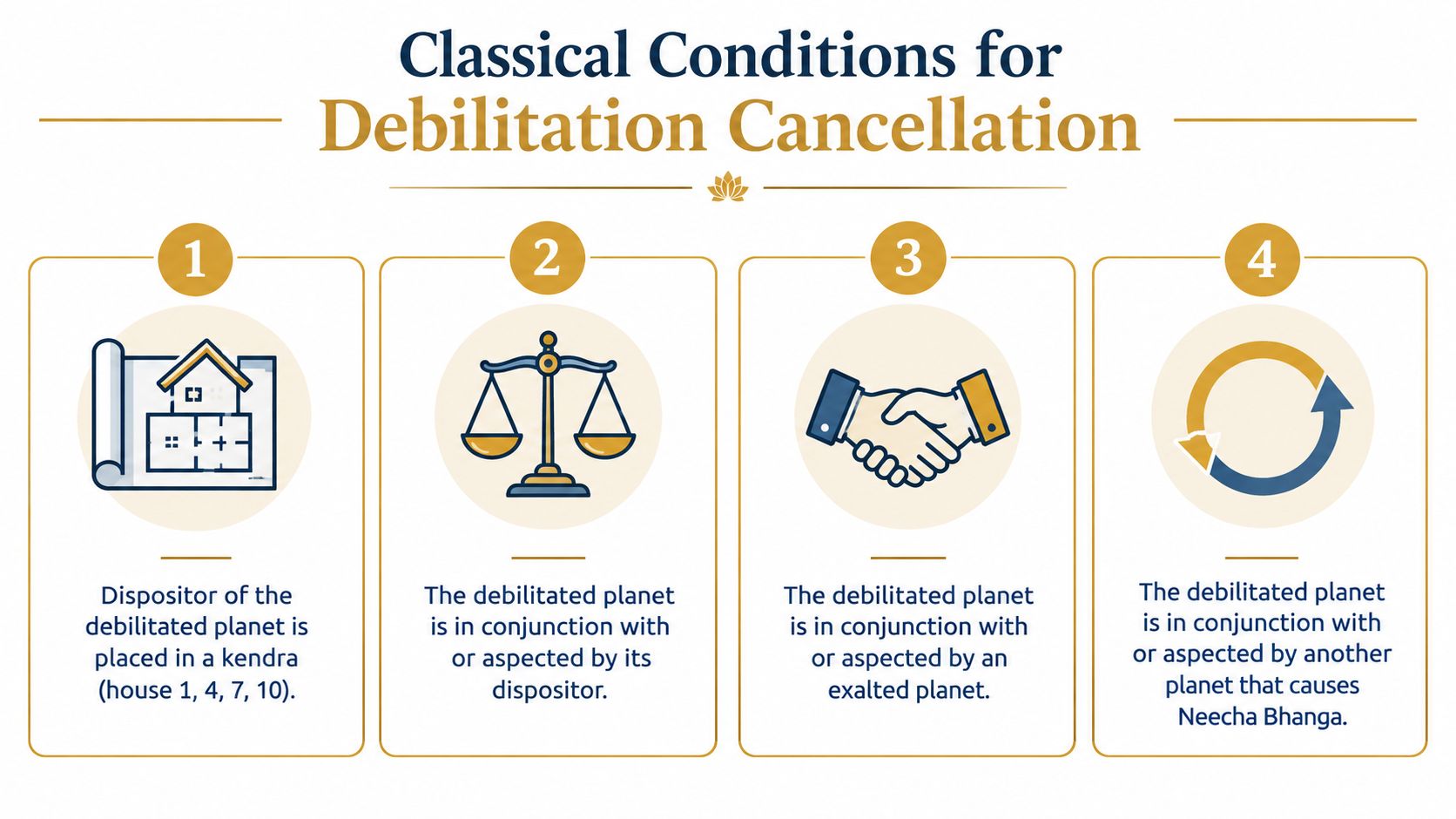
The important point is that the rule must be verified against the actual chart. A planet's dignity, house placement, lordship, strength, aspects, and timing all affect interpretation. One checkbox can show that some cancellation exists. It doesn't, by itself, establish a complete Raja Yoga.
Simple Cancellation Versus Full Raja Yoga
A useful distinction gets lost in online explanations. Neecha Bhanga and Neecha Bhanga Raja Yoga aren't always the same level of result.
Simple cancellation means the planet's weakness is reduced. The planet may function more steadily, recover capacity, or deliver results that are better than an uncancelled debilitation would suggest. That can be meaningful without becoming a dramatic rise in status.
The stronger Raja Yoga interpretation requires a wider assessment. The planet needs substantial support, useful house relationships, and activation at an appropriate time. The classical methodology overview explains why a chart reading needs more than one isolated placement before making a strong conclusion.
Navamsa adds another layer
The Navamsa, or D9 chart, is a divisional chart used to examine deeper planetary strength and development. Several modern rule-sets include a debilitated planet being exalted in Navamsa as a stronger form of cancellation. Other teaching traditions also consider a planet's repeated strength across the birth chart and Navamsa when deciding whether the cancellation is substantial.
This creates a spectrum rather than a binary answer:
| Reading level | What it suggests |
|---|---|
| Debilitation without support | The planet's challenges remain prominent |
| Partial cancellation | The planet's weakness is reduced |
| Strong cancellation | The planet can function with notable recovery |
| Cancellation with wider chart and D9 support | A more credible Neecha Bhanga Raja Yoga interpretation |
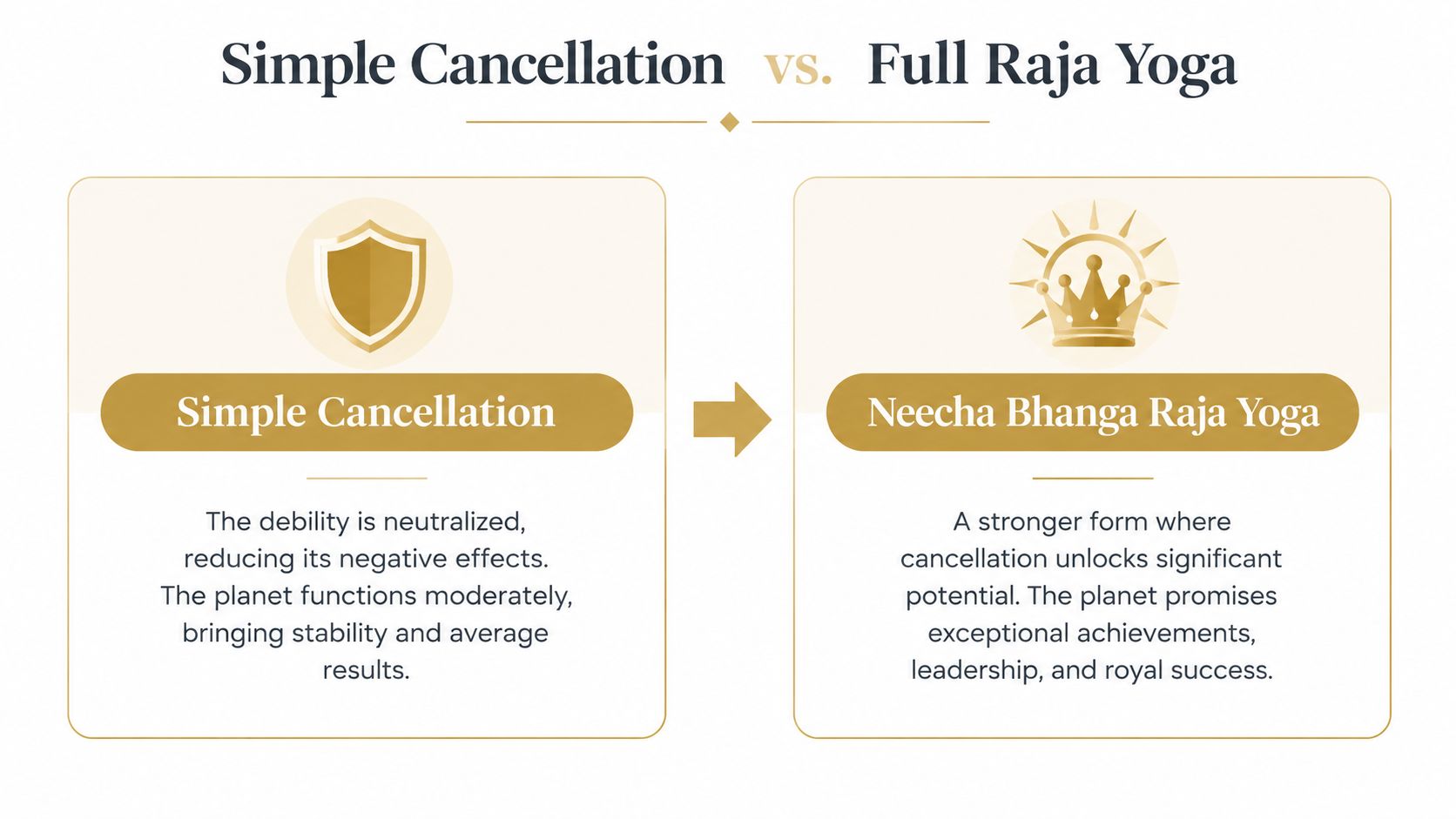
A reader shouldn't treat the strongest label as a reward for finding one technical condition. The planet's house lordship, associations, overall strength, and dasha timing still matter. The technical discussion of cancellation and Navamsa reinforcement reflects this layered approach.
Timing and Activation Through Dashas and Transits
A yoga in the birth chart describes potential structure. It doesn't mean the person experiences its full expression at every age.
Vimshottari dasha periods provide one of the main timing frameworks in Jyotish. A dasha is a planetary period in which the relevant planet becomes more prominent in the person's experience. If the debilitated planet has cancellation, its dasha may bring the planet's struggle, recovery, responsibility, or improved expression into focus.
Transits, called gochara, add the moving layer. A transit can activate or challenge natal placements, but its meaning depends on the birth chart and the dasha operating at the same time. This is why a serious timing reading doesn't announce a result from one transit alone.
A cancelled weakness still needs a time window in which the chart can express it.
Consider someone with a debilitated planet connected to career. The early experience may involve hesitation, repeated correction, or work that demands more effort than expected. Later, during a relevant dasha, the same planet may support greater responsibility or clearer authority. That doesn't prove a spectacular rise. It may show a practical improvement in the planet's domain, depending on the rest of the chart.
Timing also needs calibration. A reader can test earlier dasha periods against events the person lived, then decide how much confidence to place in forward-looking claims. This is more reliable than fitting every past event into a flattering story after the fact.
For a focused example of how planetary timing and career interpretation interact, see this Vedic astrology explanation of Saturn and the tenth house. Career moves, relationships, and major transitions should be treated as areas for reflection and planning, not as instructions issued by a single yoga.
Common Misconceptions and Overhyped Claims
The most common mistake is to treat Neecha Bhanga Raja Yoga as a guaranteed success mantra. It isn't. The yoga describes a cancellation pattern, and the strength of that pattern depends on the chart's broader structure and timing.
A second mistake is assuming that every debilitated planet automatically has cancellation. It doesn't. The astrologer must identify the relevant dispositor and exaltation lord, check their positions from the Ascendant or Moon, inspect conjunctions and aspects, and consider whether the support repeats in Navamsa.
What the yoga cannot override
The yoga doesn't erase every other chart factor. It can't independently settle questions about career, partnership, wealth, health, or family. Those areas require the relevant houses, lords, significators, dashas, transits, and divisional charts.
It also doesn't eliminate challenge. In many interpretations, the central theme is improvement through pressure, not a life without pressure. The person may still need discipline, skill, patience, and good decisions. Astrology can offer a framework for reflection and self-understanding, not professional medical, legal, financial, employment, or safety advice.
How honest interpretation handles uncertainty
A responsible reader should distinguish between:
- A valid technical condition, which can be checked in the chart.
- A strong overall pattern, which requires support from several layers.
- A timed expression, which depends on dashas and transits.
- A lived outcome, which must be compared with actual events.
Fear tactics are as unreliable as flattery. Saying “your debilitated planet will ruin your life” is careless. Saying “you have royal success guaranteed” is equally careless. The chart may support resilience in one area, while another area remains mixed or unclear.
The classical formulation attributed to Mantresvara also gives weight to whether the debilitated planet sits outside the sixth, eighth, and twelfth houses, as noted in this summary of Mantresvara's conditions. That detail reinforces the larger lesson. No single label should replace a complete reading.
How to Evaluate Your Chart Honestly
Start with the chart data, not the interpretation. Confirm the birth details and the calculation framework being used. A change in birth time can alter houses, divisional charts, and timing, so confidence should match the quality of the underlying data.
Then use a clear sequence.
- Confirm the debilitation. Identify the planet and the sign it occupies. Don't assume a website's label is correct without checking the chart calculation.
- Locate the dispositor. Find the ruler of the sign containing the debilitated planet. Check whether it occupies a kendra from the Ascendant or Moon, or directly aspects or joins the debilitated planet.
- Check the exaltation lord. Find the ruler of the sign where that planet is exalted. Test its angular position and direct relationship with the debilitated planet.
- Inspect Navamsa. See whether the planet gains notable support in D9, including exaltation, as described in this Navamsa-focused explanation.
- Assess the wider chart. Review house lordship, planetary strength, associations, and whether other chart factors support the same life area.
- Test timing against experience. Compare relevant dasha periods and transits with events you remember. Don't use a future claim to prove that a past interpretation was correct.
A calibrated reading such as a Samhita should test the chart's structural claims against lived events before making forward claims. That approach is closer to the discipline of Jyotish than a calculator that returns a dramatic label from one placement. For a grounded introduction to chart interpretation, read what a birth chart actually reveals.
Anvaya creates a structured Samhita from declared Vedic chart computations, then uses Pramāṇa to calibrate the reading against events you've lived. If you want to examine Neecha Bhanga Raja Yoga without turning it into a promise, visit Anvaya and generate your Samhita.