
You're trusted with work that seems larger than your title. People ask you to handle difficult clients, fix broken processes, or make the final call, yet recognition arrives slowly. You may feel watched at work, or wonder why responsibility keeps reaching you before authority does. This is the lived question behind 10th house Saturn in Vedic astrology.
The placement is often linked with career, public reputation, duty, and advancement that develops through sustained effort. But it doesn't guarantee a promotion, a particular profession, or an easy life. A birth chart is a system, not a single placement. Saturn's sign, house ownership, aspects, conjunctions, strength, and dasha context all matter.
This guide moves from the basic symbolism to classical strength, timing, modern work settings, and practical reflection. It treats astrology as a language for self-understanding, not as employment, financial, medical, legal, or mental-health advice. A serious reading should begin with declared chart mathematics, then test its statements against events you've lived.
Table of Contents
- What the 10th House and Saturn Each Mean in Vedic Astrology
- Why Saturn Is Considered Strong in the 10th House
- How Sign Dignity Aspects and Conjunctions Change the Result
- Timing Career Growth Through Dashas and Saturn Returns
- Real World Examples Across Different Career Contexts
- Strengths Challenges and Practical Ways to Work With This Placement
What the 10th House and Saturn Each Mean in Vedic Astrology
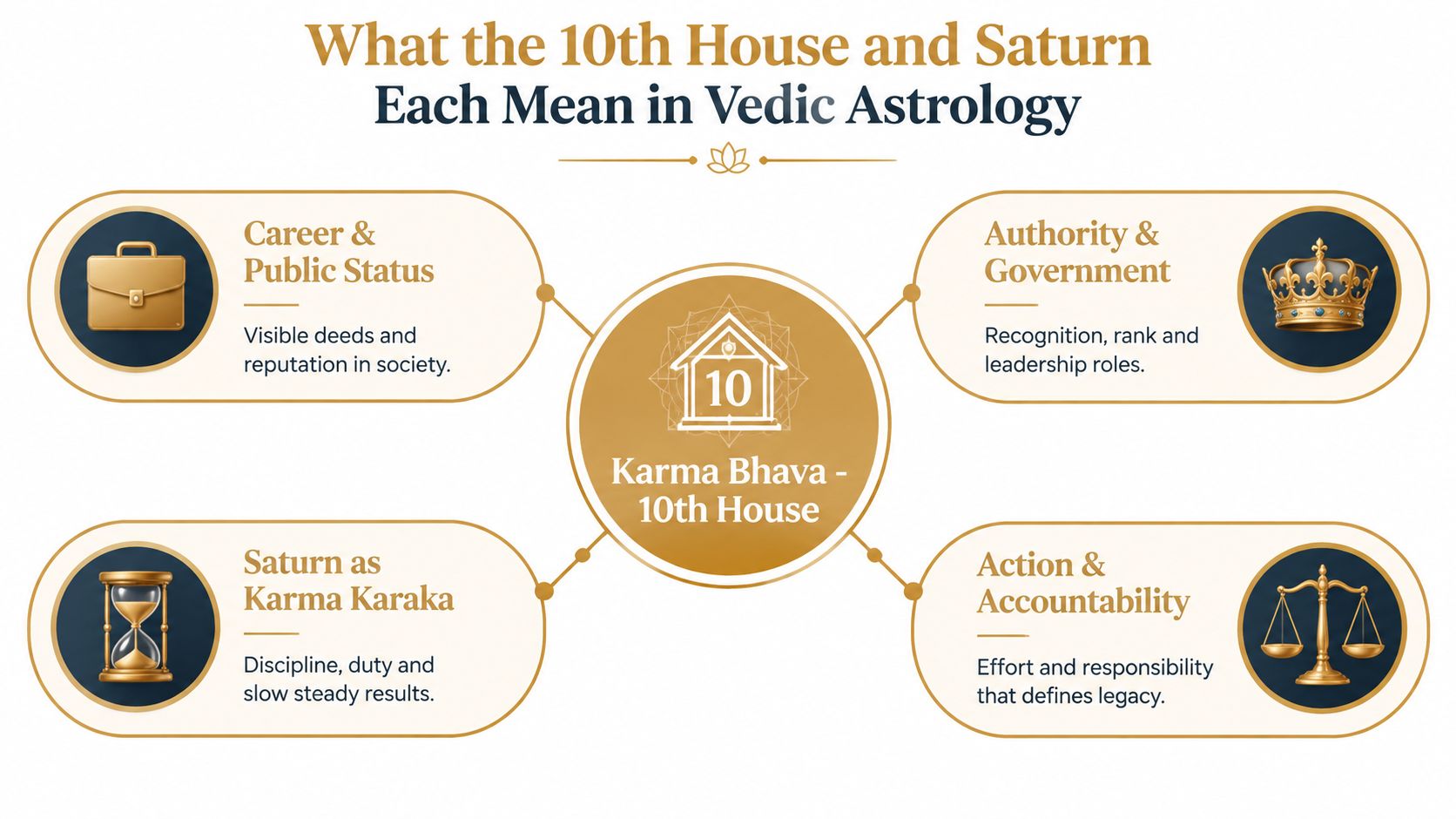
Start with the 10th house. In Vedic astrology, it is called Karma Bhava, which means the house of action, profession, and public deeds. It concerns what you do in the visible world, how society sees your work, and the responsibilities attached to your position. Classical house doctrine treats it as the most visible angle of the chart, which is why it carries strong links with career, status, authority, and reputation. A modern reference on Saturn in the 10th house also describes this axis as connected with work and public standing.
Now consider Saturn. Saturn represents structure, time, duty, limits, discipline, and the results of repeated effort. Think of a building under construction. The 10th house shows the building's public face and function. Saturn is the scaffolding, the schedule, the inspection, and the work required before the structure can carry weight.
That analogy explains the usual interpretation. Saturn in the 10th often places emphasis on accountability before applause. You may be asked to prove reliability, develop technical skill, or accept serious duties before your role feels comfortable. The placement can describe a reputation built through consistency rather than quick visibility.
The central relationship
The 10th house asks, “What do you contribute publicly?” Saturn asks, “Can that contribution withstand time, pressure, and responsibility?” Together, they can make work feel important early in life, even when status develops later.
That doesn't always mean difficulty. It may show a person who prefers clear systems, measurable duties, and roles where experience matters. It can also describe someone who becomes an authority because others learn they can be trusted with complicated work.
The public result still depends on the whole chart. Saturn may support administration, governance, engineering, compliance, operations, research, or other structured settings when the wider chart agrees. It can also produce frustration if the person carries responsibility without suitable support or recognition.
A useful starting principle is simple:
The 10th house shows visible action. Saturn asks you to make that action durable.
Why Saturn Is Considered Strong in the 10th House
Saturn in the 10th is notable for more than the familiar phrase “late success.” Several classical ideas explain why astrologers study this placement closely.
Directional strength and angular power
In Vedic astrology, digbala means directional strength. A planet has digbala when a particular direction or house supports its natural expression. Saturn is traditionally assigned maximum directional strength in the 10th house. A Vedic explanation of Saturn in the 10th identifies this placement as Saturn's point of digbala.
The 10th is also a kendra, or angular house. Angular houses are treated as structurally important points in the chart. Saturn in this position can make themes of duty, rank, administration, and public accountability more visible in the person's life.
This is not the same as saying Saturn becomes automatically beneficial. Strength gives a planet more capacity to act. Whether that action supports the native depends on sign dignity, house ownership, associations, and timing.
Upachaya and gradual development
The 10th house is also described in modern Vedic explanations as an upachaya house. Upachaya means a house associated with growth through time, effort, and experience. Natural malefic planets, including Saturn, are often said to improve in such houses as the person learns how to handle their pressure. This explanation of Saturn in the 10th links the placement with early difficulty followed by greater authority over time.
That principle explains why two people with this placement may feel different at first. One may experience strict supervisors, heavy workloads, or slow recognition. Another may enter a structured institution and gain responsibility steadily. Both expressions involve Saturnian work, but the surrounding chart and real-world setting shape the outcome.
Sasa Yoga
A more specific classical condition is Sasa Yoga, one of the five Panch Mahapurusha Yogas in Indian astrology. It forms when Saturn occupies a kendra, the 1st, 4th, 7th, or 10th house, while placed in its own sign, Capricorn or Aquarius, or exalted in Libra. In that configuration, traditional texts associate Saturn with administrative power, rank, and authority. A discussion of Sasa Yoga and Saturn in the 10th explains why the 10th is one of its exact locations.
Sasa Yoga is conditional. Saturn in the 10th alone isn't enough. A careful astrologer must examine whether the sign, house lordship, combustion, conjunctions, aspects, and dasha activation support the result.
Classical strength increases possibility. It doesn't remove context.
How Sign Dignity Aspects and Conjunctions Change the Result
A placement can be strong in one chart and burdensome in another. The difference often comes from the factors surrounding Saturn.
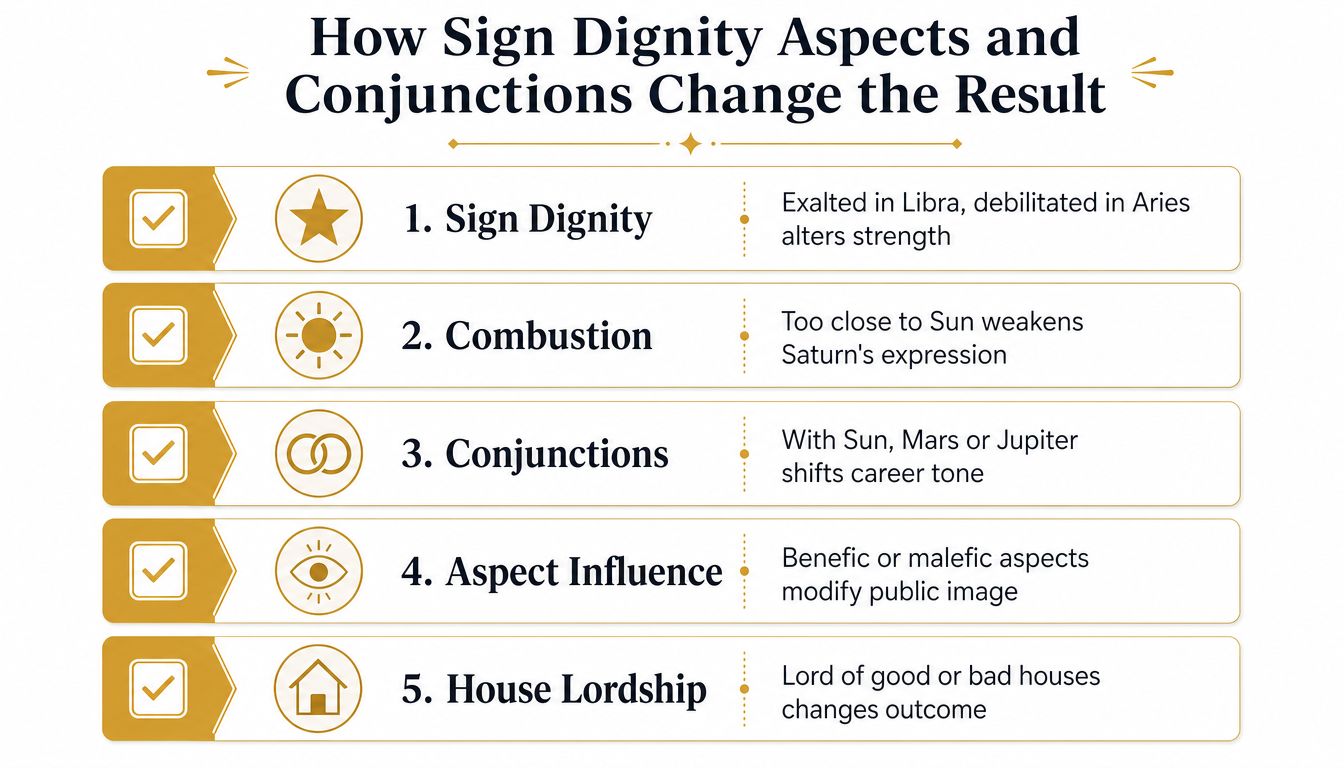
Sign dignity describes how comfortably a planet operates in its sign. Saturn is traditionally exalted in Libra and debilitated in Aries. Its own signs are Capricorn and Aquarius. These conditions can alter how clearly Saturn expresses discipline, judgment, boundaries, and long-term planning. The placement still requires a full chart reading, but sign dignity gives an important first filter.
Combustion means a planet is very close to the Sun and is traditionally considered weakened or overheated by the Sun's proximity. If Saturn is combust, its themes may feel less steady or may operate through strain, conflict with authority, or difficulty expressing independent judgment. This is one reason serious interpretation shouldn't isolate the house position. This practical discussion of Mercury in the 10th also illustrates why planetary meaning must be read with placement and context together.
Saturn's special aspects
Saturn has special aspects in Vedic astrology. From the house it occupies, it fully aspects the 3rd, 7th, and 10th houses counted from itself. A reference on Saturn's aspects describes this traditional rule.
When Saturn sits in the 10th, these aspects reach the 12th, 4th, and 7th houses from the ascendant, depending on how the chart is being judged. The 7th-house aspect is especially important because it can connect public duty with partnership themes. The aspect to the 4th can bring pressure or structure into home, emotional foundations, property, or private life. These are interpretive possibilities, not fixed outcomes.
A compact reading checklist
Use the following order rather than jumping straight to “career delay”:
- Sign: Is Saturn exalted, in its own sign, debilitated, or placed in a sign where its expression needs adjustment?
- Combustion: Is Saturn too close to the Sun to operate with its usual steadiness?
- Conjunctions: Does Saturn join the Sun, Mars, Jupiter, or another planet that changes the tone of work and authority?
- Aspects: Which planets influence Saturn, and which houses receive Saturn's full aspects?
- House lordship: Which houses does Saturn rule for this ascendant, and do those topics support or complicate the 10th-house result?
- Timing: Is Saturn, the 10th house, its lord, or a connected planet active in the dasha sequence?
A Saturn placement can describe capacity for responsibility while also showing the need to define limits. Without that balance, the person may become known for carrying work that belongs to several people.
Timing Career Growth Through Dashas and Saturn Returns
Meaning and timing are separate questions. Natal Saturn in the 10th describes a pattern of work, duty, visibility, and authority. It doesn't tell you by itself when a career shift will occur.
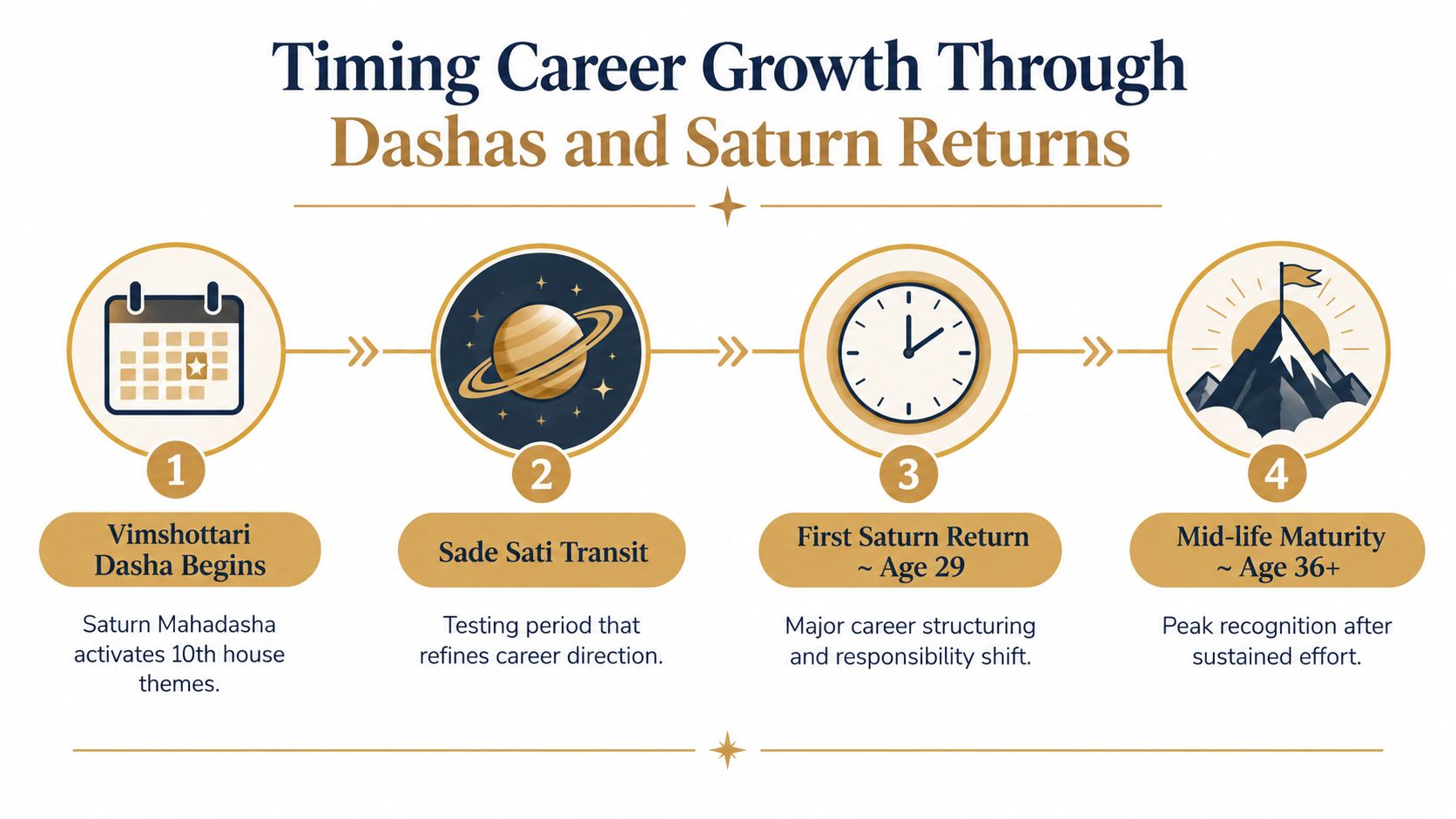
Vedic astrology often uses Vimshottari dasha, a planetary period system arranged as major and sub-periods. A Saturn period can bring Saturn's themes into focus, especially when Saturn connects with the 10th house, its lord, or relevant career indicators. Another planet's dasha may activate the placement through its relationship with Saturn or the 10th house.
Why the first Saturn return matters
A Saturn return occurs when transiting Saturn returns to the natal Saturn position. Modern reference writing commonly places the first return around age 29, when Saturn completes its first return cycle. This overview of Saturn in the 10th associates that period with maturation, delayed but durable advancement, and stronger responsibility.
For someone with Saturn in the 10th, the return may coincide with a clearer view of professional direction, a heavier role, a change in authority, or a decision to stop building a career on unstable foundations. But the event doesn't have one universal form. It may also bring prolonged stress, underemployment, or a recognition that the current work structure isn't sustainable.
Existing discussions often repeat the Saturn-return rule without transparent longitudinal datasets or clear boundary conditions. That limitation matters. A timing principle can be useful as a hypothesis, but it shouldn't be treated as proof that a particular career event must occur.
Verification before prediction
A calibration-first method asks whether earlier dasha and transit windows corresponded with events you remember. Did responsibility increase? Did your role become more visible? Did work become more structured, or did professional pressure rise without a clear outcome?
Pramāṇa means evidence or validation through lived experience. A chart-first reading can identify windows to review, then compare those windows with your record. This discussion of Saturn years without doom is useful for keeping Saturn timing reflective rather than fatalistic.
A timing window is an invitation to examine experience, not a promise of employment or income.
For personal reflection and self-understanding, you can record dates, role changes, responsibilities, and decisions. This is not professional advice, and astrology shouldn't replace practical career planning, qualified financial guidance, or support from appropriate professionals.
Real World Examples Across Different Career Contexts
The same Saturn in the 10th can look different in different work environments. A chart doesn't operate in a vacuum. Institutions, managers, income structures, team expectations, and personal choices all give Saturn a setting in which to act.
Stable institutions
Consider a person working in a large public institution, regulated company, or established technical organization. They may not receive immediate praise, but they become the person who understands procedures, catches errors, and handles difficult transitions. Their authority grows because colleagues rely on their consistency.
This setting can suit Saturn's preference for structure. Yet it can also create a trap. The person may accept extra duties because they're capable, then discover that responsibility has expanded faster than title or recognition.
Entrepreneurial work
An entrepreneur with this placement may build slowly through systems rather than constant novelty. They might focus on contracts, operations, delivery standards, compliance, or repeatable service quality. The work can feel heavy because there's no institution carrying the structure. The person must create it.
That doesn't mean entrepreneurship is unsuitable. It means the business may need clear processes, durable commitments, and realistic role boundaries. A volatile environment can expose Saturn's strengths, but it can also amplify pressure if every responsibility rests on one person.
Remote, creator, and project-based work
Remote and project-based work can express Saturn through portfolio discipline. A person may earn trust by delivering reliably across changing teams, keeping records, and producing work that remains useful after a project ends. Public reputation may develop through repeated proof rather than one dramatic breakthrough.
Creator work can be more difficult to read because visibility and income may fluctuate. Saturn in the 10th may prefer a dependable production system, clear editorial standards, and a long view of reputation. The placement doesn't guarantee an audience or stable earnings.
A useful comparison is:
| Work context | Saturn may express through | Main risk |
|---|---|---|
| Stable institution | Process, rank, administration | Carrying duties without recognition |
| Entrepreneurship | Systems, accountability, durability | Becoming responsible for everything |
| Remote work | Reliability across distance | Invisible labour |
| Creator or project work | Consistent output and reputation | Slow feedback and uneven visibility |
Reviewing past work windows can help you test which context fits. Look for periods when responsibility grew, when authority became visible, and when the structure around you either supported or blocked your effort. This career astrology discussion offers another way to think about career as a pattern of construction rather than a single job title.
Strengths Challenges and Practical Ways to Work With This Placement
Saturn in the 10th can support reliability, endurance, administrative skill, patience, and respect earned through repeated performance. It can also bring early delays, pressure to over-deliver, fear of judgment, or long periods where the person works below their apparent capacity.
The practical task is to separate meaningful responsibility from unexamined over-responsibility. Keep a record of projects, role changes, feedback, and periods when your workload changed. Review whether authority, learning, and recognition are developing alongside the duties you accept.
Try these reflection prompts:
- Scope: Which responsibilities belong to your role, and which have been added?
- Evidence: What past work windows support the idea that your career grows through structure?
- Feedback: Who can give you clear, specific information about your performance?
- Capacity: What would a sustainable workload look like in your actual life?
- Timing: Which dasha or transit periods coincide with changes you've already lived?
A structured Samhita can preserve these observations with the chart calculations and timestamped updates, so you can compare future interpretations with real events instead of rewriting the past to fit a prediction. The value lies in an auditable record and honest uncertainty, not in flattering certainty.
If you want to understand how Saturn in the 10th fits with your sign, house ownership, aspects, conjunctions, and dasha sequence, Generate my Samhita with Anvaya. Start with your birth data, review the chart-derived reading, and use lived events to test what the placement means for you.