

You open your chart because the same themes keep repeating. You push hard and get things moving, then hit friction with people close to you. A property matter becomes urgent. A marriage conversation suddenly turns technical because someone says, “Check Mars.” At that point, most readers get handed vague labels like aggression, courage, or Manglik. That usually creates more heat than clarity.
In Mars Vedic astrology, Mars matters because it is not read as a mood word. It is read as a structured force. Classical jyotish gives Mars a stable profile, specific signs it rules, specific houses it aspects, and specific placements that become important in marriage analysis and timing work. That baseline has remained structurally consistent from classical doctrine into modern Vedic practice, as outlined in this reference on Mars across civilizations.
At Anvaya, we take a simple position. Math first, language second. If Mars is active in your chart, the question isn't “Are you an angry person?” The question is where Mars sits, what it aspects, how strong it is, when its periods activate, and whether lived events confirm that signal.
That's also where many readers get confused. They hear one placement and assume a full conclusion. Real chart reading doesn't work that way. It compares placement, dignity, aspects, timing, and chart context. Then it checks whether the pattern matches your life.
Use this as a guide for personal reflection and self-understanding, not professional advice.
Table of Contents
- Introduction Why Mars Keeps Coming Up in Your Chart Questions
- What Mars Means in Vedic Astrology Beyond the One Word Labels
- How Mars Acts Through Houses and Its Three Special Aspects
- Mangal Dosha Decoded Classical Rule Versus Modern Expansion
- Mars Dashas and Strength Measures That Set Timing and Intensity
- Yogas Afflictions and When the Whole Chart Overrides Mars
- Working With Mars Energy Remedies Reflection and Next Steps
Introduction Why Mars Keeps Coming Up in Your Chart Questions
A common chart question starts with an ordinary event. A home purchase turns tense. A disagreement with family gets sharper than expected. A marriage discussion suddenly includes the word Manglik, meaning a Mars condition used in compatibility analysis. Mars comes up because it often shows itself when pressure, heat, timing, and action all meet.
That is also why Mars gets simplified too fast.
In Vedic astrology, Mars is not useful as a loose personality tag. It works more like a measurable force in the chart. You read its rulership. You read its aspects, called drishti, meaning planetary sight or influence. You check its strength through tools such as Shadbala, meaning sixfold strength, and Ashtakavarga, meaning a point-based system that shows support across signs and houses. Then you test timing. Then you compare all of that with lived events.
Mars gets overused because its topics are easy to dramatize. Conflict, property, siblings, sex, injury, ambition, and marriage strain are memorable. So readers often hear “this is Mars” long before anyone has measured how Mars is operating.
A better starting rule is simple.
If Mars is being explained only with adjectives, the reading is incomplete.
Mars also carries weight in South Asian thought beyond horoscope reading. As noted earlier, scholars have treated Mars as a military and cultural symbol as well as a graha, meaning planetary force. That background helps explain why people react strongly to Mars language. It does not justify skipping chart math.
The useful questions are more concrete:
- Where is Mars placed in the birth chart?
- What does Mars rule from the rising sign?
- Which houses does it aspect, meaning influence through drishti?
- How strong is it by dignity, Shadbala, and other chart measures?
- How many supportive points does it receive in Ashtakavarga?
- Is a Mars period active, such as a dasha, meaning planetary period, or sub-period?
- Does Mangal Dosha look mild, moderate, or strong once the whole chart is checked?
That last point matters. Mangal Dosha makes sense only after calibration. A Mars placement by itself does not tell you severity. House position, sign, aspects received, strength, cancellation factors, and timing all change the result. The same placement can act very differently in two charts.
Use that frame first. It keeps Mars readable. It also keeps fear out of the interpretation.
What Mars Means in Vedic Astrology Beyond the One Word Labels
A reader sees Mars in a chart and asks, “Does this mean anger?” That question is understandable. Mars is often reduced to a single word. The chart becomes easier to fear than to read.
In classical texts, Mars is called Mangala or Kuja. It is also called Senapati, meaning commander. That image is useful because it points to function. Mars shows how force is gathered, aimed, and used.
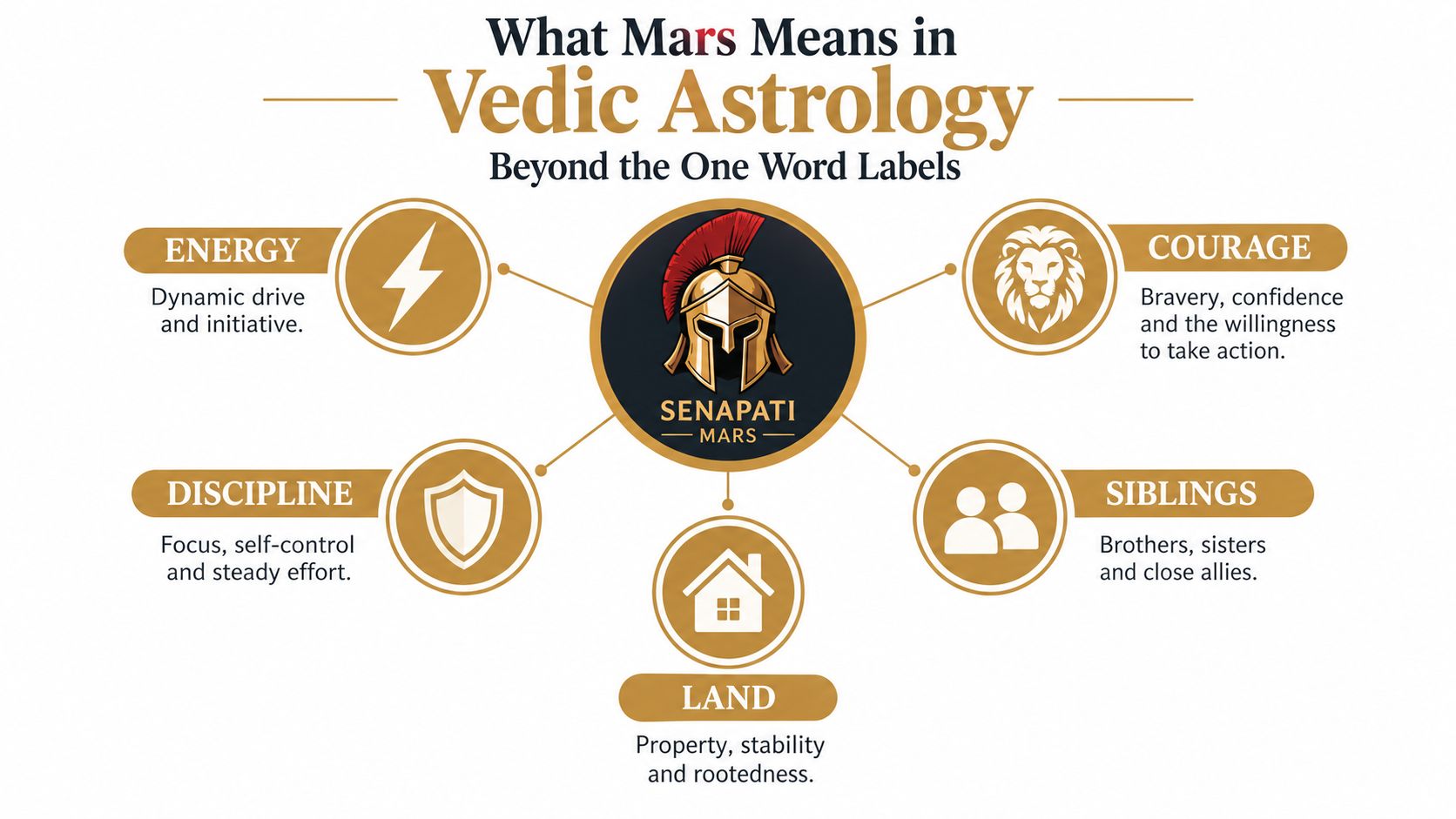
A commander does more than fight. A commander allocates pressure. In the same way, Mars is not a personality sticker. It is a measurable factor in the chart. You judge it by what it rules, where it sits, how it aspects, and how strong it is by methods such as Shadbala, meaning sixfold strength, and Ashtakavarga, meaning the point system that shows support across houses.
That is why one-word labels fail. “Aggressive Mars” tells you very little. A strong Mars can show courage, technical skill, physical stamina, clean decision-making, or the ability to hold a boundary without drama. A strained Mars can show heat without aim. The force is the same. The calibration is different.
Classical doctrine gives Mars rulership over Aries (Mesha) and Scorpio (Vrishchika). It is exalted in Capricorn (Makara) and debilitated in Cancer (Karka), as described in standard Jyotisha teachings.
Those terms need plain English.
- Rulership means Mars has authority in that sign.
- Exaltation means Mars tends to express its qualities with order and efficiency there.
- Debilitation means Mars has a harder time expressing its nature directly there.
These are not moral rankings. They are condition readings, like checking whether a tool is sharp, blunt, or awkward to use in a given setting.
The same logic applies to sign meanings. Mars in Aries may act fast because the channel is direct. Mars in Scorpio may act with secrecy or strategy because the channel is controlled and inward. Mars in Capricorn often works with structure, duty, and endurance. Mars in Cancer may protect first and strike second, because feeling and defense color the expression.
Notice what this does not tell you. It does not tell you outcome by itself.
A surgeon, a soldier, an engineer, and a litigator can all need Mars. The question is not whether Mars exists in the chart. It always does. The question is how usable that Martian force is, where it is directed, and whether the rest of the chart supports or distorts it.
This point matters later when people ask about Mangal Dosha, meaning a marital compatibility condition linked to Mars. Severity cannot be judged from the word “Mars” alone. It has to be measured in context. A well-placed Mars with support can behave very differently from a weakened or afflicted Mars in the same house category.
So the clean definition is simple. Mars signifies directed force. Anger is one possible byproduct. It is not the whole meaning.
How Mars Acts Through Houses and Its Three Special Aspects
A common chart mistake starts here. Someone sees Mars in one house and reads only that house. The result is partial, because Mars also acts through drishti, meaning aspect or directional influence.
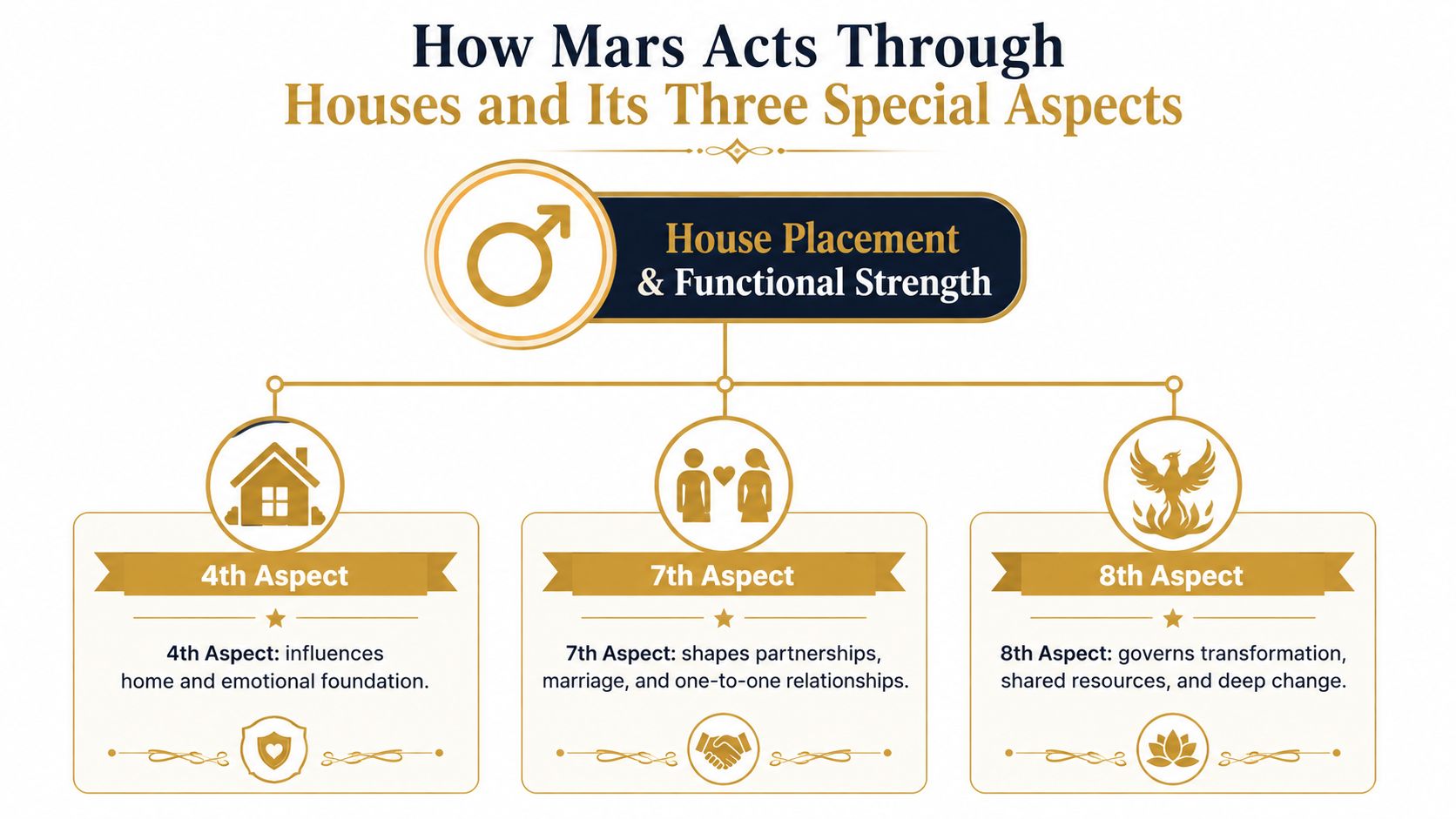
The three special aspects
In Jyotisha, meaning Vedic astrology, Mars gives full aspect to the 4th, 7th, and 8th houses from where it sits. You can read this like force lines on a map. One placement sends pressure, effort, and heat into three other zones of life.
That is why house reading matters so much with Mars. A planet does not only occupy space. It also influences other spaces.
Here is the basic geometry:
- 4th aspect. Mars presses on the house four places away. This often shows where effort becomes defensive, protective, or controlling.
- 7th aspect. Mars faces the house opposite it. This often shows direct friction, open competition, or force meeting resistance.
- 8th aspect. Mars pushes into the house eight places away. This often brings strain, urgency, surgery, rupture, hidden pressure, or hard transformation.
The exact result still depends on context. A strong Mars can protect and stabilize the houses it aspects through disciplined action. A damaged Mars can irritate the same houses through haste or conflict. Measurement becomes more useful than labeling. You are judging direction, strength, and support.
Why the house map changes the reading
Suppose Mars sits in a kendra, meaning an angular house such as the 1st, 4th, 7th, or 10th. Its effect usually becomes more visible because angular houses are active places in the chart. If Mars also has good Shadbala, meaning sixfold strength, or supportive Ashtakavarga, meaning point-based house support, its aspects tend to act with more usable force. If those measures are weak, the same aspect pattern may produce more strain than output.
This is why whole-chart calibration matters. House placement shows where Mars sits. Aspect pattern shows where it acts. Strength measures show how much force it can deliver.
A simple example helps.
If Mars is in the 12th house, some readers stop at loss, expense, sleep, retreat, or private struggle. But Mars also aspects the 3rd, 6th, and 7th from there through its special pattern. So relationship questions may come less from “Mars in the 12th” by itself and more from Mars casting its 8th aspect onto the 7th house. If you want to compare that with a more combustible pattern, see this article on the Rahu Mars conjunction in Vedic astrology.
The practical rule is simple. Read Mars in three layers at once. Where it is placed. Which houses it aspects. How strong it is by chart measurement.
That is also why Mangal Dosha cannot be judged from house position alone. The same Mars placement can behave very differently when rulership, benefic support, Shadbala, and house context change.
Mangal Dosha Decoded Classical Rule Versus Modern Expansion
Anxiety usually spikes here. Someone says you are Manglik. Another person says you aren't. Often both are using different standards and not saying so.
The classical rule and the modern expansion
A narrower classical formulation linked to Parāśara treats Mars in the 1st, 4th, 7th, 8th, or 12th from the Ascendant as relevant to Mangal Dosha, especially when there is no benefic aspect or conjunction, in this reference on Mangal Dosha. A commonly used modern expansion adds the 2nd house and checks these placements not only from the Ascendant, but also from the Moon and Venus, as outlined in this explanation of the expanded standard.
That difference is not minor. It changes who is labeled dosha-bearing.
Mangal Dosha Standards Compared
| Standard | Houses Counted | Reference Points | Severity Note |
|---|---|---|---|
| Classical Parāśara-style rule | 1st, 4th, 7th, 8th, 12th | Ascendant | Narrower test. Often read with benefic cancellation in mind. |
| Common modern expansion | 1st, 2nd, 4th, 7th, 8th, 12th | Ascendant, Moon, Venus | Broader screening tool. Used widely in modern matchmaking. |
Severity is graded, not binary
The six-house model often used today treats Mars in the 1st, 2nd, 4th, 7th, 8th, or 12th from Lagna, Moon, or Venus as dosha-bearing, and notes that severity is not uniform across houses in this practical Mars reference.
Several explanations agree that the 7th house is the most sensitive because it directly signifies marriage and partnership. The 8th and 12th are also treated as higher-risk placements for intimacy, losses, private life, and longevity themes. One source explicitly labels the 7th and 8th as the most severe positions in the six-house model in this Mangal Dosha explainer.
By contrast, the 1st and 2nd are often treated as milder in graded compatibility work.
A Manglik label without the standard used is incomplete. Always ask, “Classical list or expanded list? From Ascendant only, or also from Moon and Venus?”
One tool is not the whole reading
If you want a quick screen before you pay a rupee, use a tool that states its rules clearly. Anvaya's Mangal Dosha calculator is useful in that specific sense. The important part isn't the label. It's whether the method tells you which standard it applied.
Mars Dashas and Strength Measures That Set Timing and Intensity
A placement tells you where Mars is. Timing tells you when it becomes louder.
In Vedic astrology, that timing often comes through dasha, meaning a planetary period. During a Mars Mahadasha, meaning the major Mars period, or a Mars antardasha, meaning sub-period, Mars themes often come forward more visibly. That doesn't mean one outcome is guaranteed. It means the chart is more likely to express Mars-related topics if the rest of the chart supports them.
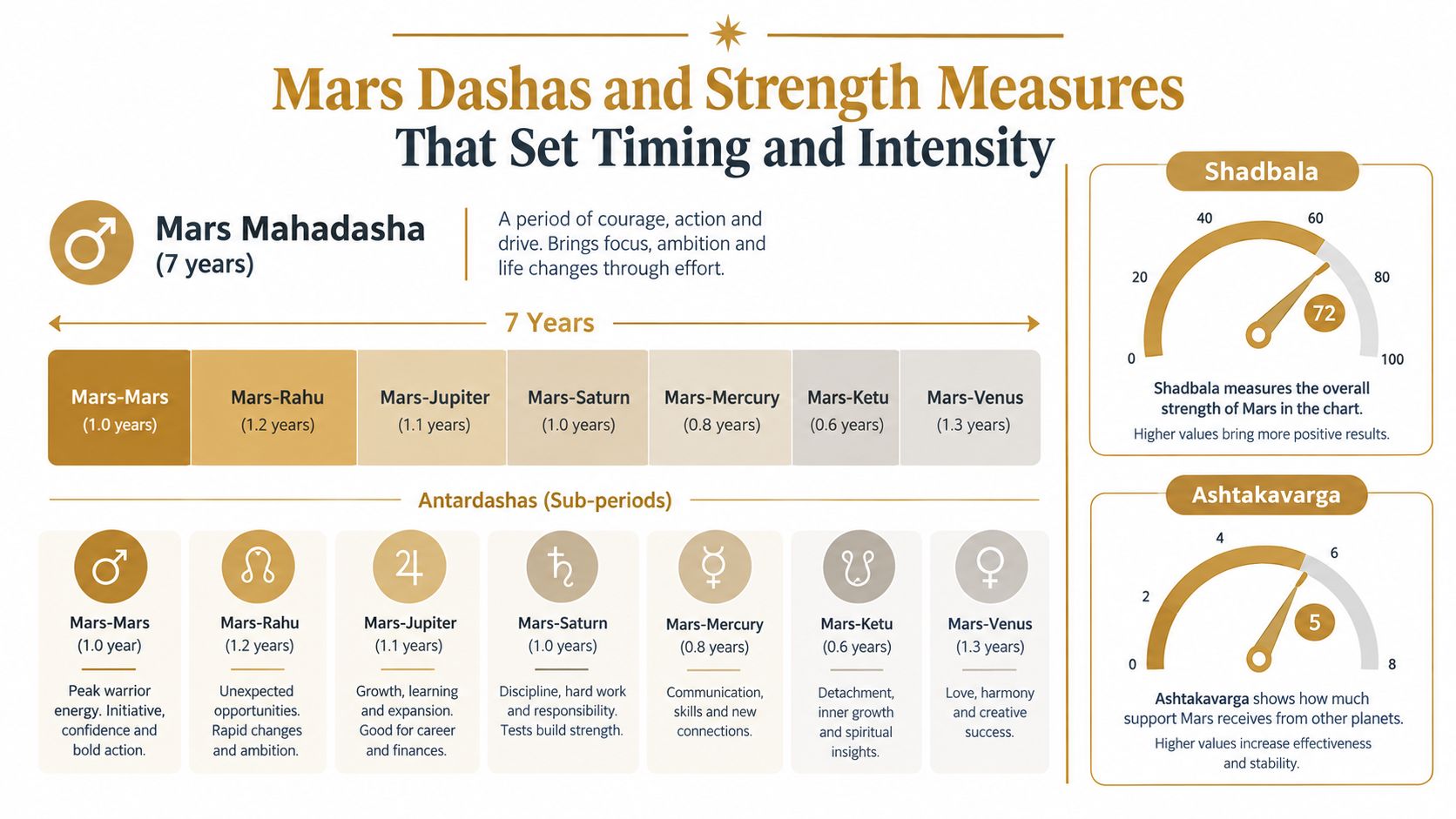
Why two similar Mars placements feel different
Shadbala and Ashtakavarga help.
- Shadbala means a structured strength assessment. In plain language, it asks whether the planet has the capacity to act.
- Ashtakavarga is a point-based system used to assess support across signs and houses. In plain language, it helps show where the chart gives more or less backing.
Two people may both have Mars in the same house. One may experience clean action, useful pressure, and strong follow-through. Another may experience the same area as stop-start, stressful, or erratic. The difference often comes from strength and timing, not placement alone.
Read timing and strength together
When a Mars period runs, ask:
- Is Mars strong enough to deliver?
- Which houses does it connect to?
- What does the current period activate?
- Do lived events already confirm this pattern?
That last question matters most. Timing should be checked against real life, not imposed on it. If you're working through a launch, move, exam season, or relationship decision, a timing framework can help you narrow windows. For a practical planning angle, see when is a good time to start.
A serious reading system computes these layers at birth, then interprets them conditionally. If the chart supports it, a Mars period may correlate with action, confrontation, land or property matters, or relationship pressure. If not, Mars may stay secondary even when present.
Yogas Afflictions and When the Whole Chart Overrides Mars
This is the section many readers skip. They shouldn't.
A single Mars placement can be real and still not be final. The whole chart can support it, soften it, redirect it, or override it. That is why modern sources increasingly stress chart-first calibration over fixed remedy lists and one-line Manglik judgments, as discussed in this article on Mars remedies and full-chart context.
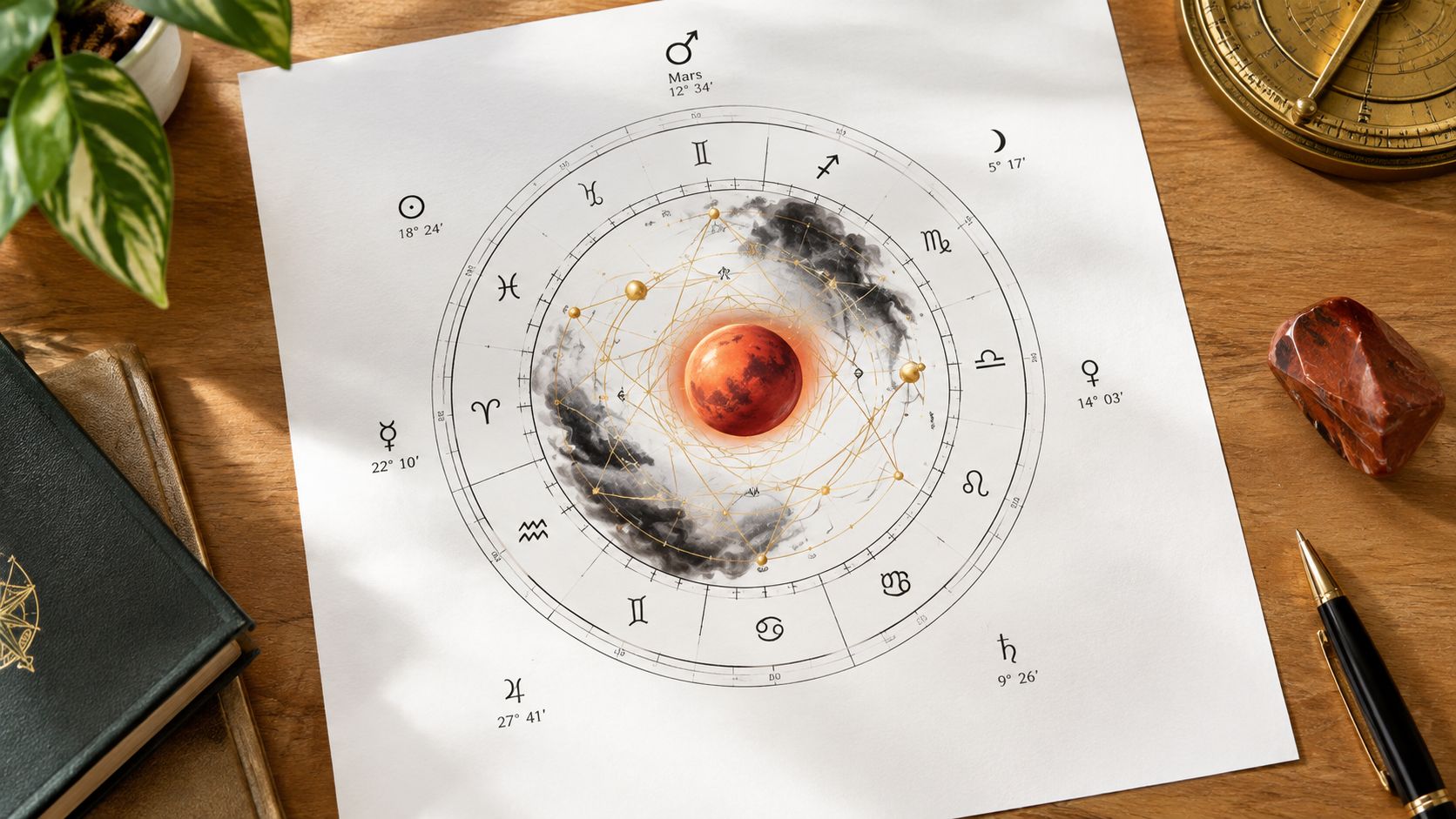
When Mars is supported
Support can come from several directions.
A benefic aspect, meaning a calming or harmonizing planetary influence, may reduce raw edge. Strong dignity can help Mars act with discipline instead of excess. Functional role matters too. A planet that rules useful houses in a specific chart can behave differently from the same planet in another chart.
This is why “Mars in the seventh means marriage trouble” is too blunt. Sometimes the chart confirms that tension. Sometimes the chart clearly modifies it.
The twelfth-house example shows the logic
A good example is Mars in the 12th house. One mechanical explanation for why this placement enters Mangal Dosha discussions is that Mars' special 8th aspect from the twelfth falls onto the 7th house of marriage. That geometry is explicitly discussed in this explanation of Mars in the twelfth house.
That's useful because it shows the rule is not random. It is based on house-to-house structure.
Why generic remedies often fail
Readers increasingly want evidence-backed guidance, especially around remedies and relationship matching. But much Mars content still offers fixed mantras, checklist remedies, or generic dosha advice without showing when the full chart changes the conclusion.
Here's the honest position. A remedy may be meaningful within a tradition. But if the chart context isn't clear, the remedy may be mistimed, unnecessary, or secondary.
Look for readings that say where they are confident, where they are uncertain, and what in the chart could cancel or reduce a Mars effect.
That is quieter than fear-based astrology. It is also more useful.
Working With Mars Energy Remedies Reflection and Next Steps
A common pattern goes like this. Someone is told they have strong Mars, hears the word Manglik, and starts collecting remedies before checking whether Mars is the main problem in the chart.
A steadier approach begins with measurement. In Vedic astrology, Mars works like a force you can assess through rulership, aspects, Shadbala (sixfold strength), and Ashtakavarga (point-based support across houses). Remedies make more sense after that. Otherwise, you may be treating noise and missing the signal.
Grounded ways to work with Mars
Mars usually responds well to containment. Fire cooks food when it stays in the stove. The same fire can burn the room when it has no boundary.
Start with ordinary disciplines that give effort a clear channel:
- Use physical discipline. Regular exercise, martial training, or manual work can direct excess drive into action with form.
- Set cleaner boundaries. Mars often shows strain where roles, limits, or expectations stay muddy for too long.
- Choose timing with care. For an important action, use a serious calendar tool such as a Panchang or a considered Muhurta process instead of acting only on urgency.
- Track repeating patterns. Note when conflict, haste, property stress, injuries, or relationship friction increase. Repeated patterns are easier to judge than one difficult week.
These are not substitutes for chart judgment. They are stabilizers.
Remedies only work when the diagnosis is clear
A long remedy list can sound comforting. It can also cover weak analysis.
Before following a Mars remedy, ask four plain questions:
- What exactly is being remedied? A house placement, a dasha, Mangal Dosha, low strength, or an affliction from another planet.
- How strong is Mars in the chart? Shadbala and Ashtakavarga help estimate whether Mars is underpowered, overactive, or prominent.
- What is Mars doing by rulership? The lord of a helpful house can act differently from the lord of a difficult house.
- Does lived experience match the reading? A claim about Mars should be checked against actual periods of conflict, surgery, property issues, discipline, competition, or technical work.
That last question matters because astrology is not only symbolism. It is also calibration.
At Anvaya, Pramāṇa means testing a reading against lived events before making future claims. The resulting structured reading is called a Samhita, not a horoscope feed. If you want to examine Mars without reducing your life to one placement, the Anvaya blog, methodology notes, and naming tool for Janma Akshara are useful places to continue.
FAQ
Is Mars in Vedic astrology only about anger
No. Mars shows directed force. Anger is one expression. Mars can also describe courage, engineering, land, precision, defense, initiative, and the ability to cut through delay.
Is every Manglik placement equally serious
No. Severity depends on context. House position matters, but so do aspects, strength, rulership, marriage indicators, and timing. A textbook rule is only the first filter.
Does sign placement alone tell the full story
No. Sign shows style. House shows area of life. Aspects show where Mars pushes. Strength measures show capacity. Dashas show timing.
Why do different astrologers give different Manglik answers
They may be using different rules, or they may be weighing cancellation and severity differently. Whole-chart judgment creates different conclusions because charts are not built from one factor.
Can remedies cancel Mars completely
That is too absolute. Remedies may support balance, attention, and discipline. The final result still depends on the full chart and on whether Mars is the active cause.
When does Mars matter most
Mars tends to stand out when its dasha or sub-period runs, when it strongly influences the houses tied to the current life issue, or when transits activate the same pattern.
If you want a chart reading that tests Mars against actual life events before making claims, Anvaya offers a Samhita built from declared Vedic compute and calibrated through Pramāṇa. It can help you check whether Mars is a major factor in your chart, or only a loud label that does not hold up when the math is examined.