
You're at a family table when someone suggests a wedding this season. Someone else names the age by which you should already be married. You haven't checked either birth time, but a deadline is taking shape.
Marriage timing astrology should begin with a chart question, not a family deadline. The useful output is a set of conditional windows, with the calculation rules, uncertainty, and intended event written down. It isn't a single age that you must organise your life around.
Table of Contents
- A Date Request Is Not a Chart Question
- Six Filters That Turn a Guess Into a Window
- How Vimshottari Ladders Narrow the Years
- Sambandha Checks Before You Set a Date
- Choosing a Muhurta Inside an Open Window
- How to Audit a Window Against Real Life
- Common Questions About Marriage Timing Windows
- Choose What the Window Is Allowed to Decide
A Date Request Is Not a Chart Question
At that table, people may be answering different questions. Your parents might mean when relatives can travel. You might mean whether a relationship is ready. A jyotishi, a practitioner of Vedic astrology, should first clarify which event you want to examine.
A cultural preference isn't an individual timing window. In Pew Research Center's survey of 23,022 adults across 18 countries, conducted in 2024, the average perceived ideal marriage age was 25.9, with country averages ranging from 21.2 in Bangladesh to 28.9 in Argentina. Respondents in India and Indonesia generally preferred marriage before 25, while several Latin American countries, South Africa, and Tunisia leaned toward the late twenties. In some countries, at least 10% said there's no single best age.
Separate expectation from opportunity
A later window may sit alongside study, migration, money concerns, family expectations, cohabitation, or the simple fact that someone hasn't freely chosen marriage. None of those makes the person a failure. Nor can a chart establish someone's willingness to marry.
The working stack is verified birth data, seventh-house promise, Vimshottari ladders, Jupiter and Saturn transits, Sambandha for two people, then muhurta. Each layer asks a narrower question, rather than repeating the preferred age in technical language.
Key principle: A culturally common marriage age and an individually interpreted window are different things.
This is for personal reflection and self-understanding, not professional advice. A responsible reading gives you a range, its assumptions, and alternative paths. Its output is a dated hypothesis, not a birthday.
Six Filters That Turn a Guess Into a Window
You can prepare a useful timing worksheet before discussing any wedding date. Keep the inputs, calculation settings, and interpretation separate, so another practitioner can understand how you reached the result.
Establish the chart before interpreting it
Lock the birth details. Record the birth date, clock time, and place, together with the source of the time. A hospital record is a stronger starting point than a rounded family estimate. Near an ascendant boundary, a small time difference can change the rising sign or relevant chart divisions. Anvaya requires a birth time and advises checking a hospital record or asking family before beginning.
Compute the birth chart and Navamsha. Use the sidereal zodiac with Lahiri ayanamsha, the declared adjustment between the tropical and sidereal reference frames. Then calculate the Navamsha, the ninth divisional chart used to examine marriage alongside the birth chart. Anvaya computes from your date, time, and place without first asking questions about your life.
Read the seventh house, the partnership house, from the ascendant, meaning the rising sign. Also examine it from the Moon and Venus. Note the seventh lord, the planet ruling that house, planets occupying it, and planets aspecting it, meaning those with a defined astrological relationship to it. Traditional readings also consider Venus in a man's chart and Jupiter in a woman's chart. These are interpretive conventions, not verdicts about gender or relationship roles.
Identify relevant period lords. List the major and subperiod rulers connected with those marriage factors. Don't select a period merely because its planet has a pleasant reputation.
Require agreement before narrowing
Check contemporaneous transits. Ask whether Jupiter, and often Saturn, connects with the seventh house, the seventh lord's sign, or a relevant trinal position during the candidate period. A trine is a specified sign relationship used in the chart. Record the exact relationship instead of writing that Jupiter looks favourable.
Compare both people when applicable. If a partner is part of the question, run the two-chart relationship reading before choosing a ceremony date. One person's supportive period doesn't establish shared timing.
Select a ceremony day last. Search for a muhurta, an astrologically selected ceremony time, only inside the supported window. Decide whether the forecast will be judged within a month, a quarter, or a year.
Traditions differ over which seventh-house reference deserves priority. State which reference you used and how you handled disagreement. The traditional marriage-timing overview from Prokerala describes these seventh-house, planetary-period, and Jupiter-transit connections as candidate indicators, not standalone guarantees.
Pass rule: Require natal support, an active relevant period, and a transit trigger together. If a layer is missing, widen the band or state that no window is supported.
At Anvaya, declared computation comes first. Pramāṇa, calibration against lived events, follows before any forward claim. That check can expose a weak interpretation, but it doesn't turn the method into a scientifically validated predictor.
How Vimshottari Ladders Narrow the Years
Vimshottari is a fixed planetary-period system, not a list of universally favourable marriage ages. Its classical sequence and allocations total 120 years, as documented in the Vimshottari backend specification.
Vimshottari lords and period lengths
| Order | Lord | Mahadasha years |
|---|---|---|
| 1 | Ketu | 7 |
| 2 | Venus | 20 |
| 3 | Sun | 6 |
| 4 | Moon | 10 |
| 5 | Mars | 7 |
| 6 | Rahu | 18 |
| 7 | Jupiter | 16 |
| 8 | Saturn | 19 |
| 9 | Mercury | 17 |
The starting point comes from the Moon's birth nakshatra, its lunar mansion, and the remaining balance of that mansion's ruling period at birth. You don't automatically begin life at the start of Ketu's full period. This is why two people of the same age can have different period ladders.
A mahadasha is the major period. An antardasha is a subperiod within it. Finer subdivisions include pratyantardasha, a further subdivision of the antardasha, but additional decimal places don't compensate for uncertain birth data.
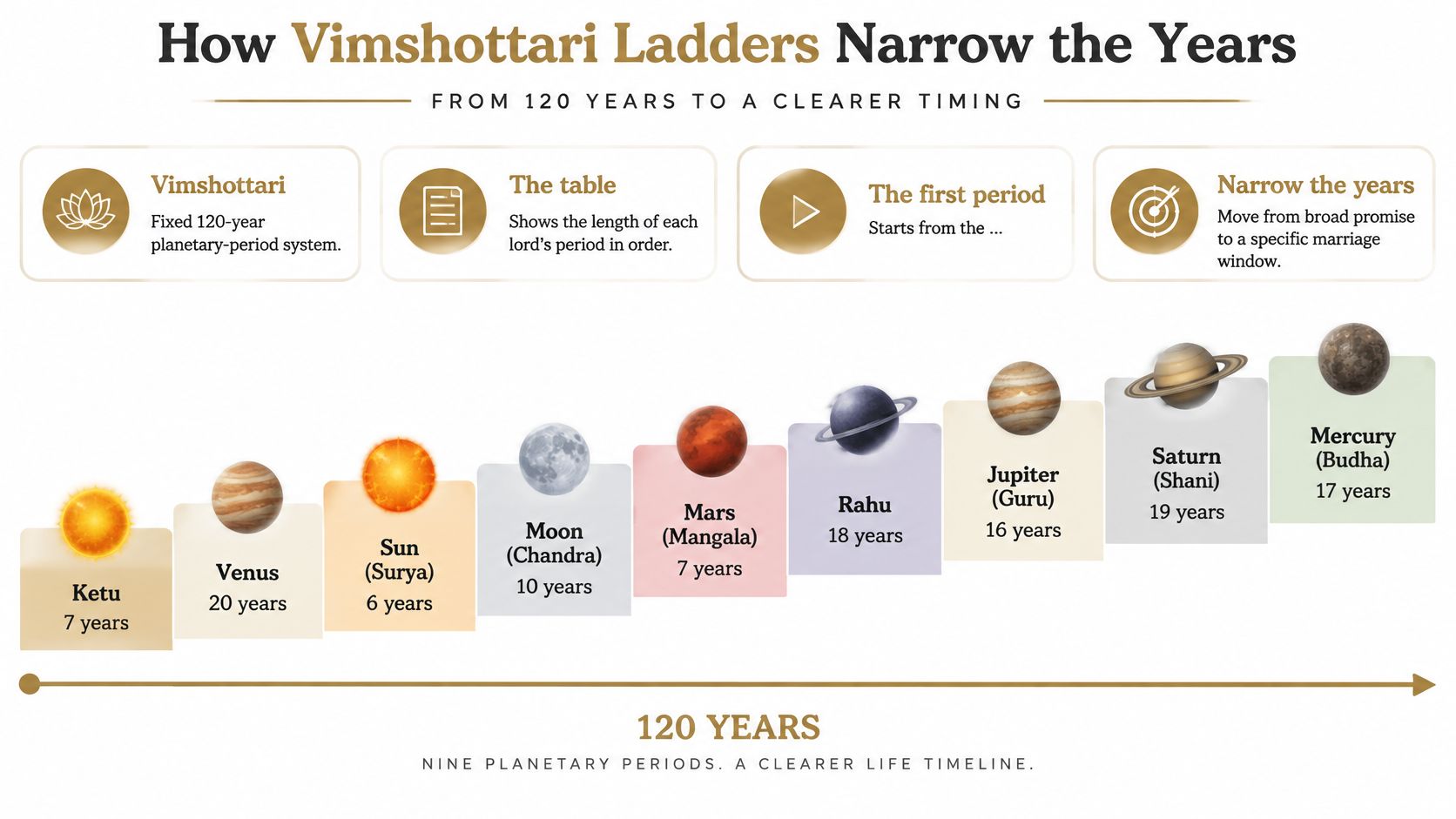
For a marriage shortlist, stop at the antardasha unless the birth time and calculation settings justify closer examination. A dasha calculation walkthrough can help you distinguish the period calculation from the interpretation placed on it.
Compare contrasting period sketches
Suppose someone enters Venus mahadasha with Jupiter antardasha. That combination deserves examination only if Venus or Jupiter connects with the relevant marriage factors. If you're comparing partners, inspect the corresponding period in the other chart too. The names alone aren't enough.
Now suppose someone is in Saturn mahadasha. You shouldn't discard it because Saturn is associated with waiting or responsibility. If Saturn rules or aspects the seventh house, and the transit conditions agree, that period can remain a candidate within the traditional method.
The negative case matters just as much. Suppose the seventh lord receives a weak assessment in both the birth chart and Navamsha, while the period links are unclear. Mark the candidate low confidence rather than forcing a confident wedding year.
A practical worksheet could retain these hypothetical bands:
- Venus major period, Jupiter subperiod: Retain if both planetary connections and shared timing support it.
- Saturn major period, Venus subperiod: Retain if Saturn's partnership role is explicit and the transit check agrees.
- An apparently pleasant but unrelated period: Remove it when no marriage connection can be stated.
Enter the computed calendar boundaries beside each retained band. Don't invent dates from the planetary labels, and don't preserve a weak candidate merely to make the shortlist look complete.
Sambandha Checks Before You Set a Date
Sambandha is the relationship reading between two charts. It asks more than whether a score passes a threshold. Ashtakoota Guna Milan, the Moon-sign and birth-nakshatra matching system, is one compatibility layer within that broader examination.
Ashtakoota points out of 36
The following weighted allocations and the commonly cited minimum of 18 out of 36 are described in Hindutone's Ashtakoota Guna Milan explainer. That threshold is a traditional convention, not a probability of a lasting marriage.
| Koota | Maximum points | Main basis |
|---|---|---|
| Varna | 1 | Moon-sign class |
| Vashya | 2 | Mutual influence of Moon signs |
| Tara | 3 | Birth nakshatra count |
| Yoni | 4 | Nakshatra pairing |
| Graha Maitri | 5 | Friendship of Moon-sign lords |
| Gana | 6 | Nakshatra temperament class |
| Bhakoota | 7 | Moon-sign distance |
| Nadi | 8 | Nakshatra nadi group |
| Total | 36 | Not a marriage-year predictor |
Keep the component scores visible. Nadi and Bhakoota carry the largest allocations, so inspect those rows separately rather than letting the total hide them. A total also needs its calculation rules attached, especially where traditions recognise exceptions.
The score doesn't independently assess the ascendant, seventh house, Venus, Jupiter, dashas, or cross-chart aspects. A Navamsha reading for marriage addresses a different part of the examination. Mangal Dosha, the classical Mars-placement check, is separate too, and schools disagree about its exceptions and cancellations.
When compatibility and timing disagree
Consider a hypothetical couple with a high guna total but no overlap between their candidate period bands. The total doesn't supply a missing wedding year. Record that compatibility scoring and timing have produced different findings.
Now consider a couple below the commonly cited floor whose period ladders show a clear overlap. That overlap doesn't erase the compatibility questions. It means only that the timing layer and the matching layer need separate interpretation.
The useful timing question is narrow: Do both people's candidate bands meet in the same year? If they don't, state the mismatch. Don't average their charts into a compromise month.
Nor should a chart score replace what the two people know about each other. Consent, communication, and shared expectations aren't quantities you can infer from a guna total.
Choosing a Muhurta Inside an Open Window
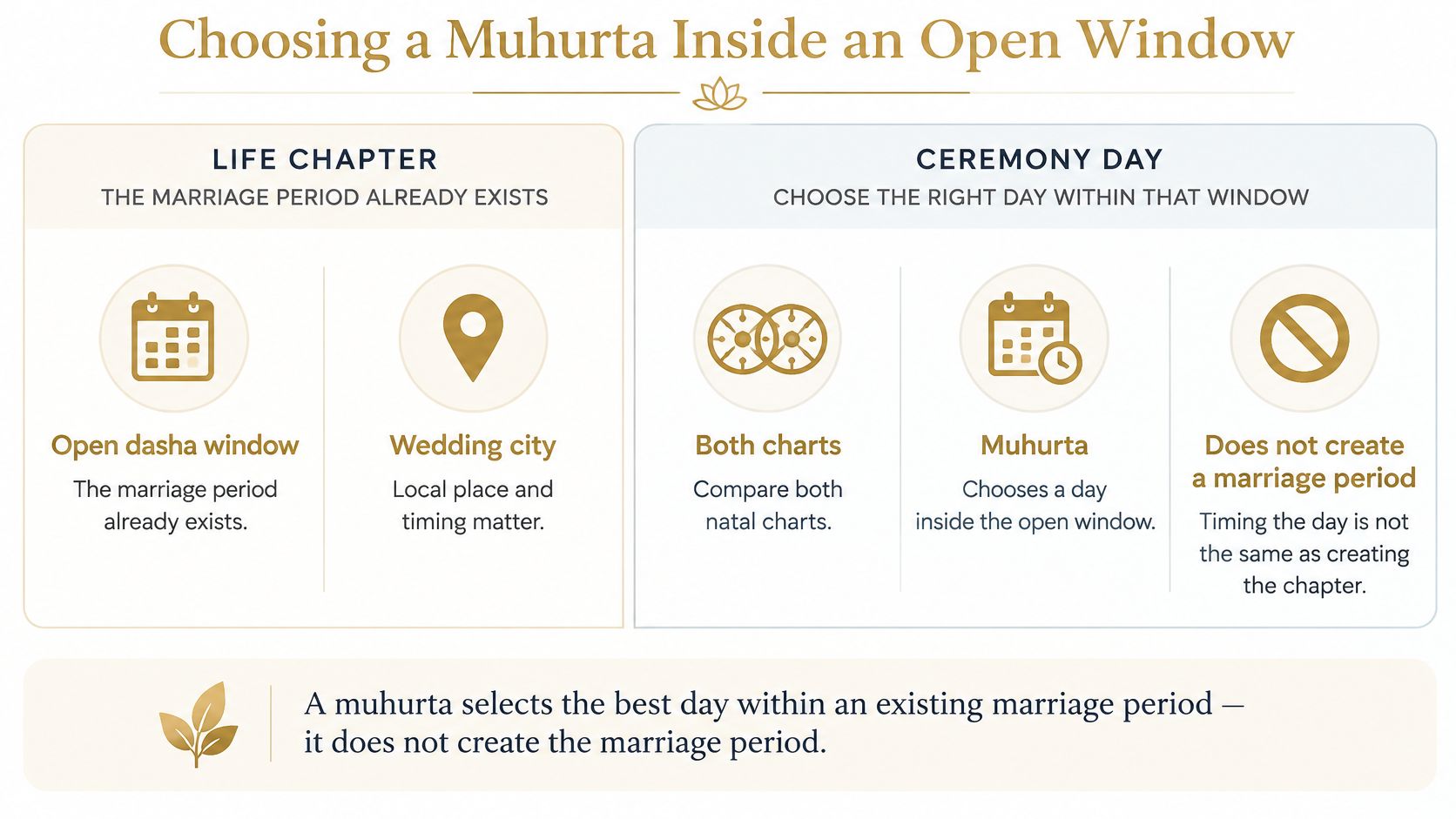
Muhurta selects a ceremony time within a candidate life period. It doesn't create that period or make a relationship suitable. Begin with the written dasha window, the wedding city, and both charts when available.
Read the local calendar
The Panchang, the traditional calendar, has these principal limbs:
- Tithi: The lunar day, calculated from the angular relationship between the Sun and Moon.
- Nakshatra: The Moon's lunar mansion.
- Yoga: A calendar calculation based on the combined longitudes of the Sun and Moon.
- Karana: A division of the tithi.
- Vara: The weekday.
Use the free Panchang to inspect tithi and nakshatra for the relevant place. It's a calendar, not a promise. A named combination such as Sarvartha Siddhi Yoga also needs context rather than automatic acceptance.
Examine the proposed ceremony lagna, meaning the rising sign at that place and time. Within the chosen tradition, prefer a configuration that doesn't place problematic emphasis on the ceremony's seventh house. Check its relationship with both people's lunar factors rather than relying on a generally preferred month.
Keep a shortlist and a rejection record
Seasonal popularity is not chart evidence. Ireland's Central Statistics Office reported that 13.4% of opposite-sex marriages occurred in August 2024, compared with 3.2% in January. That describes marriage seasonality in Ireland, not your individual timing.
Without birth details and a wedding city, specific dates would be invented. A completed shortlist should instead contain actual calculated dates in a record like this:
| Candidate | What to record |
|---|---|
| First date | Local ceremony time, calendar factors, and why it remains eligible |
| Second date | The alternative time and its interpretive trade-off |
| Third date | The fallback date and any remaining uncertainty |
For every attractive date you discard, give a concrete reason. One might lie outside the agreed period band. Another might conflict with a partner's lunar factors. A third might rely on a narrow rising-sign interval that the uncertain birth time can't support.
A precise clock time is useful only when the inputs and method justify that precision.
The result may be a workable shortlist. It may also be a clear statement that no clean day was found under the selected rules. Both are more honest than approving a date because the venue is available.
How to Audit a Window Against Real Life
A prediction about meeting someone isn't a prediction about the wedding ceremony. If the event changes after the outcome is known, the forecast becomes impossible to grade.
Write the event at the top of the record before examining whether the timing fits.
Apply the audit checks
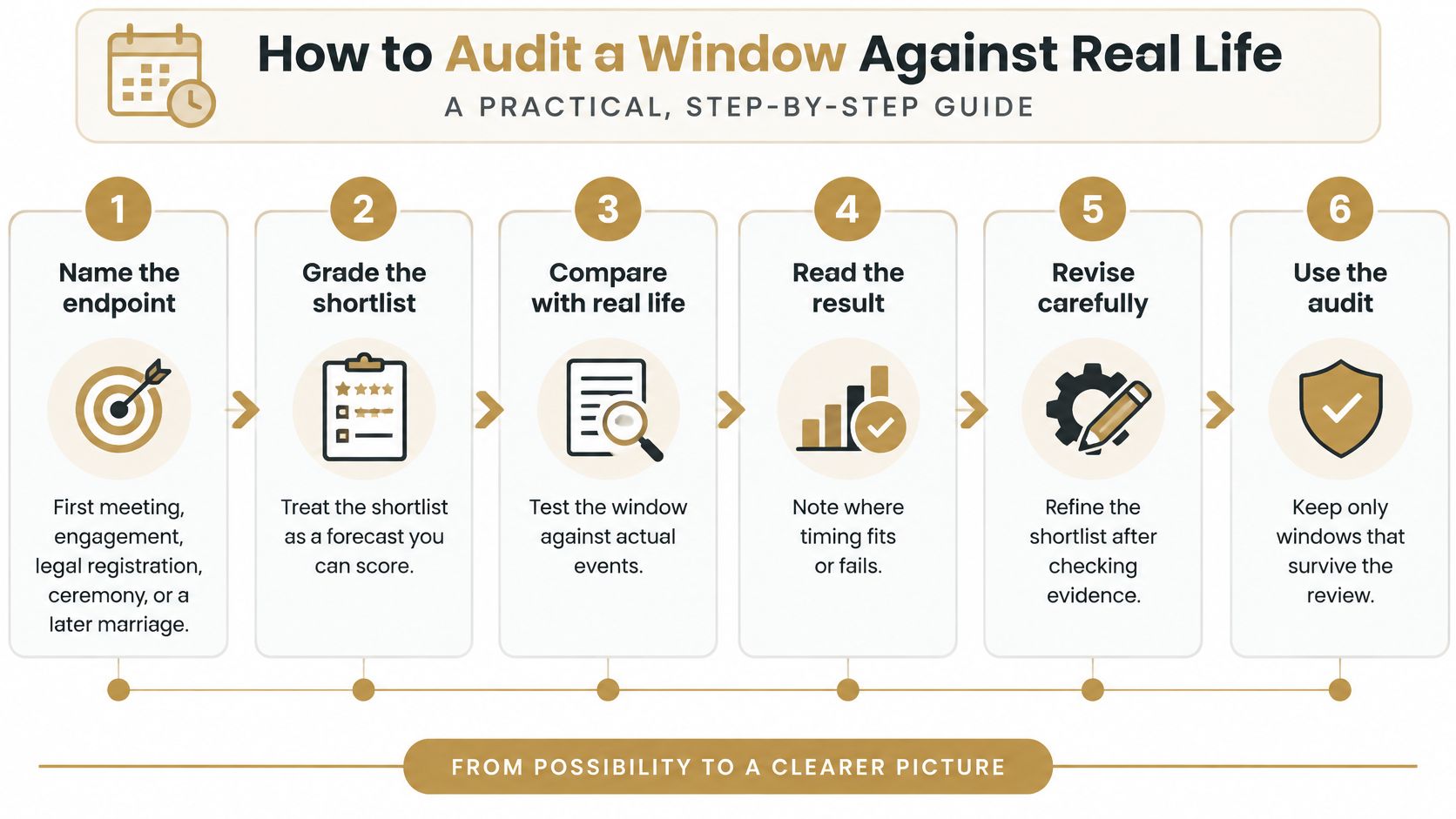
Name the endpoint. First meeting, engagement, legal registration, ceremony, and a later marriage are different events. Choose the intended event in advance rather than accepting whichever milestone happens to fall inside the band.
Save the original forecast. Preserve the window, tolerance, confidence, birth-time uncertainty, and calculation settings before the relevant date arrives. A screenshot or dated record is more useful than a memory of what the reading seemed to suggest.
Score the stated claim. Count a hit only within the original tolerance. If the ceremony falls outside it, record a miss for that endpoint. A nearby engagement may be relevant context, but it doesn't convert the ceremony forecast into a hit.
Compare with ordinary dates. An independent exploratory project analysing 3,663 marriages reported that its tested Vedic timing rules performed at chance against ordinary dates; a machine-learning model using hundreds of classical features scored roughly 0.47 to 0.51 after shared-date leakage was addressed. Shared-date leakage means that overlapping date information can make test performance appear stronger than it is. This project isn't peer-reviewed consensus, but it presents a serious challenge to unsupported accuracy claims.
Rank competing windows. When several bands survive, rank them by the agreement between independently stated filters. Keep the alternatives visible. Don't remove unsuccessful alternatives later and present the remaining one as the sole original prediction.
Let uncertainty widen the result. An unknown or approximate birth time should produce broader bands, not sharper language. At Anvaya, approximate times may lead to wider timing bands, and rectification features may be offered separately.
Distinguish calibration from proof
A rule that activates around many ordinary dates may be too broad to identify weddings. Likewise, finding a plausible explanation after an event is not the same as predicting that event beforehand.
Pramāṇa starts with chart-derived questions about past periods before discussing a future year. We check whether the calculated chart supports recognisable lived events rather than asking for your story and returning it in astrological language. A useful match can support further examination, but it doesn't establish a reliable global success rate.
The standard for marriage timing astrology should remain straightforward: write the claim, keep the claim, and let the lived date judge it. Refinement belongs in a new version, with the earlier version still intact.
Common Questions About Marriage Timing Windows
Can two people have different marriage windows?
Yes. Each person has a personal dasha ladder, so the candidate bands may differ. For a couple, examine whether those bands overlap rather than copying one person's preferred age onto the other.
Does a high guna score choose the year?
No. Guna Milan concerns a traditional compatibility layer based mainly on Moon signs and birth nakshatras. A timing assessment still needs chart support, relevant planetary periods, and the stated transit conditions.
What if my birth time is only an estimate?
Disclose the uncertainty and keep the timing band wider. Near chart boundaries, a small clock difference can change important calculations, so don't treat a fine muhurta interval as exact when the underlying birth time isn't secure.
How is a ceremony date different from a legal registration date?
They're separate endpoints and may occur on different days. Muhurta selection addresses the chosen rite, while a broader period assessment must state whether it concerns the ceremony, registration, or another relationship milestone. Record each event separately so the result can be evaluated accurately.
Choose What the Window Is Allowed to Decide
A supported window is a bounded span, from dasha years down to a muhurta day, checked against your chart and your lived events. Within that span it can help you reflect on timing, plan a conversation with family, or organise a ceremony search. Its authority ends there. No chart calculation supplies another person's consent, and no dasha decides whether your relationship should continue.
When the filters don't overlap, the honest answer is that you don't yet have a supported window. That is information, not a warning, so there is nothing to dress up as a bad omen. Keep the written result, including its tolerance, and compare it with what happens. An unfilled window is still a working answer.
Keep the reading accountable
Our process begins with birth details and declared mathematics. The chart then meets your life through past-event questions in Pramāṇa, before your Samhita, a structured, living reading rather than a horoscope feed, opens.
- Keep the boundaries clear: Readings and timing suggestions are for informational and entertainment purposes.
- Keep the record intact: Preserve the dated claim and its confidence rather than replacing an unsuccessful reading.
- Keep the decision yours: Use the interpretation as a reflection tool, not as authority over another person.
A sample reading lets you examine the form of the reasoning before deciding whether it fits your situation. Look for stated assumptions, understandable connections, and room for an honest uncertain answer.
At Anvaya, we compute from your birth details, calibrate against lived events through Pramāṇa, and present a plain-language Samhita. See a sample reading to assess how that chart-first approach handles timing and uncertainty before you begin.