

You've probably come here after finding Ketu conjunct Mars in your chart and reading that it's a warning. It isn't, not on its own. What it describes, if the chart supports it, is a style of action. Timing decides when that style gets loud.
Table of Contents
- A Reader Who's Been Warned One Too Many Times
- Mars, Ketu, and Conjunction in Plain Words
- What the Combination Actually Suggests
- Where the Accident and Anger Reading Goes Wrong
- When the Conjunction Activates
- Chart-First Questions to Verify It in Your Own Birth Chart
- What a Samhita Would Record Before Saying Anything Forward-Facing
A Reader Who's Been Warned One Too Many Times
You search for your placement late at night. You open a page, scroll past warnings about accidents, surgery, anger, and bad karma, and close the tab feeling smaller than when you started. Another page tells you the opposite. You're a fearless spiritual warrior with hidden genius.
Neither version helps you. You didn't come for a label. You came to understand why some decisions happen fast, why certain fights don't interest you, or why you can work with intense focus on one thing and walk away from another without much ceremony.
What a calmer reading asks first
A Ketu conjunct Mars placement doesn't answer those questions by itself. It gives you a symbol to test. Mars acts. Ketu cuts, detaches, or turns inward. Put together, they can describe action that doesn't chase the obvious reward, or action that moves before the usual hesitation arrives.
That's a hypothesis, not a verdict. The useful work is separating three things most pages blur together. First, what the combination means symbolically. Second, what your specific chart does to that symbol. Third, when it tends to surface, because a natal placement and an active period aren't the same thing.
A conjunction is a recurring tendency in the chart. A dasha period is a window. Confusing the two is where most scary readings begin.
Mars, Ketu, and Conjunction in Plain Words
Start with the parts. No synthesis yet.
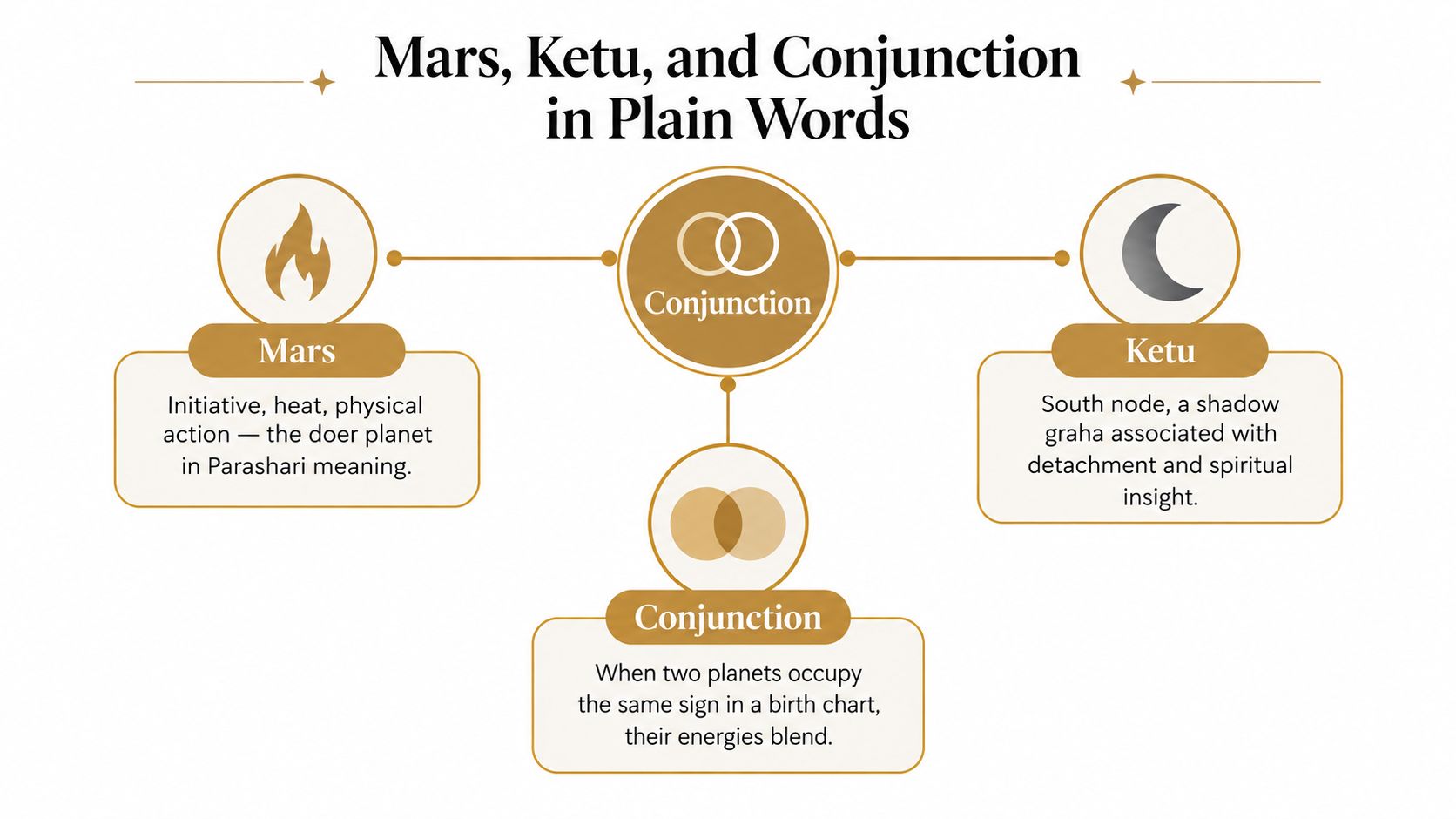
Mars is traditionally linked with heat, initiative, courage, conflict, weapons, land, and physical action, as described in a modern explanatory overview of Mangal-Ketu yuti. That means Mars is the planet a jyotishi watches when a chart raises questions about doing, pushing, competing, or defending. If you want Mars in isolation first, our guide to Mars in Vedic astrology covers its basic significations without adding Ketu to the picture.
Ketu is different. It's a shadow graha, one of the lunar nodes rather than a visible planet. That means you won't find it in the sky as a body. Classically it's associated with separation, inwardness, detachment, and disruption. Where Mars moves toward a target, Ketu often shows where interest in the target thins out.
What conjunction actually means here
A conjunction, or yuti, happens when Mars and Ketu occupy the same zodiac sign and therefore the same house in a birth chart. That detail matters because house and sign shape the reading more than the word conjunction does.
There's also a textual point worth knowing. The combination is not presented as a single, universally defined yoga in the foundational classical literature. Saravali's two-planet yoga section primarily discusses pairs among the seven visible planets, while Rahu and Ketu are treated separately in works such as Brihat Parashara Hora Shastra, Phaladeepika, and Jataka Parijata. So most readings of this pairing are constructed by combining separate significations, not copied from one agreed rule. Traditions can diverge, and honest readers should say so.
It's also not especially rare. One dataset reports the conjunction in 7.5% of 307 stored charts and 7.4% of a random sample of 10,000 births generated for 1960 to 2010, according to published chart-frequency data for Mars-Ketu placements. That's roughly one chart in fourteen. Common enough to deserve a clear definition. Far too common to predict anything specific by itself.
What the Combination Actually Suggests
Put the parts together and you get thrust with a cut in it. Mars supplies initiative. Ketu pulls that initiative inward, away from status or display, or past the point where one pauses. Read well, that can look like focused craft, research ability, or disciplined courage. Read poorly in a chart, it can look like abrupt exits, needless conflict, or acting and only later asking why.
Which version shows up depends on levers you can check.
Four levers that change the reading
- Sign and dignity: Mars in its own signs, Aries or Scorpio, has resources and a clear mode of action. Mars in Cancer, its sign of fall, is working in terrain that doesn't suit direct assertion. That changes how cleanly Mars can act, with or without Ketu beside it.
- House placement: The third, sixth, and eleventh houses are upachaya houses. That means houses where planets may gain strength over time and through effort. Both Mars and Ketu may become more workable there. Ketu's link with the twelfth house, by contrast, is often read more favorably for contemplative or ascetic pursuits than for worldly ambition.
- Aspects and company: A benefic aspecting the conjunction, or another planet sharing the sign, alters the picture. So does an afflicted Moon nearby. You don't read two planets as if the rest of the chart went silent.
- Dispositor condition: The dispositor is the lord of the sign holding the conjunction. That means the planet responsible for the house they're guests in. If that lord is strong and well placed, the conjunction has support. If it's weak or badly placed, Mars is acting without backing.
| Placement | Mars role in chart | Ketu role in chart | Dominant theme |
|---|---|---|---|
| Sixth house, strong dispositor | Handles competition, work, and opposition | Detaches from routine friction | Disciplined problem solving that improves with practice |
| First house, Mars in fall | Drives identity and first reactions | Mutes concern for how action lands | Abrupt self-assertion, then withdrawal |
| Twelfth house, supported dispositor | Acts away from public view | Favors inward and contemplative aims | Quiet, sustained effort without need for credit |
| Seventh house, weak dispositor | Presses in partnership matters | Cuts patience for negotiation | Conflict followed by detachment if other factors agree |
No single lever overrides the others. That's the point of the table. The same two planets, moved to a different house with a different dispositor, stop telling the same story.
Where the Accident and Anger Reading Goes Wrong
You've seen the standard version. Accidents. Violence. Surgery. Explosive temper. Bad karma. It's repeated so often it starts to sound like a diagnosis, and many Ketu-Mars pages collapse the conjunction into exactly those warnings without a method for weighing outcomes that point the other way.
That reading overreaches in a specific way. It assigns serious outcomes without checking house, dignity, dispositor, aspects, divisional charts, or dasha timing. It also ignores that the same combination gets described elsewhere as technical precision, courage, research ability, or spiritual discipline. Both readings can't be automatic. Something in the chart has to decide between them.

What still carries weight
Don't throw the tradition out either. Mars has carried martial symbolism for a long time, and Ketu's association with severance and disruption is a real classical touchstone. In a vulnerable house, with a weak dispositor and difficult aspects, a careful reader will take the harder expression seriously.
But serious isn't the same as certain. No cited source establishes that this conjunction causes accidents or disease. So the honest framing is narrow. This is a traditional interpretive hypothesis about tendency, not a clinical risk estimate and not a safety claim.
Practical rule: Treat the conjunction as a tendency to act abruptly, inwardly, or with less attachment to consequences. Whether that becomes craft or conflict is a chart question, not a conjunction question.
That distinction protects you from two errors at once. You won't dismiss a pattern that keeps showing up in your life. And you won't let a generic paragraph convince you that intensity automatically means harm. Intensity and harm are different claims, and only one of them comes from the symbol itself. The other needs evidence from the rest of the chart and from timing.
When the Conjunction Activates
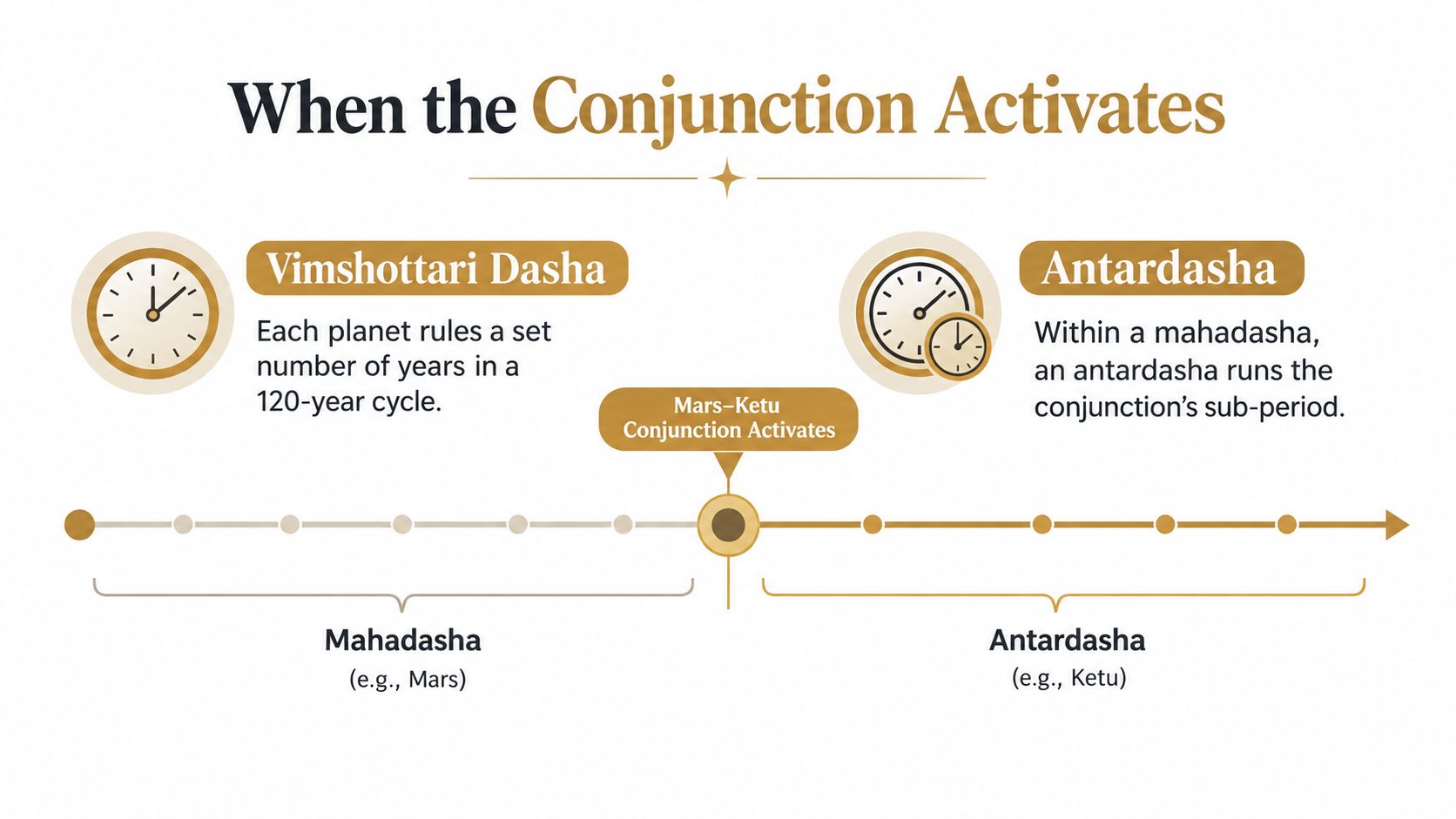
A natal placement sits in your chart for life. It doesn't fire at full volume every year. Vedic astrology handles that gap with dasha, a system of planetary periods. That means stretches of time ruled by one planet, with smaller sub-periods ruled by others inside them.
In Vimshottari dasha, Ketu's mahadasha lasts 7 years, and the Ketu-Mars antardasha lasts approximately 4 months and 27 days, as set out in a breakdown of the Ketu mahadasha and its sub-periods. The reverse pairing, Mars mahadasha with Ketu antardasha, is the other window readers commonly watch, and one source estimates that Mars-Ketu sub-period at roughly four to five months while discussing when the pairing is most active. You can check your own period dates with a dasha calculator before you interpret anything.
A window is necessary, not sufficient
Traditionally, the Ketu-Mars sub-period is associated with sharp severance, decisive action, and impulsive behavior. It can also describe unusually clear breaks from habits you've been stuck in. Notice both directions again. The duration is a timing mechanic. It's not a promise that an event must occur inside it.
The window matters more when several things line up:
- House connection: The dasha planets own, occupy, or aspect the houses tied to the natal conjunction.
- Transit support: Mars or Ketu transits over or aspects the natal conjunction during the same stretch.
- Divisional confirmation: The relevant divisional chart carries the same signature instead of contradicting it.
Exact dates also depend on your birth time, ayanamsha, and dasha calculation. That means two people with the same conjunction can meet their active windows in materially different years. Anyone giving you a fixed age for a dramatic event, without showing that math, is guessing in classical clothing.
Chart-First Questions to Verify It in Your Own Birth Chart
Don't start with a prediction. Start with your past, because your past is checkable. This is how calibration works in practice, and the guide to reading a Vedic astrology birth chart explains the chart components you'll need in front of you. Treat what follows as material for personal reflection and self-understanding, not professional advice.
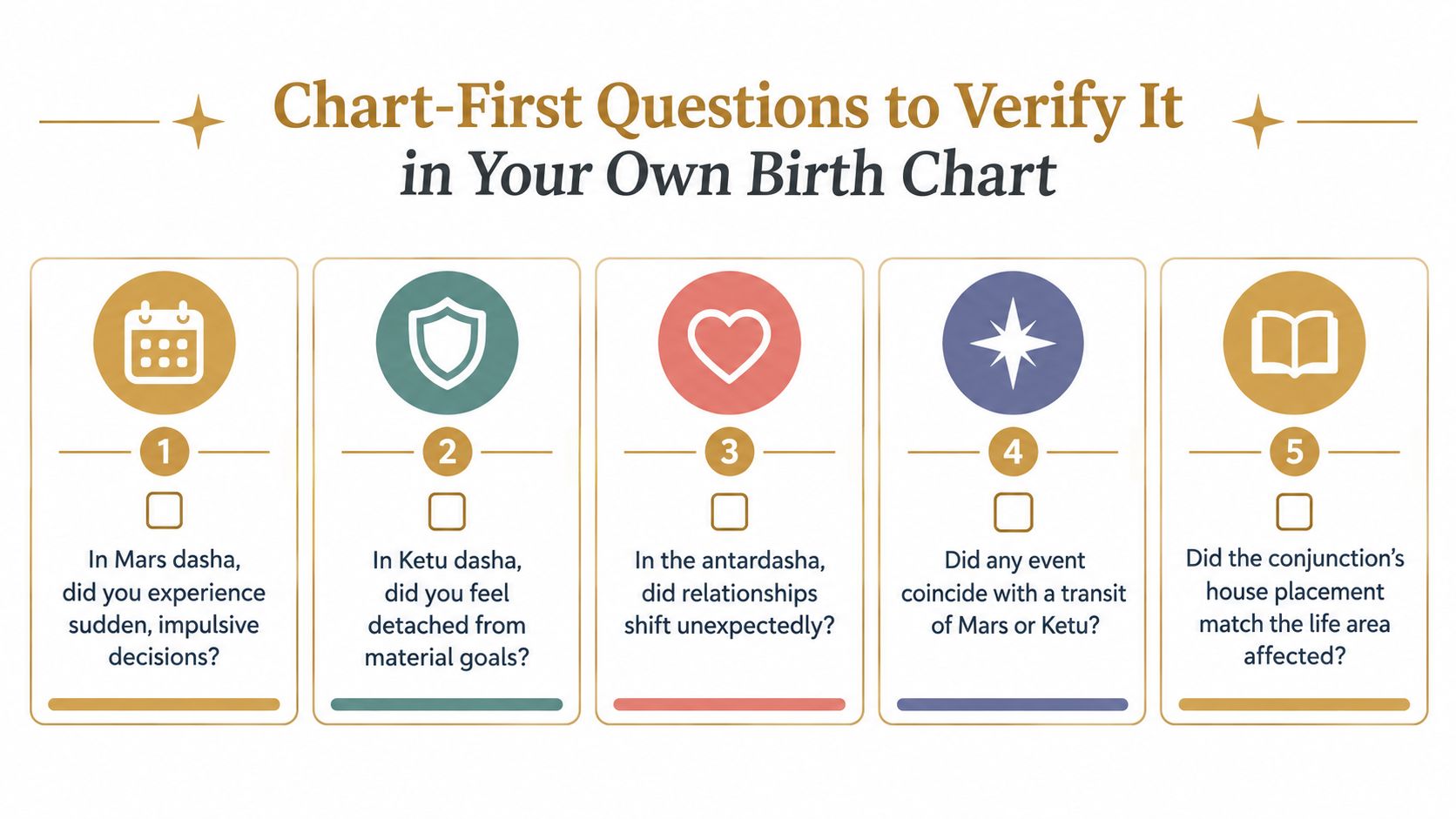
Ask these against dated events, not against your general sense of yourself.
- In your last Ketu-Mars or Mars-Ketu window, what ended or started abruptly? Look for sudden decisions, clean breaks, or a fast loss of interest in something you'd pursued seriously. Write the dates down. If you can't place anything in that window, say so plainly.
- Did Mars transits over your natal conjunction land near turning points? Check two or three past transits against moves, job changes, conflicts, or periods of unusually focused work. Coincidence once is weak. A repeating pattern is worth noting.
- Does your dispositor support Mars or leave it exposed? Find the lord of the sign holding the conjunction. Note its house, dignity, and aspects. This tells you whether abrupt action in your life tends to get backed up or tends to cost you.
- Do your divisional charts repeat the signature? Check whether Mars and Ketu stay connected in the navamsha, which refines the main chart, and in the dasamsa if the question is about work. Repetition raises confidence. Silence lowers it.
- Is there a family pattern worth recording? Mars-side themes such as land disputes, uniformed work, or technical trades sometimes recur across generations. Note it as context only. Family history doesn't prove a chart claim.
If you can't answer yes to at least two of these for a meaningful window, the conjunction is probably a latent style in your chart rather than an active pattern. That's a real finding, not a failed reading.
What a Samhita Would Record Before Saying Anything Forward-Facing
A careful reading stores its work before it speaks. For this conjunction, that means recording the sign, house, dignity, dispositor, orb or computational convention, divisional chart placement, and dasha context first. Only then does it make sense to ask whether Ketu conjunct Mars is materially relevant in this particular chart.
The order matters, and it doesn't change because a topic sounds dramatic.
The verification hierarchy
- Natal placement first: Where the conjunction sits, in what condition, with what support.
- Dasha and transit context second: Whether a current or past window activates it.
- Divisional confirmation third: Whether the finer charts repeat or soften the signature.
- Event timing last: Specific windows come after the first three agree, never before.
Confidence should vary openly along that chain. A conjunction in an upachaya house with a strong dispositor and a confirmed past window is one pattern. The same conjunction in a maraka house, a house classically linked with endings, with no lived confirmation is a different and weaker claim. A reader who won't tell you which one you're looking at isn't protecting mystery. They're skipping the audit.
This is also where sample size humbles everyone. Restrict the conjunction to one house and the numbers shrink fast. The eighth house alone appears in 0.5% of a 10,000-birth random sample, roughly 50 charts, and 0.7% of a 307-chart set, roughly 2 charts. Small cells like that can't carry sweeping claims about outcomes.
A Samhita from Anvaya follows the sequence above as a matter of method. Declared compute first, calibration against events you lived, then plain language about what's supported and what isn't. The conjunction gets recorded, scored, and left auditable. If your past windows don't confirm it, the reading should say that, and move on to what your chart does support.
If Ketu conjunct Mars sits in your chart, you don't need another warning, you need the placement computed properly and tested against your own past windows before anyone says a forward-facing word. Generate your Samhita with Anvaya and see the sign, house, dispositor, divisional placement, and dasha context recorded in order, with confidence you can audit later.