

You might be standing at a clean but awkward crossroads. A degree offer is on the table. A visa file is moving slowly. A teacher, a priest, a lawyer, or a mentor has entered the picture. Or maybe your beliefs are shifting, and you want to know whether that change is part of the chart or just a passing mood. Jupiter in the 9th house is one of the placements people ask about when life starts asking for a wider frame.
A careful reading does not start with praise. It starts with structure. In classical Vedic astrology, the 9th house carries higher learning, philosophy, religion, long-distance travel, teachers, and the search for meaning. Jupiter stands for wisdom, expansion, guidance, dharma, and growth. When those two meet, the chart often points to a life shaped by learning and belief, but the outcome depends on the whole chart, not one placement alone.
At Anvaya, we keep that order strict. Declared compute first, then calibration to lived events. A chart should not be flattered. It should be read, with room for what it knows and what it doesn't.
Practical rule, trines and natural significations matter, but strength and timing decide how fully a placement can speak.
Table of Contents
- When Higher Learning and Belief Come Into Focus
- What the 9th House and Jupiter Each Signify
- How Jupiter in the 9th House Typically Shows Up
- When This Placement Is Strong Weak or Mixed
- Timing Matters From Natal Promise to Dasha Activation
- How to Read This Placement in Your Own Chart
- A Clear Takeaway and Your Next Step
When Higher Learning and Belief Come Into Focus
A person often comes to this topic at a real turning point. They are choosing a course, changing fields, thinking about pilgrimage, or trying to understand why foreign travel, law, study, or faith keeps showing up in their life. Jupiter in the 9th house is relevant here because it ties learning and meaning to one of the most important angular frameworks in the chart.
Start with the question, not the label
The question is not, “Is this good?” The better question is, “What part of life is being asked to grow?” In classical reading, the 9th house is one of the three trine houses, and trines are treated as auspicious because they support flow, guidance, and long-range development. Jupiter is the planet most associated with wisdom and expansion, so the placement tends to bring those themes into the areas the 9th house governs.
That includes education, mentors, religion, long journeys, and the search for a coherent belief system. It can also show a person who keeps returning to teachers, books, temples, universities, courts, or places of pilgrimage. The emphasis is not random luck. It is a chart pattern that ties dharma to study and guidance.
What this promises and what it doesn't
It does not promise that every person becomes a professor or priest. It does not promise that travel is easy or that faith never shakes. It does suggest that the person's life may keep circling back to meaning, learning, and guidance systems. The exact form depends on sign, degree, aspects, house strength, and timing.
Key principle: Jupiter in the 9th works best when the chart supports the 9th house as a place of real learning, not just abstract optimism.
The rest of the chart decides whether that learning becomes formal study, teaching, law, publishing, religious practice, or a quieter lifelong search for truth.
What the 9th House and Jupiter Each Signify
The 9th house is easier to understand if you treat it like the part of a university where the bigger questions live. The 3rd house is the classroom you enter. The 9th house is the library, the mentor's office, the chapel, the legal archive, or the road that takes you far enough away from home to think differently. It is where a person looks for meaning, not just information.
The house side of the equation
Classical and modern Vedic references describe the 9th house as the domain of higher education, religion, spirituality, philosophy, father, mentors, and long-distance travel. That is why it is sometimes called the house of dharma, the part of life that asks, “What is the right path?” In plain English, it points to the structures that shape belief and guidance.
Jupiter fits there because Jupiter is the karaka, or natural significator, for wisdom, higher learning, dharma, and guidance. That is not a poetic overlap. It is a structural one. The planet and the house point to the same life themes, so the combination naturally draws attention in chart interpretation.
Why trines and Sagittarius matter
One classical reference notes that the 9th house is the natural territory of Jupiter, with Sagittarius as the 9th house equivalent and the first 10 degrees of Sagittarius traditionally treated as Jupiter's moolatrikona zone. Moolatrikona means the planet's most stable, rooted zone within a sign. That detail matters because it lets an astrologer distinguish a merely placed Jupiter from a more strongly supported one.

Think of it this way. If the 9th house is the road toward meaning, Jupiter is the teacher who knows the route. When both point in the same direction, the chart often gives more coherence around study, ethics, guidance, and travel for learning.
How Jupiter in the 9th House Typically Shows Up
The most common mistake is to reduce this placement to “good luck.” That is too blunt. Classical-style interpretation treats it as a concentration of growth functions inside the house of belief, mentors, and long-distance horizons. The result is often stronger engagement with learning systems and guidance systems than with random fortune.
Where it tends to show up in life
You often see this placement in people who keep returning to institutions of learning or authority. That can mean universities, legal settings, religious institutions, publishing, or pilgrimages. It can also mean the person teaches, interprets, or explains ideas for other people. Jupiter's meaning of expansion joins the 9th house's meaning of dharma, so the native may grow through study, instruction, or principled decision-making.
One classical summary frames it plainly: Jupiter is the karaka for wisdom and dharma, while the 9th house governs fortune, mentors, religion, philosophy, and long-distance travel. Put together, the placement often supports ethically guided decisions and the ability to carry knowledge forward. That can look like completing study after a delay, becoming a mentor later in life, or building a career around ideas that travel well, such as law, teaching, writing, or religious work.
The chart usually doesn't say, “You'll win at life.” It says, “You may keep meeting teachers, larger questions, and long roads that require judgment.”
Concrete examples, kept plain
A student may find that their best progress comes when they study with one trusted teacher instead of many shallow ones. Someone else may travel abroad for learning, then stay connected to a foreign place through work or belief. Another person may move into a role where they explain complex ideas to others, which is a classic Jupiter function in a 9th-house setting.
But there is no fixed script. A strong Jupiter in the 9th can support growth through study and guidance. A weaker one may still do so, but with more friction or delay. That is why the whole chart matters before anyone makes a conclusion.

When This Placement Is Strong Weak or Mixed
People often hear that Jupiter in the 9th house is automatically fortunate. Classical sources are more careful than that. One source explicitly notes that the placement can give only limited benefits unless it receives supportive aspects from other planets. That fits a standard Jyotish model, where dignity, benefic aspects, and lord strength shape the result.
What changes the outcome
The first question is whether Jupiter is reasonably strong in the chart. The next question is whether the 9th lord is strong. A later check is the ascendant lord, because that shows how well the native can carry the promise of the chart. A strong Jupiter in a supportive house with helpful aspects can make 9th-house themes easier to access. A compromised Jupiter can still carry meaning, but the path may be uneven.
The 9th house also touches father, teachers, and the moral order of life. So when the placement is afflicted, the expression may not be “bad luck” in a vague sense. It can look more specific, such as distance from father figures, blocked support from mentors, or a strained relationship with belief and guidance. That is very different from a simple fortune narrative.
Decision table
| Factor | Stronger Expression | Weaker or Mixed Expression |
|---|---|---|
| Jupiter's dignity | Clearer guidance, steadier study, more coherent belief | Uneven judgment, slower access to the 9th house themes |
| 9th lord strength | Better support for mentors, learning, travel, and dharma | Support comes with delay or complication |
| Ascendant lord strength | The native can act on Jupiter's promise with more stability | The native may understand the path but struggle to use it cleanly |
| Benefic aspects | The placement becomes easier to express and interpret | Benefits may exist, but they arrive in narrower ways |
| Affliction | Harder story, but still readable in context | Can show blocked luck, distance from father, or tension around teachers |
A Parashari-linked summary also says results depend on strength, and that afflicted versions can show blocked luck or estrangement from father rather than simple benefit. Read that as a warning against oversimplifying. Strong placement, weak placement, and mixed placement are three different stories.
For a related classical pattern where strength changes the story, you can compare it with Neecha Bhanga Raja Yoga, which also depends on condition, not slogans.
Timing Matters From Natal Promise to Dasha Activation
A lot of writing collapses two separate questions into one. The first is, “What does the natal chart say?” The second is, “When does it wake up?” Those are not the same question. A Jupiter-in-the-9th chart can describe a strong life theme without saying when education, foreign travel, legal matters, or faith changes will happen.
Natal promise is not the same as timing
The natal placement is the structural promise. Timing comes through dashas and transits. When Jupiter runs a mahadasha, a longer life chapter, 9th-house topics tend to rise in importance. During a Jupiter antardasha, a shorter sub-period inside a larger chapter, those topics can become more visible inside the ongoing story. A transit is a passing trigger, so it may open a window but not define the whole phase.
That is why the same chart can behave differently over time. One year may bring study. Another may bring travel. Another may bring a teacher, a legal process, or a shift in belief. Current astrology coverage often blends those windows together, but timing is the part that decides when the promise becomes concrete.
The classical timing note
A classical Parashari source states that if Jupiter is in the 9th house and the 9th lord is also strong, the native becomes highly fortunate. The same text also gives a timing rule, saying that abundant fortunes are earned after the 36th year when Jupiter is in the 9th itself. That is a classical statement, not a universal rule. It should be read as conditional and chart dependent.
A modern note on timing makes the same practical point in another way. It warns against treating natal placement and activation periods as identical. That is the exact blind spot many readers have when they ask, “When will this show up?” rather than “Is the chart good?”
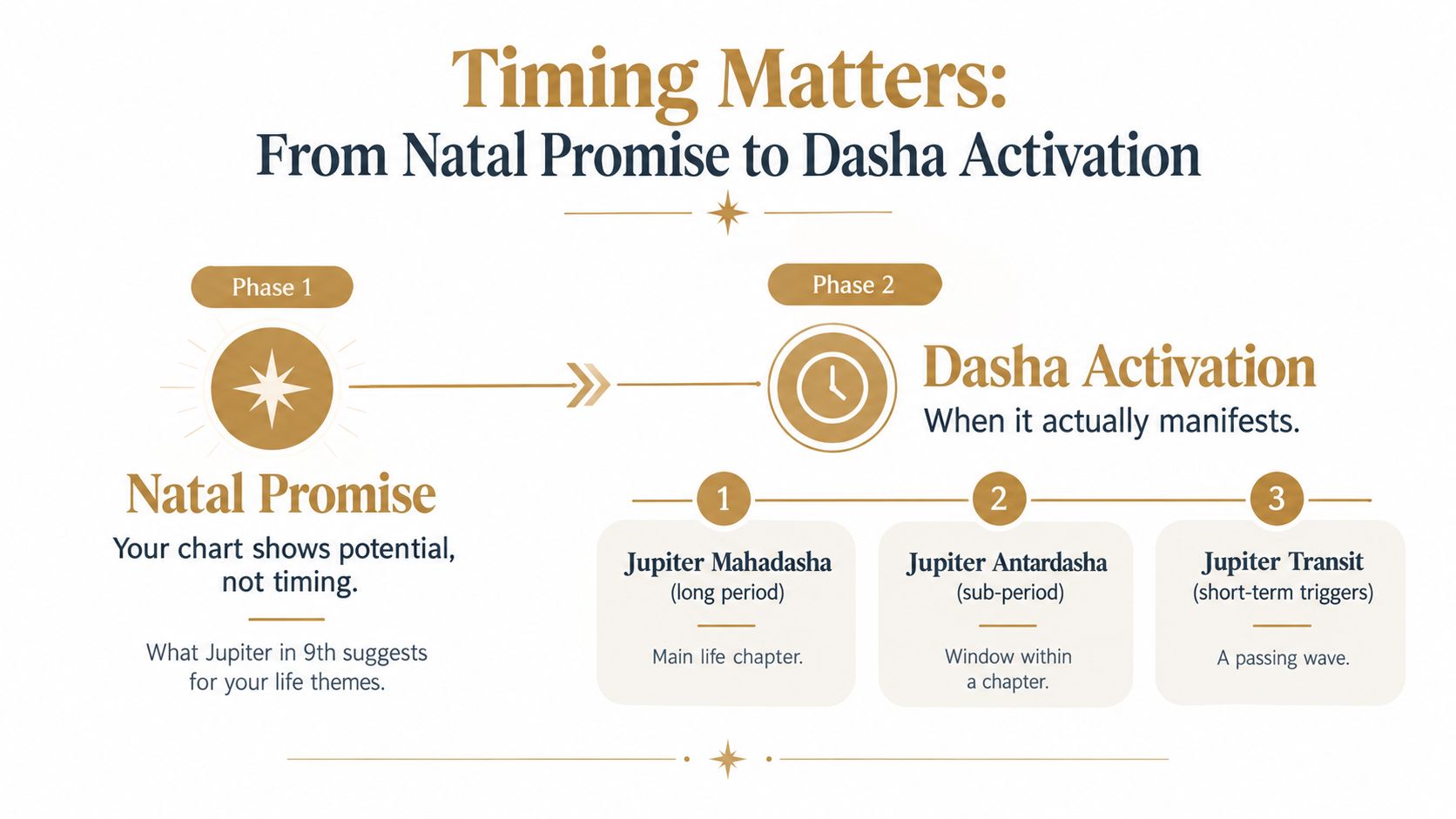
If you want to map timing cleanly, keep the order straight. First the birth chart. Then the dasha ladder. Then the transit. Only after that do you ask what kind of real-life event is likely to fit the window.
You can also compare that logic with when to start a reading window, because timing only makes sense when the chart is already stable enough to read.
How to Read This Placement in Your Own Chart
A serious reading does not begin with a slogan. It begins with birth data, then it checks whether the chart is being measured in the right system. That includes the ayanamsha, because sidereal calculation must be consistent if you want the 9th house to mean the same thing throughout the reading.
A simple checklist
Verify birth data.
Double-check date, time, and place. If the time is off, house placement can shift, and that changes the whole reading.Confirm the zodiac frame.
Decide whether you are using sidereal calculation and keep it consistent. Mixed systems create mixed conclusions.Note the sign and degree.
Check where Jupiter sits, and whether it falls near a meaningful zone such as the first 10 degrees of Sagittarius when that sign is relevant in the chart.Check the 9th lord and ascendant lord.
Their condition tells you whether Jupiter's promise has support or friction.Look at aspects and conjunctions.
Supportive planets can strengthen the placement. Afflicting ones can narrow it.Place it in dasha context.
Ask when the chart is likely to activate 9th-house themes, not just whether the placement looks positive on paper.
Practical rule: before you make any claim about education, travel, or faith, test the chart against events already lived. That is how you separate pattern from wishful thinking.
For readers who want a structured way to do that, the birth-chart framework at what a birth chart actually reveals is the right place to start.
If the chart needs more depth, a full Samhita is the better tool than a quick summary. The point is not to sound certain. The point is to know what can be said cleanly and what should stay conditional.
A Clear Takeaway and Your Next Step
Jupiter in the 9th house often supports learning, teaching, belief, and dharma-led growth. It can also bring father, mentors, and long-distance travel into the same life chapter, so the themes cluster rather than stay separate. But the placement is not a free pass. Strength, aspects, lord condition, and timing decide how clearly it shows itself.
That is the honest classical view. Natal promise comes first. Activation comes later. Some charts make the 9th house loud and visible. Others make it quieter, slower, or more mixed. The right reading is the one that matches the chart and the life, not the one that flatters the reader.
If you want a chart-specific view, ask for a reading that tests the placement against real events before it speaks about the future. That is the only responsible way to handle a topic like this, especially when the question touches study, travel, teachers, or a change in belief. For personal reflection and self-understanding, not professional advice.
If you want a chart reading that starts with declared Vedic compute and then checks it against lived events, Anvaya can do that. Generate your Samhita at Anvaya and see how Jupiter in the 9th house fits your actual chart, your timing, and the patterns you've already lived.