
The most repeated advice about Brahma Muhurta timing is also the least reliable: set your alarm for 4 a.m. That clock rule may place you near the traditional period on some days, but it can miss the actual window by a meaningful margin when sunrise changes with location and season.
Brahma Muhurta isn't a universal civil-clock hour. It's a sunrise-relative interval, calculated from the local astronomical sunrise. Once you understand the calculation, you no longer need to guess. You can verify the date, location, start time, and end time, then decide whether the period suits your practice and sleep.
Table of Contents
- Why “Wake at 4 a.m.” Misreads Brahma Muhurta
- How the Classical Calculation Actually Works
- Three Sunrise Examples Across Geography and Season
- What Classical Sources Actually Link to This Window
- Sleep, Biology, and a Responsible Way to Practise
- Computing the Window with Anvaya's Muhurta Tool
- A Calm Way to Use Brahma Muhurta Timing
Why “Wake at 4 a.m.” Misreads Brahma Muhurta
A fixed instruction such as “wake at 4 a.m.” turns a moving astronomical window into a habit. That shortcut may sound practical, but it confuses the clock on your wall with the sunrise at your location.
In the classical framework, Brahma Muhurta begins 96 minutes before local sunrise and ends 48 minutes before local sunrise. The interval itself lasts 48 minutes. Its clock time therefore changes when sunrise changes. A person in one city may have a different window from someone elsewhere, even on the same date.
Seasonal variation creates the same issue for one person. Sunrise can occur earlier or later across the year, so the traditional window shifts with it. A fixed range such as 4:00 to 5:00 a.m. is only a rough habit. It isn't the precise traditional calculation described in Ayurvedic scholarship on Brahma Muhurta.
The practical rule: Don't begin with the alarm time. Begin with local sunrise.
This distinction matters for more than technical accuracy. If you treat Brahma Muhurta as a universal instruction to wake at a particular hour, you may practise outside the traditional interval or cut sleep unnecessarily. If you treat it as a daily window derived from sunrise, you can verify the timing without turning the practice into a test of discipline.
A serious approach also leaves room for lineage differences. Some traditions place greater emphasis on worship, others on meditation, recitation, study, or quiet reflection. The shared point is the sunrise-relative timing, not a single compulsory routine.
The calculation is simple enough to do by hand, but a date and location are always part of the input. Anvaya's Muhurta tool is designed around that principle, returning a day-specific interval rather than asking you to trust a permanent 4 a.m. rule.
How the Classical Calculation Actually Works
The arithmetic starts with the word muhurta, a traditional unit of time. In the classical framework commonly used in Ayurvedic explanations, one muhurta equals 48 minutes. The full day-and-night cycle is divided into 30 muhurtas, and the night is described as containing 15 of them. Brahma Muhurta is the penultimate muhurta of the night, meaning the second-to-last one before sunrise.
That position gives us the operational rule. The period starts two muhurtas before sunrise and ends one muhurta before sunrise.
The calculation in three steps
- Find local sunrise. Use the sunrise for the exact date and location.
- Subtract 96 minutes. This gives the start, because two muhurtas equal 96 minutes.
- Subtract 48 minutes. This gives the end, because one muhurta equals 48 minutes.
Suppose sunrise is at 6:00 a.m. Subtracting 96 minutes gives 4:24 a.m. Subtracting 48 minutes gives 5:12 a.m. The Brahma Muhurta window is therefore approximately 4:24 a.m. to 5:12 a.m., as shown in this reference on the sunrise-relative calculation.
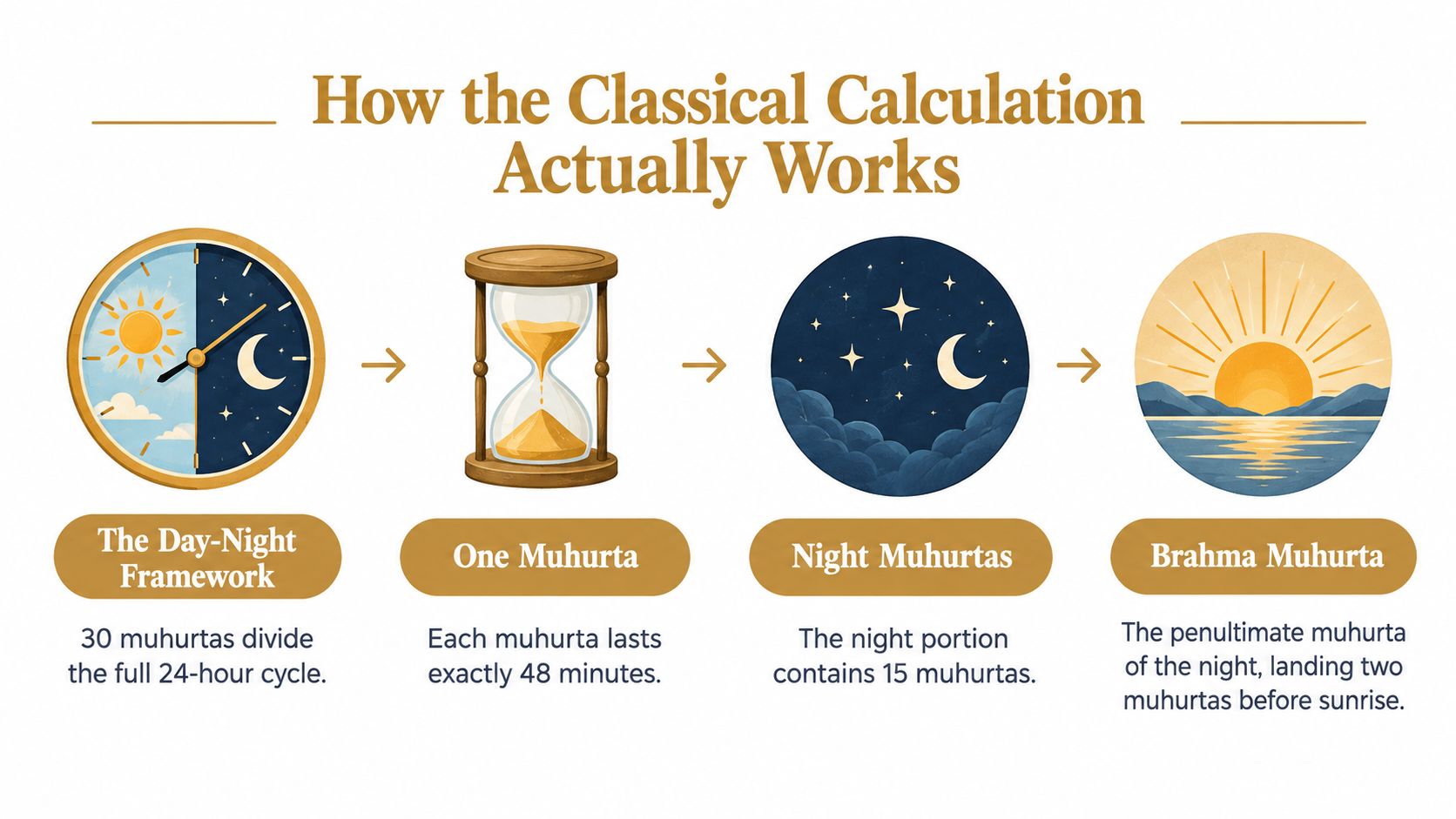
The phrase “penultimate muhurta” can feel abstract, so keep the image of a countdown before sunrise. One muhurta remains between the end of Brahma Muhurta and sunrise. Two muhurtas remain between its beginning and sunrise.
You can use the same method with any sunrise. If sunrise is at 6:30 a.m., the window runs from 4:54 a.m. to 5:42 a.m. A plain-language guide to the Panchang of the day can help place this calculation alongside other daily timing information.
The key is not memorising a clock hour. It is remembering the offsets:
- Start: sunrise minus 96 minutes
- End: sunrise minus 48 minutes
- Duration: 48 minutes
This is why a statement such as “Brahma Muhurta is from 4:00 to 6:00 a.m.” should be treated as a broad generalisation, not a precise traditional rule. The sunrise-relative method is more exact and easier to audit.
Three Sunrise Examples Across Geography and Season
“Brahma Muhurta means 4 a.m.” falls apart as soon as you compare places and seasons. The classical rule stays fixed, but the clock time drifts with local sunrise, which is why a useful example set should show movement, not repeat the same arithmetic.
Three scenarios at a glance
| Sunrise time | Window start, sunrise minus 96 minutes | Window end, sunrise minus 48 minutes | Approximate season or latitude |
|---|---|---|---|
| 4:50 a.m. | 3:14 a.m. | 4:02 a.m. | Early tropical summer sunrise |
| 5:30 a.m. | 3:54 a.m. | 4:42 a.m. | Summer example at one location |
| 7:10 a.m. | 5:34 a.m. | 6:22 a.m. | Later winter sunrise at a higher latitude |
The table matters because it shows how the same traditional interval can feel radically different on the civil clock. A 48 minute window tied to a very early summer sunrise may ask for waking in what many people still experience as deep night. A later winter sunrise pushes the same window forward enough that it may sit closer to ordinary morning routines.
That seasonal drift can happen within one country. Two people using the same time zone may still get different Brahma Muhurta timings on the same date because sunrise is local, not generic. Longitude affects when the sun rises. Latitude changes how sharply sunrise shifts across the year. Daylight saving rules, where used, change the clock reading attached to that sunrise without changing the underlying solar relationship.
This is the practical point many simplified explanations miss. “I wake at 4 a.m. every day” describes a discipline. It does not, by itself, confirm that the person is inside Brahma Muhurta on that date and in that place.
A good mental model is a train that always leaves a fixed interval before sunrise, while the station clock changes by season and geography. If sunrise moves earlier, the whole window moves earlier with it. If sunrise moves later, the whole window follows.
That is also why digital tools should be checked for location and date handling rather than trusted as black boxes. A careful calculator uses the local sunrise for the chosen place and day, then applies the classical offsets described in a reference explaining sunrise-based Brahma Muhurta calculation. The value of a tool such as Anvaya's Muhurta feature is not that it replaces the rule. It lets you verify the rule against your own location, instead of guessing from a fixed hour.
What Classical Sources Actually Link to This Window
Traditional Ayurvedic and related commentarial explanations associate Brahma Muhurta with waking, study, meditation, worship, recitation, and other contemplative practices. The period is treated as the final quiet portion of night before dawn, when a person may have fewer ordinary demands competing for attention.
That traditional association doesn't establish a modern guarantee about productivity, healing, intelligence, or personal success. It describes an observance and a preferred setting for certain practices. The meaning belongs to the practice you bring into the window, not to a promise that the clock itself will produce an outcome.
Different sampradayas, or lineages, may emphasise different activities. One household may use the time for prayer. A student of a Vedic tradition may read or recite. Another person may sit and observe the breath. Those choices can differ without changing the calculation.
A traditional time window can guide practice without becoming a guarantee about results.
The language around prana, or vital life force, also varies across teachings. Some traditions describe the pre-dawn atmosphere as settled and conducive to inward attention. That language belongs to a spiritual framework. It shouldn't be presented as a medical finding or as proof that every person will experience the same mental state.
This is also why a broader explanation of Sarvartha Siddhi Yoga shouldn't be treated as interchangeable with Brahma Muhurta. Both belong to the wider world of timing, but their definitions and traditional uses aren't identical.
For a first-time reader, the safest summary is straightforward:
- Brahma Muhurta is traditionally associated with contemplative activity.
- The window is calculated from local sunrise.
- Lineages can differ in what they recommend doing inside it.
- Traditional association isn't the same as a modern health claim.
- Missing the beginning of the window doesn't create a moral or spiritual failure.
Sleep, Biology, and a Responsible Way to Practise
Early waking can be meaningful for some people, but waking early isn't the same as sleeping less. Many people experience the pre-dawn period as a biological time for sleep, and reporting on very early work schedules notes that waking between 3 and 7 a.m. can overlap with a period when the brain is programmed for sleep, as discussed in this evidence-sensitive review of Brahma Muhurta and sleep biology.
That creates a question traditional guides often leave unanswered. What should a night-shift worker do? What about a teenager, a parent with interrupted nights, someone with insomnia, or a person whose local sunrise is extremely early? A universal alarm instruction doesn't answer those cases.
Protect rest before protecting the routine
If you want to explore Brahma Muhurta, move bedtime earlier rather than removing sleep from the night. The purpose of a contemplative practice shouldn't be pursued by creating avoidable exhaustion.
A responsible approach can be flexible:
- Start with your sleep pattern. Don't treat sleep deprivation as evidence of commitment.
- Shift gradually if appropriate. A new bedtime may be more sustainable than an abrupt alarm.
- Use part of the window. You don't have to wake at its first minute to engage in a practice.
- Keep the practice optional. The traditional timing can be respected without making it compulsory for everyone.
- Separate spiritual meaning from medical advice. A timing tradition can't diagnose or treat a sleep problem.
Recent discussion of dawn-versus-dusk yoga practice treats practice timing as an emerging subject for controlled research. That points to a useful distinction. The relevant variable may be what a person practises, how consistently they practise, and how the timing fits their life, rather than the act of waking at a specific pre-dawn minute alone.
This article is for personal reflection and self-understanding, not professional advice. If sleep disruption continues, seek appropriate guidance from a qualified health professional rather than using Brahma Muhurta as a substitute for care.
The tradition can remain valuable without overclaiming. You can honour the sunrise-relative calculation, choose meditation or study, and still decide that adequate sleep comes first.
Computing the Window with Anvaya's Muhurta Tool
Manual calculation is useful because it teaches the rule. A daily tool is useful because sunrise changes with the date and location, and repeating the arithmetic by hand can become inconvenient.
Anvaya's Muhurta feature takes the selected location and date, obtains the local sunrise through a validated astronomical calculation, then applies the classical offsets. It subtracts 96 minutes to produce the start and 48 minutes to produce the end. The result is a day-specific pair of timestamps, not a permanent early-morning range.
What the tool should make visible
A trustworthy timing tool shouldn't hide its inputs. The location and date used for the calculation should remain available so you can check why the result appears as it does.
That audit trail matters because a timing result is only meaningful when its assumptions are clear. If you change the date or location, the sunrise may change, and the Brahma Muhurta window may change with it. A tool that exposes those inputs lets you verify the result instead of accepting it on faith.

Muhurta sits among Anvaya's day tools, alongside Panchang, Sangati, and Pravāha. These tools serve different timing and daily-use purposes. They shouldn't be confused with the Samhita, which is a structured Vedic astrology reading based on birth details.
The distinction reflects Anvaya's wider method. The platform emphasises declared compute first, then calibration against lived events through Pramāṇa, before making conditional forward-looking statements. For a daily timing calculation, the immediate requirement is simpler: declare the date and location, calculate sunrise, apply the offsets, and show the output.
A guide to the Anvaya dashboard can help readers understand where day tools sit within the broader product experience. But no tool should decide whether you must wake, pray, meditate, study, or remain in bed. Muhurta supplies a verifiable timing window. You decide whether and how to use it.
A Calm Way to Use Brahma Muhurta Timing
Brahma Muhurta is easier to respect once you stop treating it as a fixed alarm. It is a 48-minute window anchored to local sunrise, with its beginning 96 minutes before sunrise and its end 48 minutes before sunrise.
That precision is useful, but it doesn't turn the period into a universal prescription. The value of the practice lies in the attention you bring to meditation, prayer, study, recitation, or quiet reflection. Waking at the first possible minute isn't the only measure of sincerity.
A practical recap
- Verify local sunrise for the date and location.
- Subtract 96 minutes to find the window's beginning.
- Subtract 48 minutes to find its end.
- Protect adequate sleep instead of cutting rest to obey a clock rule.
- Choose a practice that fits your tradition and circumstances.
- Use a calculation tool when you want the daily inputs and outputs recorded clearly.
Classical timing deserves better than a slogan. So does the person trying to practise it. You can take the mathematics seriously, acknowledge that lineages differ, and leave room for family duties, work schedules, health, and ordinary human limits.
A careful practitioner doesn't need to claim that Brahma Muhurta guarantees clarity or transformation. It can be a well-defined period for turning inward before the day becomes busy.
Anvaya's Muhurta tool helps you check the sunrise-relative window for a selected date and location, while its broader platform offers a structured Samhita built from declared Vedic chart computation and Pramāṇa calibration. Visit Anvaya to verify your timing instead of relying on a fixed 4 a.m. rule.