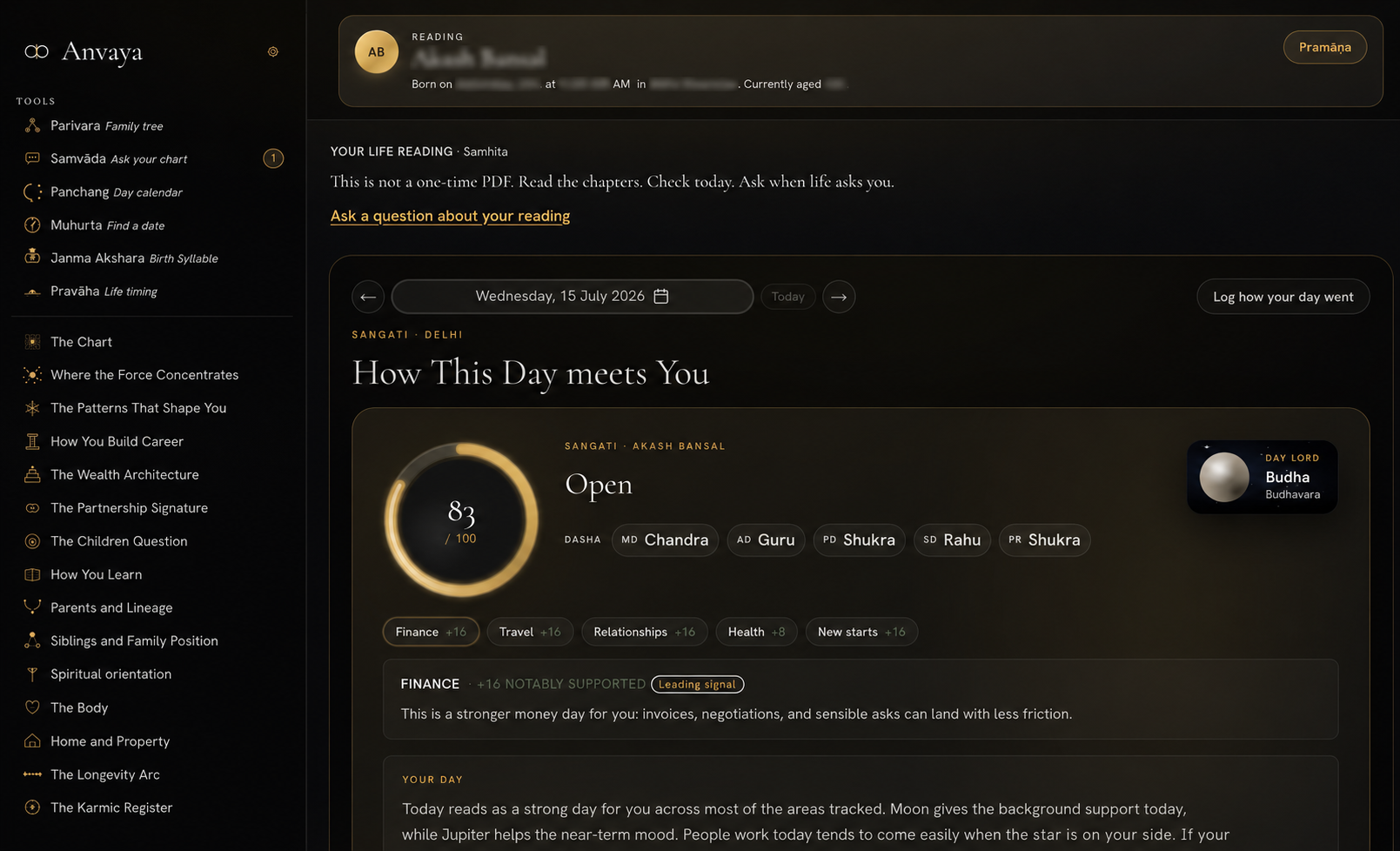
Open your dashboard and the first thing you’ll notice is that it doesn’t behave like astrology. There’s no verdict, no fortune, no scrolling wall of doom. There’s a left panel that looks like the table of contents to a life, and a right panel that reads today against it.
This is the tour. Not the numbers — those change every day, for every person, in every city. What each section is, and what it’s for.
The promise the screen makes
Before anything else, your life reading — Samhita — states its terms:
This is not a one-time PDF. Read the chapters. Check today. Ask when life asks you.
Three verbs, three habits, three parts of the screen. Read points to the chapters on the left. Check points to the daily read on the right. Ask points to Samvāda. Everything else is furniture.
The top bar: your inputs, and your receipts
The Reading header carries your name and four facts: born on this date, at this time, in this place, currently this age. That’s the entire input. Nothing you type later, nothing you confess, nothing you volunteer. Every number on this screen descends from those four facts — which is precisely what makes it checkable.
Beside it sits Pramāṇa. In Sanskrit the word means proof — valid means of knowledge. It’s the receipts drawer. A system that asks you to believe it has already lost the argument; yours is built to be audited.
PART ONE — THE LEFT PANEL
Your six tools
The tools are things you do. Each gets its own deep-dive in this guide series — here’s what each one is for.
• Parivara · Family tree. One account, many lives. Bring your parents, partner, and children in, each with their own reading. Family patterns become visible only when you can see more than one chart at once.
• Samvāda · Ask your chart. Dialogue. Bring a real question — a decision, a worry, a person — and get an answer grounded in your chart rather than a script. This is where the reading stops being a document and becomes a conversation.
• Panchang · Day calendar. The classical almanac, computed for your location. The five limbs that give any day its texture. Most people meet the panchang as a table of numbers on a crowded website; here it’s tied to you.
• Muhurta · Find a date. For when the question is when — a wedding, a launch, a signing, a procedure, a move. You give it the thing you’re planning; it finds the moments that carry least friction.
• Janma Akshara · Birth syllable. The sound your chart points to, traditionally used for naming a child — one of the oldest practical applications of Vedic astrology still in daily use.
• Pravāha · Life timing. Flow. The long view: which stretches of your life suit which pursuits. Covered in full below.
Your nineteen chapters
The chapters are the reading itself — your life, in rooms you can walk into. Read the list slowly and you’ll notice it isn’t an astrology menu. It’s the actual inventory of a human life. Each one gets its own dedicated post; here’s the map.
Who you are
• The Chart. The foundation — the sky at your birth, the raw material everything else is computed from. Start here if you want to see the instrument itself.
• Where the Force Concentrates. Your centre of gravity: the area where your nature simply runs, where effort turns into results with less friction than it should. Most people are exhausting themselves elsewhere.
• The Patterns That Shape You. The quieter, more humbling read — the stances you take under pressure, the loops you repeat. Not flaws; old strategies that outlived the danger they were built for.
How you build
• How You Build Career. Your work signature — not a job title, but how you’re built to build. Whether you go deep or wide, lead or make, compound slowly or move fast.
• The Wealth Architecture. The structural way money comes, stays, and leaves for you. Some are built to accumulate, some to earn in waves. Knowing which decides whether your financial discipline fits the person applying it.
• How You Learn. How you actually take in the world — through structure, immersion, or teaching. It quietly decides which jobs grow you and which grind you down.
Who you love
• The Partnership Signature. How you show up in love — pursue or withdraw, merge or guard. The reason the same dynamic keeps finding you with different people.
• The Children Question. The theme of children in your life — nurturing, creativity, legacy — and its timing. Held gently, never as a guarantee or a verdict.
• Parents and Lineage. What came down the line to you: the gifts and the wounds, the unspoken rules, the patterns you absorbed before you had words for them.
• Siblings and Family Position. Where you stood in the house you grew up in, and how that shaped your strategies for being seen and safe — strategies you’re probably still running at work.
The body, the home, the meaning
• The Body. Your constitutional rhythms — where you hold stress, the pace that suits you, how your energy actually behaves. Orientation for living well, never diagnosis.
• Home and Property. Your relationship to roots, stability, and ownership — and the timing of the largest purchases most of us ever make.
• Spiritual orientation. The particular way you reach for meaning — devotion, service, knowledge, solitude, creation. There is no right path, only yours; forcing someone else’s is a lonely mistake.
• The Karmic Register. The deeper why — the themes your life keeps asking you to work on. Read as direction for growth, not as punishment.
• The Longevity Arc. The shape of your vitality across a life — the seasons that ask for care and the ones of natural strength. It is not a countdown, and Anvaya does not predict lifespan.
Living it, day to day
• Daily Practice. What today asks of you — small, aligned actions rather than grand resolutions.
• Watch Windows. The stretches ahead worth watching: where the terrain steepens, where it opens. So a hard month arrives as something you saw coming.
• The Year Ahead. The twelve-month view — the themes and turns of the next year in one place.
• Right Now. The shortest chapter and often the most used: where you are today, in one glance.
PART TWO — THE DAILY READ
“How This Day Meets You” — what this section actually is
Here’s the whole idea in one sentence: a horoscope reads the sky; this reads the sky against you.
That distinction is everything. The same Wednesday is not the same Wednesday for you and your neighbour, because the sky today is meeting two different charts. This section — Sangati, meaning meeting, concordance — is the arithmetic of that encounter.
The score, and the word
A ring with a number out of 100, and beside it a single word.
The number is the day’s overall concordance with your chart. The word is there so you never have to interpret a bare figure — it tells you the posture of the day in language, not maths. It is a read on friction, not on fortune: a high day means the door is less heavy, not that someone will open it for you.
The dasha stack — the five clocks you’re inside
Five small chips sit under the score, and they are the part almost no other product shows you.
• MD — Mahadasha. The major period. The years-long weather system your life is currently inside.
• AD — Antardasha. The sub-period within it. Months.
• PD — Pratyantardasha. Finer.
• SD — Sookshma dasha. Finer again.
• PR — Prana dasha. The finest layer — the breath of the day.
This is the Vimshottari dasha system, and seeing all five stacked is the honest picture of time: you are never in one season. You’re inside a decade, inside a year, inside a month, inside a day — and today is where all five happen to meet.
They also move at wildly different speeds. Your Mahadasha may not change for years. Your Prana dasha changes while you’re looking at the screen — open your dashboard twice in an afternoon and that last chip may well have changed planets. That isn’t a glitch. It’s the resolution the system is working at.
When people search what is my mahadasha, this is where it lives — and it is doing more to shape your current chapter than anything else on this screen.
The Day Lord
Every weekday belongs to a planet, and the Sanskrit names give it away once you see them — Wednesday is Budhavara, Mercury’s day. Sunday is the Sun’s. Monday the Moon’s. It’s the oldest naming convention still running inside your calendar, and most of us use it every day without noticing. The Day Lord sets the background tone of the day before your chart is even consulted.
The domains
A row of chips — finance, travel, relationships, health, new starts — each carrying its own signed number.
This row is the honesty mechanism, and it’s worth understanding why it exists. A day is never uniformly good. It has a grain. The grain that suits signing a contract may be the wrong grain for a hard conversation. Any system that hands you one verdict for the whole day is flattening something real. This row refuses to.
The leading signal
The day then names its own headline — which single domain is most supported, and what that practically means for you.
Read the verbs carefully, because they carry the ethics. The language is can land with less friction, never you will succeed. A supported day is a tailwind. It was never going to do the work for you.
Your day, in plain words
Beneath the numbers, the day gets described the way a person would say it — which planet is giving background support, which is helping the near-term mood, whether people-work is likely to come easily, and the practical upshot.
That paragraph is the tone of the entire product: rigour underneath, calm on the surface. The maths can be elaborate; your experience of it should feel like checking the weather before you leave the house.
Daily practice — what the day asks of you
A card offering a practice focus, a recitation, and a food note for the day — light and traditional rather than prescriptive.
The idea underneath it is old and sound: alignment is built from small, repeatable acts, not grand resolutions. A few minutes of practice, a lighter meal, one honest thing written down. Take what serves you and leave the rest — nothing here is an obligation, and the reading works with or without it.
Star strength and moon sensitivity
Two lunar readings sit together.
Tara Bala measures the star the Moon is currently walking through against your own birth star — a relationship, not an absolute. This is why the same night can support cooperation for you and friction for someone else.
Moon sensitivity reads the emotional weather. The Moon governs mood in Vedic thought, so this line tells you what kind of emotional day you’re standing in. Knowing that before breakfast is often the difference between a fight and an early night.
The windows
Two columns: hours the tradition marks as auspicious, and hours it marks as inauspicious.
Forget the specific clock times — they shift with sunrise, with your city, with the weekday, and they’re computed fresh for you every day. What matters is the idea: a day is not a flat container. It has texture. Some stretches are traditionally held to carry less friction for beginnings; others more.
And a word of sanity, because this is where fear-based astrology does real damage. These windows are not curses. Nobody is telling you to stop living during an inauspicious hour. Use them to schedule what you can choose — the important call, the signing, the ask — and ignore them for everything you can’t. A calendar is not a cage.
“How is this calculated?”
A link, sitting right under the windows, that opens the reasoning.
That link is the moral position of the whole product. A magician hides the method because the method is the disappointment. A scientist shows it because the method is the proof.
Helpful / Not helpful — how the system improves itself
At the bottom of each section: Helpful · Not helpful · Tell us more.
This is not a satisfaction survey, and it isn’t decoration. It’s the mechanism by which the system gets better.
Every rating tells Anvaya whether that particular sectionactually landed for you. Enough of those signals, and the system tunes itself — the reads that keep proving useful carry more weight; the ones that keep missing get corrected. Your feedback isn’t collected and filed away. It goes back into the machine.
Which means something worth saying plainly: when you mark something “not helpful,” you are not complaining. You are calibrating. A tool that can only be praised can never be trusted. A tool willing to be told it was wrong is the only kind worth believing when it’s right — and this button is where that willingness lives.
Log how your day went
The same loop, one level up. The system read a grain into your day; this is where you tell it what actually happened.
Ten seconds at night. It’s the highest-leverage thing you can do on this dashboard, because it’s what makes tomorrow’s read sharper than today’s — and next year’s sharper than this one’s.
Pravāha — timing suitability by age
Below the day sits the long view. Pravāha means flow, and it reads which pursuits your current stretch of life actually suits — measured in years and ages rather than hours.
It names the theme of the period, pins it to real dates and your actual age, gives it a suitability read, and ranks which areas of life are most available right now. A full suitability chart sits behind it if you want the whole arc.
This is the thing a horoscope structurally cannot do. A horoscope has no idea how old you are.
How to actually use all this
You don’t need a ritual. You need a habit.
1. Read the chapters slowly, once. Not in a night. One room at a time, the way you’d read anything that’s about you.
2. Check today in ten seconds. The score, the word, the leading signal. That’s your posture for the day.
3. Ask when life asks you. Don’t save Samvāda for a crisis — but do bring it the real decisions.
4. Rate what lands and what doesn’t. Both directions. This is how it learns you.
Do that for a month and the screen quietly changes character. It stops being a clever thing you bought and starts being an instrument that knows you — which was the entire point of reading the chapters, checking today, and asking when life asks you.