
You're holding a reading that names a career change, a move, or a shift in partnership. It sounds specific until you ask when it applies, which chart factor supports it, and what would count as a miss. Birth chart life predictions should be conditional themes and time windows drawn from a sidereal Parashari chart, not verdicts about your future.
A useful sentence needs more than persuasive language. It needs a dated window, a named basis, a confidence label, and a record you can check against your life.
Table of Contents
- What Birth Chart Life Predictions Can and Cannot Say
- How Parashari Math Becomes a Samhita
- When the Birth Time Is Only Approximate
- Layers Behind a Chaptered Life Reading
- How to Verify a Prediction with Pramana
- How to Read a Confidence Label
- Check the Window Before You Act
What Birth Chart Life Predictions Can and Cannot Say
What a life prediction may say and how to check it
| Claim type | What the chart may offer | What it must not do | Lived check |
|---|---|---|---|
| Career or study timing | A dasha window, meaning a planetary period, interpreted as a possible role or study change | Employment advice or a guaranteed job | Did a similar past window match a role you held? |
| Partnership patterns | Repeating communication or timing themes | Divorce timing or a guaranteed match | Did those themes show in periods you already lived? |
| Move or project window | A conditional period for starting something | An order to relocate, or safety or legal instruction | Did a similar past window match a move or project? |
| Health and lifespan | Background on how classical texts discuss longevity, with no forecast | Any forecast of illness, accident, or death | Not applicable. Keep it out of decisions |
| Money outcomes | Themes around resources and responsibility | Investment, financial, or business advice | Not a basis for spending or trading |
| Daily mood forecast | Nothing from a natal life reading | Sun-sign horoscope language | Not applicable. This is a different product |
This is for personal reflection and self-understanding, not professional advice. Our readings, timing suggestions, compatibility analyses, and chart-grounded responses are informational and entertainment material, not medical, mental-health, psychological, legal, financial, investment, employment, or safety advice.
A window is not an event
A planetary period may support a question about changing responsibilities. It cannot establish that an employer will offer you a role, that you'll accept it, or that the role will suit your circumstances. Those are separate claims with separate evidence.
The same restraint applies to partnership. A description of recurring communication patterns can invite useful reflection, but it cannot decide whether people should marry or separate. A compatibility interpretation isn't permission to stop listening to the people involved.
Key principle: A life prediction is a dated, chaptered claim with a confidence label. It must survive a past-event check before it becomes a forward sentence.
A personality sketch can remain persuasive without ever meeting a clear test. Someone who is described as responsible but occasionally restless may recognise themselves, yet that recognition tells us little about timing accuracy.
Use a stricter filter. Can the statement be dated, tied to a named chart factor, and checked against an event you already lived? If not, keep it as interpretation rather than presenting it as a prediction.
How Parashari Math Becomes a Samhita
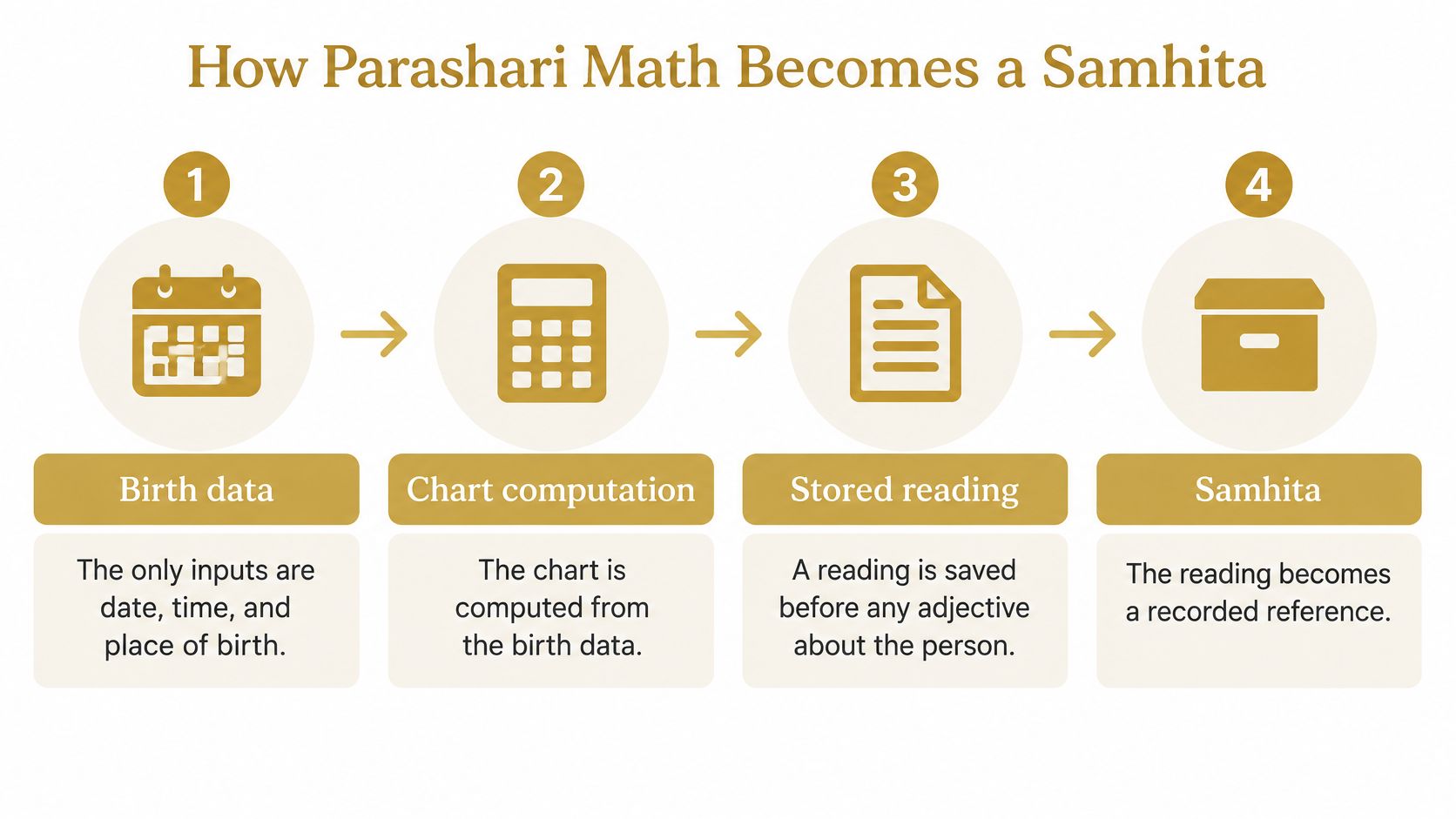
We don't start with personality adjectives. We start with birth data, use a declared calculation method, and check the interpretation before writing forward claims.
Provide date, time, and place of birth. These are the calculation inputs. We compute the chart before asking who you are or inviting a life story, so your description cannot supply the opening interpretation.
Run the declared compute stack. Our default is the sidereal zodiac, which uses a stellar reference, with Lahiri ayanamsha, the declared offset used to locate that zodiac. The same inputs and settings should return the same numbers.
Let the chart meet lived experience. Chart-derived questions about past windows come first, free. You can say whether they touch events you lived through, including when nothing relevant happened.
Open the Samhita. This is the structured, living reading. Only interpretations that hold through calibration enter its forward content, while prior outputs remain available for audit.
What the declared stack contains
The lagna, or rising sign, establishes the chart's starting frame. Houses organise life topics, while nakshatras, the traditional lunar divisions of the zodiac, supply another layer of placement and timing.
Our calculations include the Shodashvarga, the classical set of divisional charts used to examine topics in greater detail. Vimshottari and Yogini dashas are planetary-period systems, while Varshaphala is an annual-chart method.
Other calculated layers include:
- Shadbala: A traditional framework for assessing planetary strength.
- Ashtakavarga: A point-based framework used when assessing signs and transits.
- Jaimini karakas: Planetary indicators assigned through a distinct classical method.
- Yogas: Named planetary combinations requiring interpretation in context.
- Gochara: Transits, meaning planetary movements considered against the birth chart.
We compute the full kundli, meaning birth chart, along with its dasha timeline, divisional charts, planetary strengths, and yogas in seconds. Speed is not evidence of predictive validity. It enables repeatable calculation before interpretation begins.
Brihat Parashara Hora Shastra supplies the broad classical frame for planets, houses, and dashas. Phaladeepika and Saravali sometimes weigh factors differently, so a careful reader names the method rather than blending disagreements into certainty.
The numbers are then grouped into chapters. The result is one recorded reference followed across a lifetime, not a fresh account of your personality at every visit.
When the Birth Time Is Only Approximate
Your hospital record gives one time. A relative remembers another. Give more weight to a contemporaneous record than to a later estimate, and note where each candidate time came from. Do not choose the one that produces a more attractive interpretation.
Minutes can matter near a rising-sign or house boundary. Some divisional placements are also sensitive to the clock time, so uncertainty may widen the timing of a claim.
Preserve the uncertainty
Use the birthplace and the civil-time rules in force on the birth date. Local clock digits are not universal time: calendar conversion, time zones, and daylight-saving rules need explicit handling.
If candidate times produce different lagnas, keep the disagreement visible:
- Record provenance: Note whether the time came from a hospital record, certificate, diary, or family memory.
- Compare candidates: Identify which placements or timing interpretations change.
- Widen the band: Keep uncertain timing broad rather than selecting unsupported precision.
- Separate rectification: Treat birth-time rectification, an attempt to assess candidate times against events, as separate work.
An unknown or approximate birth time may produce wider timing bands. Rectification features may be offered as separate work, including as a separate purchase, rather than as a silent correction inside the original chart.
A study published in Genus identifies limited data and imprecise formulations as obstacles to evaluating astrological claims. Better birth records make a claim easier to audit, but do not make it true.
The Jyotish chart calculator guide explains calculation context. Never select a birth time to fit a hoped-for future event.
Beside each prediction, record the time source and whether its timing band is narrow or wide. Keep that note and the chosen time with your private reading rather than publishing birth records.
Layers Behind a Chaptered Life Reading
Layers that make one life statement
| Layer | Question it answers | When the signal is thin |
|---|---|---|
| Lagna and houses | Where a life topic sits | Birth time sits near a house boundary, so say so |
| Vimshottari dasha | When a theme is active | Timing band widens if the clock time is approximate |
| Navamsa and other divisional charts | How a theme matures | A divisional note must not cancel the birth chart |
| Transits, or gochara | What this season adds | A transit alone is not a life prediction |
| Yogas and strength scores | Which combinations are prominent | Name the combination. Don't call a planet bad |
| Confidence label | How settled this sentence is | Ambiguity remains a question, not guidance |
A chaptered reading files these layers under domains such as resources, partnership, and timing. Think of those chapters as a table of contents for distinct claims, not separate ways to repeat a single personality summary.
The Navamsa, the ninth divisional chart, deserves particular care. Readers use it to examine how themes develop, but it doesn't erase the birth chart whenever another interpretation is more appealing.
Describe the placement before interpreting it
Take Mars in the first house. That is a placement to describe within the full chart, not a reason to label Mars bad or tell you that conflict is unavoidable.
A responsible interpretation asks about the planet's condition, its relationships with other factors, and the active period. It then explains the proposed theme in ordinary language. A placement alone doesn't supply an event, a date, and an outcome.
Rahu and Ketu, the lunar nodes, also need context. Their names shouldn't become shortcuts for frightening claims or explanations that cannot be tested.
Ask which layer supports each part of a sentence. A placement may support the topic, a dasha the window, and calibration the confidence. None can silently stand in for all the others.
Classical material has boundaries
Classical texts discuss longevity. We won't turn that material into a forecast of death, illness, or accident.
Including a subject in a traditional text doesn't oblige a modern reading to make a consequential claim about it. Restraint is part of interpretation, especially where a sentence could create fear without offering dependable knowledge.
You should be able to point to the layer behind a statement. If a paragraph moves from one planetary placement to an exact life outcome without showing its timing basis or uncertainty, the missing reasoning matters.
How to Verify a Prediction with Pramana
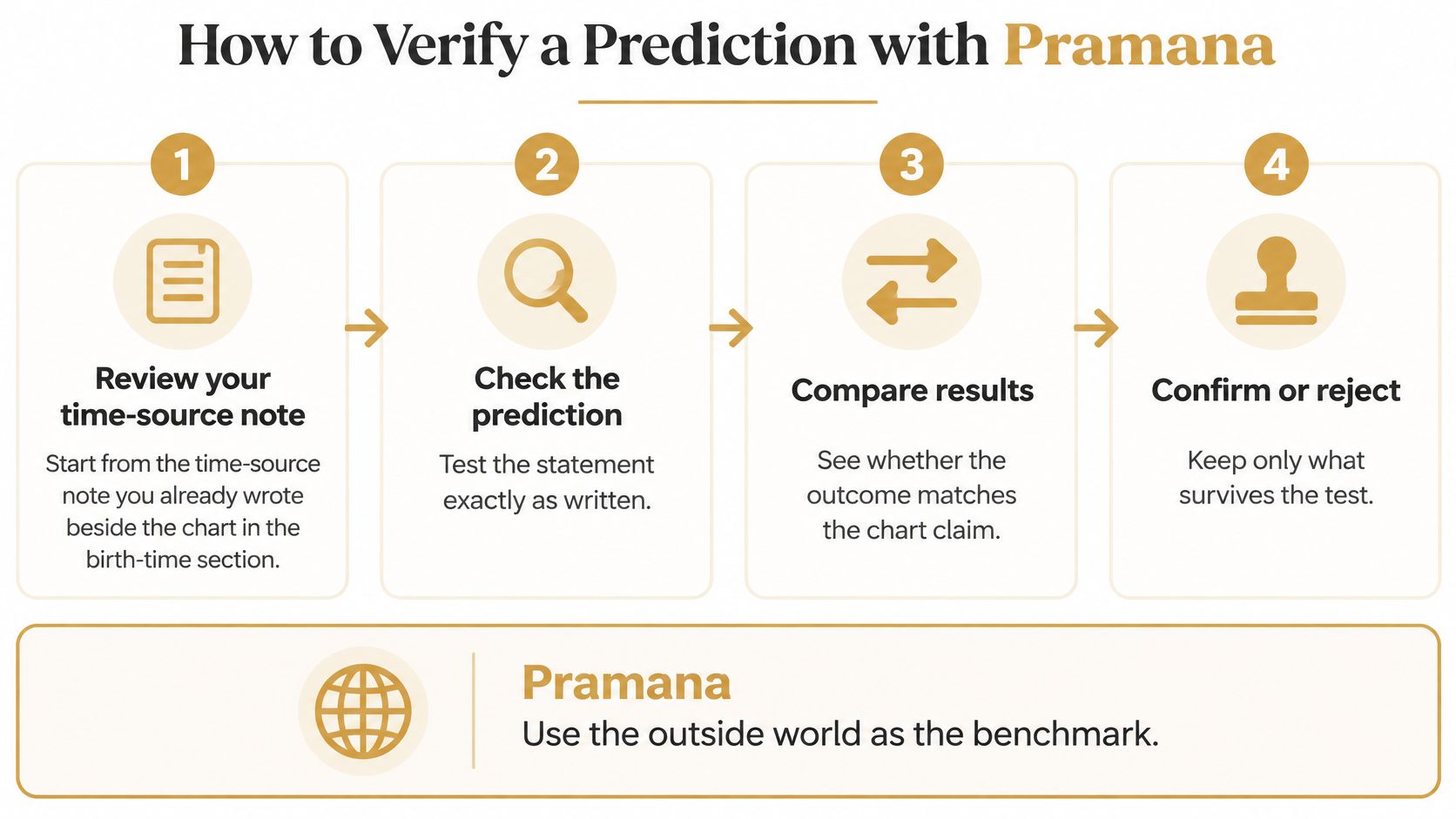
Pramāṇa means proof or a means of knowing. In our process, it means checking chart-derived interpretations against lived experience before making forward claims.
Begin with the time-source note. Use the recorded birth time and its uncertainty. Don't test a precise sentence against an input whose precision hasn't been established.
Let the chart ask first. A fair question names a past window already implied by the calculations. It doesn't begin by asking you to explain your entire life.
Answer with the event, or its absence. Say what happened without stretching an unrelated experience into a match. Nothing relevant happened is a valid answer.
Keep supported interpretations for forward use. Only what holds through calibration enters the forward reading. A convincing explanation after your answer isn't the same as a successful initial claim.
Leave misses on the record. Don't promote them, rename them, or remove them from an accuracy assessment.
Compare the frozen claim with the later outcome. When a dated window has passed, assess the original wording. Record revisions separately rather than editing the earlier statement.
Our cold-read questions are offered free before payment. They let you inspect the chart's apparent fit before committing to a reading, but a successful personal check is not scientific proof of the whole method.
The outside benchmark matters
In a double-blind test published in Nature in 1985, physicist Shawn Carlson reported that 28 of 83 participants selected their correct natal interpretation first, 33.7% against a 33.3% chance rate. That result provided no evidence of better-than-chance performance in the tested matching task.
The experiment tested personality matching, not Parashari dasha timing. It therefore doesn't settle every timing method, but it does prevent us from treating persuasive interpretation as sufficient evidence.
The practical standard remains demanding: write claims before outcomes are known and assess performance against a suitable baseline. Keeping only successful interpretations for forward use must never become reporting only successes when discussing accuracy.
Vague lines feel accurate because they fit many lives. A sentence about change after difficulty is easy to recognise; a defined period and a named life area give you something more concrete to check.
The Vedic astrology chart analysis guide provides context for reading those factors. The test itself still belongs to the record of what happened.
How to Read a Confidence Label
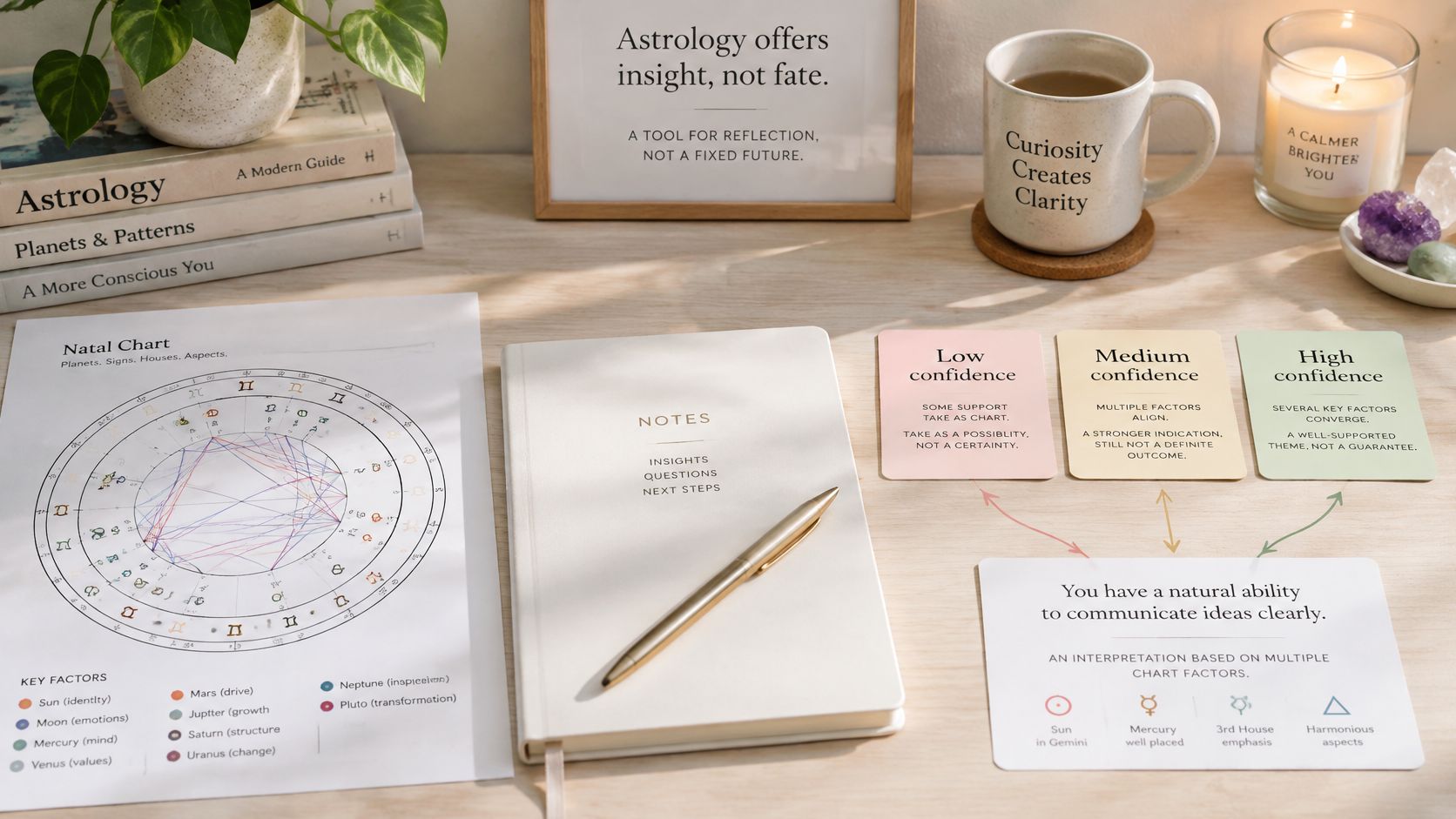
A confidence label belongs to a statement, not to your future as a whole. It indicates how settled an interpretation is within the reading process. It isn't a measured probability unless a validated probability model has been supplied.
The three confidence bands and the one move each allows
| Band | What it means | Allowed move |
|---|---|---|
| Agreed | Several chart factors point the same way and a past window already matched | Keep the sentence as a conditional forward window |
| Partial | The theme is visible, but the birth time is soft or the timing band is wide | Narrow its dates only when evidence supports doing so |
| Ambiguous | The chart raises a question without a clear theme | Drop it from forward use and keep the question on record |
These are practical reading bands, not an invented numerical scale. Agreed means internal agreement plus a relevant lived check. It doesn't mean that an outcome is assured.
A conditional forward example
A dasha change computed from the chart alone may point toward a major transition, such as a career shift. The restrained interpretation is a window that may correspond with changed responsibilities if the wider chart supports it, not a promise of a job.
Suppose a comparable past window matched a documented role change. That supports keeping the theme under review, while the actual forward sentence still needs its dates and uncertainty attached.
If later outcomes also match the original wording, confidence may rise. It shouldn't rise just because more time has passed or because you've supplied more personal detail.
A miss must change forward use
Suppose a past dasha window suggested relocation, but you didn't move. Don't rename an ordinary change of routine as relocation to rescue the sentence.
Leave the miss dated and remove that unsupported line from future claims. If another interpretation is proposed, record it as a new interpretation rather than pretending it was always the original one.
Audit rule: A later reading must not quietly replace an earlier claim. Preserve both the wording and the assessment.
A partial label also doesn't justify narrowing dates immediately. You may narrow them only when better birth-time evidence or a defensible timing check supports that change; otherwise, preserve the wider band.
The calibration methodology explains the chart-first approach. For forward use, the available moves are limited: keep the conditional sentence, narrow its dates when justified, or drop it.
Check the Window Before You Act
A timing window can prompt reflection without taking control of a decision. Before attaching an action to it, answer these questions:
- Define the decision: What exactly are you deciding?
- Check outside evidence: What do you know independently of the chart?
- Consider error: What would it cost if the interpretation were wrong?
- Preserve alternatives: Which options remain if the window is misread?
A Pew Research Center survey found that 1% of U.S. adults relied a lot on the practices it surveyed for major life decisions, while 5% relied on them a little. Consultation and handing over decision-making are different behaviours.
For health or money questions, keep the substantive assessment with an appropriately qualified professional. A chart can prompt a question, not supply the professional answer. Marriage, work, and relocation also require evidence about the people and circumstances involved.
Frequently asked questions
Is a strong yoga a guarantee of an event?
No. A yoga is a named planetary combination that may make a theme more prominent within the interpretation. It doesn't guarantee an event or remove the need to examine timing and context.
Can astrologers disagree about the same birth chart?
Yes. Readers may use different settings, traditions, or weights for individual factors. Each should name the method and distinguish a calculation difference from an interpretation difference.
Is a Samhita the same as a daily horoscope?
No. A Samhita is a persistent, structured reading based on classical Parashari calculations and calibration. Our scope excludes tarot, numerology, and sun-sign horoscope feeds.
Can I get a reading with only a birth date?
Yes, but without a reliable time, some factors cannot support precise claims. Timing bands may be wider, and no birth time should be invented to make the reading appear complete.
You can inspect the sample reading and pricing information to understand the format and scope before choosing.
Anvaya offers declared Vedic computation, past-event calibration, and a persistent Samhita with dated claims you can revisit. Visit Anvaya to Generate my Samhita, beginning with the free chart-derived questions before any forward reading.