
You keep clearing the same obstacles at work, yet the list never seems to end. A demanding colleague needs managing, small health complaints appear when pressure rises, and you find yourself proving your value by taking responsibility for difficult tasks. If that pattern feels familiar, Sun in the sixth house may seem both reassuring and unsettling. It can describe courage in competition, but also a habit of turning every problem into a test of competence.
In Vedic astrology, this placement isn't read as a simple promise of good health or an automatic sign of trouble. The sixth house concerns service, daily work, illness, debt, and opposition. The Sun represents vitality, authority, and self-direction. Their combination needs context.
This guide treats the placement as a working pattern rather than a label. We'll look at why the sixth house is both difficult and growth-oriented, how Sun here can help you face pressure, when it can create overwork, and why sign dignity, aspects, ascendant context, and dasha timing matter. For Anvaya, the method is simple in principle: math first, language second, followed by calibration against events you have lived. Astrology here is for personal reflection and self-understanding, not medical or professional advice.
Table of Contents
- What the Sixth House Means in Vedic Astrology
- Why the Sun Behaves Differently in the Sixth House
- Health Service Enemies and Daily Work With Sun in Sixth House
- When Sun in Sixth House Helps and When It Strains
- Dasha Timing Transits and How to Verify the Pattern
- Reading Your Chart With Honesty and Next Steps
What the Sixth House Means in Vedic Astrology
Start with the house before interpreting the planet. The sixth house describes the parts of life that require maintenance: daily work, service, routines, debts, disease, and opponents. It isn't the house of effortless comfort. It describes the queue of practical problems that asks for your attention.
A useful analogy is a workshop. Tools become reliable because someone uses them, cleans them, and repairs them. In the same way, sixth-house matters improve through regular effort. You don't master a difficult task by admiring it. You become capable by meeting it repeatedly.
The difficult house
In Vedic astrology, the sixth house is classified as a dusthana, a house associated with difficulty. It relates to illness, debt, conflict, and burdens that can drain attention. That classification doesn't mean every sixth-house placement produces a bad life. It tells you where friction is likely to enter the chart.
The house also concerns service. Work done for others, practical support, problem-solving, and the routines that keep life functioning all belong here. A person may meet sixth-house themes through employment, caregiving, administration, competition, or the need to organise an untidy situation.
The growth house
The sixth house is also an upachaya, meaning a growth-oriented house. The other upachaya houses are the third, tenth, and eleventh. This dual classification is part of house doctrine itself, not a modern attempt to make a difficult placement sound pleasant. The sixth remains a dusthana while also being a place where effort can produce development over time. This dual role of the sixth house is outlined in a Vedic astrology reference on Sun in the sixth house.
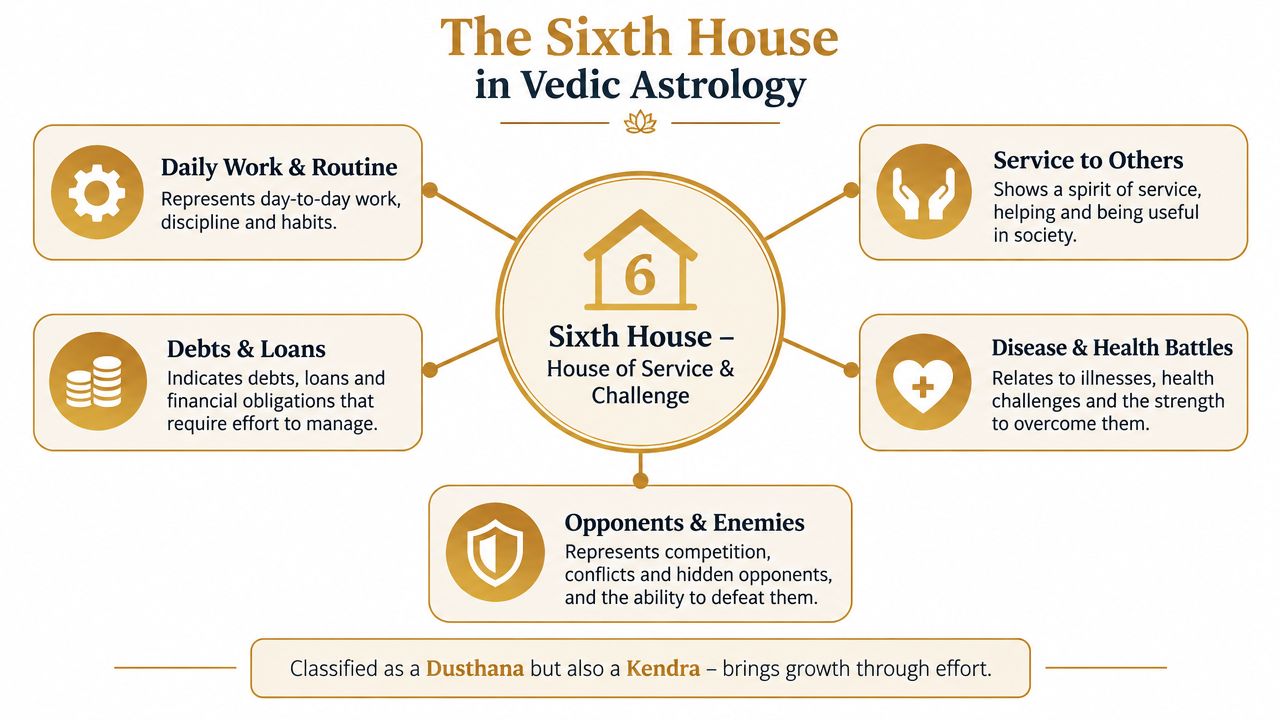
Key principle: The sixth house doesn't promise ease. It describes the arena where disciplined effort can become competence.
That is why interpretations of the Sun in this house often focus on overcoming opposition, succeeding through service, and handling competitive environments. The house gives the Sun a problem to solve. Whether that becomes strength or strain depends on the rest of the birth chart.
Why the Sun Behaves Differently in the Sixth House
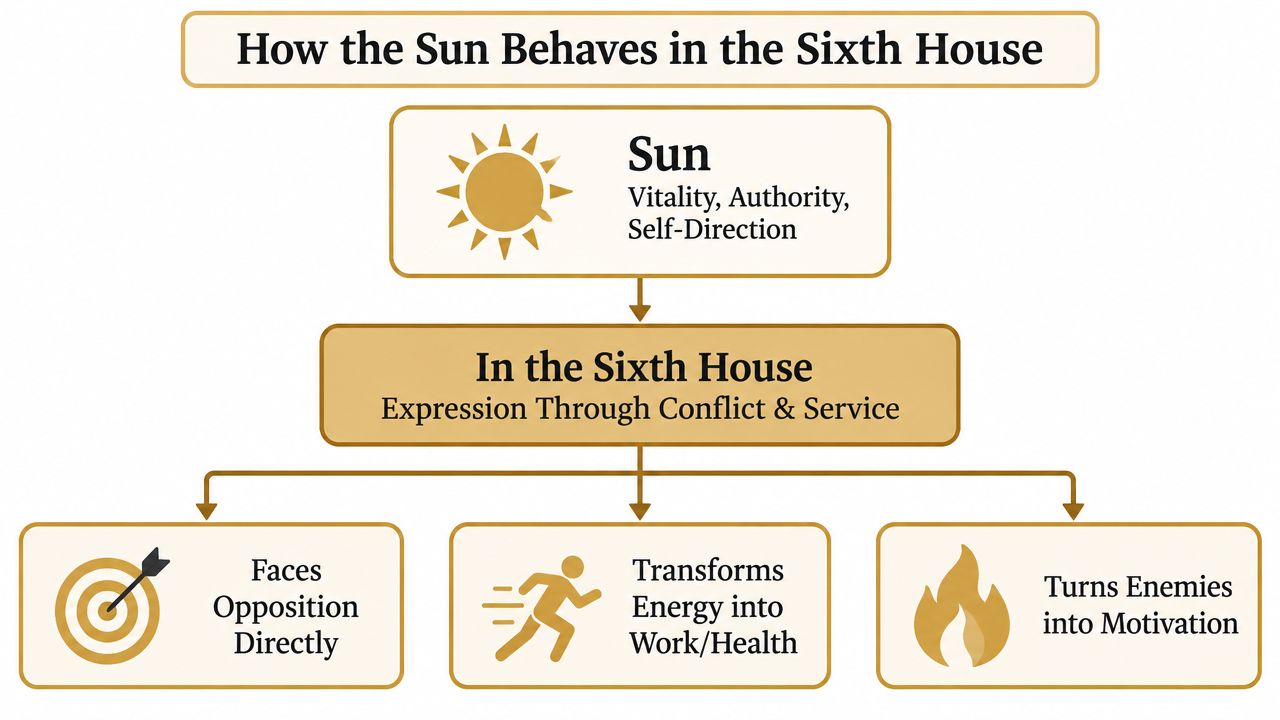
The Sun signifies vitality, authority, self-direction, and the will to stand at the centre of a responsibility. In a quiet house, those qualities might express through visibility or leadership. In the sixth house, they often express through work, conflict, repair, and service.
The Sun may want to lead, but the sixth house keeps presenting tasks. You may become the person who handles complaints, manages pressure, faces difficult colleagues, or takes ownership when others hesitate. This isn't necessarily a desire for public attention. It can be a need to demonstrate competence by solving what others avoid.
The dusthana and upachaya tension
The sixth house creates a useful paradox. As a dusthana, it brings struggle. As an upachaya, it can reward persistence. Classical-style interpretations therefore often treat challenging planets as comparatively capable in this house. The planet's heat and force have somewhere practical to go.
For the Sun, that outlet may be competition or service. Opposition can sharpen your focus. A difficult task can make your authority visible. Repeated responsibility can develop a steadier form of confidence than praise alone would provide.
Comfort isn't the main measure
Readers often ask whether Sun in the sixth house is good or bad. That question assumes comfort is the only measure. This placement may be constructive because it develops the ability to deal with resistance, but constructive doesn't mean painless.
Classical sources use strong language for the placement. AstroSage's summary of Saravali and Phala Deepika presents themes such as strength, reputation, prosperity, and overcoming enemies. These are traditional potentials, not guarantees. A serious reading asks whether the chart supports disciplined service, or whether the Sun turns every disagreement into a personal contest.
Health Service Enemies and Daily Work With Sun in Sixth House
Health is one of the most misunderstood themes here. Sun in the sixth house doesn't by itself prove disease, nor does it guarantee immunity. The Sun is treated as a vitality indicator, while the sixth house describes illness and health battles. Their combination is therefore often read as the capacity to confront strain and recover, provided the wider chart supports that interpretation.
This can show someone who responds to health problems with discipline. They may follow a routine, seek practical solutions, or become attentive to the relationship between workload and physical energy. It can also describe a person who ignores limits until the body forces a pause.
The same pattern appears in work and competition. The person may perform well when a clear problem needs solving, especially where persistence matters. Enemies in this context needn't mean dramatic personal enemies. They can be rivals, institutional obstacles, unresolved disputes, or situations that repeatedly challenge authority.
One pattern, several arenas
Service connects these themes. You work, maintain routines, address problems, and meet opposition because something needs to function. The Sun wants to direct the effort. The sixth house asks whether that direction produces useful service or unnecessary combat.
| If the pattern leans toward resilience | If the pattern leans toward overdrive |
|---|---|
| You use routines to manage pressure. | You treat rest as weakness. |
| Competition gives you focus. | Every disagreement becomes a status battle. |
| You recover by returning to measured habits. | Work stress spills into digestion, heat, or general strain. |
| Authority grows through service. | Authority becomes control or defensiveness. |
These are interpretive tendencies, not medical conclusions. A detailed discussion of Sun in the sixth house and health-related themes connects the placement with recovery capacity while also noting possible stress, digestive strain, ego clashes, and friction with authority when the Sun is afflicted.
A practical reading
Ask how you respond after the crisis, not only how you perform during it. Someone with a constructive sixth-house Sun may face a difficult period and then improve the routine that caused the difficulty. Someone experiencing strain may keep escalating effort without changing the system.
For personal reflection, track your workload, sleep habits, recurring health concerns, and conflict patterns. Don't use astrology to diagnose a condition or replace qualified care. Use it to notice where your approach to service may need better boundaries. A broader look at body and longevity symbolism is available in Anvaya's guide to health, body, and longevity in astrology.
When Sun in Sixth House Helps and When It Strains
Different astrologers describe this placement as favourable, mixed, or strongly constructive. The disagreement often comes from reading the house placement without checking the modifiers. Sun in the sixth house isn't a complete interpretation. It's one component of a chart.
The first modifier is sign dignity. Dignity means how comfortably a planet operates in its sign. A Sun placed in a sign that supports its nature may express authority with more steadiness. A Sun in a sign where it has less support may struggle to direct its energy cleanly.
The ascendant matters because it determines which sign occupies the sixth house and which life areas the Sun rules. The same house placement can therefore mean different things for different ascendants. A chart reader must check the Sun's lordship, strength, house position, and relationship with other planets before making a judgment.
Support and affliction
Aspects and conjunctions alter the expression. A supportive influence may help the Sun turn conflict into organised service. A difficult conjunction may increase pressure, defensiveness, or repeated friction. The terms aren't moral labels. They describe how easily the planet's energy can perform its job.
| More supported expression | More strained expression |
|---|---|
| Clear responsibility and practical leadership | Ego clashes with colleagues or institutions |
| Steady routines during demanding periods | Work stress that keeps escalating |
| Competitive focus used to solve problems | Constant need to prove superiority |
| Service that builds authority | Service that becomes self-erasure or control |
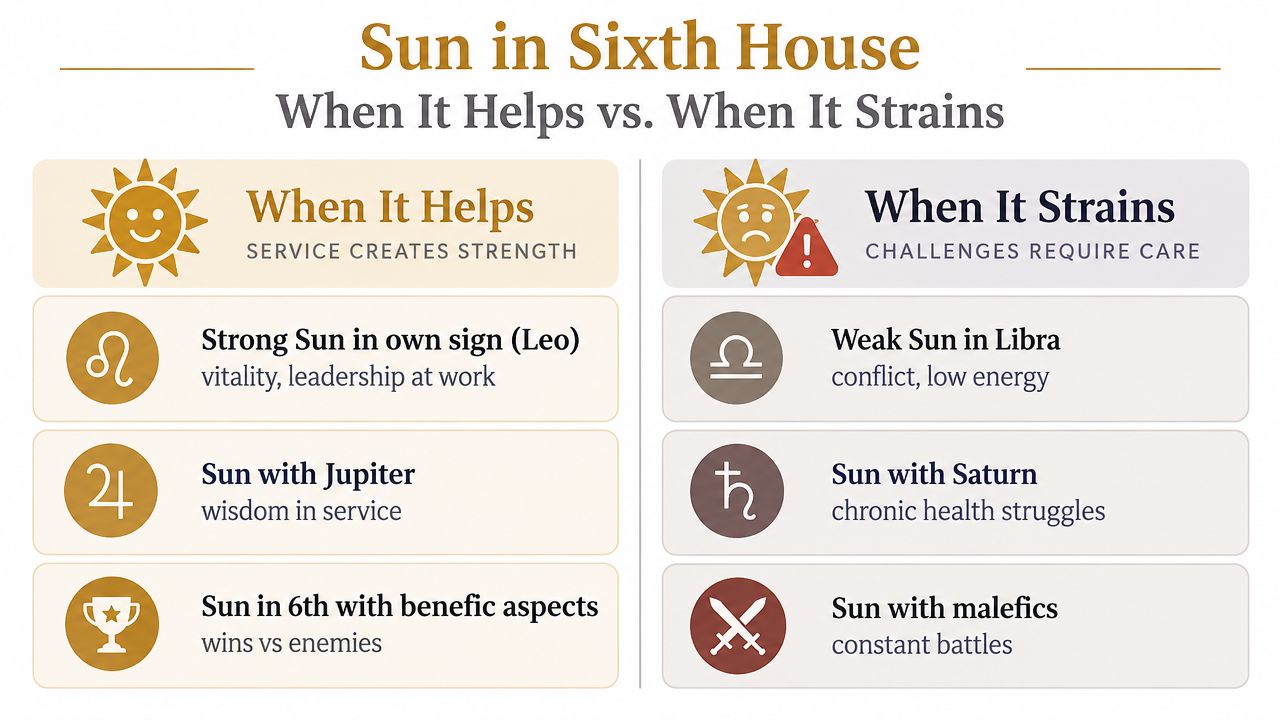
A chart with the Sun in its own sign, Leo, is often discussed as having a stronger basis for vitality and leadership at work. A Sun in Libra is traditionally treated as less comfortable, which can shift the reading toward conflict or reduced energy. Those examples don't settle the chart by themselves. They show why sign dignity matters.
Read combinations carefully
A relationship with Jupiter may support wisdom in service. A difficult relationship with Saturn may describe heavier health or workload themes. Benefic aspects can support success against opposition, while malefic influences may increase battles. These are traditional interpretive patterns, not fixed outcomes.
The sixth-house reference from DK Foundation also highlights the importance of sign dignity and aspects. That is the point many generic readings miss. Before calling Sun in the sixth house favourable, ask which Sun, in which ascendant context, with which relationships, and during which periods.
Dasha Timing Transits and How to Verify the Pattern
A birth chart shows a pattern. It doesn't mean every part of that pattern operates at full volume all the time. Dasha periods and transits act as timing windows, bringing certain themes into greater focus when the relevant planets and houses become active.
Vimshottari dasha is a timing system used in Vedic astrology. A Sun period, or a period connected to the sixth-house ruler, may make work, service, competition, routines, or health concerns more noticeable. A transit can add another layer by moving a planet through a relevant sign or house. The result is conditional, and the chart must support the event before the timing becomes meaningful.
Verify more than the sign
Sign-only interpretation can be too broad. More precise work may examine the Sun's degree, nakshatra, and sub-lord, especially in approaches that use KP-style verification. These details help distinguish a general possibility from a more specific pattern.
A practical review can ask:
- Work pressure: During which periods did responsibility increase or conflict become more visible?
- Health routines: Did you respond to strain by building better habits, or by pushing harder?
- Competition: When did rivals or institutional obstacles become a source of focus?
- Authority: Which periods brought recognition, and which brought friction with managers or officials?
The point isn't to search your past for a perfect match. It's to test whether the chart describes your life with enough precision to deserve confidence. Anvaya calls this calibration Pramāṇa. The system uses declared chart computation, then checks chart-derived questions against lived events before making forward-facing claims.
For decisions involving timing, you can also study the practical relationship between planetary periods and choosing a start date in this guide to identifying a suitable time to begin. Astrology should support reflection, not replace medical care, legal advice, financial guidance, or other qualified professional help.
Reading Your Chart With Honesty and Next Steps
Sun in the sixth house is best understood as a workshop for courage. It may support disciplined service, recovery after pressure, and measured competition when the wider chart gives the Sun enough support. It may also describe overwork, authority friction, or health strain when the Sun is weakened, afflicted, poorly timed, or expressed through constant proving.
The traditional promise of overcoming enemies should be read as a potential, not a guarantee. The same applies to classical descriptions of strength, renown, or prosperity. Your chart cannot remove the need for judgment, boundaries, qualified care, or practical action.
A short reflection checklist
- Notice the trigger: What kind of work or conflict brings out your strongest response?
- Check the cost: Does service leave you steadier, or depleted?
- Track the timing: Which dasha or transit periods correspond with changes in workload and routine?
- Review the chart: Has anyone checked dignity, aspects, conjunctions, ascendant context, and divisional support?
- Keep uncertainty visible: Treat a symbolic interpretation as a hypothesis until your lived experience supports it.
A birth chart can reveal structured possibilities, but it can't tell the whole story without accurate birth data and careful verification. This explanation of what a birth chart can actually reveal offers a useful standard: begin with calculation, test the pattern against life, and state uncertainty plainly.
Generate a chart-first reading that checks how Sun in the sixth house fits your actual life, including its dignity, aspects, and timing context. Visit Anvaya to generate your Samhita and receive a structured reading grounded in declared Vedic computation and Pramāṇa calibration.