

You can have a chart that looks louder on paper than it feels in real life. Sun in the 4th house often does that. A person may carry family responsibility, care about the home, or feel tied to mother, land, or ancestry, yet still feel oddly unseen in public. For personal reflection and self-understanding, not professional advice, the question is not “Is this good or bad?” It's “What changes the result in my chart?”
That question matters because the 4th house is the private base of the chart, while the Sun is about identity, authority, and dignity. Put them together, and the meaning turns inward. Sometimes that inwardness becomes quiet strength. Sometimes it becomes strain at home. The difference depends on sign dignity, aspects, and timing, not on a single label. As a life-intelligence reading at Anvaya would treat it, the chart has to be checked first, then calibrated against lived events before any forward claim is made.
Table of Contents
- Introduction Why Sun in the 4th House Feels So Personal
- What the 4th House Means in Vedic Astrology
- How Sun Energy Expresses in the House of Home and Roots
- Strengths Challenges and What Actually Flips the Result
- Timing Education Property and Real Life Examples
- How to Read Sun in 4th House in Your Own Chart Honestly
- Conclusion and Your Next Step With Anvaya
Introduction Why Sun in the 4th House Feels So Personal
A lot of people notice this placement only after a home event. They move cities. They take over family property. They become the one who keeps the household steady. Or they realise they feel more alive in private than in front of a crowd. Sun in the 4th house often lands that way, because the Sun's need for identity meets the chart's most inward room.
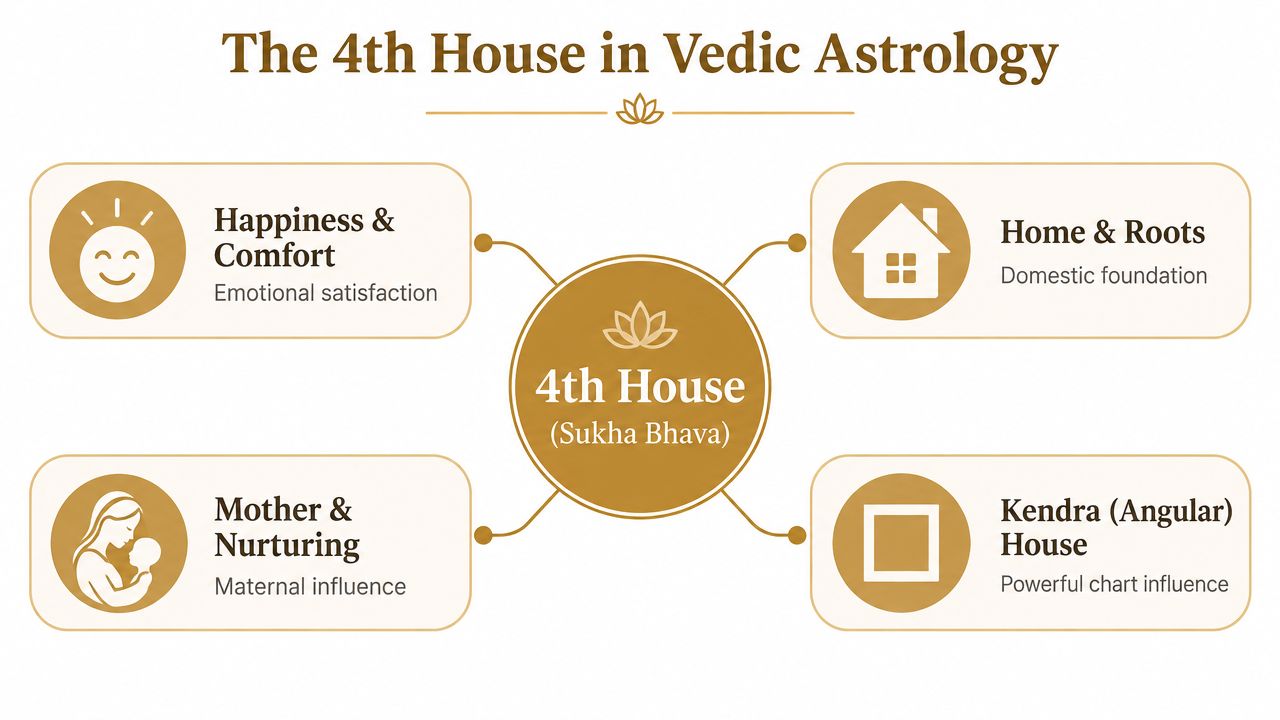
In classical Vedic astrology, the 4th house is Sukha Bhava, the house of inner happiness. It is also a kendra, an angular house, so it does not stay quiet. It affects the whole chart. Modern explainers also connect it to mother, home, property, vehicles, and education, which is why people search this placement when they're trying to understand family life, schooling, or real estate themes. One traditional line even describes the placement in very hard terms, while other texts speak of domestic strain and agitation. That range is exactly why a one-line meaning is not enough. See the classical framing in Jagannath Hora's Sun in 4th house overview.
Practical rule: if a placement touches home, mother, property, and education, you don't read it like a personality sticker. You read it like a foundation question.
This guide stays simple on purpose. You'll see what the 4th house means, how Sun energy behaves there, what tends to support the placement, what tends to strain it, and how timing can change the story. You'll also see how a serious chart reading checks the math before it trusts the meaning.
What the 4th House Means in Vedic Astrology
The 4th house is not just “home” in a surface sense. In Vedic language, Sukha Bhava means the house of comfort, ease, and inner contentment. That is why people associate it with the place where life settles down, where the nervous system rests, and where the private self can breathe. It is the chart's foundation, not its display window.
Why kendra status matters
A kendra is an angular house. That means planets placed there carry weight across the chart, not only in one narrow topic. So when a planet sits in the 4th, it does not stay tucked away like a minor detail. It affects the way the whole chart organizes itself around home, roots, and emotional base.
In plain language, think of the 4th house like the floor under a house. If the floor is steady, the rest of the structure can stand with more ease. If it is stressed, the strain often spreads upward. That is why classical and modern Vedic sources keep returning to the same cluster of topics, home, mother, land or property, vehicles, education, and emotional roots. A readable modern summary of these meanings appears in Astromedha's overview of the 4th house.
The key point is not that every person with a strong 4th house will own land or have a perfect family life. It is that the chart keeps returning to the same foundation questions. Where do you belong? What is your private base? Who or what shaped your earliest sense of safety?
Why this house feels private
The 4th house is inward by nature. It points to what supports you when nobody is watching. That is why readers often connect it to childhood patterns, ancestry, and the feeling of being rooted. When a planet lands here, the chart asks whether that planet can express itself in private life, not just in the public arena.
How Sun Energy Expresses in the House of Home and Roots
The Sun carries selfhood. It stands for vitality, authority, dignity, and the urge to shine. In most charts, that energy wants visibility. It wants to be seen, named, and recognised. When the Sun sits in the 4th house, that outward impulse turns inward and starts organising life around home, ancestry, and emotional security instead of public display.
Identity becomes private
That inward turn can be healthy. Some people with this placement are strongest when they are protecting a home, preserving a family line, or building a private base that lets them stand tall. Their authority may not look theatrical. It may look like steadiness. Others experience the same inward turn as pressure, especially if the Sun is weakened or heavily afflicted. Then the person may feel that home life carries too much heat, too much control, or too much strain.
A careful way to state it is this.
The Sun in the 4th house internalises self-expression. It often moves identity away from public visibility and into private life, family duty, ancestry, and the need for emotional stability.
That is why the placement can look quiet from outside even when the person is responsible inside. A reader who only looks for career prominence can miss the centre of gravity. A person may not chase public attention, yet still carry strong inner standards and a clear sense of duty at home. Vedacharts explains this inward shift in solar identity well.
Healthy strength or private strain
The same placement can produce very different lived experiences. If the chart supports it, the Sun here can show a person who builds dignity through private responsibility. If the chart does not support it, the same placement can show friction around home life, a tense bond with family roles, or a feeling that personal warmth is harder to relax into.
That is why the phrase “Sun in the 4th is bad” is too crude. The chart is not debating a slogan. It is showing how solar force behaves when it enters a private house. Sometimes that force becomes a strong inner spine. Sometimes it becomes heat where calm is needed.
Strengths Challenges and What Actually Flips the Result
This is the part people usually want first. Is it supportive, or is it difficult? The honest answer is that Sun in the 4th house can show both. Classical reading traditions already point in the adverse direction, with descriptions of reduced domestic comfort and strain at home, while some modern interpretations also connect it to property, status, or public-facing support tied to land. That split is not a contradiction. It is a sign that conditions matter.
What looks supportive
When the placement is supported, you often see someone who takes home seriously. They may hold a family role with clear boundaries, care about property matters, or feel a strong duty to build a stable base. Their standards are usually high, and they may want order in private life more than applause in public.
What looks strained
When the placement is under pressure, the same house can feel hot and heavy. Domestic ease may reduce. Family life can feel tense. The mother theme, the home theme, or the feeling of being settled can become complicated. None of that is automatic, but it is part of the classical picture, especially when the Sun is weakened or hit by difficult influences.
| Sun in 4th House Supportive vs Strained Expressions | What It Looks Like | Condition That Drives It |
|---|---|---|
| Supportive home authority | Quiet responsibility, clear family role, steady private dignity | Strong sign placement, good dignity, helpful aspects |
| Property or status focus | Attention to land, home assets, or a respected base of operations | Chart support from the 4th lord and timing periods |
| Private confidence | Self-respect built at home rather than in public performance | Sun well placed and not heavily afflicted |
| Domestic strain | Less ease at home, friction in private life, agitation | Weak dignity, harsh aspects, difficult conjunctions |
The four levers that flip the story
- Sign and dignity. The sign tells you whether the Sun can act cleanly or awkwardly.
- Aspects and conjunctions. Other planets can protect the placement or add pressure.
- House lord strength. The 4th lord matters because it shows the condition of the house itself.
- Dasha context. Timing decides when the placement becomes active in real life.
A useful reference point for readers who are already checking strength conditions is Anvaya's note on Neecha Bhanga Raja Yoga, because it shows why weakness in one place is not the end of the story if the chart provides cancellation or support elsewhere.
Practical rule: don't read Sun in the 4th by the Sun alone. Read the Sun, the 4th lord, and the timing period together.
Timing Education Property and Real Life Examples
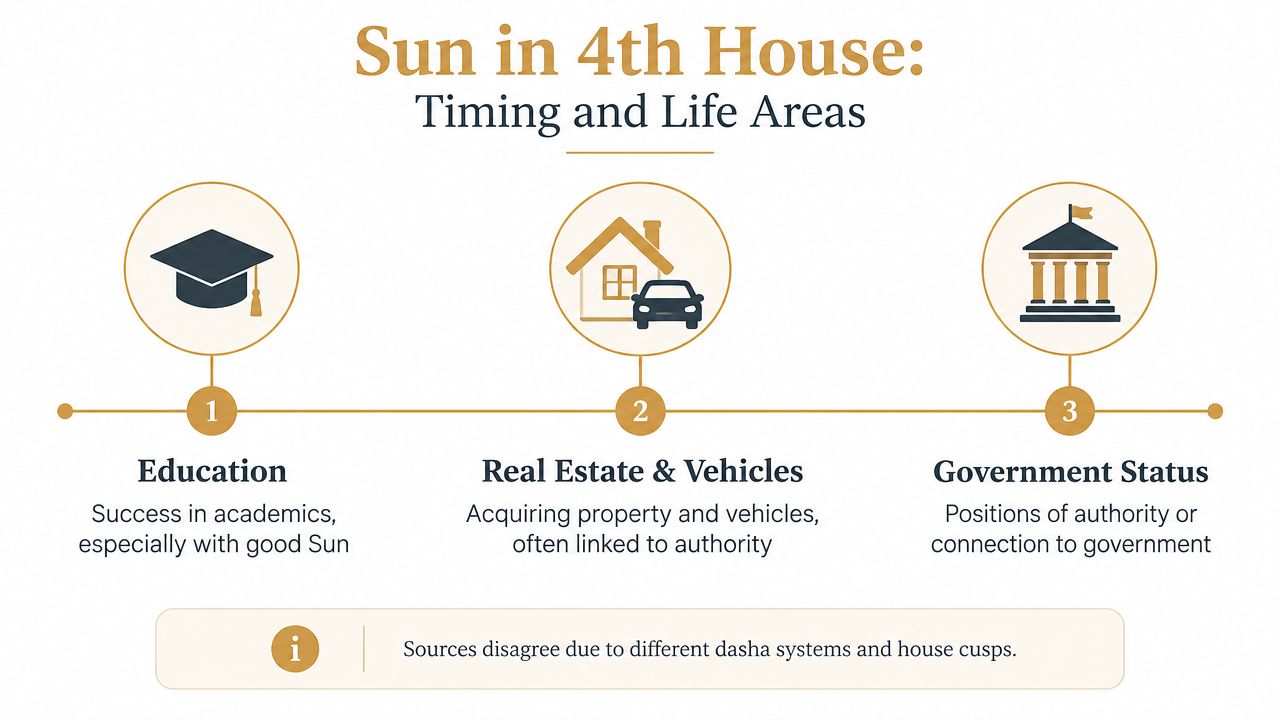
People often ask about this placement because they want to know where it shows up in life. The usual themes are education, real estate, vehicles, and government-linked status. That makes sense, because the 4th house already covers education and property, while the Sun brings authority and public role into the picture. But sources disagree because they are often reading different chart conditions, not because the placement has one fixed outcome.
Why timing matters
The same natal placement can stay quiet for years and then suddenly become obvious during a Sun period. In Vimshottari timing, Sun mahadasha or a Sun antardasha can activate what the Sun signifies in the natal chart. If the Sun is supported, you may see a stronger link with home responsibility, property themes, or educational focus. If the Sun is under strain, the same window may bring pressure around those areas instead.
One traditional interpretation also says Sun in the 4th can show poor directional strength, while still supporting major success after mid-30s. That is a useful example of why timing and maturity matter together. The chart does not have to look the same at every age. A later phase can express the placement more cleanly than an earlier one. See Indastro's 4th house reading for Sun for that specific strength claim.
Two simple chart-style vignettes
A man in his Sun period may suddenly need to handle family property paperwork after a parent steps back. The natal chart may have shown this for years, but the timing made it active.
A student with the same placement may struggle in one schooling phase, then stabilise later when the chart's timing changes and the 4th house becomes more supported. The meaning is not “bad education.” The meaning is “education themes are sensitive to timing and chart condition.”
The earlier section on house meaning already explains why the 4th house links to home and education. What changes here is activation. A placement can be present in the chart without being loud until the right dasha or transit opens the door.
A practical reading reminder
Anvaya's approach is to treat timing as something to test against life, not something to announce with certainty. That means the chart gets read first, then compared with actual events before any future-facing claim is made. For readers trying to connect property or home timing with a concrete window, the platform's wealth and property reading guide is the kind of place where that logic is applied.
How to Read Sun in 4th House in Your Own Chart Honestly
Start with the birth data. If the time is off, the house placement can shift, and that changes the reading. Then check the ayanamsha being used, because Vedic calculation depends on that choice. After that, look at the Sun's sign, its dignity, and whether other planets aspect or join it. The 4th lord matters too, because it tells you how the house itself is functioning.
A short honesty checklist
- Confirm the birth data. If the time or place is wrong, the 4th house may be wrong too.
- Check the house position. See whether the Sun is clearly in the 4th or close enough to the cusp to matter.
- Notice the Sun's condition. A strong Sun reads differently from a weakened one.
- Look at the 4th lord. That shows whether the house has support of its own.
- Map the timing. Dasha and gochara, meaning planetary periods and current transits, tell you when the placement becomes active.
Ask the chart, then ask your life
Does your sense of self feel stronger in private than in public? Do home, mother, property, or family duty keep returning as central themes? Did important shifts happen during a Sun period or another period that touched the 4th house? These are the kinds of questions used in Pramāṇa, the calibration step where chart logic is checked against lived events.
Don't settle for one-line interpretations. “Good intellect” or “owns land” means little without sign, aspects, lord strength, and timing.
If you want a full chart compute with calibration questions, Anvaya's Samhita is built for that. If your main question is timing, the same platform also pairs naturally with tools like Panchang and Muhurta when you're checking dates and windows.
Conclusion and Your Next Step With Anvaya
Sun in the 4th house points identity toward home, roots, and the private base of life. In some charts, that shows up as calm authority and steady family responsibility. In others, it shows up as domestic strain or a harder path through emotional security. The difference is not random. It comes from dignity, aspects, the 4th lord, and the timing period carrying the placement forward.
That is why serious Vedic reading starts with math, not adjectives. Then it tests the reading against lived events. Then it speaks plainly about what seems supported and what still needs caution. That is the same method Anvaya uses when it builds a Samhita and calibrates it with Pramāṇa.
If you want a reading that treats this placement as a chart question, not a slogan, Generate my Samhita at Anvaya. If you want to see how the method works before you pay a rupee, read how Anvaya reads a chart and decide from there.