There’s a particular kind of frustration that has nothing to do with effort. You prepared. You showed up. You did everything right. And the day simply wasn’t having it. Then a week later, half as ready, you walk through a door that opens like it was waiting for you.
We tend to explain this away — mood, luck, other people. The Panchang has been explaining it for a very long time, and more precisely than “luck.”
What the Panchang actually is
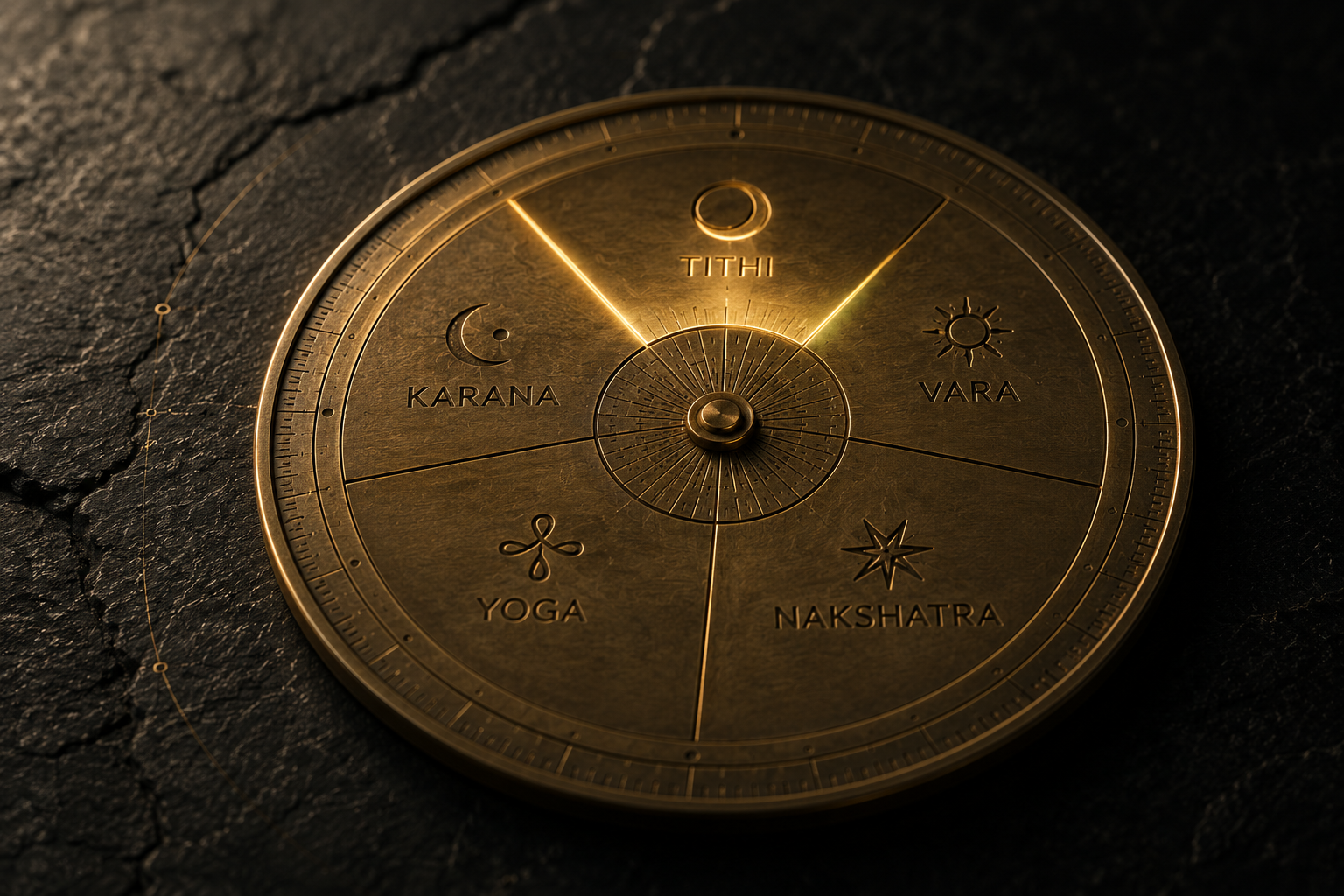
The Panchang is a traditional Vedic almanac. The name means “five limbs,” because it describes each day through five moving measures:
- Tithi — the lunar day, the moon’s phase-distance from the sun
- Vara — the weekday and its planetary ruler
- Nakshatra — the lunar mansion the moon is passing through
- Yoga — a specific sun–moon angular relationship
- Karana — the half-tithi
You don’t need to memorize these. The point is the shape of the idea: a day is not a flat, neutral container. It has texture. Some textures suit beginnings. Some suit finishing, resting, repairing, waiting. Classical timing — muhurat — is the art of matching the task to the texture.
The problem with classical muhurat (and why we built a score)
Traditional muhurat has a real flaw for modern life: it’s general. An almanac might call a day “auspicious” — but auspicious for what? The grain that’s perfect for signing a contract can be the wrong grain for a hard conversation. A day that supports rest can quietly sabotage a launch.
A single “good day / bad day” label flattens all of that. It’s the astrology equivalent of a weather report that only ever says “weather: yes.”
So Anvaya does something different. The Panchang Score is activity-scoped. We compute the five limbs, but then we ask the question that actually matters:
Good for what?
How the score is built
In plain terms, three layers:
1. Calculate the day. We resolve all five limbs precisely for your location and time zone. This part is pure astronomy and arithmetic — no interpretation, no opinion.
2. Scope it to the activity. A first date, a funding pitch, a surgery follow-up, and a difficult email don’t want the same day. The model weights the five limbs differently depending on the kind of thing you’re doing.
3. Calibrate it to you. This is the part most systems skip. Your Atlas has already learned how your momentum actually behaves. The same cosmic day reads slightly differently for a person whose energy runs in short cycles than for someone steady-state. The score bends toward the version of the day that fits the version of you we’ve confirmed.
The output isn’t a verdict. It’s a single honest number with a reason attached — “strong for outreach and creative starts; soft for confrontation” — so you can decide.
What it is not
Let’s be exact, because this is where trust is won or lost.
- It is not a guarantee. A high score is a tailwind, not a hand of fate. You still have to do the work.
- It is not an excuse. “Bad Panchang” is not a reason to avoid your life. Hard days still hold your name on them.
- It is not a replacement for judgement. If your gut and the score disagree, your gut knows things the model doesn’t. Log it. The model will learn.
Why a number, and not a paragraph
Because you have a life to live. When you’re deciding whether today is the day to send the thing, you don’t want a 600-word reading. You want one clear read you can trust at a glance — and the option to open the reasoning if you care.
That’s the whole philosophy in one line: rigour underneath, calm on the surface. The math can be elaborate. Your experience of it should feel like checking the weather before you leave the house.
The honest payoff
The Panchang Score won’t make you lucky. What it does is quieter and more durable: it stops you from spending your best effort on the day least able to receive it — and it gives some of your hardest days a reason that isn’t you failed. Sometimes the door was simply heavier that morning. Tomorrow it isn’t.