

You pay for a consultation, share your birth details, and hear a series of warm statements about being loyal, sensitive, ambitious, or misunderstood. They sound personal, but you leave unsure whether anyone checked your chart. The problem is simple. Many readings begin with forward claims and never test the birth chart against the past.
The questions on astrology below help separate a verifiable Vedic reading from a vague one. A serious reading should check your past before it makes claims about your future. This list is for personal reflection and self-understanding, not professional advice.
The ten questions move from individual self-checks to couple and family questions. For each one, look for a specific answer, a stated method, and a plain test against events you have lived.
Table of Contents
- 1. What are your exact birth details, and how confident are you in the time?
- 2. Which major life events can you date precisely, and what was happening in your chart then?
- 3. What specific life domain needs clarity most, and in what timeframe?
- 4. Are you asking about timing, outcome prediction, or self-understanding?
- 5. What decision are you trying to make, and by when?
- 6. What does success look like, and how will you know it has happened?
- 7. If the chart showed a challenging period, how would you want to hear it?
- 8. Have you or someone close to you lived through a similar dasha or transit?
- 9. Are you making this decision alone, or are other people part of it?
- 10. What would make you change your mind about the reading?
- Comparison of 9 Key Astrology Questions
- Take One Honest Reading Before You Commit
1. What are your exact birth details, and how confident are you in the time?
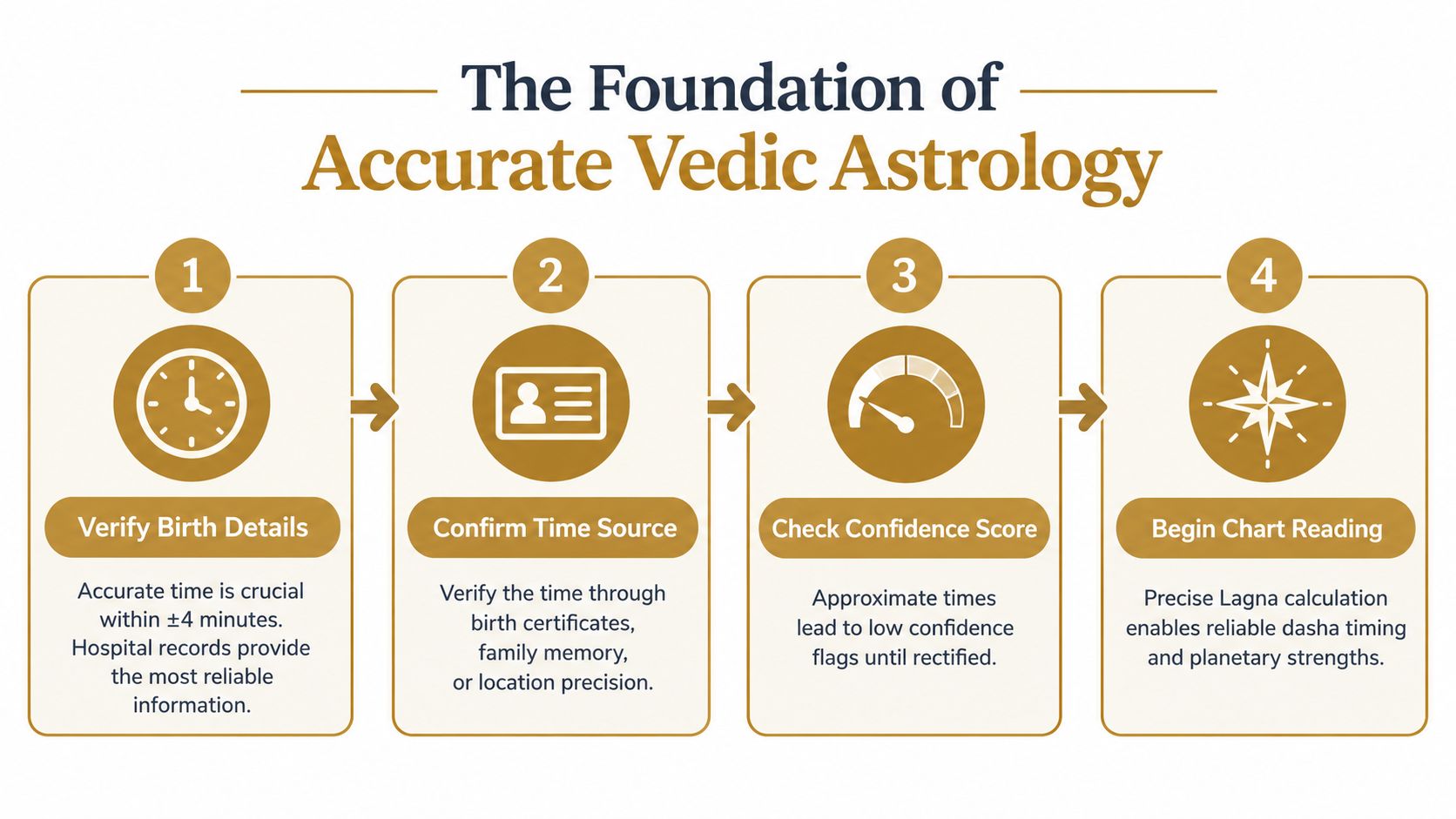
Birth time is the foundation of a Vedic chart. It affects the Lagna, or ascendant, house positions, dasha timing, and the strength assigned to different chart factors. A difference of minutes can matter when the ascendant or a house boundary is close to changing.
Start with the source of the time, not with an interpretation. A hospital record is stronger than a family estimate. If the record uses local standard time, the calculation should account for the location and convert the time correctly before the chart is generated.
Record the source before interpreting the chart
Write down whether your time comes from:
- Hospital record: Keep the original time and location noted in your account.
- Birth certificate: Check whether the document records local time accurately.
- Family memory: Record the range, such as “between 6 and 8 in the morning.”
- Rectification: Mark the time as refined through past-event testing, not as certain fact.
If your family remembers a two-hour range, a practitioner can calculate the most likely chart and mark it low-confidence. The chart then needs testing against dated events before anyone makes strong forward claims.
Pramāṇa, Anvaya's calibration process, uses chart-derived questions about past windows to test or refine the birth time. A job loss, relationship ending, move, or school entry can help narrow the search when you can date it with reasonable confidence.
Practical rule: If the birth time is uncertain, the reading should show that uncertainty. It shouldn't hide it behind confident language.
A birth time that looks precise on screen isn't automatically reliable. Ask what supports it, how it was converted, and what would cause the chart to be recalculated.
2. Which major life events can you date precisely, and what was happening in your chart then?
A chart should meet your lived history before it speaks about your future. Choose several major events and write down when they happened. Use the official date where possible, not only the date when you first felt a change coming.
A finalized divorce, a job promotion, a relocation, or the start of a major family responsibility can each provide a useful test. The practitioner can then compare the event with the dasha, relevant transits, and yearly chart periods active at that time.
Test events, not personality adjectives
Suppose a divorce was finalized in March 2018. The reading may examine whether the relevant partnership factors, dasha periods, and transits were active around that month. That doesn't prove a complete causal explanation, but it gives you something concrete to evaluate.
If you remember only that a promotion happened sometime in the third quarter of 2022, the match is less precise. A broad Jupiter period may appear relevant, but the result should be marked as partial until you can identify the actual month.
A useful event list might include:
- Career change: Joining, leaving, or receiving a formal promotion.
- Relationship milestone: Beginning a relationship, marriage, separation, or divorce.
- Relocation: Moving city or country, with the date of the move.
- Education event: Starting or completing a course or qualification.
- Family transition: A major change involving parents, siblings, or children.
Use dated emails, certificates, payslips, photographs, or other records where appropriate. Separate “when I first knew” from “when it became official.” If two events align and one doesn't, the answer may be a birth-time problem, an interpretation problem, or a limit in what the chart can distinguish.
For a more technical example of how chart factors can be examined together, see Anvaya's guide to Ashtakavarga chart analysis.
3. What specific life domain needs clarity most, and in what timeframe?
A birth chart can raise questions about relationships, work, family, money, learning, and personal direction. A reading becomes scattered when you ask for all of them at once. Name the domain that matters most now, then define the period you want to examine.
“When will I find love?” isn't the same question as “I'm in a relationship. When might we formalize it?” The first may call for a broader relationship and readiness discussion. The second can focus the analysis on partnership factors, current dashas, and a possible muhurta if a ceremony is being considered.
Make the question narrow enough to test
Career questions also need sharper wording. “I'm stuck” could mean you want a promotion, a new field, a business, or a less stressful role. Each asks the practitioner to inspect a different mix of houses, planets, dashas, and practical circumstances.
Rank your top two or three domains by urgency. Then add a timeframe, such as the coming months, the current dasha, or a specific period before a decision. A dasha can last many years, so “within this dasha” isn't automatically a useful deadline.
A chart can show a supportive window for an interview or conversation. It can't guarantee another person's decision.
Be precise about what astrology is being asked to do. It may help you reflect on timing and patterns. It shouldn't replace a doctor, therapist, lawyer, financial adviser, or other qualified professional.
A good reading also tells you what it can't answer clearly. That boundary is useful. It prevents a discussion about one decision from becoming a collection of broad statements about your entire life.
4. Are you asking about timing, outcome prediction, or self-understanding?
These are different questions, and they need different standards of honesty. Vedic methods can be used to examine periods of activity, pressure, change, or support. They don't give you control over another person, an employer, or an uncertain external event.
If you ask, “Will I get promoted?” a responsible answer might examine the tenth house, current dasha, and relevant transits for a favourable period to apply, negotiate, or take on more responsibility. The promotion itself still depends on performance, available roles, and the employer's choice.
Separate the chart signal from the result
Self-understanding is another use. You may ask why you keep withdrawing in relationships or why you repeatedly change direction at work. A practitioner can describe chart patterns as possible tendencies, then invite you to compare them with your conduct and experience.
That language matters. “This placement proves you fear commitment” is too strong. “This combination may correlate with caution, doubt, or attraction to unavailable situations, if the broader chart supports it” leaves room for your actual life.
For a move, the question may be whether the chart supports a period of transition, not whether one destination is guaranteed to work. Varshaphala, the annual chart, may add timing context, but it doesn't remove practical checks such as work conditions, housing, family needs, or immigration requirements.
The strongest answer tells you:
- What was calculated: Name the house, planet, dasha, transit, or annual method.
- What it may indicate: Keep the statement conditional.
- What remains outside the chart: Include other people, effort, resources, and chance.
- How to test it: Compare the statement with past events and record what happens later.
5. What decision are you trying to make, and by when?
“Should I move?” is too broad to guide a useful reading. “Should I accept this job in another city, and I must answer by April 15?” gives the chart and the reader a real decision to examine.
A concrete question keeps astrology from becoming a reason to postpone action. Waiting indefinitely for a perfect Jupiter transit can become another form of avoidance. Timing is useful only when it connects to a choice you have to make.
Put the decision in one sentence
Try these forms:
- Marriage: “We're engaged and want to choose a ceremony window within the next year.”
- Career: “I'm deciding whether to leave my current role and start a business in one of two periods.”
- Relocation: “I have an offer in another city and need to respond by a stated date.”
- Project: “I'm choosing between two launch periods and want to compare their timing.”
Then ask what happens if you miss the deadline. If nothing changes, the date may be a preference rather than a real constraint. If the offer disappears or another person must decide, the timing deserves clearer attention.
Muhurta can help select a suitable time for a defined activity. It isn't a substitute for deciding whether the activity makes sense. A ceremony, launch, move, or signing still needs practical preparation.
A practitioner should also ask what you're really seeking. Sometimes “When should I do this?” means “Please give me permission.” A chart can support reflection, but you remain responsible for the decision and its consequences.
6. What does success look like, and how will you know it has happened?
Before paying for a reading, define the result you want in terms you can observe. “Will I be happy?” may express a real concern, but it gives you no reliable way to judge the answer.
For a relationship, success could mean a committed partnership in which both people communicate openly and make time for each other. Meeting someone is a different outcome. For a business, success might mean reaching break-even, building a team, or maintaining a workable routine. A Vedic chart may help examine timing and patterns, while execution still depends on your actions and circumstances.
Write the result in a few plain sentences:
- Daily life: What would you do differently if the situation improved?
- Evidence: Which event, condition, or repeated behaviour would show progress?
- Your part: Which actions, habits, or conversations are within your control?
- Other people's part: What depends on a partner, employer, client, or family member?
Use this test against lived events later. If your definition cannot be observed, it will be difficult to tell whether the reading helped or whether you adjusted the meaning afterward.
Some questions contain two needs. “Will I get married this year?” may also mean “Will I feel emotionally secure?” “Will my health improve?” may describe a genuine medical concern. Astrology can support reflection on timing and personal patterns, but it is not a diagnosis and cannot replace a doctor or another qualified professional.
Write down your definition of success before the reading. Otherwise, a broad prediction can sound accurate after the fact because you changed the meaning of the question.
Review the definition after the relevant period or event. Your priority may have changed, or the original goal may have belonged more to someone else's expectations than to you. That result still gives the reading a useful test.

7. If the chart showed a challenging period, how would you want to hear it?
Before booking a reading, decide how much difficult information you can use. A Saturn transit, a demanding dasha shift, or a period marked by confusion and delay may deserve discussion. The value depends on how the practitioner presents it.
Ask for an explanation that connects the technique to practical choices. You may want the factors involved, the areas of life they could affect, and the limits of the interpretation. You may instead need a shorter account because you are already distressed. State that preference before the reading begins.
A useful reading should include:
- Context: Identify the dasha, transit, or other Vedic factor being assessed.
- Range of outcomes: Explain possible expressions rather than declaring one fixed event.
- Practical response: Describe preparation, boundaries, or decisions that remain within your control.
- Clear limits: Do not present astrology as proof of unavoidable illness, death, or loss.
The language itself is a test. A Saturn period can be described as a time that may call for patience, structure, and careful effort. Turning it into a threat gives you fear, not usable guidance. An explanation of Saturn years without the doom offers a calmer example of this framing.
Pause the reading if the discussion increases panic or becomes a repeated search for reassurance. Stabilize an immediate crisis and seek qualified support where needed. Astrology can support reflection, but it is not medical or mental health care.
Protect private information as well. Share sensitive relationship or family details only when they serve the question, and ask who can access your account. You should be able to question an interpretation, limit further detail, or stop without pressure to book more sessions.
8. Have you or someone close to you lived through a similar dasha or transit?
A family member's experience can test an astrological theory before you treat it as a forecast. Ask whether a parent, sibling, or partner went through a comparable dasha or transit, then compare what happened with the interpretation you were given.
Start with dates and observable events. You do not need the other person's complete birth chart to begin. Note when a job changed, a move occurred, a relationship shifted, or a period felt demanding. Family memory can be incomplete, so separate what happened from the meaning later assigned to it.
A sibling's experience during Jupiter Mahadasha, for example, might include expanded work, a change of direction, and disappointing results at the same time. That mixed record is more useful than applying one classical label to everyone. A similar Saturn or Rahu period may have brought pressure for one relative and greater stability for another.
Use the comparison as a check, not as proof. Similar planetary-period names do not create identical charts, circumstances, or choices. If the family history contradicts a simple prediction, ask what chart factors or practical conditions differ.
Record four points:
- Date: When did the change become visible?
- Event: What happened, without the family's interpretation?
- Result: Did gains and difficulties occur together?
- Fit: Which chart details make the comparison relevant?
The Dasha Calculator Online guide explains why planetary periods require accurate dates and birth details rather than generic age-based assumptions.
Respect consent throughout. Do not pressure relatives to disclose private information for a reading. Use Anvaya's Parivara family-tree context only when everyone involved knows what is being recorded and why. Their experience can sharpen your questions, but it cannot decide your outcome.
9. Are you making this decision alone, or are other people part of it?
A marriage choice may involve two partners, while a relocation can affect parents, an employer, or a business partner. A career change may depend on someone else's approval or availability. If you frame the question around one chart, you may miss the person who can change the result.
Sambandha, Anvaya's two-chart work, can place two calibrated Samhitas in conversation. It gives the reading a relationship context instead of treating one person's timing as the whole story.
Start by naming every affected party and their actual role. Who shares the commitment? Who may need care or a change in living arrangements? Who controls approval, funding, or a contract? In a business decision, who carries the risk with you?
Then compare the method with lived events. If one partner enters a supportive period while the other becomes more cautious, check whether the difference appears in real discussions, delays, or changed priorities. Neither chart automatically overrides the other. The useful question is whether both people can act on the proposed timing.
Relocation needs the same test. A strong work period may coincide with an aging parent's need for nearby support. Record the competing demands, the people responsible, and what happened after the decision. This shows whether the reading helped clarify timing or merely described one person's preference.
Consent sets the boundary. Do not use another person's private chart or history without permission. Couples can compare charts to discuss compatibility and timing, but astrology cannot replace a partner's boundaries, practical concerns, or choice. A reading is more credible when its advice still works after every affected person has been heard.
10. What would make you change your mind about the reading?
The final question is about your standard of evidence. Before paying, decide what would count as a useful match, a weak match, or a mismatch. Otherwise, you may remember the statements that sounded right and forget the ones that did not.
Keep the original reading, including dates, conditions, and confidence. Don't allow later interpretations to replace earlier ones. A dated record makes it possible to ask whether a forecast was specific enough to test and whether the outcome matched the original wording.
Build a simple audit trail
Write down:
- The exact claim: What did the practitioner say?
- The time window: Was it a month, a year, or an undefined future?
- The condition: Did the claim depend on effort or another person's choice?
- The outcome: What happened, and when?
- Your confidence: Did the result clearly match, partly match, or not match?
This standard matters because astrology has been tested narrowly in scientific research. Shawn Carlson's double-blind study, published in Nature on 5 December 1985, tested whether natal charts could accurately describe personality traits and reported that the tested hypothesis was not supported in that design. The result concerned that specific claim and method, not every technique in Jyotish, such as Vimshottari dasha, Shodashvarga, Ashtakavarga, gochara, or Varshaphala. The published study is worth reading if you want to understand the distinction between a computational system and a validated prediction.
A traditional rule can be calculated correctly without every interpretation being scientifically established. That is why Anvaya's positioning matters: math first, language second, honest about what it knows and what it doesn't. Calibration, confidence labels, and preserved outputs give you a way to inspect the reading instead of accepting a polished narrative.
Comparison of 9 Key Astrology Questions
| Question | Implementation complexity 🔄 | Resource requirements ⚡ | Expected outcomes ⭐📊 | Ideal use cases 💡 | Key advantages ⭐ |
|---|---|---|---|---|---|
| What are your exact birth details, and how confident are you in the time? | 🔄 Low to high, simple to collect, complex if rectification required | ⚡ Official records or time‑consuming rectification (location, timezone, documents) | 📊⭐ High accuracy in Lagna, reliable dasha/muhurta timing, high confidence scores | 💡 Prerequisite for full Vedic readings, muhurta and precise timing | ⭐ Prevents false claims; one-time verification reduces rework |
| Which major life events or transitions can you date precisely, and what was happening in your chart then? | 🔄 Moderate, needs event dating and correlation work | ⚡ Dated events/docs, analyst time to map dashas/transits | 📊⭐ Improves calibration, refines birth time, raises or lowers chart confidence | 💡 Pramāṇa/rectification and trust‑building before forward predictions | ⭐ Retroactive validation; strengthens credibility |
| What specific life domain needs clarity most, and in what timeframe? | 🔄 Low, focused questioning; moderate compute for targeted houses | ⚡ User clarity on domain and timeframe; targeted chart computations | 📊⭐ Actionable, domain‑specific insights with bounded scope | 💡 Focused consultations (career, relationships, health, finances) | ⭐ Efficient, reduces scattered readings, sets realistic scope |
| Are you asking about timing, outcome prediction, or self‑understanding, and which is realistic here? | 🔄 Low, framing and interpretive nuance required | ⚡ Analyst judgment and careful phrasing; some extended dialogue | 📊⭐ Clear scope: reliable timing windows or pattern insights; reduced overpromising | 💡 Users seeking realistic guidance or self‑knowledge rather than guarantees | ⭐ Prevents false promises; supports informed decision‑making |
| What decision are you trying to make, and by when do you need to decide? | 🔄 Low to moderate, requires specific decision and deadline | ⚡ Exact decision details and ability to compute dasha/muhurta against deadline | 📊⭐ Practical timing advice and actionable windows for decisions | 💡 Time‑sensitive choices (job offers, marriage dates, business launches) | ⭐ Converts astrology into actionable guidance; preserves user agency |
| What does success or resolution look like to you, and how would you know it's happened? | 🔄 Low, probing for measurable goals; subjective input needed | ⚡ User introspection and documented success criteria | 📊⭐ Measurable outcomes enable post‑hoc validation and clearer advice | 💡 Users wanting accountability and measurable results | ⭐ Clarifies goals; prevents vague expectations; enables outcome tracking |
| If the chart showed a challenging period ahead, would you want to know about it, and how would you prefer to hear it? | 🔄 Low, choice‑driven delivery; reader must adapt tone | ⚡ Emotional assessment and alternative framing options | 📊⭐ Safer delivery, tailored framing, better preparedness | 💡 Sensitive users or those prone to anxiety; mitigation‑focused readings | ⭐ Respects readiness; reduces harm while preserving usefulness |
| Have you or anyone close to you been through significant life events in the same dasha or transit period? | 🔄 Moderate, comparative analysis across multiple charts | ⚡ Birth details for relatives, extra computation, privacy consent | 📊⭐ Signal reinforcement when patterns repeat; higher predictive confidence | 💡 Family pattern analysis, Parivara/Sambandha studies, validation of methods | ⭐ Amplifies signals; validates predictions across family contexts |
| Are you considering this decision alone, or are others, partner, family, employer, part of the context? | 🔄 Moderate to high, multi‑chart analysis and negotiation complexity | ⚡ Other persons' birth data, Sambandha tools, additional time | 📊⭐ Holistic, relational guidance that accounts for multiple agents | 💡 Joint decisions (marriage, relocation, family care, employer negotiations) | ⭐ Prevents unilateral use of chart; incorporates others' timing and agency |
Take One Honest Reading Before You Commit
Before paying for any reading, prepare three things.
First, write down your birth time and its source. If it comes from a hospital record, keep that record noted. If it comes from family memory, write down the range and label it as an estimate. If the time has been rectified, record that separately from the original time.
Second, list three to five dated life events. Choose events you can place in a month or narrower period, such as a job change, move, relationship milestone, education transition, or major family event. Use documents where they help. Don't change your memory to fit the chart. If the dates don't align, the birth time or interpretation may need revision.
Third, name one decision and its deadline. “I want clarity about work” is a starting concern, not a testable decision. “I must choose between these two roles by a specific date” gives the reading a clear purpose.
Also write down the answers you want to hear and the answers you would rather avoid. This helps you notice when a reading is offering reassurance instead of analysis. A useful practitioner should be able to explain the chart factors, state the method, identify uncertainty, and tell you how to compare the reading with your past.
The core test remains simple. A reading worth paying for should test itself against your past before it speaks about your future. It should describe timing as conditional, not guaranteed. It should respect your agency and avoid claims that replace medical, mental-health, legal, financial, employment, or safety advice.
Anvaya approaches this through a persistent Samhita, generated from declared classical Vedic computations. Its Pramāṇa process asks chart-grounded questions about past events before finalizing paid content, and it preserves readings and confidence indicators for later review. That doesn't turn astrology into certainty. It gives you a clearer record of what was calculated, what was said, and what your life later showed.
For personal reflection and self-understanding, that record is more useful than a warm paragraph you can't test. If you want a reading, choose one that lets you examine the method before you commit to the story.
Generate your Samhita with Anvaya, using your birth details, chart-first calibration, and a persistent reading you can review against lived events. Visit Anvaya to see your chart and begin with a more accountable approach to questions on astrology.