You may absorb a friend's sadness in the morning, then spend the afternoon searching for a new philosophy, course, journey, or destination that might explain it. By evening, you may want both complete emotional closeness and enough space to breathe. That is the central puzzle many people recognise in a Pisces Sun Sagittarius Moon chart.
This combination isn't best understood through flattering adjectives. It needs a more practical question: when does emotional openness become useful direction, and when does it become drift? The answer depends on the relationship between the Sun and Moon, the houses they occupy, the dasha period operating at a given time, and the accuracy of the birth data.
This guide uses a classical, math-first lens. A chart can support reflection and self-understanding, but it isn't professional medical, mental-health, legal, financial, employment, or safety advice. For a clearer explanation of declared calculations and chart verification, see this overview of how a serious astrology methodology works.
Table of Contents
- Introduction When Empathy Meets Wanderlust
- How Sun and Moon Work Together in Vedic Astrology
- Inside the Pisces Sun Sagittarius Moon Blend
- Strengths Challenges and Real Life Patterns
- Compatibility and Relationship Dynamics
- How Houses Dashas and Birth Time Modify Expression
- Living Well With This Combination and What to Check Next
Introduction When Empathy Meets Wanderlust
Consider someone who notices every change in a partner's voice, feels responsible for easing tension, and still becomes restless when life turns too predictable. They may want a stable relationship, yet resist arrangements that feel controlling. At work, they can understand a team's unspoken mood while also questioning whether the project has any larger purpose.
That person may search for “Pisces Sun Sagittarius Moon” because a simple sign description doesn't resolve the contradiction. Pisces is associated with sensitivity, imagination, and emotional permeability. Sagittarius is associated with meaning, exploration, candour, and movement. When both appear in the same chart, one part of life may ask for softness while another asks for distance, truth, or a wider horizon.
The useful interpretation isn't that you're “confusing” or “unpredictable.” It's that two different functions are active. The Pisces Sun describes the identity and direction you're developing. The Sagittarius Moon describes instinctive emotional responses and what helps you feel internally free. Their relationship can create friction, but friction can also show where conscious structure is needed.
Astrology interest has also moved beyond static personality copy. People increasingly ask how sign combinations behave in relationships, work environments, and different stages of life. A serious reading must therefore ask not only what a placement symbolises, but where it operates, when it becomes active, and whether the birth data is precise enough to support the conclusion.
This article moves from the Sun and Moon distinction to the mutable square, then to real-life patterns, compatibility, houses, and dashas. The aim is neither praise nor prediction. It's a grounded way to test whether the symbolism matches the life you've lived.
How Sun and Moon Work Together in Vedic Astrology
Start with the two chart functions separately.
In mainstream astrology descriptions, the Sun sign is associated with conscious identity, vitality, and the public-facing self, while the Moon sign relates to private emotional needs, instinctive reactions, and what feels safe. This distinction is explained clearly in this guide to Sun sign and Moon sign roles.
For this combination:
- The Pisces Sun describes the direction of identity, will, and conscious development.
- The Sagittarius Moon describes the instinctive emotional response, private needs, and inner comfort zone.
The Sun is not “your personality.” It can show what you're learning to express with awareness. The Moon isn't just a mood label. It can show how you react before you've had time to organise the experience intellectually.
A simple working analogy
Think of the Sun as a compass and the Moon as a weather system.
The Pisces Sun points toward empathy, imagination, meaning, and a less rigid way of understanding people. It may draw you toward creative work, service, spiritual inquiry, or situations where emotional intelligence matters. The Sagittarius Moon changes the internal weather through a need for honesty, movement, learning, and a wider view.
A compass can point toward a meaningful destination while the weather changes the route. You may consciously want emotional depth, yet react to pressure by seeking open space. You may value devotion, yet feel uneasy when devotion is expressed as surveillance or restriction.
Practical rule: Don't collapse the two placements into one personality label. Ask what the Sun is developing and what the Moon does under pressure.
The chart's wider structure matters too. In relationship work, synastry and two-chart comparison can show how one person's emotional habits meet another person's planets and houses. A Sagittarius Moon that seems restless in isolation may behave differently when supported by a stable relationship pattern or a constructive dasha.
The first interpretive task is therefore separation. Identify the solar layer. Identify the lunar layer. Then study the angle between them. That prevents a common mistake, treating an inner conflict as proof that one side is false.
Inside the Pisces Sun Sagittarius Moon Blend
The central feature is a square relationship. Pisces and Sagittarius are both mutable signs, and the Sun in Pisces with the Moon in Sagittarius forms a 90-degree aspect that astrologers commonly treat as dynamically tension-filled and productive rather than harmonious, as described in this reference on the Pisces Sun Sagittarius Moon natal combination.

The elemental symbolism adds another layer. Pisces is water symbolism, receptive and sensitive. Sagittarius is fire symbolism, searching and directional. The chart emphasis is therefore split between deep feeling and active meaning-making, rather than resting comfortably in one element.
What the tension feels like
You may take in more emotional information than you can immediately sort. Pisces can register another person's pain without needing a detailed explanation. Sagittarius then looks for the principle behind the experience. It asks what the event teaches, where it leads, and whether a larger truth can make the discomfort intelligible.
That process can produce insight. It can also move too quickly. A person may feel sadness, then immediately convert it into a lesson. They may be hurt by a partner, then retreat into a philosophy about freedom. They may recognise a workplace problem, then start planning a completely different future before addressing the practical issue in front of them.
The difficulty isn't feeling or searching. It's anchoring emotional life into action without flattening it. Pisces needs room for ambiguity and compassion. Sagittarius Moon often wants a clear statement, a wider horizon, or an honest answer. If neither side receives its proper role, the person may oscillate between absorbing everything and escaping into ideas.
When the square becomes useful
The square works better when you create a container for both functions. Emotional sensitivity can inform the direction, while curiosity helps you avoid becoming trapped inside one feeling. The result may be strong storytelling, cross-cultural understanding, teaching, creative interpretation, or work that turns complex human experience into a wider point of view.
The chart doesn't promise that every idea is correct or every intuition is reliable. It does suggest a recurring developmental task: feel fully, investigate, and then choose a practical next step.
Strengths Challenges and Real Life Patterns
A Pisces Sun Sagittarius Moon combination often becomes clearer through ordinary decisions than through abstract descriptions. Look at how you respond when a colleague is struggling, when a relationship asks for commitment, or when a familiar routine starts to feel empty.
Where the blend can help
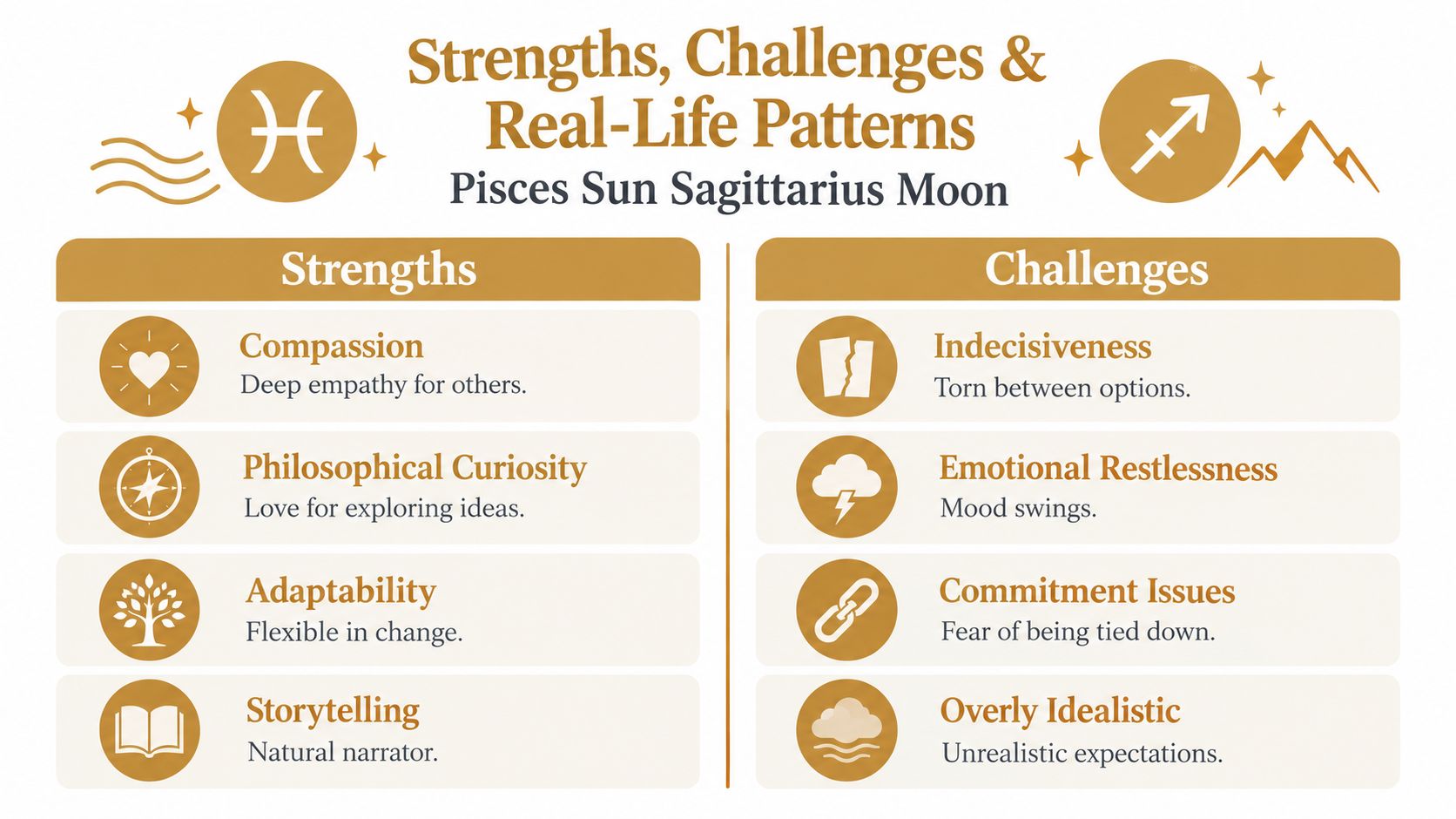
Compassion may show through a strong ability to notice what other people leave unsaid. You might listen without rushing to judge, then help someone see a larger possibility.
Philosophical curiosity can keep emotional experience from becoming a closed room. You may read, travel, study, or compare traditions because understanding gives your feelings a workable frame.
Adaptability is another possible asset. Mutable symbolism often relates to adjustment, and this combination can shift perspective when circumstances change. You may be able to work across different groups, cultures, or intellectual environments.
Storytelling can connect the two signs. Pisces supplies atmosphere and emotional texture. Sagittarius supplies a message, journey, or argument. Together, they may help you explain complicated experiences in language others can remember.
Where it can become costly
The same openness can create boundary stress. A helper may agree to another request because they understand the person's pain, then feel trapped by the commitment. A learner may keep changing subjects, jobs, or plans because every new horizon seems more meaningful than the task already underway.
In relationships, emotional restlessness can appear as a demand for both closeness and escape. At work, idealism may make ordinary administration seem beneath the larger purpose. In daily life, a person may use research, travel plans, or spiritual ideas to avoid a difficult conversation that needs a direct answer.
The important question is functional context. Recent 2026 astrology pages increasingly acknowledge anchoring problems, boundary stress, and the need for structure in this pairing, including the different ways it can behave across life stages, work cultures, and relationship settings, as discussed in this context-based Pisces and Sagittarius interpretation.
A placement becomes easier to use when you give it a job. Let empathy gather information, let curiosity test assumptions, and let structure decide what happens next.
A supportive work culture may value imagination while still defining deadlines. A healthy relationship may respect privacy without becoming vague. A mature personal routine may allow exploration without making every interest a new life plan.
Compatibility and Relationship Dynamics
Compatibility isn't a promise that two people will remain together. It's an assessment of how their needs, habits, values, and timing interact. For a Pisces Sun Sagittarius Moon person, emotional attunement and personal freedom both matter, but they don't always appear at the same moment.
The Pisces Sun may want a partner who can meet vulnerability with care. The Sagittarius Moon may need direct speech, movement, and room to process without being watched. A partner who offers only emotional intensity can feel overwhelming. A partner who offers only independence can feel unavailable.
| Condition | Supportive Pattern | Straining Pattern |
|---|---|---|
| Emotional expression | Empathy with clear language | Silence, guessing, or emotional pressure |
| Personal freedom | Space agreed openly | Disappearing without explanation |
| Beliefs and values | Curiosity and respectful disagreement | Rigid dogma or moral policing |
| Commitment | Flexible structure with dependable actions | Possessiveness or repeated vagueness |
| Conflict | Time to process followed by honest repair | Escape, over-promising, or avoidance |
The strongest fit is often someone grounded enough to keep agreements, but open enough not to treat freedom as disloyalty. A partner doesn't need to share every belief or interest. They do need to understand that space and intimacy are not automatic opposites.
In traditional matchmaking, the Moon receives serious attention because emotional temperament affects daily life. Ashtakoota is a structured comparison method, not a complete verdict. House placements, planetary dignity, the seventh house, Venus, Mars, and dasha timing can change how a sign-level observation behaves.
For two-chart work, Sambandha can be used to compare calibrated charts rather than relying on one sign pairing. This plain-language guide to marriage and love compatibility explains why sign matching alone can't carry an entire relationship assessment.
The pressure points are usually boundaries and empathy. You may need to say what you can offer, not what compassion makes you want to offer. You may also need to let a partner process privately without interpreting every pause as rejection. These are relationship skills for reflection, not professional advice or guarantees about an outcome.
How Houses Dashas and Birth Time Modify Expression
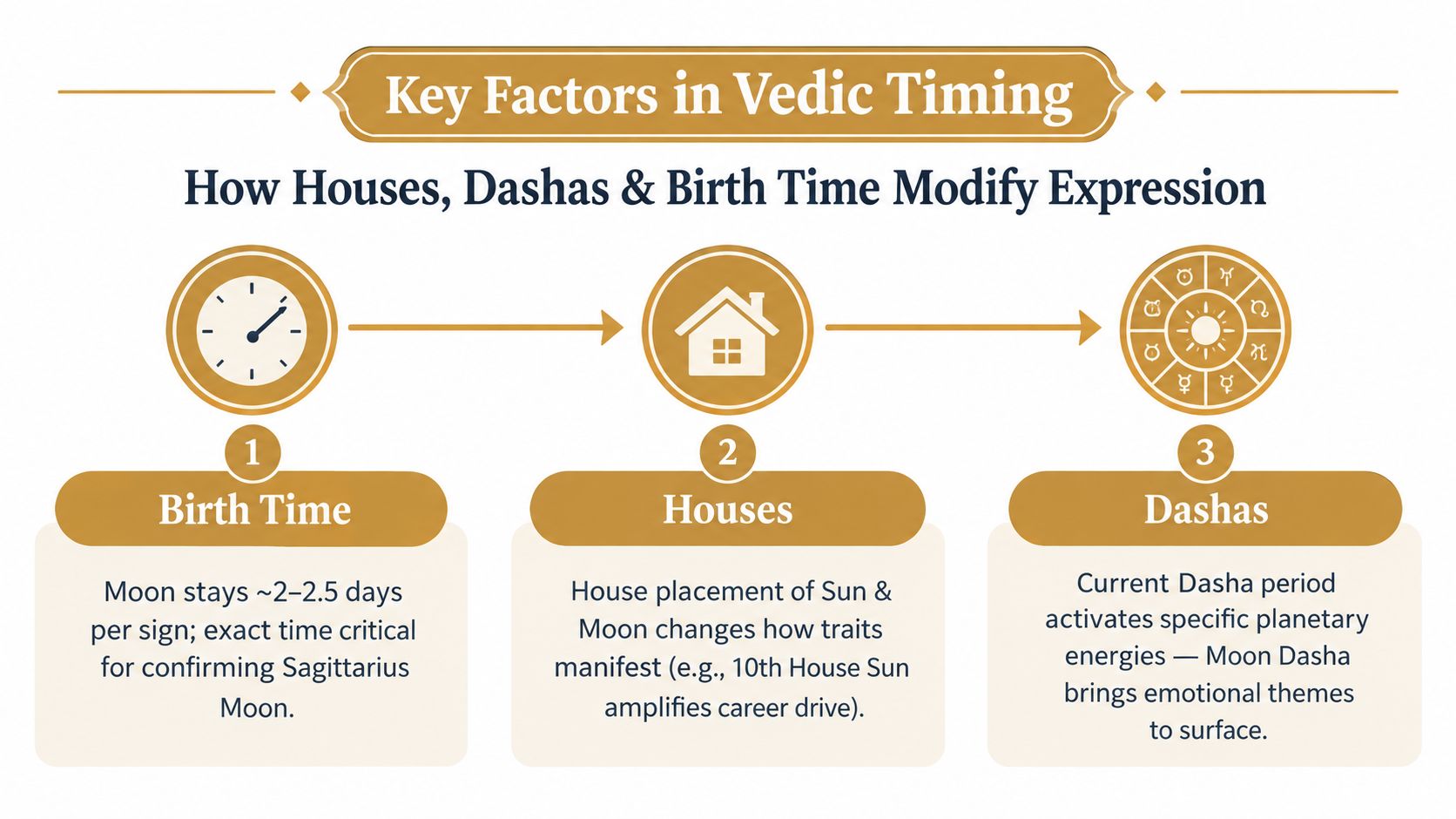
A sign combination is only one layer of a Vedic birth chart. The house placement shows where the symbolism operates. A Moon connected with learning may express its Sagittarian need through study. The same Moon connected with partnership may express it through relationships with people from different backgrounds or through a need for intellectual openness in commitment.
Birth time matters before interpretation begins. Vedic astrology sources treat the Moon as moving quickly through the zodiac, spending only about two to two and a half days in each sign, as explained in this reference on why the Moon sign and birth time matter. The exact time helps confirm the Moon's sign, degree, house, nakshatra, and the timing calculations that follow.
Three checks before making a claim
Confirm the birth data. If the time is uncertain, the Moon's position and house-based conclusions may need caution. Don't turn an approximate chart into a precise life story.
Read the houses. The Sun and Moon may influence family, education, work, partnership, travel, or spiritual practice in different ways. A house describes the life area, while the sign describes the style of expression.
Apply the dasha layer. Vimshottari dasha is a planetary timing sequence. A period connected with the Moon may bring emotional themes into focus, while a period connected with Jupiter, Mercury, Saturn, or another planet can change the practical setting in which the Sun and Moon operate.
A placement can feel quiet during one period and demanding during another. That doesn't mean the chart changed. It means the timing layer changed which parts of the chart received attention. A discussion such as Jupiter in the ninth house also shows why a planet's house context matters more than a free-floating sign description.
A careful reading follows declared compute, lived-event calibration, and conditional interpretation. First calculate the chart with a stated method. Then compare relevant past events through Pramāṇa, or life-proof. Only after that should anyone discuss possible forward patterns, and ambiguous areas should remain marked as uncertain.
Living Well With This Combination and What to Check Next
The Pisces Sun Sagittarius Moon square is not a flaw to remove. It's a skill to practise. You're learning how to protect sensitivity without becoming porous, and how to pursue meaning without abandoning ordinary responsibilities.
Use the symbolism as a reflection checklist:
- Give empathy a boundary. Before you agree to help, name the time, energy, and responsibility you can realistically provide.
- Give restlessness a channel. Study, travel, writing, teaching, or disciplined inquiry can provide movement without requiring constant disruption.
- Test ideals against facts. Ask what happened, what was promised, and what evidence is available before turning an experience into a larger conclusion.
- Build flexible structure. A routine should support curiosity, not punish it. Clear appointments, review points, and written commitments can help you keep direction.
- Watch dasha transitions carefully. If your priorities shift, record the change and compare it with the chart's timing rather than assuming every new impulse is a final answer.
The most useful interpretation remains conditional. This combination may express with greater steadiness if the houses, planetary strengths, and current dashas support containment. It may feel more unsettled when timing activates unresolved boundaries or when the birth data is too uncertain for precise judgment.
For personal reflection and self-understanding, ask three honest questions. What am I feeling before I explain it? What freedom do I need to name directly? What small, observable action would connect this insight to real life?
Anvaya generates a Samhita, a structured Vedic reading based on declared birth-chart calculations and calibrated against events you've lived through. If you want to check whether your Pisces Sun Sagittarius Moon pattern is supported by your houses and dashas, visit Anvaya and generate your Samhita.