A first-time client joins a video call with three questions written on a notepad: Is this the right time to change direction, what does the chart say about marriage, and why has the past year felt so unsettled? The astrologer asks for the birth date, exact time, and birthplace, then opens a calculated kundli. There's no instant personality summary and no copied daily horoscope.
That quiet beginning matters. A serious online jyotish consultation should first establish whether the birth data and chart timing match events you already know. Only then should it discuss current dashas, transits, relationships, work, or life transitions. This guide shows you how that process works, how to prepare, what to keep on record, and how to recognise honest uncertainty.
Table of Contents
- What a serious online jyotish consultation actually feels like
- Jyotish in plain language and why classical Parashari is different
- What a Parashari chart reading actually computes
- Chart-first calibration and why it comes before any prediction
- How to prepare for your first online jyotish consultation
- Red flags, confidence signals, and how to read the reading
- Privacy, data, and what to keep from your consultation
- Frequent questions before you book a session
What a serious online jyotish consultation actually feels like
You sit at a laptop and share your birth details. The practitioner confirms the date, time, place, and timezone, then displays a North Indian style chart through screen sharing. The first part often feels slower than expected because the astrologer isn't trying to impress you with quick predictions.
The chart comes first. The practitioner checks the ascendant, planetary placements, house themes, and running dasha periods. They may ask about a school change, a move, a family event, or a major shift in work. These questions should come from the computed chart, not from guesses based on what you said during booking.
Practical rule: A forward claim deserves more attention after the chart has explained something specific about your past.
An online consultation can happen through live video, phone, or chat. Some practitioners also provide a written report or a recording, but you should confirm this before paying. Practitioner guidance commonly places standard readings in the 45 to 90 minute range, with longer sessions used for birth-chart work and annual forecasting. One consultation format describes these common duration bands.
A methodical reading is usually calm. You'll see the chart, hear which dasha or transit supports a point, and receive clear limits around what the chart can't establish. The aim isn't certainty at any cost. It's a structured record you can revisit and compare with lived events.
Jyotish in plain language and why classical Parashari is different
Jyotish is the traditional Indian study of planetary patterns at a precise birth moment. In plain language, it uses the birth chart to examine life themes, strengths, periods of change, and possible timing. The chart depends on more than your month of birth. It requires the birth date, time, and place.
A sun-sign app uses a much smaller input. It assigns content to a sign associated with a broad solar period, then presents a general message to everyone in that group. A Parashari reading uses the lagna, or rising sign, the positions of the grahas, house relationships, planetary strength, yogas, divisional charts, and dasha periods.
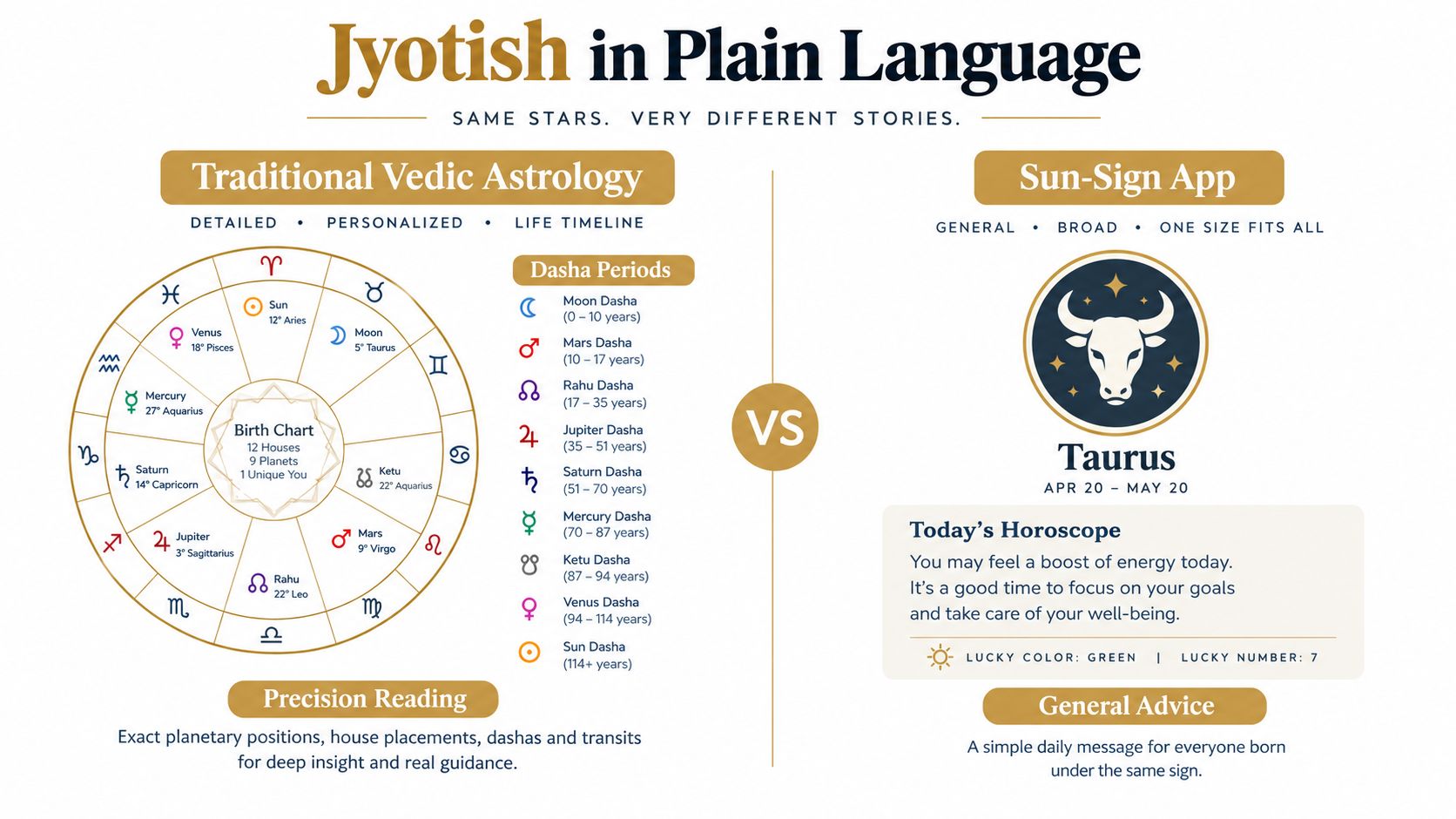
Consider a simple contrast. A sun-sign app might tell people born under Scorpio that a career change could arise in March. A Parashari reading asks which dasha lord is active, which houses relate to work, and whether a relevant transit supports movement at that time. It may still conclude that the timing is uncertain, but the reasoning is visible.
That doesn't mean every short horoscope is worthless or every technical reading is correct. The two formats use different inputs and operate at different levels of precision. A useful introduction to the difference between generic and chart-based approaches is available in this guide to AI astrology reading.
What a Parashari chart reading actually computes
A structured Parashari reading begins with the birth chart, the lagna, and the positions of the nine grahas used in the tradition. The chart shows the starting arrangement. It doesn't answer every question by itself, so the astrologer adds several layers.
The shodashvarga means sixteen divisional charts. Each division gives a more focused view of a life area. For example, the D9 is commonly used in marriage analysis, the D10 in career analysis, and the D4 in property-related questions. Traditions differ in how much weight they give each division, so a careful reading should name the method rather than treat every chart as equally decisive.
The dasha ladder sequences planetary periods. A Jupiter Mahadasha, or a Saturn Antardasha within a larger period, becomes a timing framework. This is the layer that asks when a theme is more likely to become active.
Transits, known as gochara, show the current movement of planets over the natal chart. Slow-moving Jupiter, Saturn, and Rahu-Ketu often receive particular attention because their movement can alter the context of an already active dasha. Yogas are combinations of planetary placements that may support particular results. This is the layer that asks what kind of result the chart can support.
| Layer | What it covers | Plain-English gloss |
|---|---|---|
| Birth chart and lagna | Core planetary positions and house structure | What is present in the chart |
| Divisional charts | Focused views such as marriage, work, or property | Which life area needs closer inspection |
| Dasha ladders | Major and sub-periods | When a theme may become active |
| Transits | Current planetary movement | What is changing around the natal chart |
| Yogas and strengths | Combinations and relative planetary capacity | How strongly a result is supported |
A full compute can also include ayanamsha, Shadbala, Ashtakavarga, Varshaphala, and Jaimini methods. These are not decorations. They are separate calculations that should be declared, stored, and explained in plain language.
Chart-first calibration and why it comes before any prediction
The astrologer has calculated the chart. Instead of opening with a forecast, they ask whether its timing matches your life.
“Was there a clear change in schooling during childhood?”
“Did your family relocate during a period shown by the chart?”
“Did a parent experience a major health event during the relevant Mars period?”
The point isn't to collect colourful stories. Each question should connect to a dasha, transit, house activation, or yoga already visible in the chart. You answer with dates or narrow time windows where possible. “Some time in my twenties” gives less help than a documented year and a description of what changed.
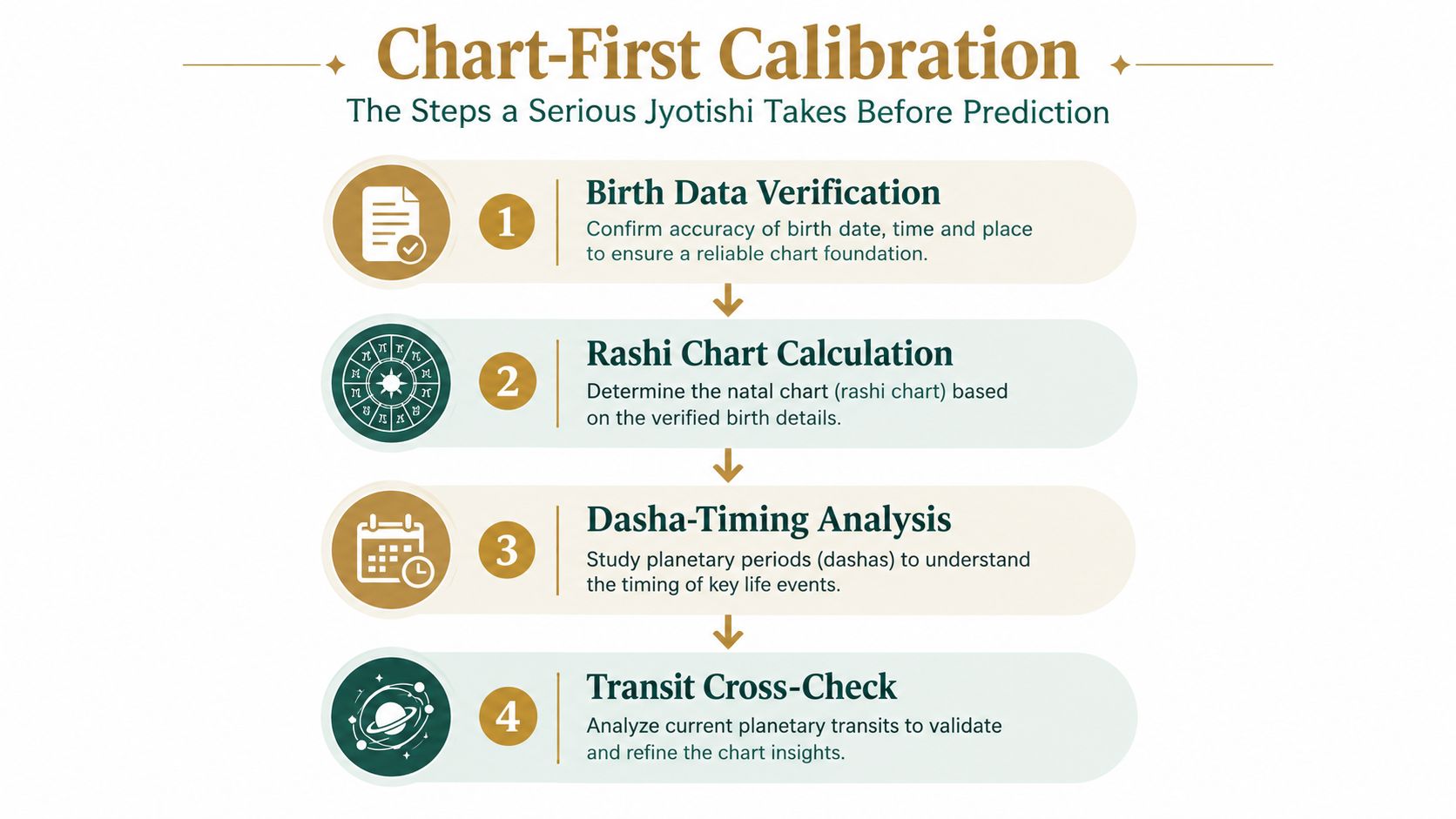
If several important events fail to match, the practitioner should pause. The problem may be an incorrect birth time, timezone conversion, birthplace, or ayanamsha selection. It may also be an interpretive error. A responsible reading doesn't hide that problem behind more confident language. Anvaya's published calibration approach treats past-event checking as a separate stage before forward interpretation.
A prediction made before the chart explains anything verifiable about your past is an untested claim.
Calibration doesn't prove that every future event will happen. It does improve the question being asked. You move from “Tell me what will happen” to “Which chart factors support this possibility, and how well did the same factors describe earlier events?” That is a more honest standard for an online reading.
How to prepare for your first online jyotish consultation
Preparation starts with birth data, not with a long list of worries. Find the most reliable record available, such as a birth certificate or hospital record. Confirm the date, time to the minute if possible, birthplace, and the timezone rules that applied on that date.
If the time is uncertain, say so before the chart is calculated. Don't turn an estimate into a false fact. A chart built on guesswork may produce timing that looks precise but doesn't survive calibration.
Bring a short paper trail of events you can verify:
- Schooling changes: Note major transitions and the year they occurred.
- Relocations: Record moves between cities or countries.
- Work changes: List significant starts, endings, breaks, or changes in role.
- Family events: Include marriages, deaths, and serious illnesses when relevant to your question.
- Current questions: Rank your questions, because a session has limited time.
Online astrology sessions are often structured around 45 to 90 minutes, so a focused list helps you use the appointment well. A practitioner's consultation outline also highlights exact birth data and follow-up formats as central parts of a reliable workflow.
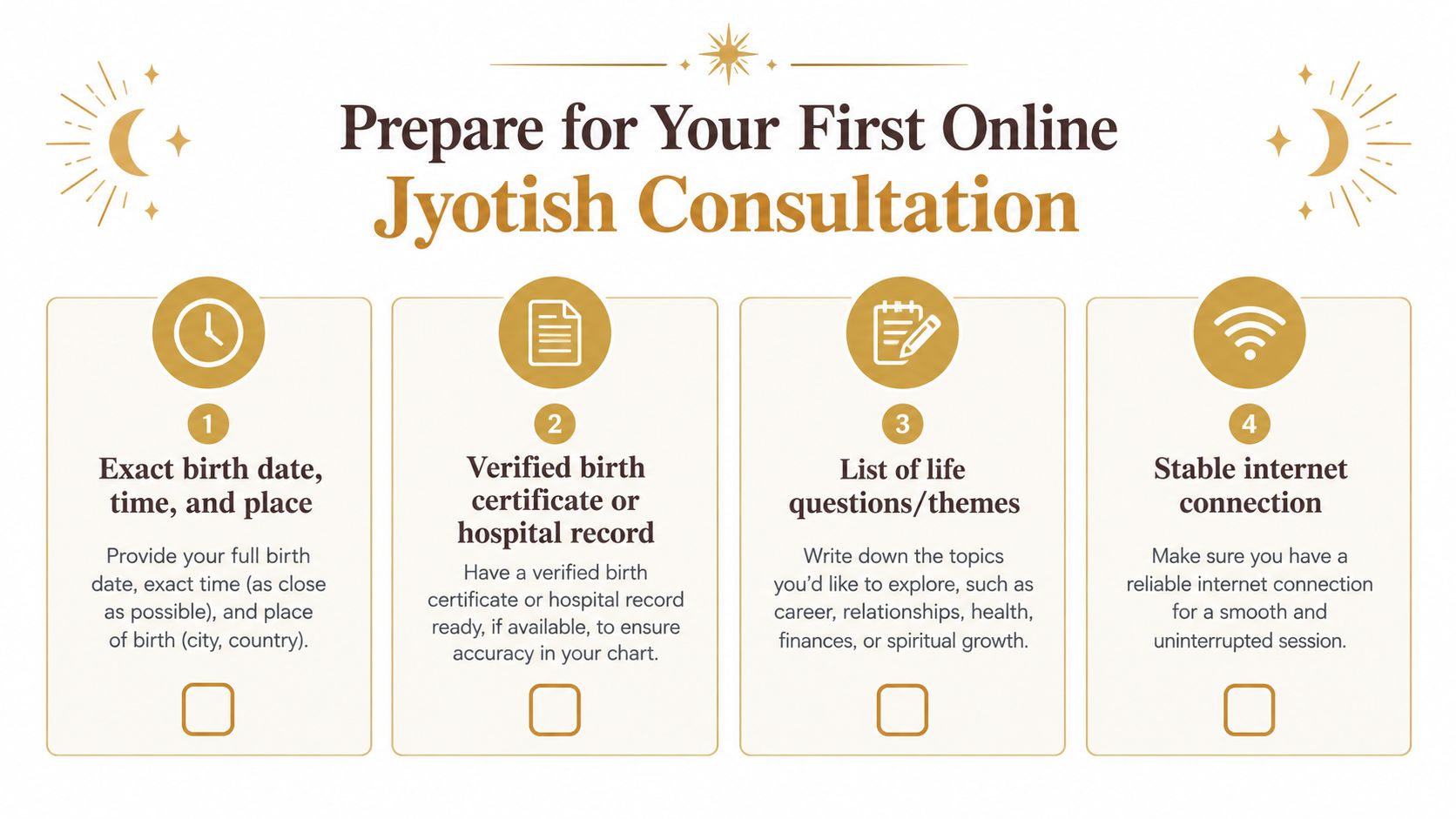
Don't book an expensive package, course, or chain of follow-ups before the first session demonstrates that the astrologer can read your chart. Choose a quiet room, stable internet, and a working camera. If the practitioner shares chart annotations on screen, save the relevant files immediately after the call.
Red flags, confidence signals, and how to read the reading
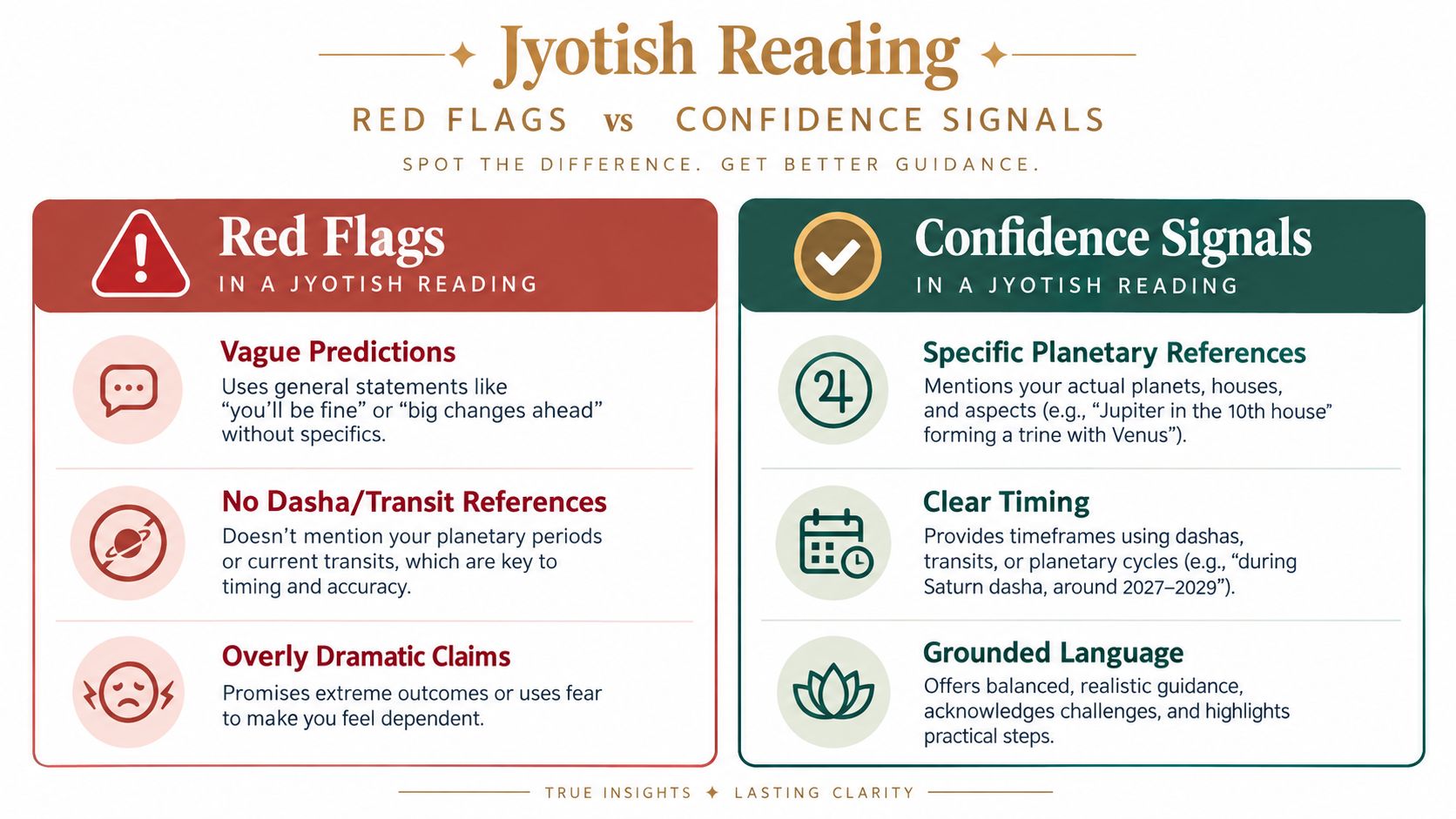
Evaluate the consultation like a buyer, not like a believer hoping to be reassured. A calibrated reading names the dasha, transit, yoga, or house logic behind a statement. It uses approximate timing where appropriate and distinguishes chart evidence from interpretation.
A flattering reading often avoids all of that. It gives broad praise, makes dramatic claims, or turns your own answers into evidence that the astrologer was right. The following comparison can help:
| Red flags | Confidence signals |
|---|---|
| Predictions have no chart reference | The practitioner names the relevant dasha or transit |
| The computed kundli isn't shared | You can see the chart and understand its main inputs |
| You face pressure to buy a package immediately | Follow-up is offered without urgency |
| Guaranteed remedies or outcomes are promised | Uncertainty is stated plainly |
| Curses, black magic, or sudden clearing fees appear | The reading stays within chart interpretation |
| Past events are never checked | Specific past windows are tested first |
A written summary is useful because it creates a record. So is a clear statement of what the chart can't determine. A practitioner who welcomes correction about a date is giving you a better basis for trust than one who treats every challenge as resistance.
Keep the reading as one perspective among several. It can support reflection and self-understanding, not professional advice from a doctor, lawyer, therapist, or financial adviser. Revisit the dated claims later and ask what matched, what remained ambiguous, and whether the original confidence was justified.
Privacy, data, and what to keep from your consultation
Birth details deserve careful handling. Your date, time, and birthplace can identify you when combined with other information, so share only what the calculation requires. Usually that means the birth date, exact time, birthplace city, and the questions you want to examine.
Don't send your full address, identity document numbers, or unrelated family information unless there's a clear reason. Use a secure form or protected email where available. Avoid putting a complete birth record in a public chat or an unsecured group.
A reasonable privacy policy should explain:
- Purpose: Why the service collects each birth and relationship detail.
- Retention: How long the chart, notes, and recordings remain stored.
- Deletion: How you can request erasure when the purpose has ended.
- Recording: Whether calls are recorded and who can access them.
- Reuse: Whether readings may be used for marketing, training, or case studies.
India currently has no dedicated legislation or guidelines specifically regulating online astrology platforms, so broader consumer, information technology, and data-protection duties matter. The Digital Personal Data Protection Act, 2023 requires clear consent and reasonable safeguards for personal data, with deletion when the purpose is served unless a longer period is legally required. This privacy discussion covers birth data and consent obligations.
Keep the computed chart, written summary, payment receipt, and recording only if you consented to it. Add a dated log of forward claims so you can check them later. A public platform privacy policy may specify a limited recording window, such as 90 days, rather than indefinite storage. One astrology platform's privacy policy gives an example of this kind of retention disclosure. You can also review Anvaya's privacy information before sharing personal data.
Frequent questions before you book a session
How long should an online jyotish consultation take?
A general reading commonly falls within the 45 to 90 minute range, while a focused birth-chart session or annual forecast may need more time. Duration alone doesn't prove quality. A shorter session can be useful for one defined question, but a broad life reading needs enough time for the chart, dasha timing, questions, and calibration.
How should you compare cost?
Compare what the fee includes, not just the hourly rate. Ask whether the practitioner computes divisional charts, reviews dasha and transit timing, provides a written summary, and allows questions after the session. A clear scope is more useful than a low price attached to vague promises.
How can you verify that the consultation worked?
Before any future claim, the practitioner should identify specific past events or periods implied by the chart. The chart should also be reproducible from the birth information you provided, with the chosen compute method stated clearly. If the reading depends only on details you volunteered during conversation, it hasn't shown chart-first calibration.
What should you do after the reading?
Treat the output as a working document. Keep the chart and dated notes, revisit the stated windows, and record what matched or remained unclear. If a major dasha change raises new questions, a focused follow-up may be more useful than repeating the entire reading. Don't make irreversible decisions about health, law, money, employment, or safety from one astrology session. Seek the appropriate qualified professional for those matters.
Anvaya generates a persistent Samhita from your birth data, uses Pramāṇa to check chart-derived signals against lived events, and preserves the reading for later review. Visit Anvaya to see how a chart-first online jyotish consultation can keep its calculations, claims, and uncertainty in one record.