
Some people reduce Moon in the 5th house to a neat label, creative, romantic, good with children. That sounds reassuring, but it's incomplete. In practice, this placement can describe joy and tenderness, yes, but it can also describe mood-led choices, attachment patterns, and short-lived emotional spikes that people mistake for a permanent trait.
A serious reading starts with the chart, not the compliment. At Anvaya, we treat any house placement as a question of math, timing, and context, then we check that reading against lived events through Pramāṇa before making forward claims. If you want a family-focused example of how chart themes are organized, see Anvaya's family astrology reading path.
Table of Contents
- Why Moon in the 5th House Is More Than a Creative Label
- The Classical Vedic View of the Fifth House
- How Dignity and Jupiter Shape the Real Outcome
- Natal Placement Versus Monthly Transits and Dasha Windows
- When the Placement Supports You and When It Becomes a Risk
- Practical Reflection and Remedial Considerations
- Frequently Asked Questions About Moon in the 5th House
Why Moon in the 5th House Is More Than a Creative Label
The internet likes tidy astrology labels. Moon in the 5th house is often described as warm, artistic, and emotionally generous. That can fit, but it can also hide a more unsettled pattern, where the Moon is reactive, selective, or only strongly felt during certain periods.
The 5th house is not a personality sticker. In classical Vedic work, it has to be read with the Moon's condition, the house lord, and the dasha context. Two charts can share the same placement and still produce very different results, because one Moon may be supported and another may be strained.
Practical rule: read the Moon in the 5th as a pattern, not a promise.
Timing matters too. A Moon transit through the 5th house is a brief activation, like a light passing over a room. A natal Moon in the 5th is part of the chart's structure and can shape how a person processes joy, attention, and emotional risk over time. Serious reading starts by separating those two levels, especially if you are judging creative work, family matters, or romance.
That separation also helps explain the speculative downsides that popular content skips. A Moon in the 5th can show mood-led choices, over-attachment to approval, or emotional swings around children and pleasure. Anvaya's method starts with declared compute, then calibration, then plain-language interpretation, which is why we begin with chart support instead of compliments. For a broader method comparison, this note on Vedic and Western astrology helps frame how the two systems read houses differently.
The Classical Vedic View of the Fifth House
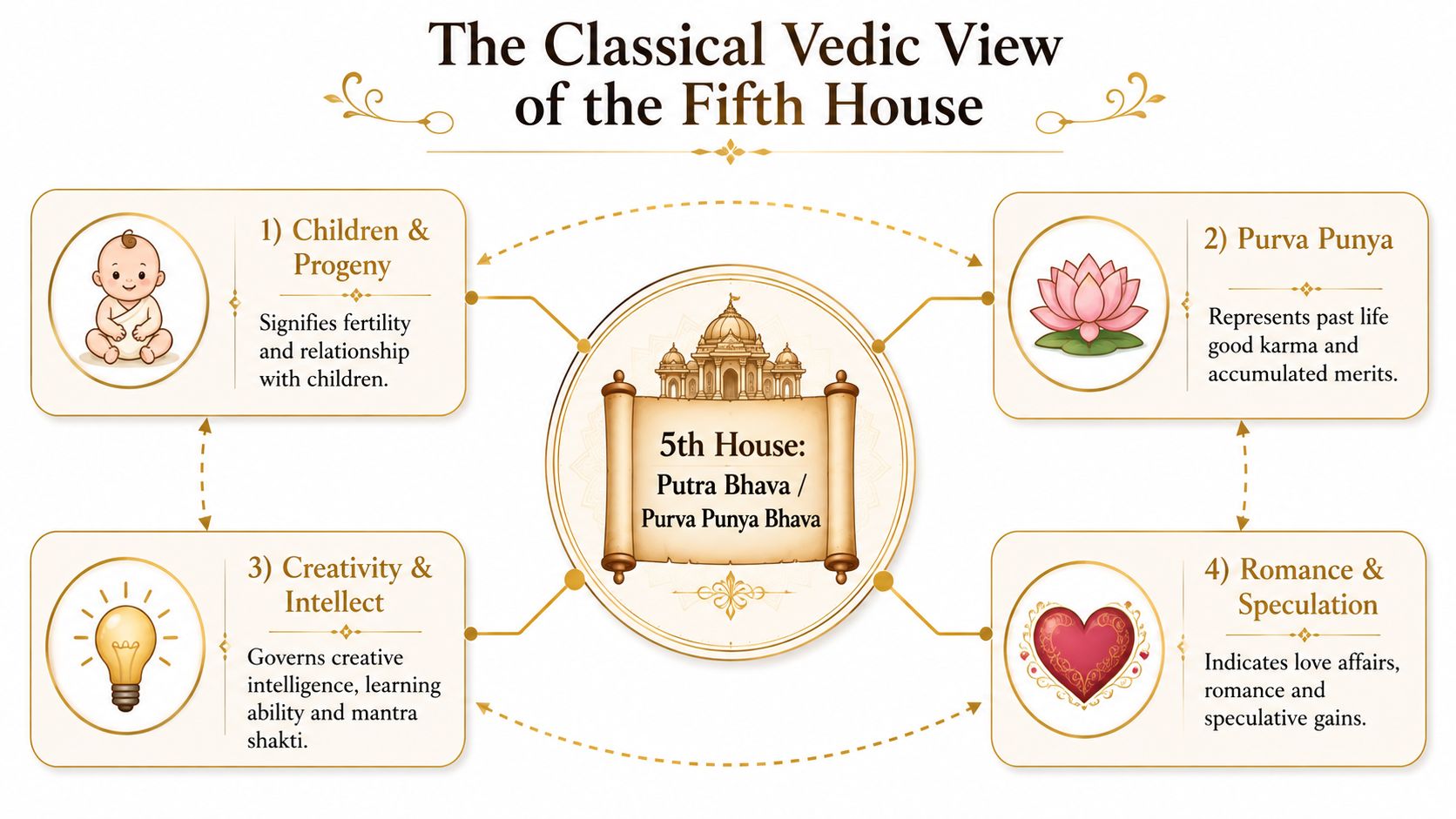
The 5th house is traditionally called Putra Bhava and Purva Punya Bhava. In plain language, it points to children, learning, intelligence, mantra, creativity, romance, and past-life merit. It is a trikona house, a dharma house, so classical reading gives it a different weight from houses tied to strain or loss.
That matters because the Moon changes how those themes are felt. The Moon is the mind, the emotional receiver, the part of the chart that notices, absorbs, and responds. In the 5th house, it turns attention toward learning, pattern recognition, and creative expression that carries feeling rather than detachment.
What the house does
The 5th house is not just “art.” It is the place where a person may make, nurture, teach, or risk. That can include children, but it also covers anything that grows from personal inspiration. In classical language, it is one of the houses where life force becomes visible.
A practical reading stays grounded in chart function. A Moon here can make the mind receptive to 5th-house matters, but it does not act in isolation. The house carries dharma, memory, and the logic of the whole chart.
That is why Vedic house doctrine is not the same as a loose symbolic reading. Anvaya's foundation page on Vedic vs Western astrology is useful here because it shows how the classical method starts with house function first, then interpretation.
How Dignity and Jupiter Shape the Real Outcome
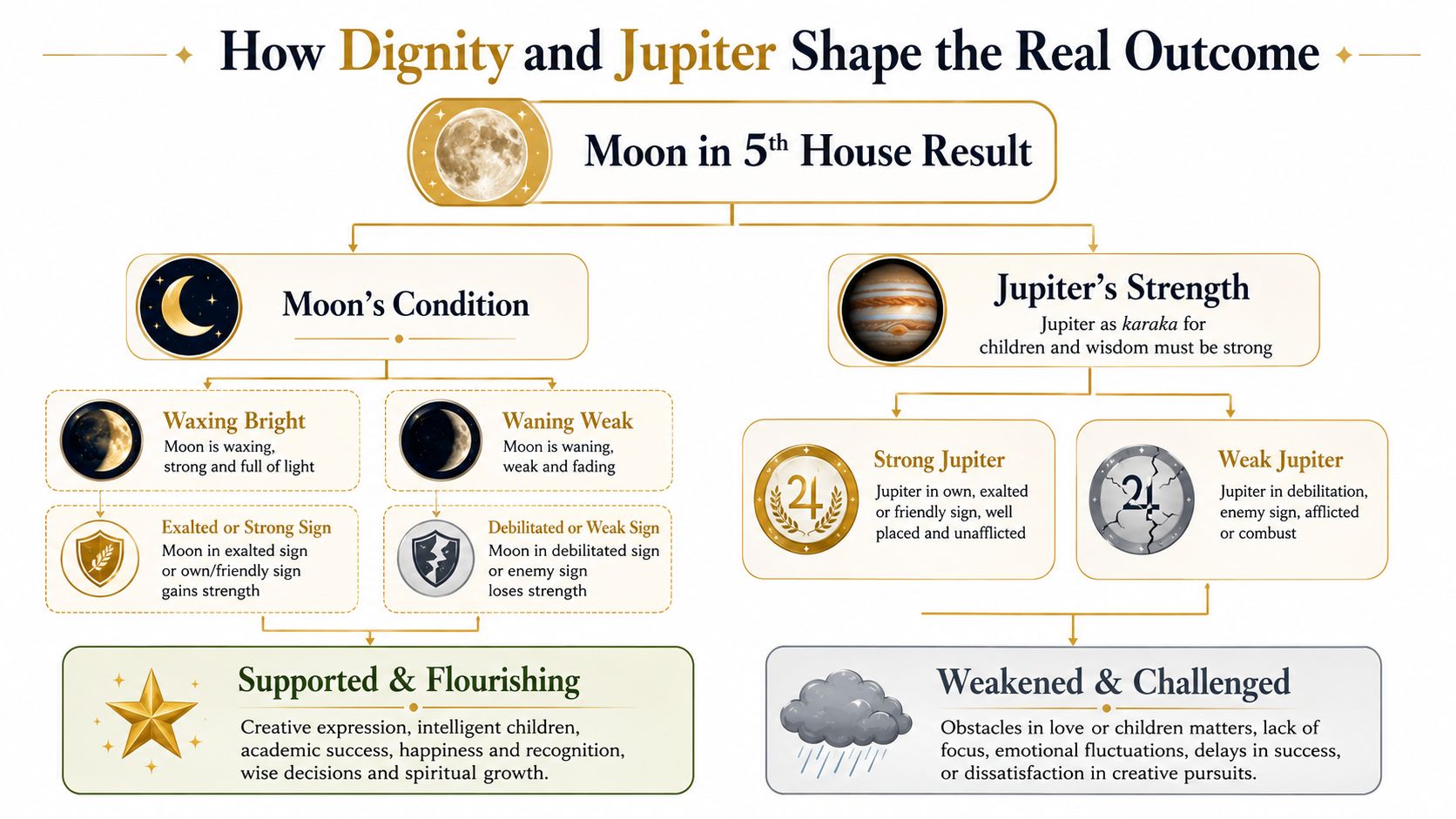
Two charts can both say Moon in the 5th house, and still behave very differently. The first question is the Moon's condition. A waxing Moon is usually read as more receptive and bright, while a waning Moon tends to be more withdrawn or reduced in expression. Sign dignity matters too, because a Moon that's well placed in sign can express the 5th house more cleanly than a Moon that's under strain.
Moon and Jupiter do not work alone
Jupiter matters because it is the karaka for progeny and wisdom in this context. If Jupiter is strong, the 5th house often has more support for its natural themes, but if Jupiter is weak or disturbed, the placement can feel less stable. Classical Vedic framing says the outcome depends heavily on the full chart context, not on Moon alone.
That's the part popular content usually skips. It says “creative,” “fertile,” or “romantic” without asking whether the chart supports those themes in a balanced way. A supported Moon can show easy mental receptivity, pattern recognition, and a more settled relation to children or creative work. A weaker Moon can still show the same themes, but with more fluctuation.
A strong placement is not the same as a guaranteed outcome. It means the chart gives that theme more room to operate.
So if you're reading your own chart, don't stop at the house placement. Ask whether the Moon is waxing or waning, whether the sign is supportive, and whether Jupiter is helping the 5th house do its job. That is the difference between poetic astrology and chart-based reading.
Natal Placement Versus Monthly Transits and Dasha Windows
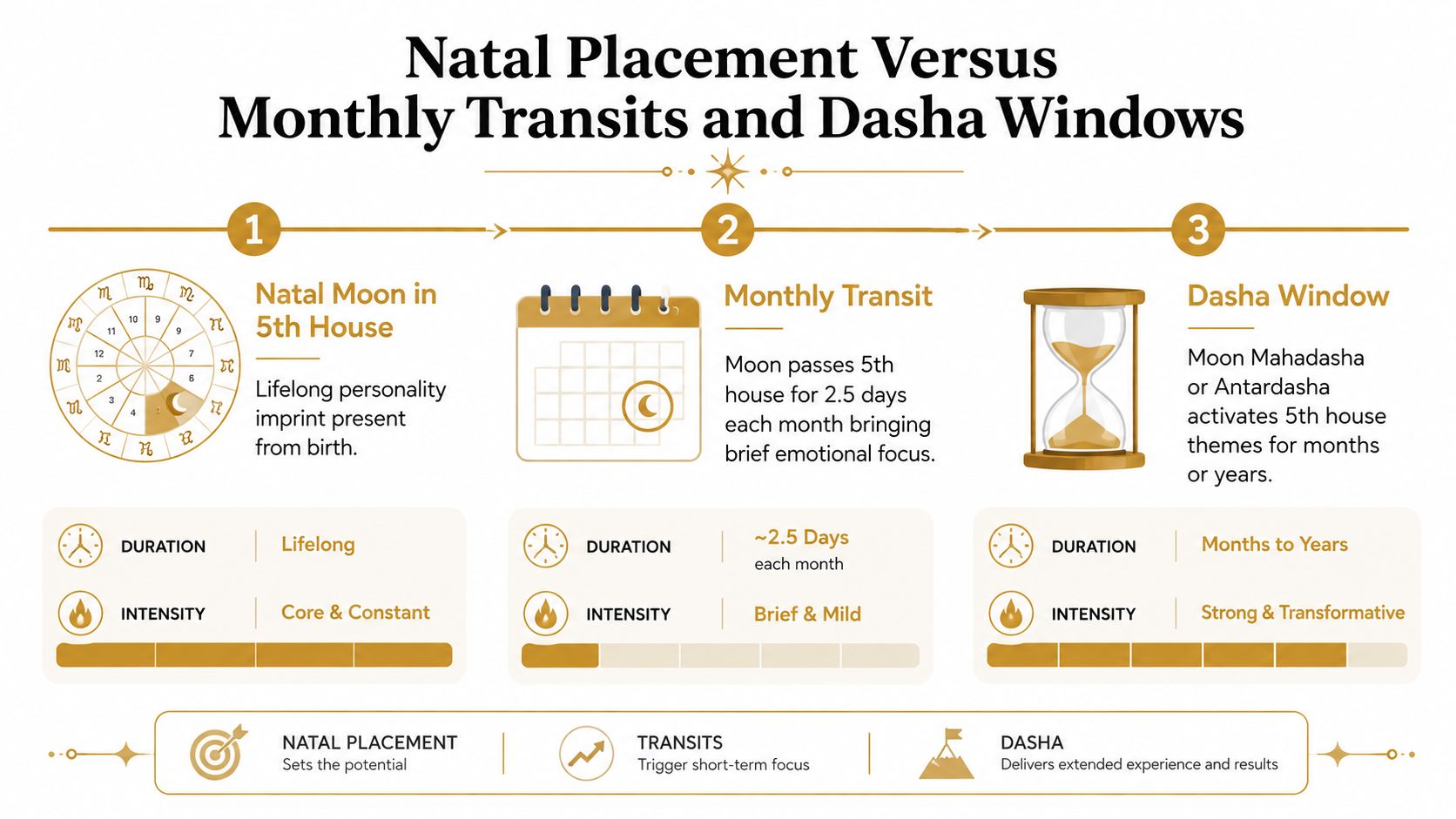
A lot of astrology writing mixes three different timing layers into one. A birth placement, a monthly transit, and a dasha period do not act the same way. A natal Moon in the 5th house describes a lasting pattern. A transiting Moon is brief and changes the mood of the house for a short stretch. A dasha window is longer, so the same 5th-house themes can stay active in the background for much longer.
That distinction matters because the Moon moves fast. It completes one sidereal circuit in about 27 days and is reported to spend a little over two days in each house, so the 5th house becomes a temporary transit zone about 40 times across a three-year span such as 2026–2028 (LivePanditji).
Three different clocks
A natal Moon in the 5th house shapes how a person repeatedly meets 5th-house topics, such as creativity, affection, and children. A transiting Moon in the 5th house is more like a passing weather pattern. It can lift the mood, prompt play, or bring a quick emotional focus, then move on.
A dasha window works on a different scale. Traditional timing systems extend the activation, so 5th-house matters can rise for months or years depending on the planet running. That is why a chart can feel quiet for a while, then bring the same themes to the front with more force.
A transit can show the moment, but a dasha shows whether the topic has staying power.
For timing a conversation, a launch, or a family decision, the transit tells you when to act, while the dasha shows whether the matter has enough weight to deserve sustained attention. For readers who want a practical timing filter, Anvaya's timing guidance uses a similar idea, because activation windows are not the same as birth promise.
When the Placement Supports You and When It Becomes a Risk
A woman with Moon in the 5th house may find that she writes best when she feels emotionally held. Another person with the same placement may become more speculative when stressed, trusting a bad suggestion because it feels emotionally urgent. The chart does not moralize. It describes patterns, and the pattern changes with support, affliction, and timing.
Supportive expression
When the Moon is well supported, this placement can show a natural bond with children, a quick sense for mood in creative work, and a mind that learns through feeling. People often notice that their best ideas arrive when the emotional environment is calm. In those charts, the 5th house acts like a clear channel.
Riskier expression
The same placement can go sideways when the chart is under strain. Some references note over-trusting bad advice, clinging to unsafe relationships, or becoming overly controlling with children. That doesn't mean the placement causes those outcomes by itself. It means emotional investment in 5th-house matters can become too reactive when the Moon is weak or the broader chart is under pressure.
Here's the practical distinction.
- Creative ease: ideas arrive, but the person can still test them.
- Mood-driven speculation: the feeling itself becomes the reason to act.
- Tender parenting: care is present, but it leaves room for the child's autonomy.
- Over-control: concern turns into monitoring, correction, or anxiety.
The same person can move between these states across different dashas or transit periods. That is why chart-first reading matters. It helps you notice whether the placement is asking for expression, discipline, or patience, instead of assuming that every strong feeling is a signal to move.
Practical Reflection and Remedial Considerations
Use this placement as a prompt, not a verdict. If the Moon is crossing your 5th house by transit, that can be a good time for writing, study, creative rehearsal, or an honest conversation with a partner or child. If a longer dasha is activating the same house, you may need more emotional discipline and less impulsive decision-making.
A grounded checklist
- Notice the Moon's condition: Is the chart showing support, or is the Moon under strain?
- Check Jupiter: Is wisdom, guidance, and proportion available, or is the 5th house overstimulated?
- Watch the timing layer: Is this a two-day transit, or a longer activation window?
- Choose one deliberate act: write, practice, teach, or reflect, rather than scattering energy.
Classical remedial themes for the 5th house often include mantra, education, and careful engagement with children. Use those as reflection practices, not as promises. Astrology is for personal reflection and self-understanding, not professional advice, and it shouldn't replace medical, legal, or financial guidance when those are the central issues.
If you want a simple habit, keep a note of what happens each time the Moon activates your 5th house. Over time, that record tells you more than a generic prediction ever will.
Frequently Asked Questions About Moon in the 5th House
Does Moon in the 5th house guarantee children? No. The 5th house is linked with children in traditional Vedic astrology, but the result depends on the whole chart, especially the Moon's condition, Jupiter, and the timing system.
How long does the transit last? The Moon moves through each house for a little over two days, and completes a sidereal circuit in about 27 days, as noted earlier.
Is this the same as Western sun-sign astrology? No. Classical Vedic reading is based on the full chart and the house system, not on the Sun sign alone.
What should I look for in a serious reading? Clear chart calculation, stated limits on confidence, and a check against real events before any prediction is treated as reliable.
Can the placement be risky? Yes. If the Moon is under strain, or if the wider chart is unsettled, the same placement can tilt toward mood-led choices instead of stable creative expression.
A useful rule is to separate natal promise from timing. A birth placement describes a baseline pattern, while transits and dashas show when that pattern is louder or quieter. Without that distinction, people often mistake a passing Moon activation for a permanent trait.