

You're in a meeting, explaining an idea you've spent days refining. The room doesn't remember every detail of your analysis. It remembers whether you made the problem clear, answered objections, and gave people a reason to trust your judgment. Later, during a career change, the same pattern appears in interviews, proposals, teaching, writing, and negotiations.
This is the lived question behind Mercury in the tenth house. It isn't “Will you be a good speaker?” The more useful question is whether your professional life repeatedly turns on information, language, analysis, and the credibility of your thinking. In Vedic astrology, the answer depends on the condition of Mercury, its relationships with other planets, and the dasha operating at the time.
Table of Contents
- Why Mercury in the Tenth House Matters for Your Career
- The Classical Foundation of the Tenth House and Mercury
- How Dignity and Sign Placement Change the Outcome
- When Mercury in the Tenth House Signals Career Restlessness
- Timing Your Career Moves with Dasha Context
- How to Verify This Placement Against Your Lived Experience
- Common Questions About Mercury in the Tenth House
Why Mercury in the Tenth House Matters for Your Career
A person with Mercury in the tenth house may become known for explaining difficult subjects, finding patterns, asking precise questions, or connecting people and information. That can appear in a classroom, a newsroom, a consulting room, a business, a research team, or a public-facing leadership role. The job title may change, but the professional signature often involves making knowledge useful to other people.
The tenth house is the visible part of the chart concerned with career, status, authority, and public contribution. Mercury signifies intellect, speech, learning, commerce, calculation, and analysis. When these two factors meet, the mind doesn't remain a private resource. It becomes part of how others evaluate your work.
A technical summary of this placement associates it with public visibility of intellect, including writing, teaching, media, consulting, and public speaking, because Mercury's domains are expressed through the tenth house's career and reputation themes (Mercury in the tenth house and public work).
You might notice this pattern when:
Your explanations create opportunities: A clear presentation, article, lesson, or recommendation brings professional recognition.
Your reputation follows your words: Colleagues remember how accurately and responsibly you communicate.
Your work keeps moving toward information: Even after a role change, research, writing, analysis, teaching, or advising remains central.
Your career develops through variety: You may combine several skills rather than follow one narrow occupational ladder.
That last point matters. Mercury is adaptable. A strong Mercury can support intelligent career pivots, but a poorly supported Mercury can produce scattered effort, rushed speech, or an unstable public image. The placement alone doesn't decide which one you'll experience.
For a broader look at how a chart can describe professional development, see this guide to how career themes are built in astrology. The tenth house gives the public arena. The rest of the chart tells you how Mercury behaves there.
The Classical Foundation of the Tenth House and Mercury
Start with the house before interpreting the planet.
In classical Vedic astrology, the tenth house is Karma Bhava, the house of action and visible work. It signifies profession, reputation, authority, public status, and worldly achievement. It's also a kendra, meaning an angular house with a prominent place in the chart, and an upachaya, a house whose results can develop through time, practice, and effort (classical-style definitions of the tenth house).
The historical logic is older than modern career language. A history of astrological house systems explains that early astrologers often treated the Midheaven as the whole tenth house. Greek descriptions connected the tenth with the idea of action, while the Midheaven became integrated into horoscopes after the 2nd century CE (history of the astrological house systems).
Now add Mercury. Mercury, or Budha, is commonly treated as the significator of:
Intellect: How you process and organise information.
Speech and writing: How you communicate ideas.
Learning: How you acquire and transmit knowledge.
Mathematics and calculation: How you handle structure, numbers, and detail.
Business and commerce: How you exchange information, negotiate, and connect buyers or participants.
Analysis: How you break a problem into workable parts.
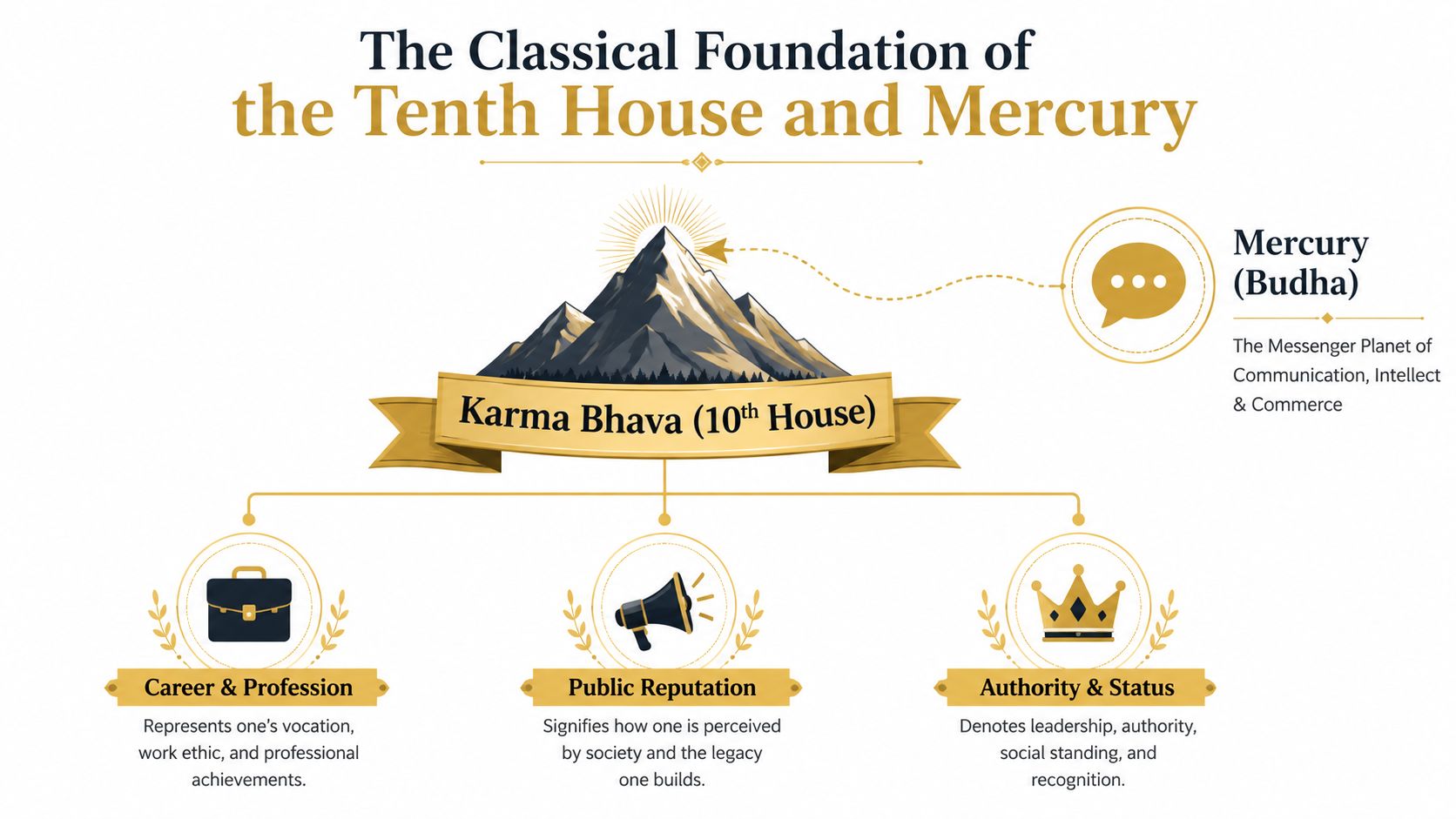
The combination is straightforward. The tenth house shows where your work becomes visible. Mercury shows the mental and communicative tools you bring to that visibility. This is why traditional interpretations connect Mercury in the tenth with learnedness, successful undertakings, calculative skill, and public intelligence.
Classical summaries preserve this theme. Saravali describes “distinguished intelligence” and “fruition in undertakings.” Phala Deepika describes the person as learned, wise, virtuous, and successful in ventures (classical summaries of Mercury in the tenth house). These descriptions aren't a promise of status. They explain the interpretive foundation for linking Mercury here with visible expertise and professional accomplishment.
How Dignity and Sign Placement Change the Outcome
Mercury in the tenth house is an important starting point, not a complete judgement.
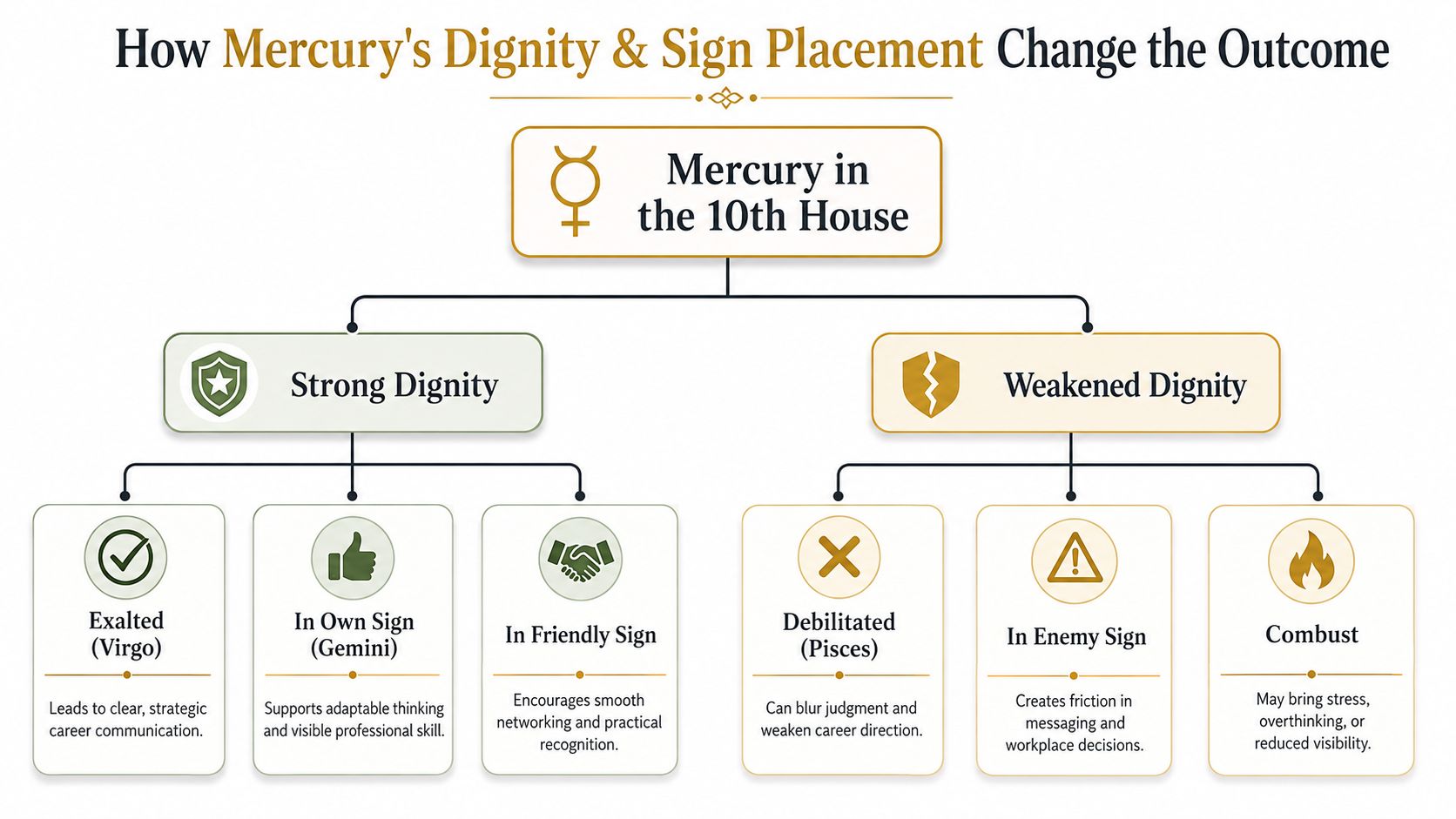
The first question is dignity. In Vedic astrology, dignity describes how well a planet can operate through its sign. Mercury in its own sign or exaltation is generally given more functional support than Mercury in a weakened condition. A neutral sign produces a different result again. These distinctions matter because the same house placement can express as careful expertise in one chart and unreliable messaging in another.
The second question concerns planetary associations. Aspects and conjunctions modify Mercury's expression. A constructive relationship with Jupiter is traditionally associated with learning, reputation, and scholarly or ritual activity. Adverse associations can distort judgement, conduct, or communication. A source discussing Mercury's directional strength also stresses that the result depends on dignity, aspects, and dasha, rather than on the house alone (Mercury's strength and associations in the tenth house).
Mercury has partial digbala, or directional strength, in the tenth house in some Vedic frameworks. That means the house can give Mercury a suitable public direction, but it doesn't erase weakness elsewhere in the chart.
Practical rule: Don't ask only, “Is Mercury in my tenth house?” Ask, “What condition is Mercury in, and which planets are shaping its expression?”
A useful reading separates potential from outcome:
| Chart factor | More constructive expression | More difficult expression |
|---|---|---|
| Mercury in a strong dignity | Clear analysis, learning, strategic communication | Confidence may still become excessive if other factors support overreach |
| Mercury linked with Jupiter | Teaching, scholarship, sound judgement | Broad claims may exceed practical delivery if judgement is not otherwise supported |
| Mercury under adverse association | Pressure to manage words and credibility carefully | Miscommunication, distorted conduct, or professional confusion |
| Mercury supported by its dasha | Communication-led work receives timely emphasis | A weak Mercury period may expose unresolved communication problems |
The chart doesn't confirm a specific profession from this placement alone. It indicates that Mercury's condition deserves close attention when you assess career direction, visibility, and professional trust.
When Mercury in the Tenth House Signals Career Restlessness
Some interpretations treat Mercury in the tenth as a clean promise of writing, media, teaching, or business success. That reading is too narrow. Mercury can also describe movement, experimentation, and a career assembled from several roles.
One independent interpretation explicitly links this placement with a restless career and more role changes than peers (Mercury and occupational restlessness). The point isn't that every person with Mercury here will change jobs repeatedly. The point is that Mercury's flexibility can seek new problems once an old role becomes repetitive.
That movement can be healthy or disruptive.
Strategic pivots
A strong Mercury may change direction because it recognises a better use for its skills. You might move from teaching to consulting, from writing to product strategy, or from analysis to business ownership. The surface role changes, but the underlying work still involves information, language, judgement, or exchange.
Favourable dignity and supportive timing can make these transitions deliberate. Your professional identity may become broader without becoming incoherent.
Reputation risk
A weaker Mercury can produce a different pattern. Frequent changes may come from unfinished work, inconsistent messaging, or difficulty deciding which professional identity to maintain. Classical-leaning interpretations acknowledge that Mercury alone or in poor condition can correlate with frequent job changes, while other traditional discussions describe its tenth-house strength as dependent on dignity, aspects, and dasha (mixed outcomes for Mercury in the tenth house).
Public communication adds another layer. A careless promise, inaccurate statement, or poorly timed response can travel further than intended. In communication-heavy work, credibility depends not only on intelligence but also on accuracy, restraint, and consistency.
Use your actual history as a test. If every pivot increased responsibility and clarified your skill set, Mercury may be expressing adaptability. If each move followed confusion, conflict, or overpromising, the chart calls for more careful judgement before the next public step. You can also reflect on how to know when it's time to leave your job, without treating astrology as a substitute for practical employment advice.
Timing Your Career Moves with Dasha Context
A birth-chart placement describes a standing capacity. Dasha shows when particular planetary themes become active. For Mercury in the tenth house, that distinction prevents a common mistake: assuming that a communication-centred career pattern must operate with the same intensity throughout life.
Vimshottari dasha divides life into planetary periods. When Mercury's major period or sub-period operates, Mercury's house placement, dignity, rulership, associations, and broader chart context become more relevant. If Mercury is well supported, that period may coincide with greater emphasis on writing, teaching, analysis, commerce, advisory work, or public communication. It can be a useful window for presenting ideas or developing a role where your thinking is visible.
If Mercury is weak or adversely associated, the same period may require discipline. Miscommunication, verbal overreach, scattered commitments, or reputational strain may become more noticeable. This isn't a guaranteed event. It's a reason to review language, documentation, promises, and professional boundaries before acting.
A practical timing review asks four questions:
What is the running dasha? Is Mercury active as the major period or sub-period, or is another planet directing the period?
What does Mercury control? Its house rulerships and sign placement alter what its tenth-house presence can deliver.
What supports or challenges Mercury? Examine aspects, conjunctions, dignity, and strength rather than isolating one placement.
What has already happened? Compare the timing with lived events before making a forward claim.

This is why a serious timing practice should remain conditional. A dasha may indicate that a communication-heavy opportunity deserves attention, but it can't guarantee promotion, acceptance, or public approval. Use it alongside preparation, feedback, and the facts of your situation. A timing framework can help you decide when to investigate or prepare, not outsource your judgement.
You can explore the practical relationship between timing and action through this guide to choosing a suitable time to begin. The chart should support reflection, not replace professional advice about employment or financial decisions.
How to Verify This Placement Against Your Lived Experience
A textbook description becomes useful only when it survives contact with your biography. Start with dates, roles, and observable events. Don't begin by asking whether you “feel like” a Mercury person. Ask whether Mercury's themes repeatedly appear in the public shape of your life.
Write down the answers to these questions:
Career movement: Have you followed one stable path, or have you made several role or industry changes?
Professional language: Is writing, speaking, teaching, advising, or presenting central to your work?
Problem-solving: Do employers or clients rely on your ability to gather information and analyse complexity?
Public credibility: Has your reputation depended on accuracy, clarity, or articulate communication?
Commerce and networks: Have business, marketing, sales, negotiation, or professional connections opened important doors?
A strong match doesn't mean every textbook keyword must apply. It means the chart's Mercury themes show up with enough specificity to distinguish them from flattering generalities.
A serious reading should be willing to discover that a placement is less active, differently expressed, or weaker than the standard interpretation suggests.
Pramāṇa, or life-proof calibration, follows this principle. Chart-derived questions about specific past windows can test whether the computed chart corresponds with events you lived. Only after that check should anyone make a conditional statement about future timing.
This process is for personal reflection and self-understanding, not professional career advice. Your employer, skills, responsibilities, and circumstances still matter. Astrology can offer a framework for examining patterns, but it can't confirm a job offer or tell you to ignore practical evidence.

Common Questions About Mercury in the Tenth House
How common is Mercury in the tenth house?
Mercury is never more than 28 degrees from the Sun, which constrains where it can appear in a chart. One independent astrology source estimates that roughly 8% to 10% of birth charts place Mercury in the tenth house, making it moderately common rather than rare (Mercury's solar proximity and tenth-house frequency). Frequency doesn't determine quality. Dignity, aspects, rulership, and dasha still decide how the placement functions.
Does it guarantee success in writing or media?
No. It supports a professional emphasis on communication, information, analysis, or public intelligence when the wider chart confirms that pattern. A weak or poorly supported Mercury can instead require careful management of clarity, accuracy, and reputation.
What happens when Mercury is retrograde in the tenth house?
Retrograde status should be judged with the rest of the chart. It may describe a more reflective, revising, or non-linear relationship with communication and career decisions, but it doesn't automatically mean failure or career delay. Assess sign dignity, aspects, strength, rulership, and dasha before drawing a conclusion.
Can Mercury in the tenth house indicate business ownership?
It can support business, commerce, negotiation, calculation, and advisory work, particularly when other chart factors reinforce enterprise. The placement alone can't confirm ownership, profitability, or a specific business outcome.
Is this always a public-speaking placement?
No. Public visibility can come through writing, research, teaching, analysis, technology, consulting, or commercial work. Mercury's public expression may be highly verbal, but it may also appear through the quality of decisions and information systems you build.
A Samhita from Anvaya reads Mercury in the tenth house through declared chart computation, dasha context, and Pramāṇa calibration against your lived events. Visit Anvaya to see whether this placement describes your actual career pattern before you pay a rupee for a generic prediction.