
A couple can feel drawn together from the first conversation and still argue about nearly everything that matters. The Aries partner acts quickly, speaks plainly, and wants a decision. The Libra partner weighs consequences, considers other people, and wants a fair process. Both may admire the other's strength while feeling repeatedly misunderstood.
That's why the search question, “Are Libra and Aries compatible?”, is too broad to be useful. Aries and Libra are opposite signs on the zodiac wheel, but zodiac matching alone hasn't been shown to predict whether a marriage will last. A large 2026 analysis summarized by Flairt's review of star-sign relationship research reported no lower divorce risk or overrepresentation among married couples based on zodiac compatibility, and a Swedish longitudinal study reached the same conclusion.
The better question is narrower: which chart factors decide whether this particular Aries-Libra polarity becomes workable or combustible? Classical structure comes first, lived chart evidence comes next, and pop-horoscope assumptions come last. The aim here isn't to give you a flattering verdict. It's to give couples and families a sound way to investigate the match.
Table of Contents
- Why the Aries and Libra Pairing Demands a Better Question
- The Cardinal Fire and Cardinal Air Polarity Explained
- How Sun Sign Compatibility Differs From a Real Vedic Reading
- Chart Factors That Actually Decide the Outcome
- Timing the Partnership With Dasha, Transits and Muhurta
- An Honest Decision Framework for Couples and Families
- Questions Couples Ask Before They Commit
Why the Aries and Libra Pairing Demands a Better Question
In classical astrology, Aries and Libra form one of the clearest oppositions in the zodiac. Aries is traditionally dated March 21 to April 19, while Libra is traditionally dated September 23 to October 23. Aries is described as cardinal Fire, and Libra as cardinal Air. They sit directly opposite each other across the zodiac wheel, which is why the pair has become a standard example of “opposites attract” in compatibility discussions. The historical framework behind the zodiac is ancient, with compatibility concepts described in modern commentary as having been studied for more than 2,000 years in astrology traditions. Britannica's overview of the zodiac provides the broader historical context.
Yet symbolic attraction isn't the same as predictive evidence. The opposition describes a relationship pattern, not a guaranteed outcome. It can show why two people notice each other, challenge each other, and bring qualities the other lacks. It can't, by itself, establish emotional maturity, shared values, trust, or the ability to repair conflict.
The practical principle: A strong axis can create contact. It can't create compatibility without support elsewhere in the charts.
The 1st/7th axis is compelling because it places the self opposite the partner. Aries is associated with initiative, drive, and directness. Libra is associated with balance, cooperation, and relationship focus. That contrast can feel vivid in dating, especially when each person represents a quality the other is learning to understand. But the same polarity can become tiring if one partner experiences every discussion as delay and the other experiences every decision as pressure.
A serious reading therefore asks what lies behind the Sun signs. Is the Moon able to receive the other person's emotional style? Do Venus and Mars cooperate or repeatedly provoke each other? Is the 7th house supported? Are the current dashas opening a period for commitment, or exposing unresolved strain?
The answer to libra compatible with aries isn't yes or no. It's a chart-specific assessment with clear limits.
| Dimension | Aries tendency | Libra tendency |
|---|---|---|
| Element | Fire, direct action | Air, ideas and dialogue |
| Modality | Cardinal, initiates | Cardinal, initiates |
| Traditional ruler | Mars | Venus |
| Relationship emphasis | Independence and self-direction | Partnership and balance |
| Common friction | Impatience with negotiation | Discomfort with forceful decisions |
| Potential contribution | Momentum and courage | Mediation and social awareness |
The Cardinal Fire and Cardinal Air Polarity Explained
Start with the mechanics, not the verdict.
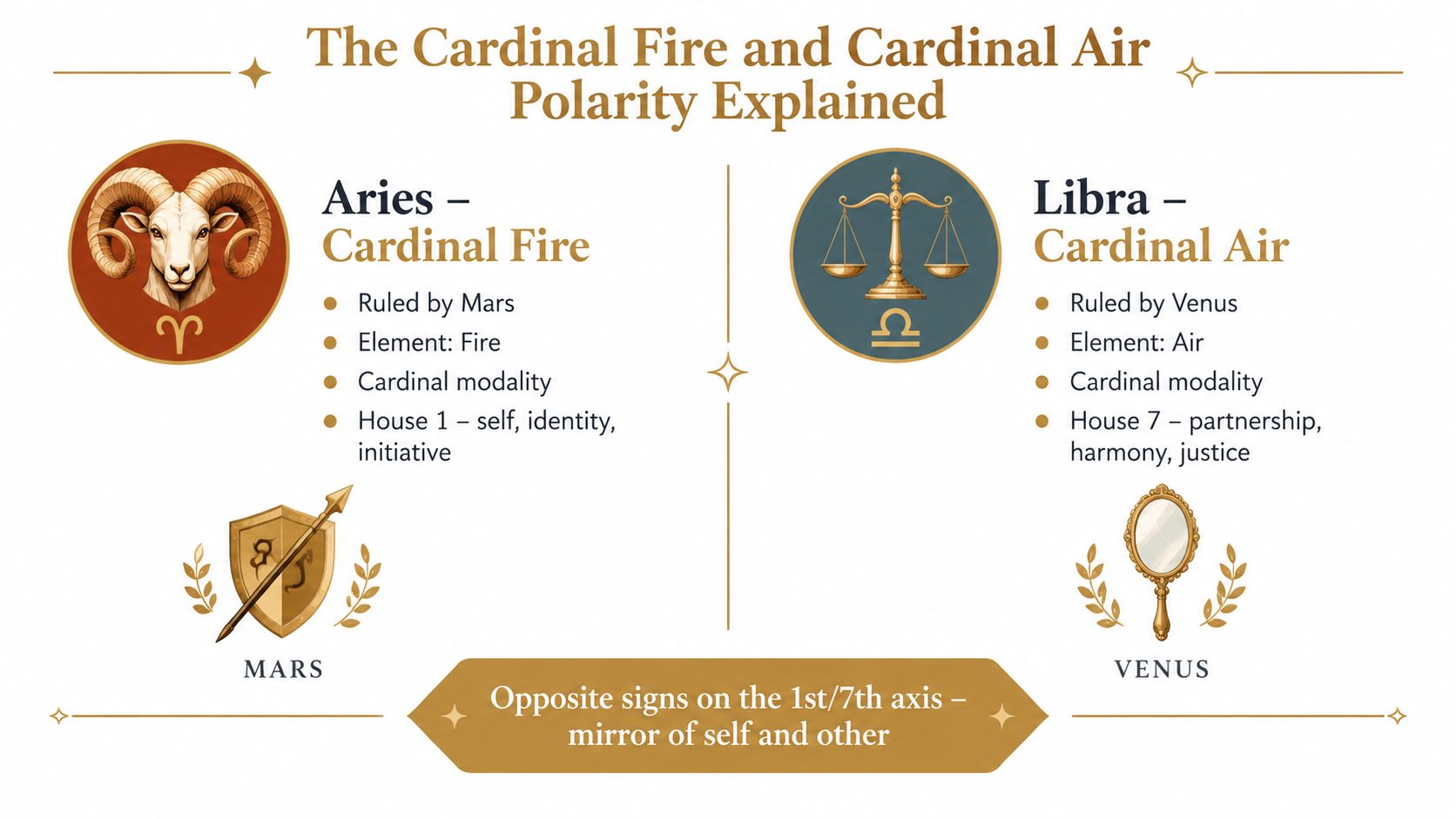
Aries is cardinal Fire ruled by Mars. Cardinal signs begin, launch, and move situations forward. Fire acts through instinct, confidence, and visible momentum. Mars adds assertion, competition, desire, and a willingness to confront obstacles directly.
Libra is cardinal Air ruled by Venus. Air works through thought, language, comparison, and social exchange. Cardinal Air initiates by opening a conversation, weighing options, and creating agreement. Venus adds attraction, cooperation, aesthetics, and the search for relational harmony.
The two signs share the cardinal modality, so neither is naturally passive. Both want movement. The difference lies in how they create it. Aries may say, “Let's decide and begin.” Libra may say, “Let's understand the options and make a decision everyone can live with.” Aries sees delay as a cost. Libra may see haste as a risk.
The traditional planetary rulers sharpen the contrast. Mars pursues and separates. Venus attracts and harmonises. In an Aries-Libra relationship, desire can be strong because Mars and Venus represent complementary principles. Attraction may feel immediate, while daily life exposes the tension between conquest and diplomacy.
The 1st and 7th houses
Aries and Libra are also read through the 1st/7th relationship axis. The 1st house concerns the self, identity, embodiment, and personal direction. The 7th house concerns the other person, partnership, agreements, and the way you meet an equal.
This axis creates a mirror. Aries may force Libra to state a preference instead of accommodating everyone. Libra may teach Aries that partnership requires consideration, not only personal conviction. If either lesson becomes one-sided, the mirror turns into a contest.
The Fire-Air element pairing is often considered energetically supportive because Air is said to fuel Fire. Compatibility frameworks commonly use this logic to explain why Aries and Libra can be socially lively and mutually stimulating. A 2026 dataset analysing 32,736 zodiac pair combinations placed Gemini with Libra at 75.6 and Aquarius with Libra at 75.4, showing that Libra's strongest air-sign comparisons clustered in the mid-70s, though the published snippet doesn't list Aries and Libra specifically. Those figures come from the Sagelon compatibility dataset, and they're a benchmark, not an Aries-Libra score.
Polarity is a condition, not a verdict. The chart must show whether the two people can use the tension constructively.
How Sun Sign Compatibility Differs From a Real Vedic Reading
A Sun-sign match compares broad zodiac identities. It may describe Aries as assertive and Libra as diplomatic, then infer attraction from their opposition. This can be a useful entry point for language, but it calculates very little about the actual relationship.
A Vedic kundli reading begins with birth data, a chosen ayanamsha, and a declared computational method. It then examines the individual charts and the relationship between them. In matchmaking, this can include Ashta Koota through Gun Milan, alongside the wider Samhita and Sambandha picture.
| Dimension | Western Sun-Sign | Vedic Kundli Reading |
|---|---|---|
| Starting data | Usually the Sun sign | Birth date, time, and place |
| Main comparison | Sign pairing and element | Planets, houses, nakshatras, dashas, and chart relationships |
| Relationship lens | General personality and attraction | Marriage capacity, emotional fit, intimacy, family factors, and timing |
| Matching tools | Broad compatibility language | Gun Milan, Mangal Dosha, divisional charts, and synastry |
| Timing | Usually absent or general | Dasha, transit, and muhurta analysis |
| Conclusion | General tendency | Conditional interpretation with uncertainty stated |
The technical labels need plain translation. In Samhita, kuta refers to the matching categories used in a compatibility assessment, including kuta, dina, gana, yoni, and rashi. Sambandha refers to the relationship between two charts, including layers such as Rasi, Mahendra, Stree-Deergha, and Vasya. These are not interchangeable with a Sun-sign description.
Different traditions also produce different weights and conclusions. One Vedic-style model gives Aries and Libra 22 out of 36, or 61%, and describes the result as good while identifying Fire-Air complementarity, cardinal quality, same Gana, and different Nadi in its breakdown. Star-Meet's Aries-Libra compatibility model shows how a structured score can still require interpretation.
Another independent Vedic-style page assigns the pair 68% but gives only 5 out of 15 rashi-computable Gun Milan points, and says a full Kundli Milan is needed before a serious marriage conclusion. Ishvaram's Mesh-Tula compatibility page makes the methodological point clearly. A score is an aid to judgement, not a guarantee.
For a fuller explanation of these traditions and their assumptions, compare Vedic and Western astrology methods. The key discipline is transparency. Readers should know what the method computes and where interpretation begins.
Chart Factors That Actually Decide the Outcome
The Aries-Libra label describes the outer polarity. The following factors tell you how that polarity behaves in a specific couple.
The relationship houses
Begin with the 7th house from each ascendant, or lagna. From an Aries ascendant, examine Libra and its lord Venus. From a Libra ascendant, examine Aries and its lord Mars. Check the condition of the 7th house, its lord, occupants, aspects, dignity, and links with benefic or difficult planets.
The dispositor chain matters too. A dispositor is the planet ruling the sign where another planet sits. If Venus or Mars ends up dependent on a weakened or afflicted dispositor, the relationship story may be less smooth than the Sun-sign pairing suggests.
Emotional and intimate compatibility
The Moon shows how each person processes experience and seeks emotional safety. Its nakshatra, the lunar constellation, and its pada, the quarter within that constellation, can refine the reading beyond the sign. Bharani, Vishakha, and Chitra may appear in discussions of intimacy and commitment, but no single nakshatra should be treated as a standalone promise. Its lord, placement, dignity, and relationship with the other chart still matter.
Venus and Mars deserve direct attention. Their conjunction or mutual aspect can increase attraction, but it can also create a pattern of pursuit and resistance if other factors lack steadiness. Trust and communication need separate assessment. One independent compatibility breakdown reports overall compatibility at roughly 72%, with sexual and activity scores of 87% and 81%, but communication and trust lower at 68% and 65%. The AstroChartus Aries-Libra analysis supports a practical conclusion: chemistry can be easier to find than stability.
Dosha and timing
Mangal Dosha must be assessed from its actual placement and from the relevant matching rules. Mars occupying certain houses can create a Mangal Dosha consideration, but the existence, cancellation, and practical weight of that condition require a full chart review. A generic article shouldn't prescribe a remedy from the sign pairing alone.
Dasha supplies the timing. A natal promise may remain quiet until a planetary period activates it. That's why a relationship can feel easy in one phase and demanding in another without either person becoming a different sign.
| Chart factor | What it actually checks | Relative weight |
|---|---|---|
| Sun | Identity style and visible will | Contextual |
| Moon and nakshatra | Emotional rhythm and response patterns | High |
| Venus | Affection, values, agreement, and pleasure | High |
| Mars | Desire, assertion, conflict, and initiative | High |
| 7th house and lord | Partnership capacity and relational structure | Very high |
| Navamsa | Deeper marriage indications and maturity of the promise | Very high |
| Mangal Dosha | Mars-related matching concerns | Conditional |
| Dasha | When chart promises become active | Timing-critical |
A transparent approach to two-chart work should explain the calculations before interpreting them. An overview of synastry methodology is useful for readers who want to understand why a full-chart comparison is more informative than a sign label.
Timing the Partnership With Dasha, Transits and Muhurta
Compatibility and timing answer different questions. A chart may show relational capacity, while the current dasha indicates whether commitment, distance, renegotiation, or closure is more likely to occupy the present period. Any future-facing statement remains conditional on the complete chart and accurate birth data.
Dasha periods
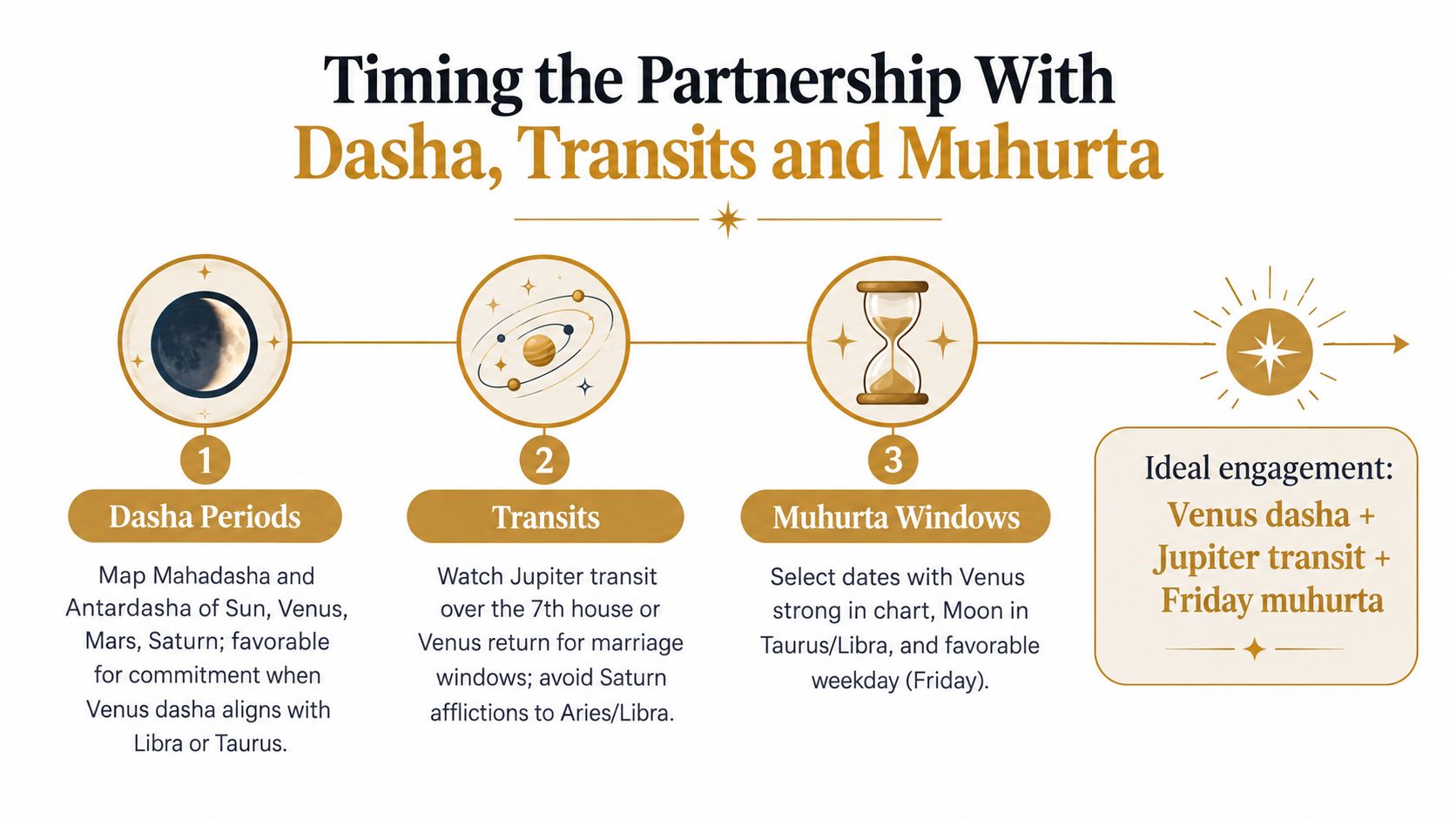
Review the Mahadasha and Antardasha, the major and sub-periods, of the 7th lord, Venus, and planets placed in or aspecting the 7th house. These periods can open relationship windows when the natal chart supports partnership.
Saturn or Rahu periods often require more careful judgement. They may coincide with responsibility, delay, restructuring, or completion cycles. That doesn't make a relationship impossible. It means the couple should examine what the period is asking them to handle rather than forcing a simple good or bad label.
Transits
Transits, or gochara, show current planetary movement against the natal charts. A Jupiter transit over the 7th house may support growth in partnership matters when the underlying promise is sound. Venus moving over or strongly connecting with the 7th lord can highlight affection, agreement, or social milestones.
Rahu-Ketu axis shifts can expose unclear expectations or intensify a decision that has been avoided. Their meaning depends on the houses, natal planets, and running dashas. Transit symbolism can't replace the birth chart.
Muhurta selection
For engagement, marriage, or reconciliation, a jyotishi may select a muhurta, an auspicious time, by considering tithi, nakshatra, weekday, ascendant, and the condition of relevant planets. The chosen window should respect both charts. A date selected only because it is associated with Aries or Libra is too shallow for a serious ceremony.
Families can use muhurta and daily timing guidance as a starting point, but personal selection still requires chart context. Timing is not a promise of a result. It's a way to choose a supportive beginning when the broader chart supports the action.
An Honest Decision Framework for Couples and Families
A useful reading should help you decide what to verify next. It shouldn't replace conversation, observation, or consent.
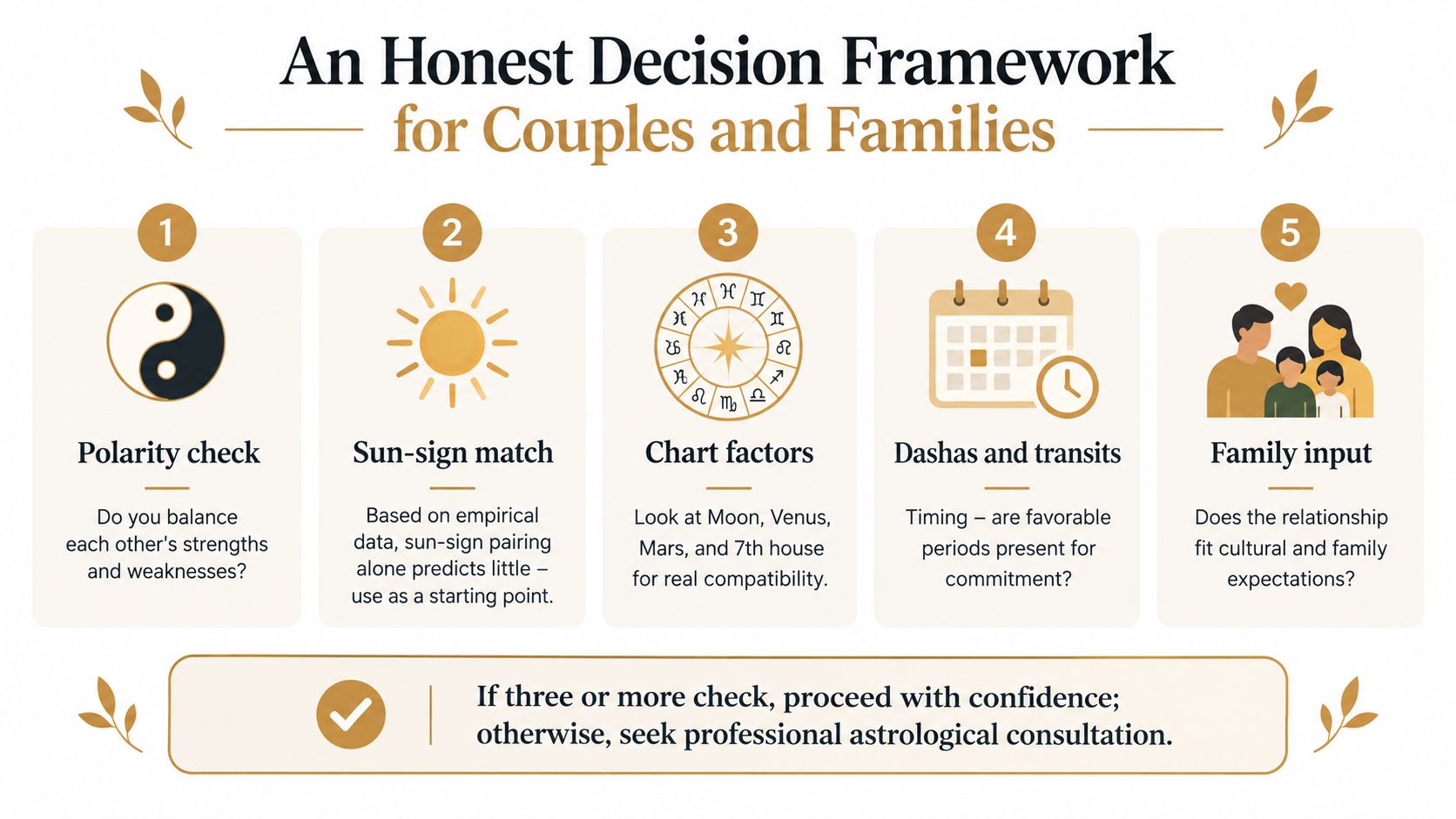
Start with the polarity itself. Can Aries speak directly without turning every disagreement into a contest? Can Libra express disagreement without hiding behind politeness or indefinite delay? If both partners can answer yes in lived behaviour, the opposition may be productive.
Then move beyond the signs. The empirical evidence doesn't support treating Sun-sign pairing as a predictor of marital duration or satisfaction. Use the Aries-Libra label to identify a theme, not to make a commitment decision.
What makes the match more workable
Look for mutual support between the partnership houses and their lords. A benefic 7th house, constructive Venus and Mars links, emotionally compatible Moon placements, and a dasha that supports commitment can make the polarity easier to carry.
A couple should also test the symbolism against real behaviour:
- Conflict repair: Do both people return to difficult conversations and change conduct afterward?
- Decision-making: Can the pair combine Aries initiative with Libra consultation?
- Boundaries: Can each partner protect individuality without withdrawing from partnership?
- Family expectations: Have practical responsibilities, living arrangements, and cultural expectations been discussed clearly?
- Timing: Do the current dashas support building, or are they demanding major personal restructuring?
When to pause
Pause when the charts show unresolved concerns that the couple hasn't addressed. An active Rahu period, severe Mangal Dosha without a properly assessed response, repeated clashes, or a weak partnership structure can justify further examination. None of these should be turned into fear or a guaranteed prediction.
Before committing, request full kundli matching through Ashtakoot or Dashakoot, a cross-chart Navamsa review, and current dasha analysis. In some families, a jyotishi may discuss Kumbh Vivah or gemstone recommendations. Those are specialised decisions and belong to a qualified practitioner who has reviewed the complete charts, not to a generic sign article.
A sound family rule: Don't reject or approve a person because of one sign, one score, or one dosha. Ask what the complete method shows, how confident the interpretation is, and whether lived evidence agrees.
Astrology here is for personal reflection and self-understanding, not professional advice. Relationship decisions still belong to the people living them.
Questions Couples Ask Before They Commit
Is Aries and Libra sexual compatibility usually strong?
It can be, especially when Venus and Mars connect constructively across the two charts. A Venus-Mars conjunction, mutual aspect, or supportive dignity may describe attraction and active desire. It doesn't automatically prove emotional safety, fidelity, or long-term satisfaction, so the Moon and 7th house must be read alongside it.
Can Libra and Aries build trust?
Trust depends on more than the opposition. Compare the Moon and Sun, examine their relationships with Venus, Saturn, and the 7th house, and assess how each chart handles speech and conflict. A strong attraction with poor communication indicators can remain exciting while becoming unstable.
Does this pairing work for remarriage?
It can, if the charts support partnership in the relevant period and the individuals have addressed patterns from earlier relationships. For remarriage, examine the marriage indicators, Navamsa, 7th house, and dasha context rather than assuming the second partnership will repeat the first.
Will family approval make the match safer?
Family support can reduce practical friction, but it can't substitute for chart matching or direct communication between the couple. In arranged contexts, families may review Gun Milan, Nadi, Gana, Yoni, Mangal Dosha, Navamsa, and the current timing for both people. Cultural expectations should be discussed openly instead of being treated as an astrological footnote.
What about children?
A responsible reading won't answer the child question from Aries and Libra Sun signs. Relevant fertility and family indicators require a complete chart assessment and careful language. This is a sensitive area, and astrology shouldn't replace medical guidance or create pressure around personal choices.
So, is Libra compatible with Aries?
The pair has a clear symbolic attraction and a demanding self-versus-partnership axis. Whether it works depends on the Moon, Venus, Mars, 7th houses, Navamsa, dosha assessment, dashas, and the conduct of the two people. Verify the full kundli before treating a sign-level pattern as a relationship conclusion.
A serious two-chart reading should show you more than a compatibility label. Visit Anvaya to generate a chart-first Samhita, calibrate it against lived events through Pramāṇa, and explore a structured Sambandha reading for your relationship.