
You can have a month where the money comes in, the inbox stays active, and people still don't feel close. Or the opposite, your name travels, your circle looks full from the outside, but the connections feel thin and the goals keep changing shape. That mix is exactly why Ketu in the 11th house gets searched so often, because it sits at the point where gains, friends, and desire all meet, and then asks why satisfaction still feels distant.
In Vedic astrology, the 11th house is Labha Bhava, the house of gains, income, friends, networks, and the fulfillment of desires. Ketu brings detachment, so this placement is rarely just “good” or “bad”. It often creates a clean split between what comes to you and how much you emotionally cling to it. That is the question here, not whether the chart promises easy success.
We read this kind of placement with a calm, math-first lens. A birth chart gives structure, but lived events tell us whether the structure is active in the present. That's why a serious reading starts with the chart, then checks the life pattern against it. If you want the foundation behind that method, see what a birth chart actually reveals.
For personal reflection and self-understanding, not professional advice, the useful frame is simple. Ketu in the 11th house can mean income without strong attachment to income, and fewer but more intentional connections. It can also mean volatility if you expect social life or money to behave in a straight line.
Table of Contents
- What the 11th House Means and What Ketu Brings to It
- How Ketu in 11th House Shapes Gains, Friendships and Goals
- Why the Same Placement Feels Different for Everyone
- Timing Matters Dashas Transits and Life Stages
- Chart Examples That Make the Pattern Concrete
- A Calm Way to Work With Ketu in 11th House Next
What the 11th House Means and What Ketu Brings to It
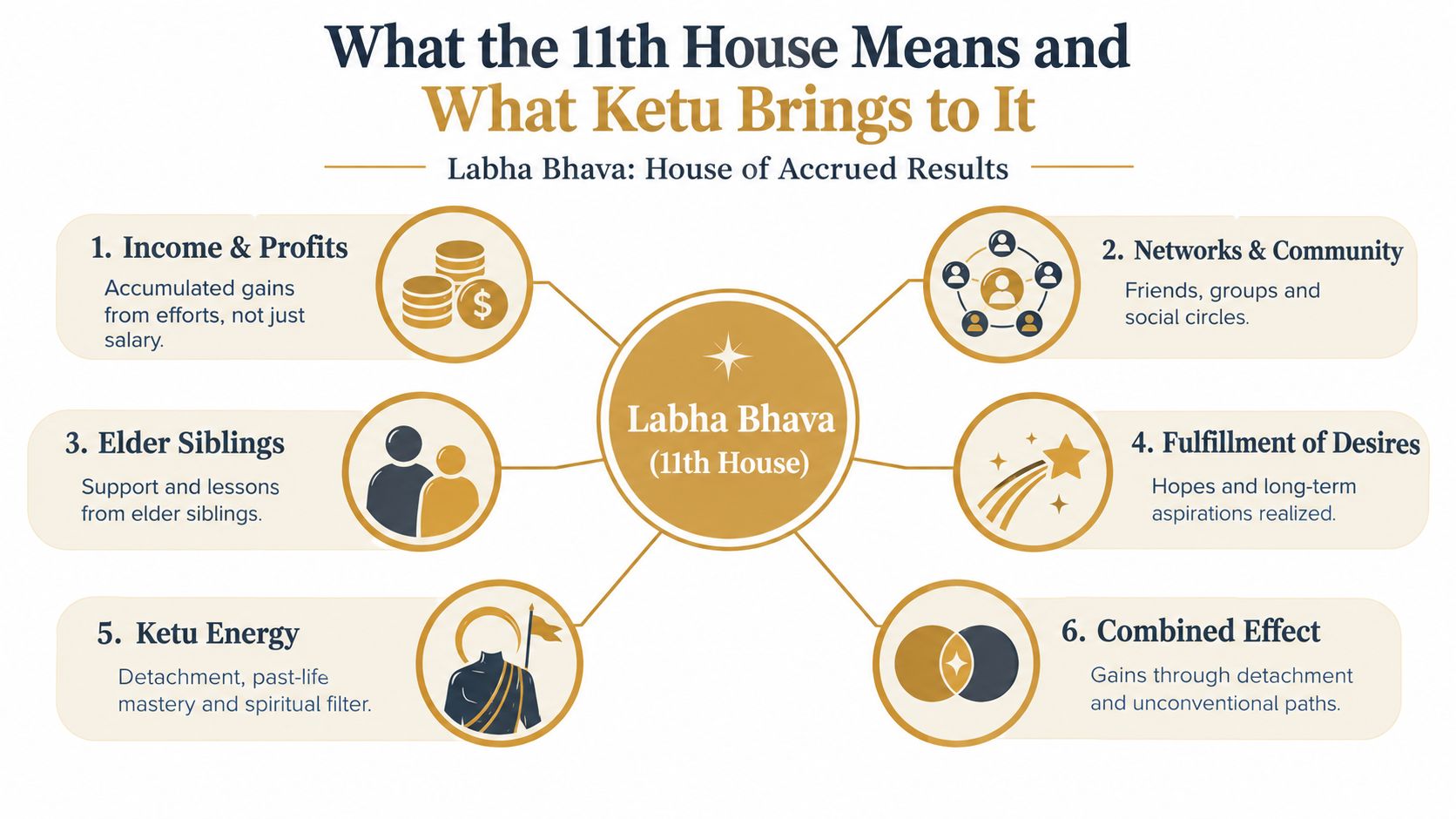
The 11th house, or Labha Bhava, is not just a money house. It covers income, profits, elder siblings, friends, social circles, aspirations, and the things you finally get after effort. Classical and modern Jyotish sources keep returning to that broader idea of accrued results, not just salary or business profit. A person may think of it as the chart area where effort becomes visible in the world.
Ketu changes the tone of that house. Ketu is the point of detachment, reduction of attachment, and inward focus. So when Ketu sits in the 11th, the person may still receive gains, but the emotional relationship to those gains often looks different. It acts as a filter. The result passes through, but the craving for applause gets lowered.
Why astrologers often call this a workable placement
The 11th house is an upachaya house, which means results can improve with time and effort. That matters. In several interpretive traditions, that is part of why Ketu in this house is often treated as more usable than Ketu in many other places. The placement may not feel smooth at first, but it doesn't have to stay static.
Practical rule: If a house is an upachaya, the chart can mature there. You don't judge it only by the first chapter.
This is also why some astrologers describe Ketu in the 11th as a placement where gains can come in unconventional ways. The person may not chase visibility the way others do, yet results still arrive through selective effort, niche skills, or the right moment. That doesn't mean the person avoids all ambition. It means ambition is often edited down to what matters.
A beginner often gets confused here. They hear “detachment” and assume loss. That's too simple. In this house, detachment can reduce noise, reduce social dependency, and reduce the need to prove everything publicly. The result can be leaner, quieter, and more focused gains.
How Ketu in 11th House Shapes Gains, Friendships and Goals
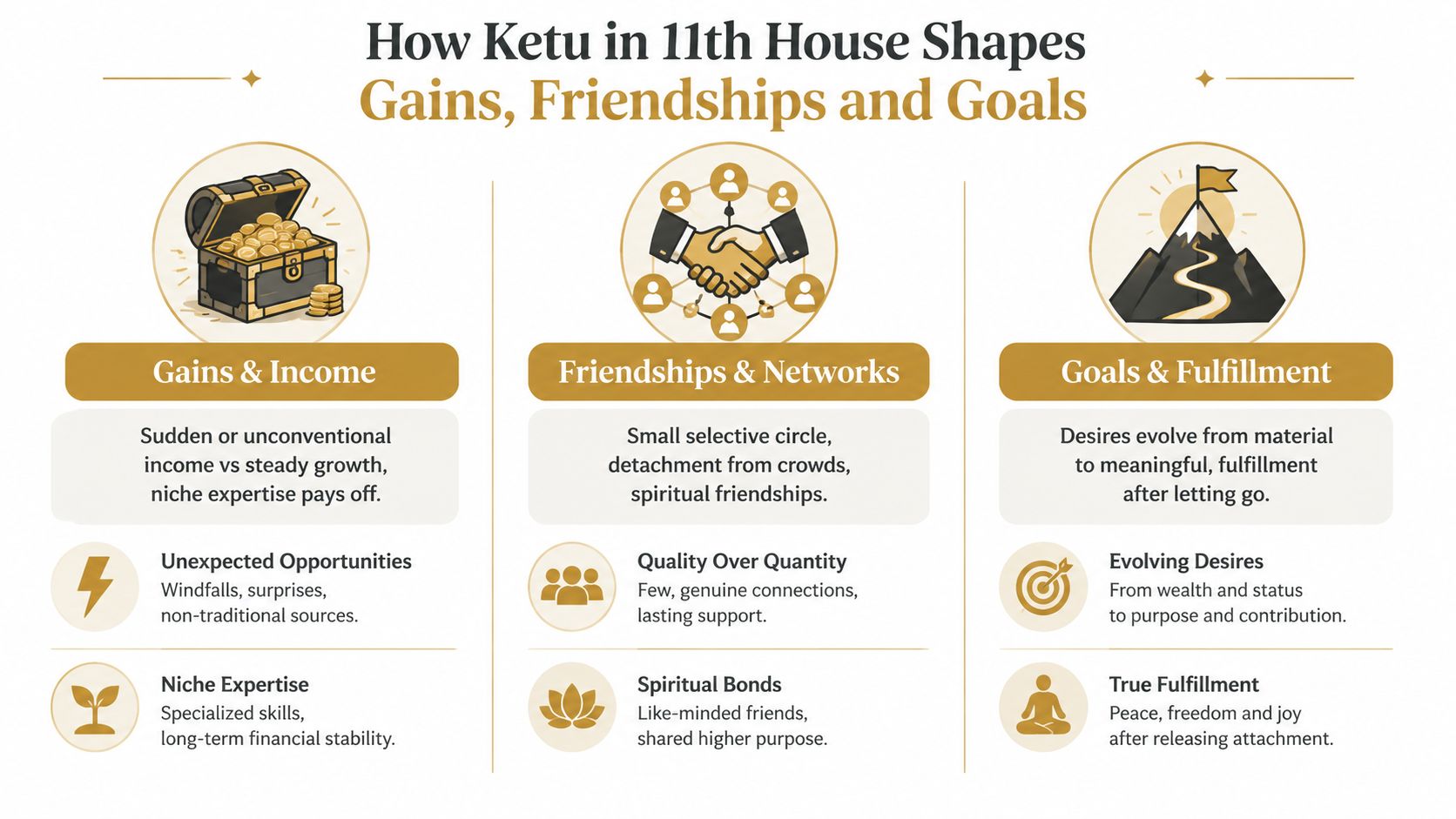
The easiest way to read this placement is to separate it into three tracks, gains, relationships, and goals. Each one can move differently. That is why two people can both have Ketu in the 11th and live it in opposite ways.
Gains can come, but not always in a straight line
Modern interpretive guides repeatedly describe this placement as linked to sudden, irregular, or unexpected financial outcomes rather than steady linear growth. That doesn't mean instability is guaranteed. It means the pattern may reward timing, specialty, and nonstandard channels more than broad networking or constant social visibility. Some sources even describe the placement as benefic in transit with a mild tone, which fits the idea of measured rather than dramatic growth.
A simple example helps. One person builds value through research, tech, writing, or another niche field, then gains recognition without chasing the crowd. Another person expects income to rise only through visible networking, and feels frustrated when that route doesn't deliver. The same placement can look like ease in one life and restlessness in another.
Friendships become selective
The placement is often felt most clearly. The 11th house rules friends and social networks, while Ketu lowers attachment. So the person may have fewer ties, less dependence on group approval, and a smaller social graph. That can look lonely from the outside, but it isn't always lonely from the inside.
A person with this placement may keep only a few relationships active, and those ties may be lower-maintenance, more spiritual, or more honest. Broad social performance often stops feeling interesting. Crowds can still be useful, but they don't always feel nourishing.
Ketu in the 11th often shifts you from quantity-based social capital to selective connection.
Goals can change shape over time
The 11th house also governs aspirations. With Ketu there, goals may evolve from status-driven aims to more meaningful or service-oriented aims. A person who once wanted recognition may later want clean work, useful work, or work with less noise around it. That shift can feel like loss if you expect your old goals to stay fixed.
It helps to read this as a change in appetite, not a failure of ambition. Some charts show a person still achieving outcomes, but no longer caring as much about public proof. That's a real change in how fulfillment works.
Why the Same Placement Feels Different for Everyone
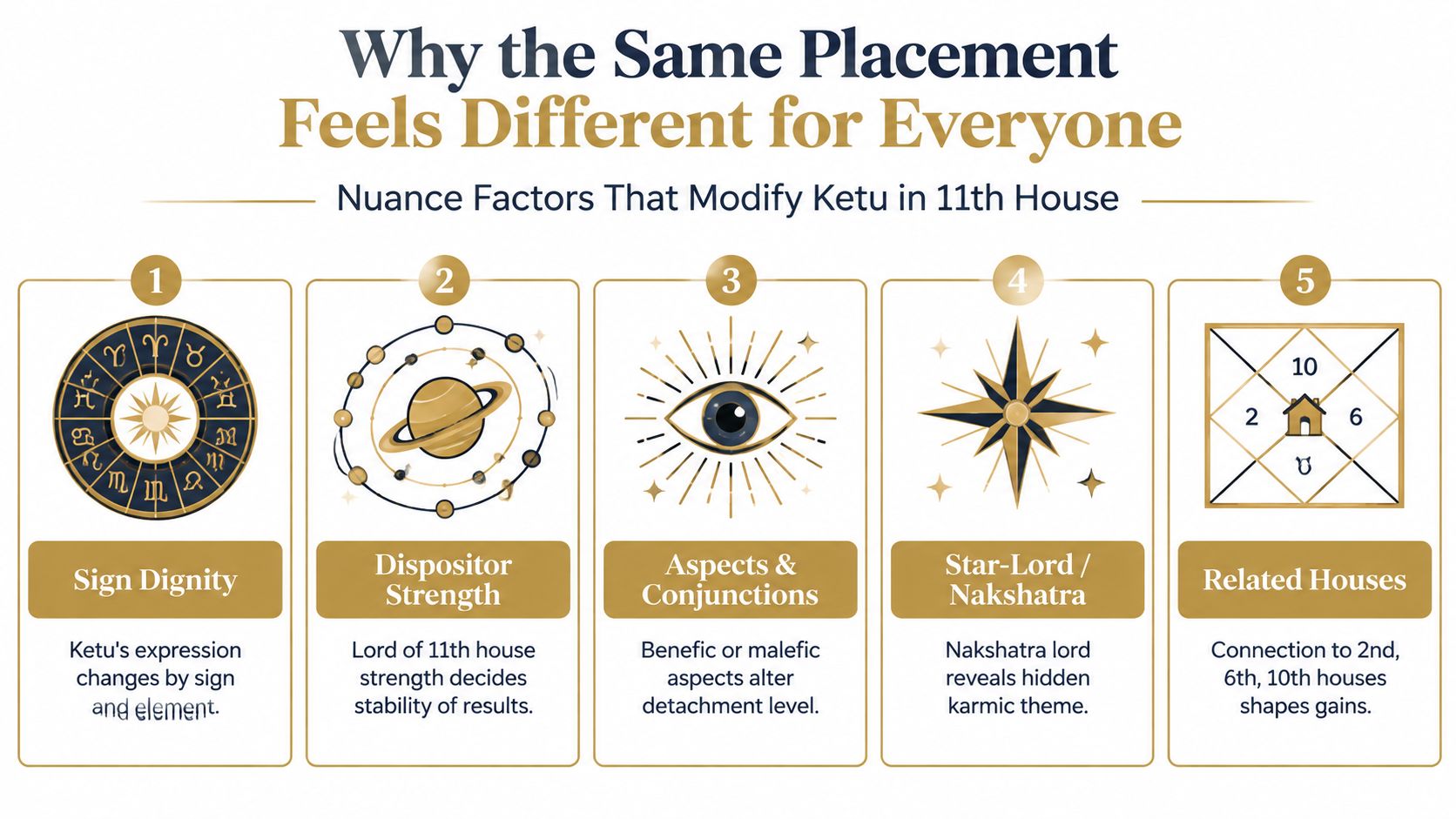
No placement works in a vacuum. Sign dignity, dispositor strength, aspects, and related house links all change the result. That is why two charts with Ketu in the 11th can feel very different even if the headline sounds the same.
What to weigh first
A practical way to sort the chart is this:
- Sign dignity: Ketu's expression changes by sign and element.
- Dispositor strength: The ruler connected to the 11th house helps decide whether results stay stable.
- Aspects and conjunctions: Other planets can soften detachment or make it sharper.
- Nakshatra lord: The lunar mansion lord can reveal the hidden theme underneath the placement.
- Related houses: Links to the 2nd, 6th, and 10th houses can shape how gains show up.
If these factors support the placement, Ketu in the 11th can act like focused gain through a smaller network, better timing, or niche competence. If they're weak or conflicted, the same placement can feel like unstable reciprocity, mixed signals in friendships, or gains that don't match expectations. That's why a blanket “good” or “bad” label misses the chart logic.
Upachaya timing matters too
Because the 11th is an upachaya, this placement often improves with time. Some people feel it more in middle life than early life. Early on, they may seem socially distant or unusually selective. Later, that same selectivity becomes an asset.
The practical takeaway is simple. If broad networking exhausts you, the chart may be asking for a smaller and more deliberate social field. If broad networking is already part of your work, the chart may show where you need quality over volume. In both cases, the question is not “How do I become more social?” It is “What kind of connection produces results in this chart?”
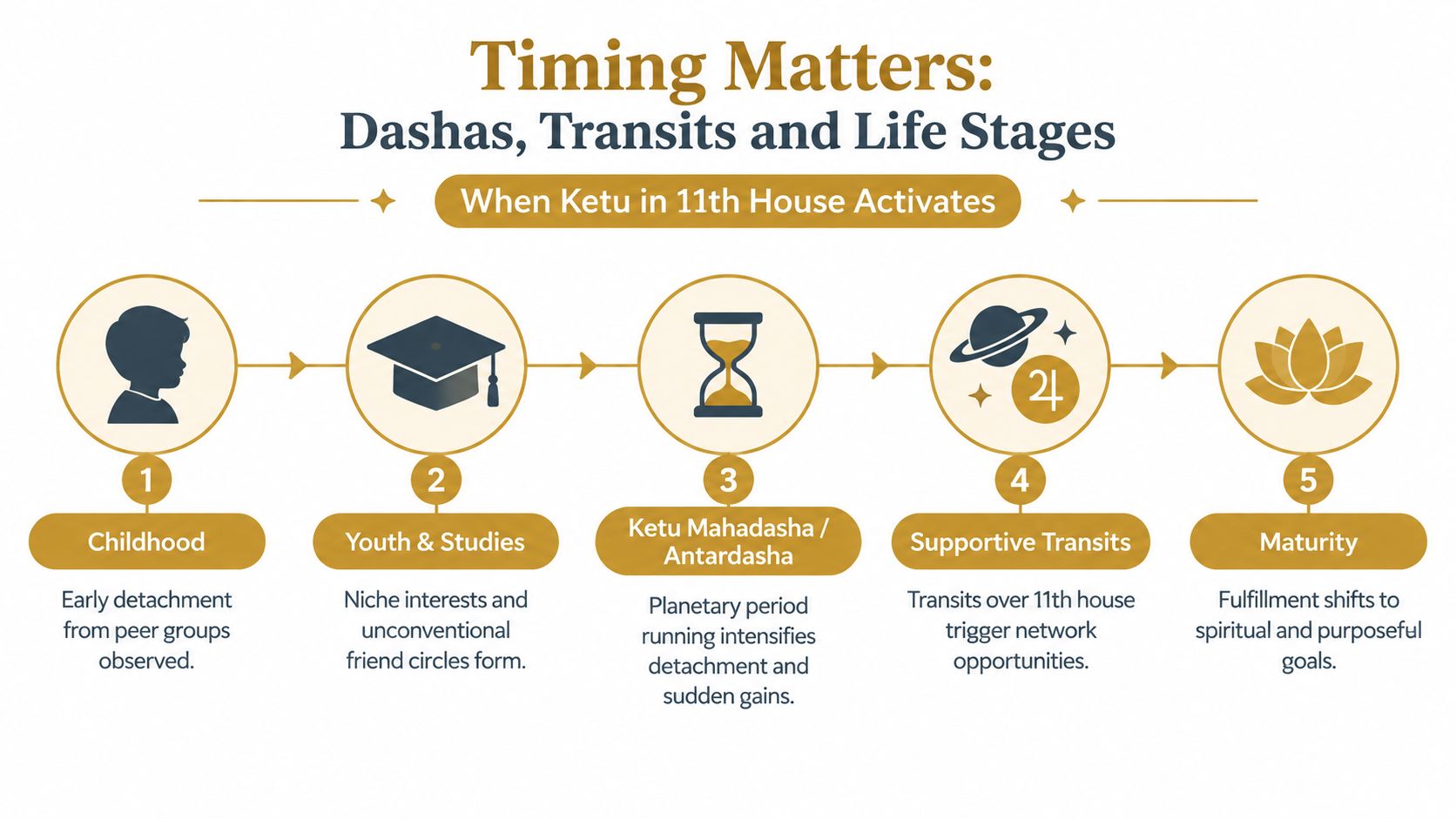
Timing Matters Dashas Transits and Life Stages
A static placement doesn't tell you when it wakes up. Dasha means the planetary period running in your life. Transit means where a planet is moving now and what it activates in the chart. That is the timing layer, and it matters a lot with Ketu in the 11th.
When the placement becomes visible
When Ketu periods run, or when periods of linked planets activate the 11th house, the themes usually surface more clearly. That can mean changes in friend circles, shifts in goals, or gains from unusual channels. Modern transit-focused sources even describe the effect as mildly benefic in some periods, which is a useful reminder that not every activation is dramatic.
Early life can show this placement as quiet distance from peer groups. Later, that same distance may become a strength because it keeps the person from chasing approval. If the person's work depends on constant social reinforcement, though, the same timing can feel volatile. The chart doesn't promise steady applause.
What to look for in real life
A serious reading watches for patterns like these:
- Sudden gain windows: money or opportunity arrives through a route you didn't plan.
- Social thinning: friendships become fewer, but more intentional.
- Goal revision: the target changes, and the old goal no longer feels central.
- Nonstandard work paths: research, tech, service, or other niche fields start to matter more.
That's why timing should be checked against lived events before any forward claim is made. If the last gain window came during a specific planetary period, that matters more than a generic house description. If your networks improved only when a linked planet was active, that matters too.
For readers who want a clean timing lens, see when it's a good time to start. It's the same logic here. The chart is not just about what a placement means. It's about when the meaning becomes active.
Chart Examples That Make the Pattern Concrete
Two charts can carry the same placement and live it very differently. That's normal. The difference usually sits in the supporting factors, not the headline placement alone.
One chart may have Ketu in the 11th with strong support from the rest of the structure. The person keeps a small circle, works in a niche area, and gains through skills that don't need constant visibility. Friends are few, but the ties are real. A chart reader would check past gain windows first, then ask whether those windows matched moments of withdrawal, study, or focused work.
Another chart may place Ketu in the 11th with weak support and high expectation around reciprocity. That person may keep expecting a crowd to show up, or expect professional circles to behave like a reliable support system. When that doesn't happen, the result feels like disappointment, even if some gains still arrive. The problem is often not the gain itself, but the mismatch between expectation and the chart's actual style.
A careful reading would test both charts with Pramāṇa, the chart-first calibration against real events. We would ask about known gain periods, friendship changes, and goal shifts before saying anything about the future. That keeps the reading honest. It also keeps the placement from being flattened into a generic “good for money” line.
A Calm Way to Work With Ketu in 11th House Next
The core idea is simple. Ketu in the 11th house often gives gains without strong attachment to gains, and friendships that become smaller, quieter, and more intentional. It can help when the chart supports selective effort and nonstandard paths. It can feel volatile when you expect steady social reinforcement or linear growth.
A grounded check is enough before you decide what it means in your own chart:
- House lord: Is the 11th house ruler strong or weak?
- Aspects: Are there supportive or difficult influences on the house?
- Dasha: Is Ketu, or a linked planet, running now?
- Past events: Did your gains and friendships already show this pattern?
If you want to explore the karmic side of this placement more, the broader framework is worth reading alongside the idea of past-life karma in astrology. That keeps the discussion rooted in classical structure instead of internet shorthand.
For reflection, not prescription, the clean next step is to compare the chart against life history before drawing conclusions. A serious reading should tell you what the chart supports, where it stays uncertain, and where timing still needs to be tested.
Generate my Samhita if you want a declared, chart-first reading with Pramāṇa calibration, not a generic horoscope feed. Anvaya reads the chart first, then checks it against lived events before it makes forward claims. If you're trying to understand Ketu in the 11th house with less noise and more method, that's the place to start.