

You registered the company on Tuesday because your lawyer was available. Your website opens later, and the first customer payment may arrive after that. Which moment should an astrologer time?
If you're searching for the best time to start business astrology guidance, begin with that distinction, not a calendar of favourable dates. A careful Vedic reading names the act, screens its possible hours, and compares the surviving windows with your birth chart. It doesn't turn a selected date into a promise of sales.
Table of Contents
- Name the Business Event You Are Timing
- Muhurta Rules That Screen a Start Date
- How to Score Dasha and Transit Support
- Tips When the Calendar and the Chart Disagree
- Confirm the Chosen Window Before You Act
- Questions People Ask After They Pick a Date
Name the Business Event You Are Timing
A business can have several meaningful beginnings. Registration creates one record. Opening your shop creates another. Accepting payment marks a different act again.
General business astrology guidance often brings incorporation, opening, and commercial activity under the same launch question. For a useful timing exercise, separate them before calculating anything.
Choose the act you can identify
Legal inception. Record the filing or registration timestamp shown by the relevant authority. Use the authority's time zone, and distinguish the time you submitted an application from the effective time recorded in the official document. This is a record-keeping distinction, not a legal interpretation.
Operational launch. Name the moment customers can use the business. For a shop, that might be opening for trade. For software, it might be making the working product publicly available, rather than uploading a private test.
Revenue inception. Use the first completed customer payment if you're timing the beginning of paid trade. Sending an invoice and receiving payment aren't interchangeable events. Choose the one you mean before you look at the chart.
Funding close or public announcement. These can deserve separate timing records when they're the act under consideration. A public announcement concerns visibility. A funding close concerns a different milestone. Neither automatically replaces the operational launch.
Don't force every event onto the same day. You may have control over a public release but no control over an authority's processing clock.
Practical rule: Choose the primary event because it matches your question, not because its existing timestamp gives the most attractive chart.
Put the clock beside the event
Write down the city, local time zone, and daylight-saving status. For a remote company, distinguish the filing office's clock from the clock where the chosen commercial act happens. Keep the corresponding universal timestamp in your record so another practitioner can reproduce the calculation.
Say a founder is opening an online teaching service. The primary event could be: public access to the paid teaching platform, Bengaluru, India Standard Time, at the selected local hour. It's primary because the question concerns when customers can begin using the service, not when the company's paperwork was processed.
That statement is specific enough to calculate. “Starting my business sometime next month” isn't.
Muhurta Rules That Screen a Start Date
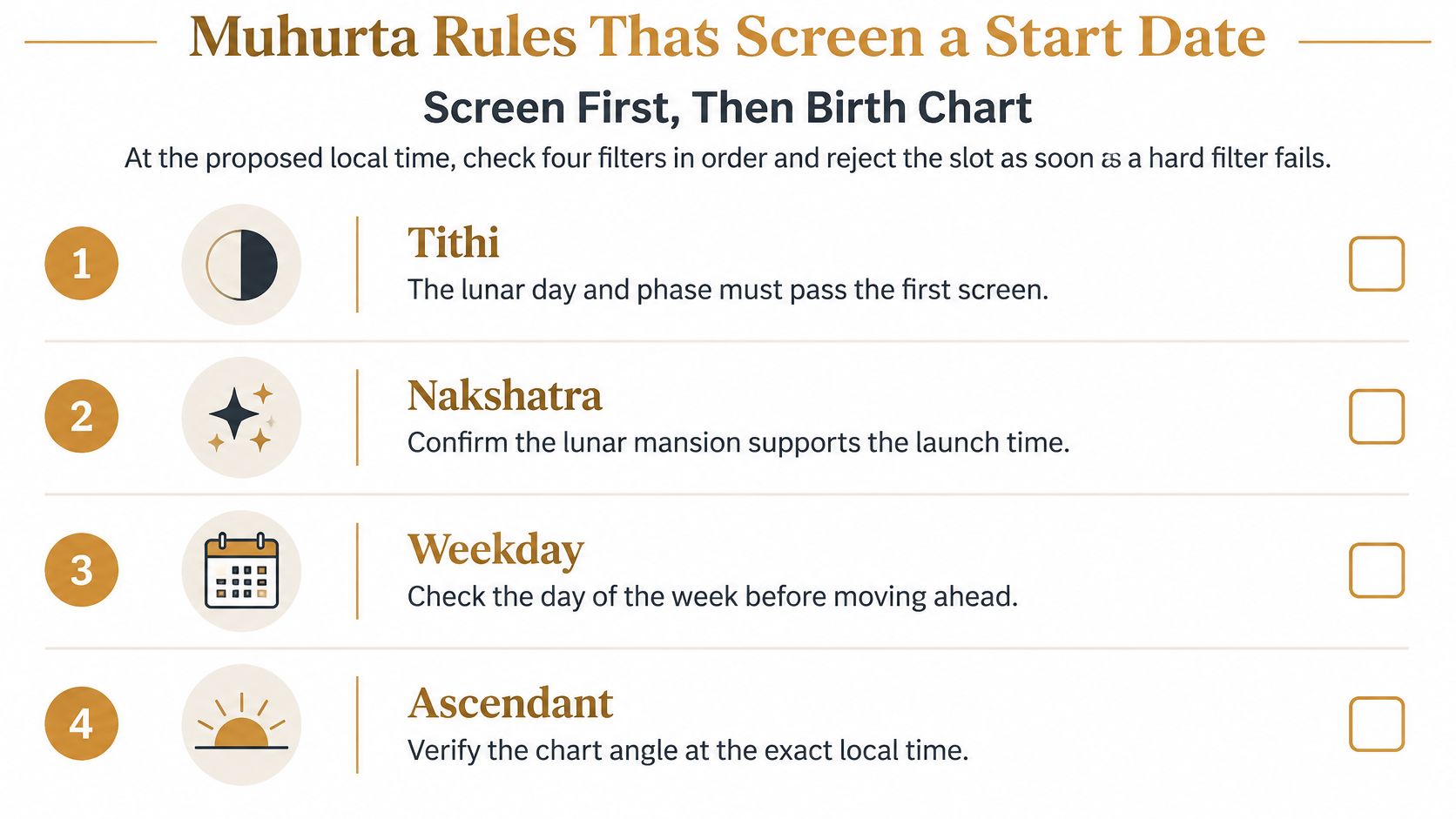
Muhurta means selecting a suitable time for a particular act. Start with the calendar conditions at the proposed local hour, rather than fitting a story to a favourite date.
The checklist illustrates the screening approach. A complete election can also examine the ascendant, meaning the sign rising at the chosen place and time; the personal Moon checks below remain separate requirements.
Apply the filters in a declared order
Check tithi, weekday, nakshatra, and the founder's Moon. Reject a candidate when a hard exclusion in your chosen method applies. If practitioners disagree, record the disagreement rather than changing methods.
A tithi is a lunar day calculated from the angular separation of the Sun and Moon. It isn't a civil date or a general waxing-Moon label. The Vedic Nakshatra business table gives a broader favourable set than some narrower lists, including disputed choices such as Shashthi, Dwadashi, and Purnima.
Business muhurta screen for one proposed hour
| Filter | Usually keep | Usually drop | Notes |
|---|---|---|---|
| Tithi | Dwitiya, Tritiya, Panchami, Saptami, Dashami, Ekadashi, Trayodashi | Chaturthi, Ashtami, Navami, Chaturdashi, Amavasya | Shashthi, Dwadashi, and Purnima are kept by some lists and omitted by others. Ekadashi is used in some traditions for Vyapara Arambha, meaning business commencement. |
| Weekday | Wednesday for trade and software; Thursday for advice and teaching; Friday for beauty and luxury; Monday for food and care | Tuesday and Saturday for an ordinary launch | Sunday can suit government-facing or leadership work. Engineering or heavy industry may retain Tuesday or Saturday. |
| Nakshatra | Pushya first; then Ashwini, Rohini, Punarvasu, Hasta, Anuradha, Uttara Phalguni, Uttara Ashadha, Shravana, Dhanishtha, Revati | Bharani, Krittika, Ardra, Ashlesha, Magha, Jyeshtha, Moola | Published lists disagree on some lunar mansions. Pushya on Thursday is sometimes called Guru-Pushya Yoga. |
| Founder Moon | Transit Moon clear of the twenty-second nakshatra from the birth nakshatra and the eighth sign from the natal Moon | Vedha or Chandrashtama | These are personal exclusions, not judgements about a day for everyone. |
The weekday associations in AstroSight's muhurta guide match the day's planetary ruler to the work. Wednesday isn't automatically superior for every business.
A nakshatra is a lunar mansion, a defined part of the zodiac occupied by the Moon. Diastrologer's business guide places Pushya among the strongest general choices and describes Guru-Pushya Yoga, while showing why the selected nakshatra list must be stated.
Add the personal exclusions
Nitya Panchangam's business guide describes vedha, the twenty-second-nakshatra exclusion, and Chandrashtama, the transit Moon in the eighth sign from the natal Moon. The same civil date can therefore pass for one founder and fail for another.
Use a location-specific Panchang of the day to inspect the actual hour. A favourable label at sunrise doesn't establish that every later hour passes.
Passing the screen creates a candidate. It doesn't rank that candidate.
How to Score Dasha and Transit Support
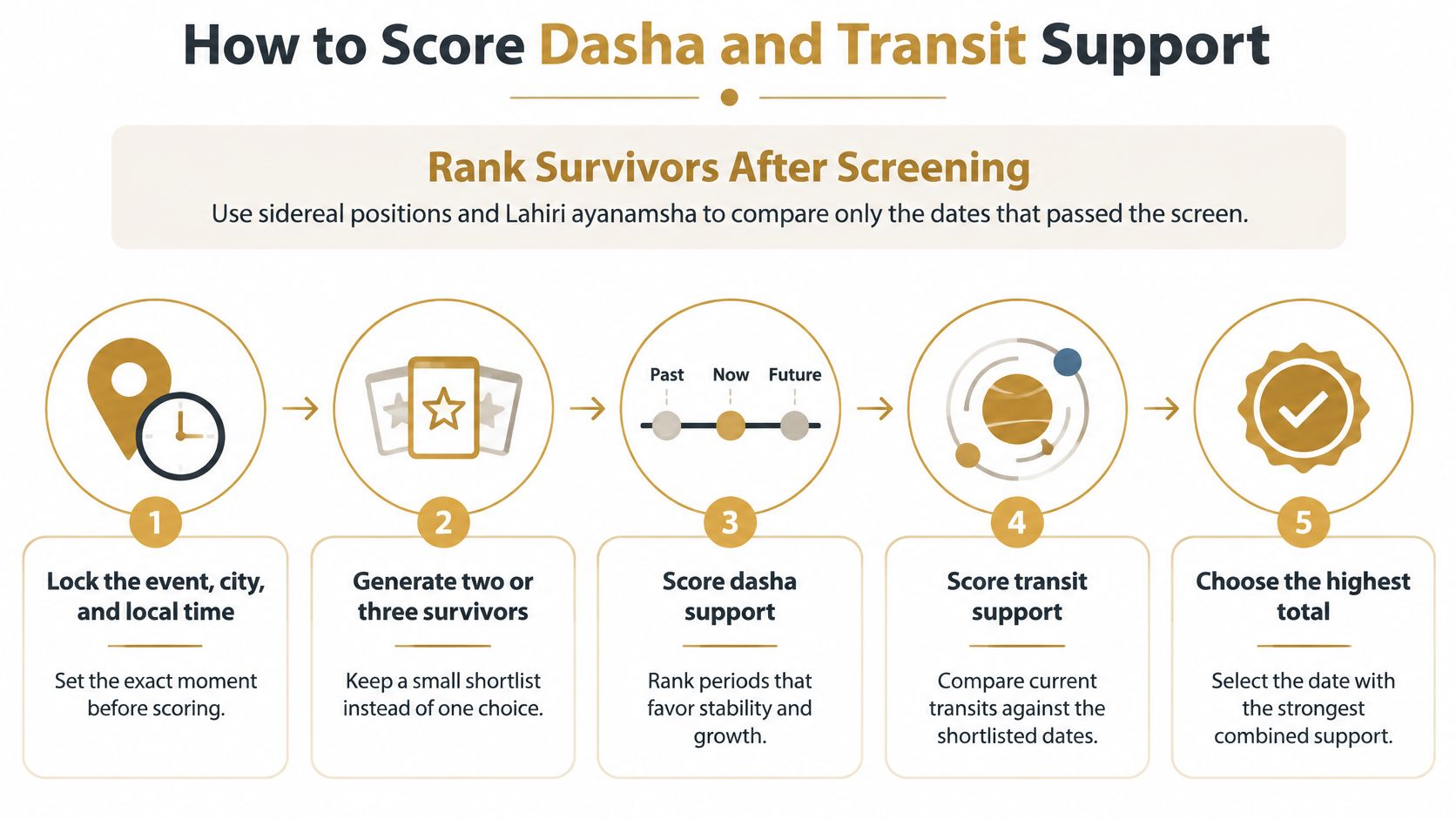
A surviving window needs a reasoned comparison, not a decorative score. Use sidereal positions with Lahiri ayanamsha, the declared offset used to calculate the sidereal zodiac, consistently across the charts.
The Muhurta Chintamani tradition provides an electional framework. It establishes traditional rules, not empirical proof that a chosen hour causes commercial success.
Make the comparison reproducible
Lock the event and location. Keep a small shortlist of surviving windows, with each local timestamp recorded. Changing the act midway changes the question being judged.
Compute the founder's birth chart. Use date, time, and place of birth. We require birth time and advise checking a hospital record or asking family before beginning. A recorded time is preferable to an estimate, though the record itself can still contain uncertainty.
Read the active Vimshottari dasha. This is a system of planetary periods. Compare the mahadasha, the main period, and antardasha, its subperiod, with the work under consideration. A period change may suggest a career shift if the chart supports it; it doesn't establish that entrepreneurship is the correct choice. The dasha calculator explainer gives the timing context.
Check transits, or gochara. Examine Jupiter and Saturn in relation to relevant natal houses. The tenth house concerns career and public role; the seventh concerns partnerships and dealings with others; the second concerns accumulated resources. Interpret these together rather than treating a single transit as approval.
Use the career division carefully. D10 is the divisional chart used for professional interpretation. Consult it only when birth-time reliability supports that level of detail. An approximate time shouldn't produce a minute-level election.
Mark the evidence separately. Record calendar compliance, dasha support, transit support, and practical readiness. Clear, mixed, or weak provides a more accurate judgement than an unexplained numerical total.
Freeze the decision note. Preserve the chosen window, rejected alternatives, calculation settings, assumptions, and confidence. Keep computed positions, traditional rules, confirmed past events, and interpretation in separate fields.
Anvaya's canonical computation includes Vimshottari Dasha, Navamsa or D9, nakshatras, Shadbala planetary strengths, yogas or planetary combinations, Muhurta timing, and Transits or Gochara. Its two-chart work, Sambandha, includes Ashtakoota Guna Milan compatibility scoring and Mangal Dosha checks. Those additional layers aren't all needed to decide a business hour.
Unknown or approximate birth times may require wider timing bands. Rectification, meaning birth-time correction, may be offered separately; it shouldn't be implied by a confident-looking result.
Compare an illustrative shortlist
This is a hypothetical example, not a real chart. Window B survives under the selected tithi list, but another list disputes it. Under a stricter declared method, it would be excluded rather than scored.
Scoring three surviving windows (illustrative)
| Check | Window A | Window B | Window C |
|---|---|---|---|
| Muhurta filters | Passed all four | Passed, tithi disputed by one list | Passed all four |
| Dasha support | Clear | Mixed | Clear |
| Transit support | Mixed | Clear | Clear |
| Readiness | Product live, payments tested | Product live, payments not tested | Product not ready |
| Confidence note | Medium | Low | Low |
Read combined support as a documented comparison, not a validated total. In this scenario, the founder chooses Window A because it clears the declared filters and the product is ready. Cleaner transit marks don't compensate for an untested payment flow or an unavailable product.
Tips When the Calendar and the Chart Disagree
Your filing deadline falls on a tithi your chosen tradition excludes. That's a scheduling conflict, not a failed omen. An astrology preference shouldn't be used to disregard an official requirement; questions about that requirement belong with a qualified professional.
Record the actual filing timestamp. If you still want an election for a later commercial act, name that act separately. Don't invent a backdated incorporation or describe a ceremonial opening as the official filing.
Resolve the specific conflict
- The product can't accept payment. An earlier muhurta can't make an unfinished checkout operational. Keep it as a rejected candidate and compare windows after the required systems are ready.
- The founders have different natal Moons. A shared election should state whether both founders' exclusions were checked. If the act is assigned to one operating founder, document that scope before inspecting the result, rather than switching founders to obtain a preferred answer.
- The birth time is approximate. Don't argue over a few minutes when the underlying record doesn't support that precision. A finely divided career chart shouldn't settle the dispute.
- Rahu Kaal overlaps the intended act. This is a daytime interval traditionally avoided for new beginnings. Check its local timing rather than rejecting an entire weekday.
Give early operations their proper weight
Cross-country OECD evidence on firm survival puts average survival at just above 60% after three years and approximately 50% after five years. The same evidence identifies especially high exit probability when a business reaches two years of age.
Those are contextual benchmarks, not a forecast for your company or a test of astrology. They show why choosing an hour is a much narrower task than sustaining a business.
Key principle: A favourable tithi can organise a deliberate start. It cannot replace validation, cash planning, customers, or operational review during the first two years.
Preserve your timing note before outcomes arrive. Later, compare the original assumptions with the first payment, early customer retention, and continued operation. Don't rewrite a mixed interpretation as a clear prediction after something goes well, or search retrospectively for a different chart factor after a setback.
Confirm the Chosen Window Before You Act
Use each tool for its stated job. A calendar calculation, a birth-chart interpretation, and a check against lived events aren't interchangeable kinds of evidence.
The free tools include Panchang, showing tithi, nakshatra, yoga and karana, which are calendar components; Muhurta, for auspicious windows; and Pravāha, for suitability by age. Janma Akshara provides classical birth syllables and Lagna Kundali, the birth chart. It isn't a business-name success test.
Keep calculation and interpretation separate
A named calendar combination deserves its own explanation. The Sarvartha Siddhi Yoga explainer provides background for that term; no auspicious label should substitute for the complete event-specific check.
Our method is declared compute, then calibration against lived events, then a plain-language reading. In the user process, that means:
- You provide birth details.
- The declared Parashari math runs.
- The chart meets your life through past-event questions, called Pramāṇa.
- Your Samhita opens as a structured, living reading.
We compute before asking for your life story. We don't use what you've just told us as if the chart independently established it.
Pramāṇa checks the reading against events you recognise. It doesn't prove that astrology causes later outcomes. Any forward-looking interpretation comes after that check and remains conditional, with uncertainty stated rather than hidden.
Readings, timing suggestions, compatibility analyses, and Samvāda responses are for informational and entertainment purposes. They aren't medical, mental-health, psychological, legal, financial, investment, employment, or safety advice.
Questions People Ask After They Pick a Date
Does Guru-Pushya Yoga mean customers will buy?
No. Guru-Pushya Yoga names the traditional combination of Thursday and Pushya nakshatra. It can be favourable within that framework without establishing demand for your offer.
A reader should be able to distinguish the traditional judgement from the commercial question. Neither the calendar label nor the founder's enthusiasm tells you whether customers will purchase.
Does a good muhurta guarantee business success?
No. A muhurta records a traditionally preferred beginning. It doesn't supply a validated probability of business survival or revenue.
A useful record states what was selected, why it was preferred, and what remained uncertain. A guarantee would erase precisely the limits a careful reading should preserve.
Can I choose a business muhurta without an exact birth time?
You can examine general calendar conditions, but the personal reading needs a clear uncertainty note. Don't treat unknown birth time as though it were an accurate time entered into a calculator.
If you obtain a better record later, preserve the earlier calculation and make a dated revision. Replacing the original would prevent an honest comparison.
Which zodiac and calculation settings should I use?
This guide uses the sidereal zodiac with Lahiri ayanamsha in a classical Parashari frame. Keep those settings consistent when comparing candidate windows.
If an existing chart uses another declared setting, label the difference before comparing interpretations. Otherwise, a calculation difference can look like a disagreement about meaning.
Is business astrology a substitute for professional advice?
No. This is for personal reflection and self-understanding, not professional advice. A timing reading doesn't replace a lawyer, accountant, or business plan.
Use qualified professionals for decisions within their fields. Use the astrological record to examine the traditional timing interpretation and your own assumptions, without asking it to certify matters it cannot establish.
Anvaya offers declared Vedic computation, Pramāṇa calibration against lived events, and a persistent Samhita with explicit confidence. For a business beginning, that gives you a chart-grounded context rather than a universal favourable date. Visit Anvaya to generate your Samhita before adding your launch story.