It's past eleven on a Sunday night. You've been turning over a job change for weeks, you download what looks like the best Jyotish app in the store, and by morning all you've got is a daily horoscope and a push notification telling you to stay positive. That gap is the whole problem with most rankings. They count features. They don't ask what job you needed done.
Best depends on the job. A daily Panchang check, deep chart study, a human consultation, couple matching, and family records are different tasks, and no single app does all of them well. So this list sorts ten tools by intended use and judges each on five things: astrological approach, verification, features, pricing model, and intended use. Verification matters most. Can you check the reading against events you have lived through, or do you just have to trust the paragraph?
Anvaya is one of the ten here, and it's judged by the same standards as the rest. No prices are stated for any product, check current terms on each site or store listing. Skim the comparison table after the reviews if you want the short version first. Read the individual notes if you're about to put real birth data into one of these.
This is for personal reflection and self-understanding, not professional advice.
Table of Contents
- 1. Anvaya
- 2. AstroSage Kundli
- 3. Jyotish App and Jyotish Computer
- 4. Drik Panchang
- 5. Parashara's Light
- 6. Jagannatha Hora
- 7. KundliAI
- 8. Jyotish Sarathi
- 9. myJyotish
- 10. Astroyogi
- How the 10 Jyotish apps compare on core focus, pricing model, and best use
- Pick the App That Lets You Check Its Work
1. Anvaya
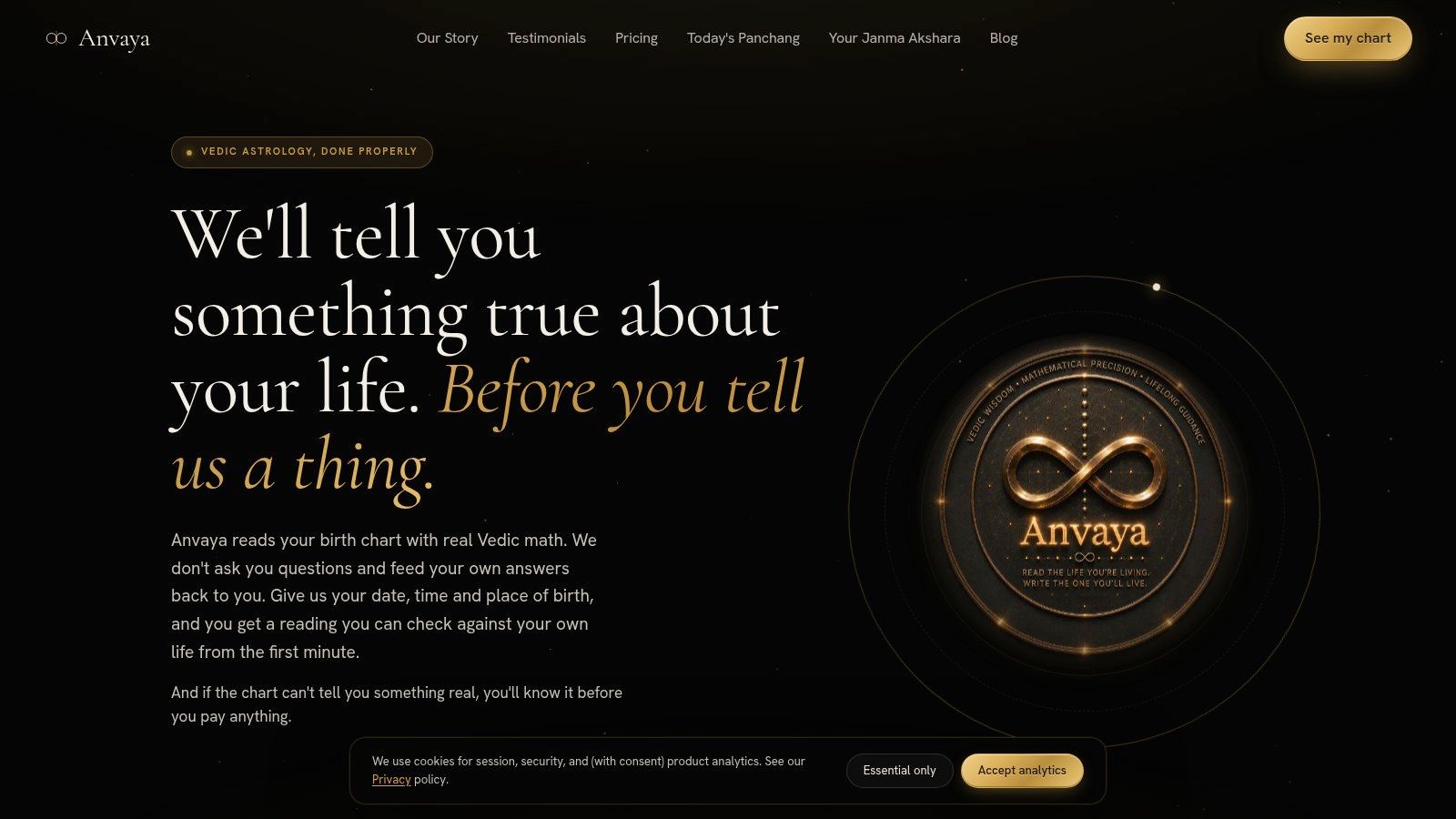
Start with the method, because that is where Anvaya differs. It takes birth date, time, and place, runs a declared classical Vedic compute stack, then checks the chart against events you have already lived. That check is called Pramāṇa: free, chart-derived questions about specific past windows, asked before you pay and before any forward claim. If the chart does not match your life, you learn that early. The platform was built in counsel with 40+ practising jyotishis across the Parashari, Jaimini, and KP lineages, and it encodes 20+ classical jyotisha texts. It stays inside classical Vedic astrology and leaves out tarot, numerology, and daily horoscopes.
The paid product is a Samhita, a structured reading rather than a horoscope feed. It covers career, relationships, health, money, and timing, with divisional charts, Vimshottari and Yogini dasha, Shadbala strengths, yogas, and transits underneath. Live views include Right Now, Watch Windows, and The Year Ahead, plus a Daily Practice that tracks the active dasha context. Free tools cover Panchang, Janma Akshara, Muhurta, Sangati, and Pravāha. A feature called the Atlas connects different parts of your life and shows why certain patterns keep repeating. Readings stay saved and dated, so you can reopen them and compare what was said with what happened.
Where it earns trust, and where it doesn't
Dated, preserved readings matter because confident astrological prose is easy to overclaim. In controlled tests of chart matching, astrologers have generally failed to beat chance, and a polished interface does not change that. Calibration is a better basis for trust than testimonials: the chart has to prove itself on your own past before you spend money. Follow-up questions through Samvāda are answered from your saved chart rather than from a generic template, which keeps the responses grounded.
- Strengths: Free past-event calibration before purchase, broad classical computation, dated readings you can audit later, and no subscription. You pay only for what you read; see current pricing terms rather than relying on any listicle.
- Couples: Sambandha compares two charts with Ashtakoota Guna Milan and Mangal Dosha checks. Matchmaking, muhurta dates, and compatibility reports are paid add-ons to the Samhita.
- Limits: Accurate birth time matters a great deal, and uncertain details weaken results; extra correction rounds may need a paid rectification. There is also no bank of cited third-party awards to lean on. The case rests on whether Pramāṇa matches your life.
Everything here is offered for reflection and entertainment, not as medical, financial, legal, or other professional advice.
Practical rule: Test any reading against three dated events you remember clearly before you act on a future window.
2. AstroSage Kundli
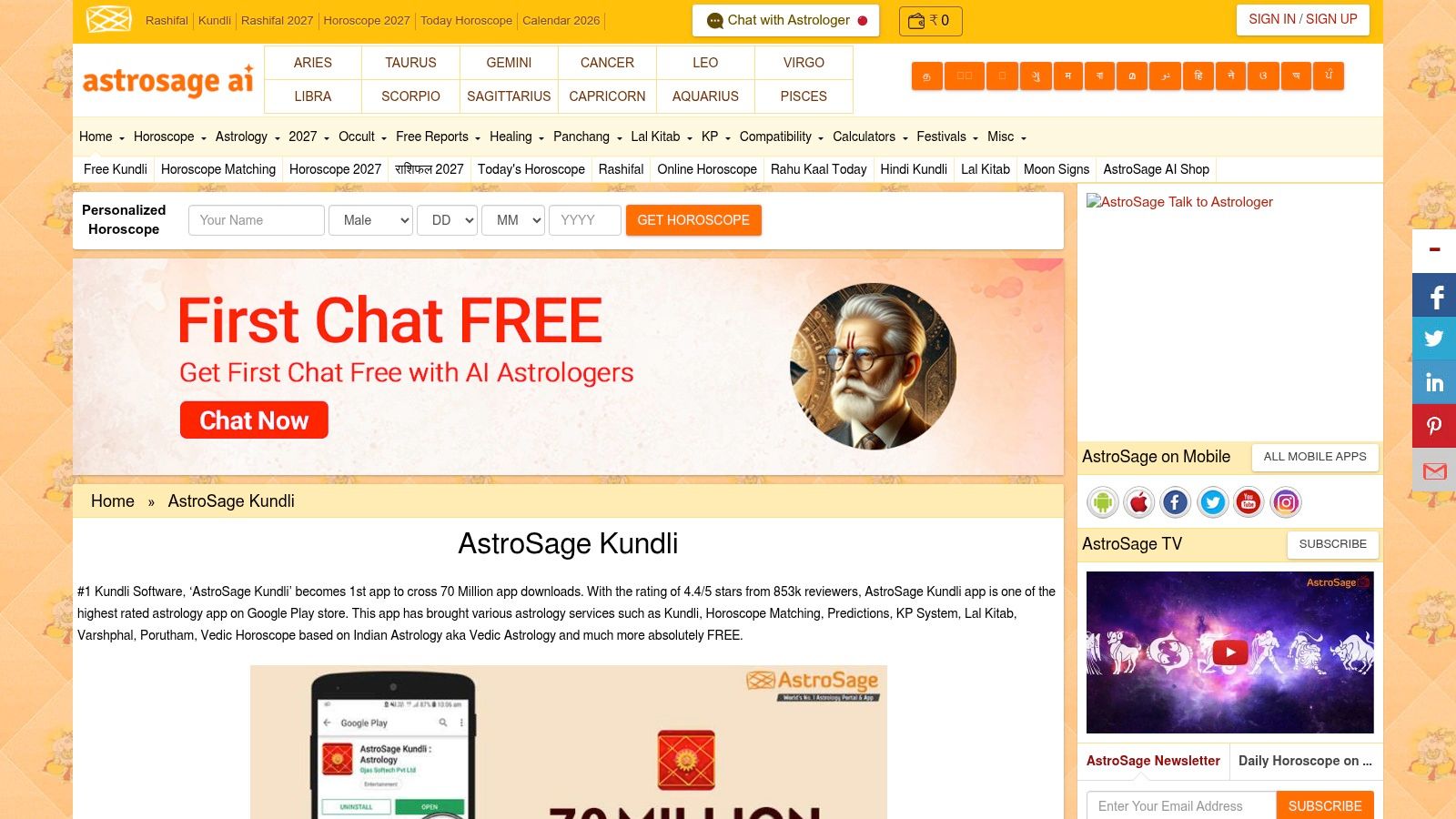
If you want everything in one busy place, AstroSage Kundli is the mainstream starting point many users in India find first. Kundli creation, kundli matching, predictions, consultations, reports, and a long list of side tools sit in the same app. That breadth is convenient when you're not sure what you need yet. It's less helpful when you want one method, done carefully.
The feature list is wide. You get Panchang and PDF reports, plus KP, Lal Kitab, Nadi, and Varshphal tools, with multiple Indian-language options. Many services are free, while reports and other services may cost extra, and ads and in-app purchases are part of the experience. For a quick chart to show a family member, that trade-off is often fine.
The limit is focus. Systems with different rules sit side by side, and automated prediction text isn't the same as a personalised, accountable consultation. There's no clear past-event calibration step that asks you to confirm chart-derived events before a forward reading, and no dated record designed for later audit. You're left judging tone and familiarity.
- Best for: A free, general-purpose first kundli and quick matching checks.
- Watch for: Clutter, mixed systems, and upsells interrupting chart work.
- Verification: Weak. You can compare outputs across tools inside the app, but that's consistency, not proof against your life.
Pick it for breadth and familiarity. Don't pick it if you want a single declared method.
3. Jyotish App and Jyotish Computer
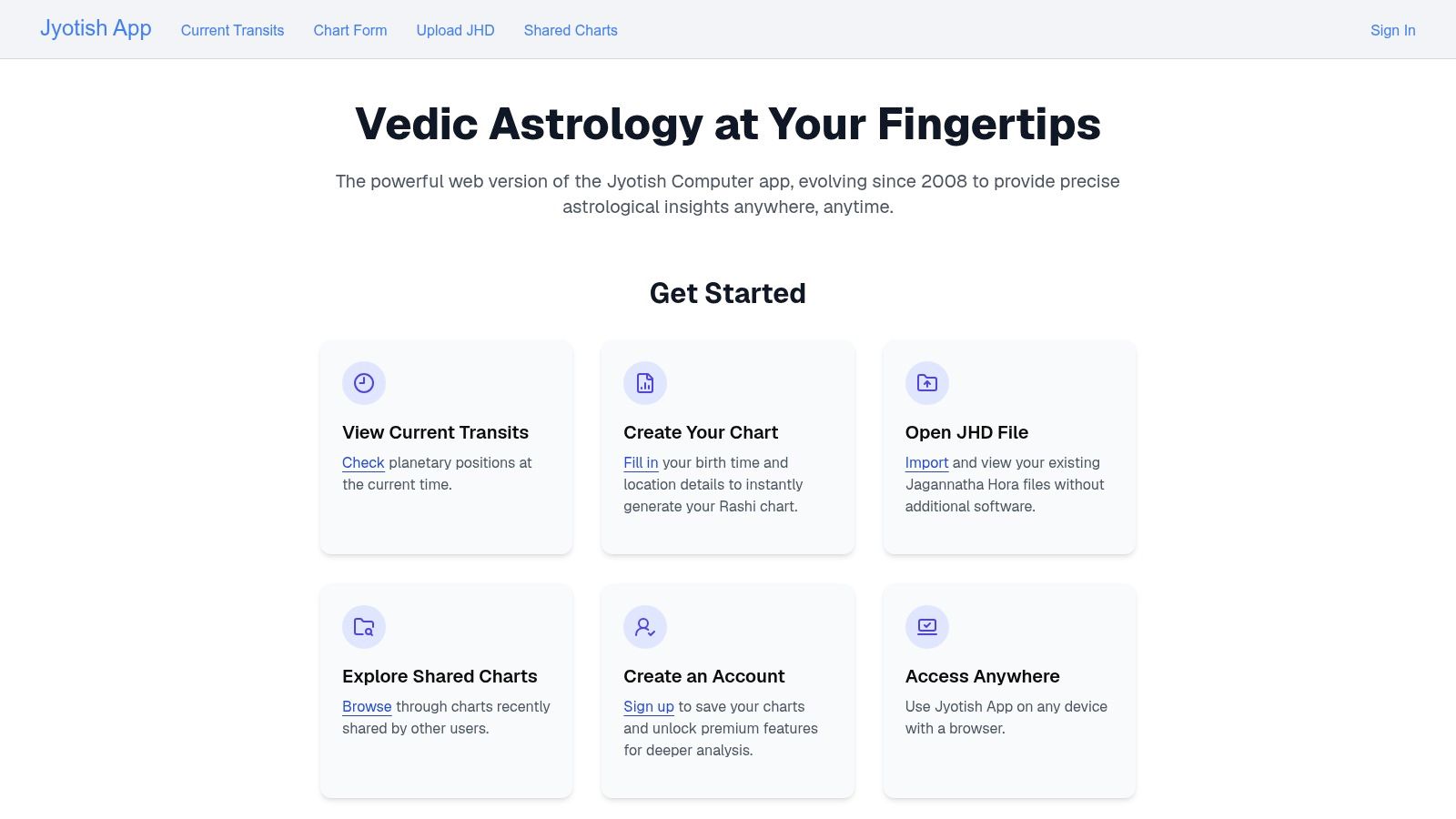
For deep chart study, Jyotish App behaves like a bench where the chart stays in front of you. It runs in a browser, creates rashi charts, shows current transits, and opens Jagannatha Hora chart files, which saves serious students from re-entering years of records. An Apple-device version adds divisional charts and dasha features. I would place it in the study and record slot, alongside Jyotish Computer, for readers who already know how a chart should be interrogated.
Accounts let you save charts, notes, tags, and records, and share them when you want a second eye. That suits practitioners who keep client files and students who annotate as they learn. The checking burden stays with the reader: the software can keep the work organised, while judgment still has to be earned against known events.
Who should skip it
Newcomers will likely feel under-guided. The web version is closer to a calculation and file-working environment than a complete predictive-reading product, and it leaves chart patterns in chart language. There is no structured calibration step that asks which past events matched before forward reading, so verification is manual. Premium account features and pricing should be checked directly with the product.
- Strengths: Chart-first design, JHD file import, browser access plus an Apple version.
- Limits: Little hand-holding, and interpretation remains your job.
- Verification: Manual. Strong in skilled hands, absent if you do not know what to check.
Use it to work. Use a guided reading only after you know which claims you want tested.
4. Drik Panchang
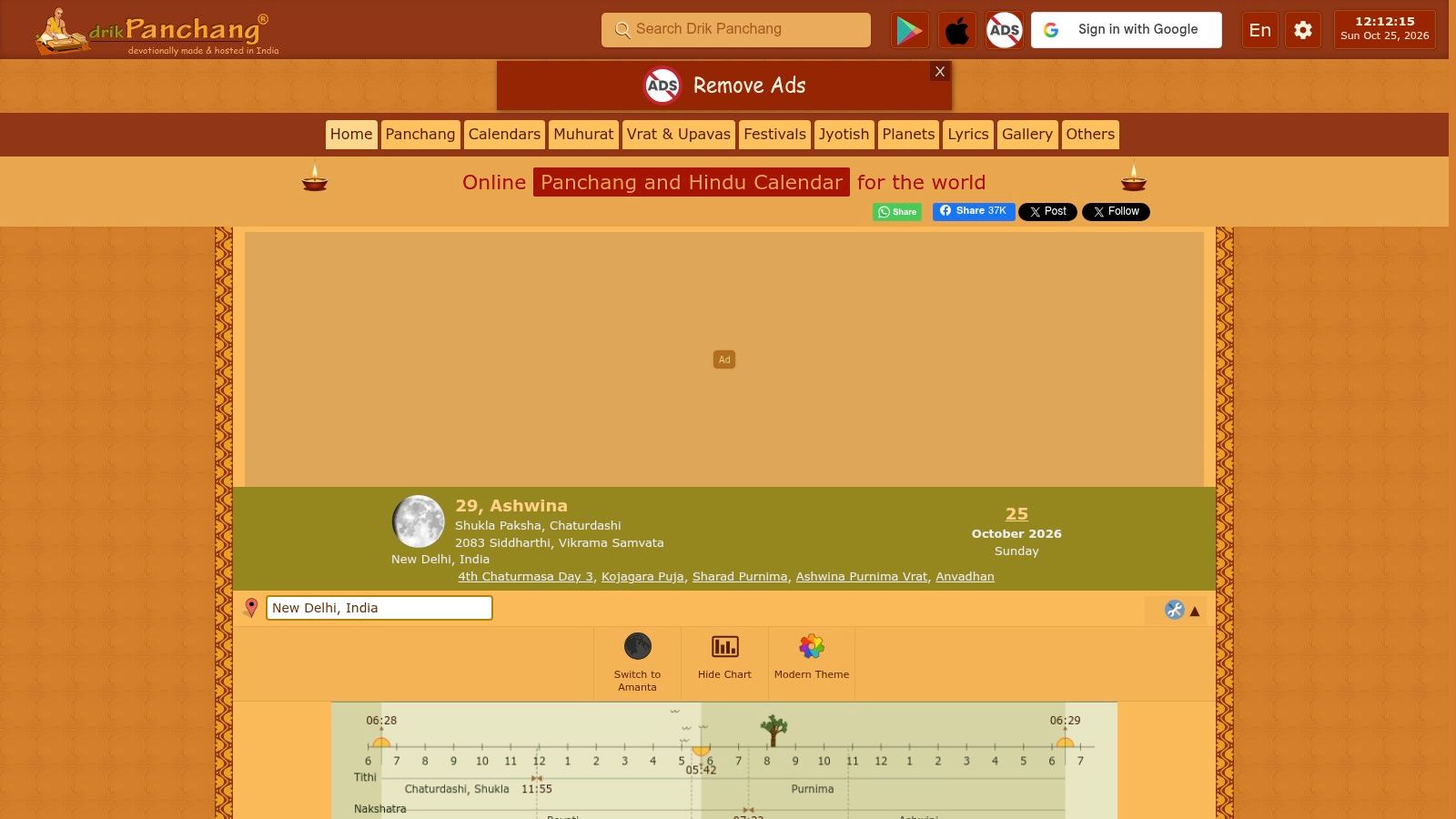
A family fixing a griha pravesh date does not need a natal reading. It needs the tithi, the nakshatra, and whether the morning muhurta window holds for their city. Drik Panchang is built for exactly that: location-specific Hindu calendar data, festival dates, and daily auspicious and inauspicious timings. Judge it as a calendar and it does its job well. Judge it as a chart-reading app and you are testing the wrong thing.
The developer describes its services as free, mobile apps are available, and the iOS app is described as working offline. Features and presentation differ by platform, so check the store listing for your device before relying on a specific one.
One caution applies to any panchang app. The five limbs, tithi, vara, nakshatra, yoga, and karana, are easy to display and easy to misread. A plain walkthrough of how to read the day's panchang elements will sharpen your judgment more than installing a second calendar app. Drik Panchang gives accurate data for your location. The data stays general, with no sustained link to your dasha periods or your birth chart.
- Best for: Daily tithi, nakshatra, yoga, and karana checks and festival dates.
- Limits: No connection to personal dasha context or deep natal-chart analysis.
- Verification: Calendar output is checkable against date and location, a cleaner test than prediction.
Keep it on the phone for the calendar. For personal timing, you need a tool that knows your chart.
5. Parashara's Light
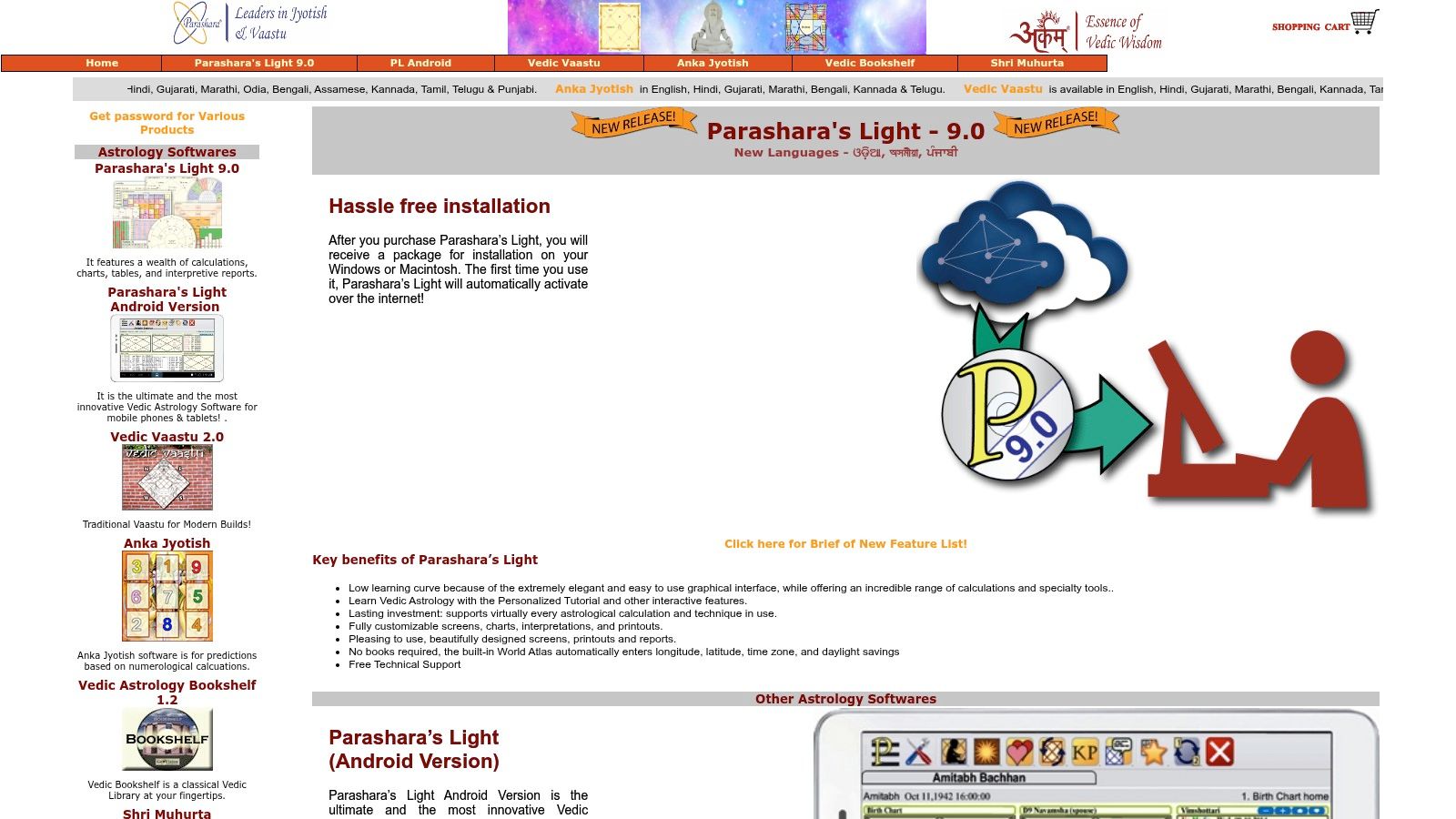
Desktop software is a different commitment from a phone app. Parashara's Light is dedicated Vedic astrology software for Windows and Mac, aimed at serious students and practitioners who want extensive charting and interpretation tools in one place. The vendor describes version 9.0 as available for both platforms, with Indian-language interfaces listed.
You get detailed charting and calculation tools, interactive charts and tables, and dasha and transit work designed for extended study sessions. A specialist focus and a commercial support presence matter when you use a tool weekly for years. This is the category where inspecting the math yourself is the point.
That history is worth respecting. Classical practice is layered rather than single and unchanged, from early calendrical texts through later horoscopy, a development traced in the history of the Vedāṅga Jyotiṣa and later chart traditions. Software that lets you see which tradition and settings you're using respects that complexity. Software that hides its settings doesn't.
- Strengths: Specialist Jyotish focus and a desktop workflow that suits long study.
- Limits: Higher upfront cost than free apps, desktop-first rather than phone-first, and more breadth than a casual user needs.
- Verification: You inspect calculations directly. Interpretation still depends on your skill.
Buy it to practise. It's poor value as a curiosity download.
6. Jagannatha Hora
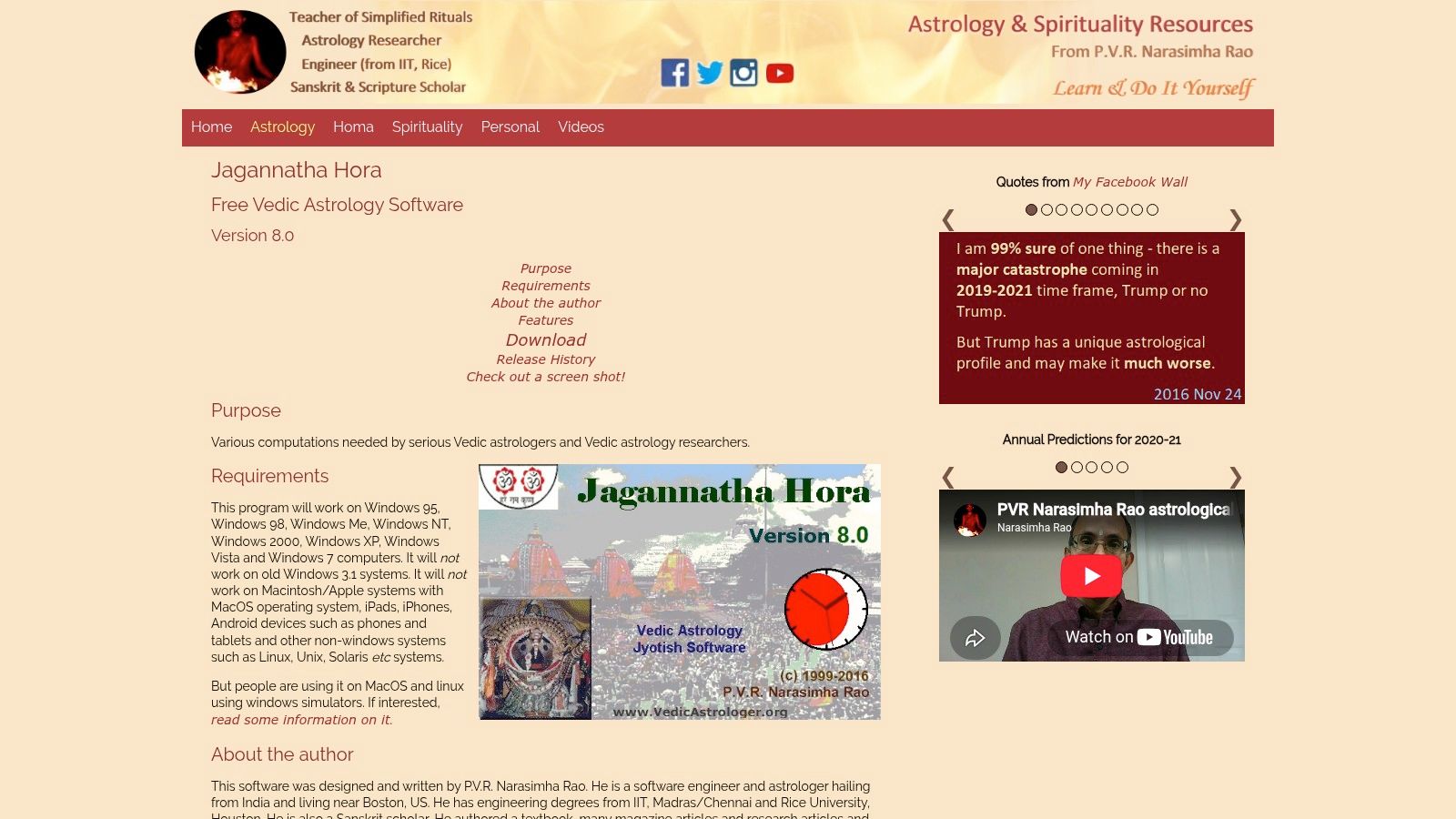
Ask practising jyotishis what they learned on, and Jagannatha Hora comes up often. It's a free, long-running Windows program associated with astrologer and software engineer P. V. R. Narasimha Rao, built for students, astrologers, and researchers who want to inspect chart details rather than accept an automated summary. Free does not mean shallow here.
The scope covers natal and divisional charts, dasha calculations, planetary strengths, and other traditional calculations aimed at study and research. If you want to understand why another app produced a particular period or strength value, JHora is where many people go to check the working. That makes it a useful reference even alongside a consumer app.
The costs are usability costs. It's Windows-focused, the interface and setup can feel dated, and beginners get little plain-language guidance. There's no guided calibration and no structured reading waiting at the end. You bring the judgment.
A calculation you can inspect is worth more than a confident paragraph you cannot.
- Best for: Serious students who want broad technical scope without paying.
- Limits: Steep learning curve and a dated feel compared with consumer apps.
- Verification: Excellent for checking math, silent on whether an interpretation fits a life.
If you're learning Jyotish properly, install it. If you want answers tonight, it will frustrate you.
7. KundliAI
Conversation is the product here. KundliAI runs in a browser, says it uses a Lahiri sidereal chart, and offers AI explanations across dashas, transits, compatibility, and muhurta. No install, a free starting tier, several languages, and one-time question packs make it a low-friction first try for beginners.
The risk sits in the same place as the appeal. A fluent chat answer can feel personal while resting on thin calculation, and the format invites you to hand over details the system then appears to know. Read a sober account of what an AI astrology reading can and cannot check before trusting one, then ask whether the app separates its chart math from its generated language.
Reporting from the user side raises the same worry: readers may not spot when AI has flattened a chart, and dramatic promises about partners or property are nearly impossible to verify, as discussed in coverage of credibility gaps in astrology apps. KundliAI also does not advertise a persistent reading model, so there is no dated record of earlier answers you can return to and score against what happened.
- Strengths: Browser access, no install, approachable explanations that teach vocabulary quickly.
- Limits: Free access is capped, and a chat reply is not a human astrologer's considered judgment.
- Verification: Light. Test it on your past before asking about your future.
Useful for learning the terms. Treat its forward claims with care.
8. Jyotish Sarathi
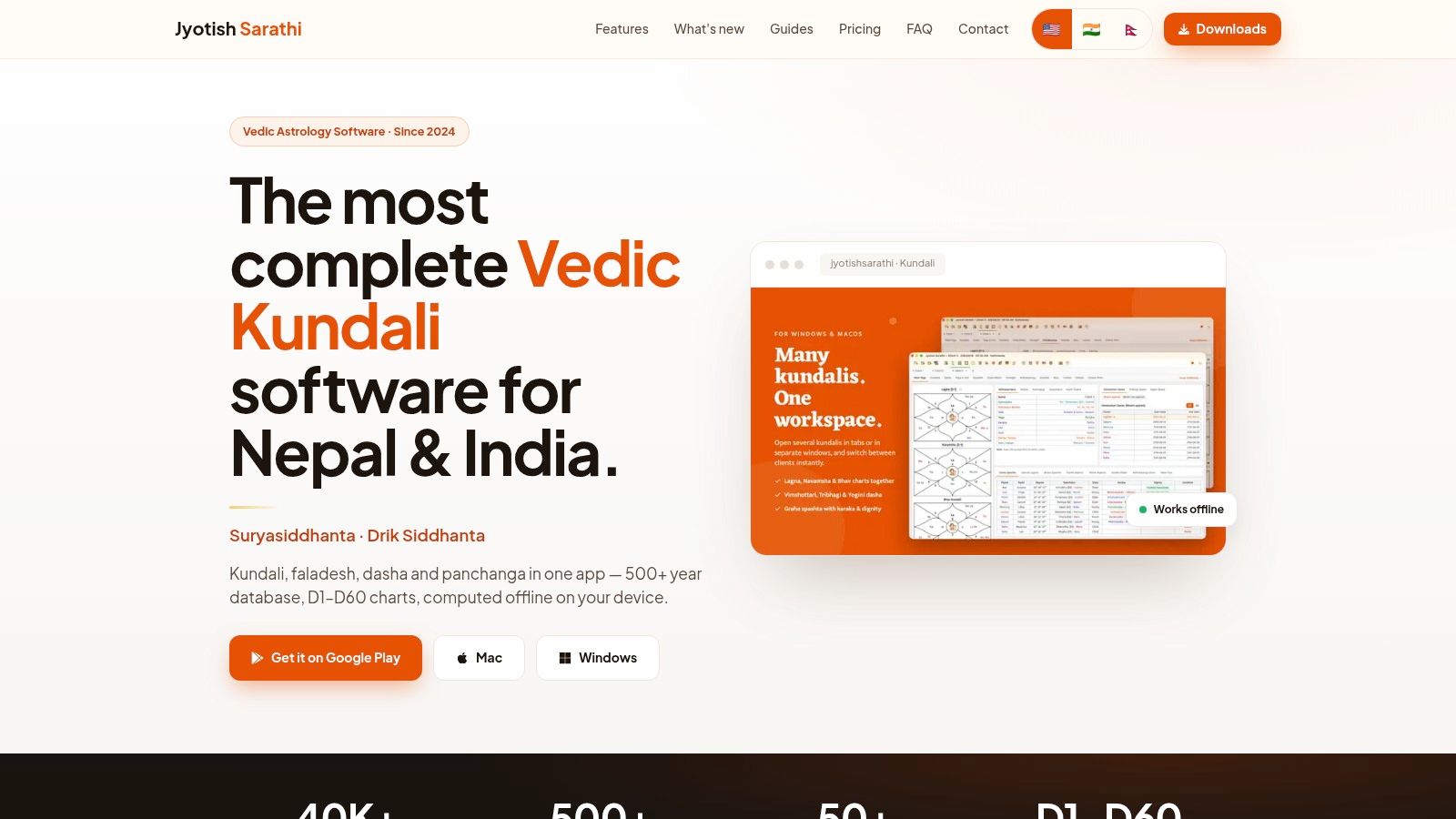
Offline calculation is an underrated feature. Jyotish Sarathi covers Android, Windows, and macOS, and its official site describes divisional charts from the birth chart through D60, multiple dasha and Panchang tools, and both Surya Siddhanta and Drik Siddhanta modes. Offering a choice of calculation approach, and naming it, is more honest than presenting one hidden default as the only tradition.
Nepali calendar and language support may make it especially relevant to Nepali users, a group larger apps often serve as an afterthought. Offline use also helps with privacy and with access where connectivity is poor. Your birth data staying on your device is a real consideration, not a marketing line.
Birth details are personal data, and the standard for handling them should be explicit. India's Digital Personal Data Protection Act requires consent to be free, specific, informed, unconditional, and unambiguous, as set out in the text of the Digital Personal Data Protection Act, 2023. Any app that syncs charts to the cloud should explain what it stores and why.
- Strengths: Cross-platform, offline work, and a stated choice of Siddhanta methods.
- Limits: Some advanced features and cloud synchronisation require a paid plan, and it's newer and less established than major apps.
- Verification: Strong on declared calculation method, manual on life-event checking.
Check device support and plan details before you build your records in it.
9. myJyotish
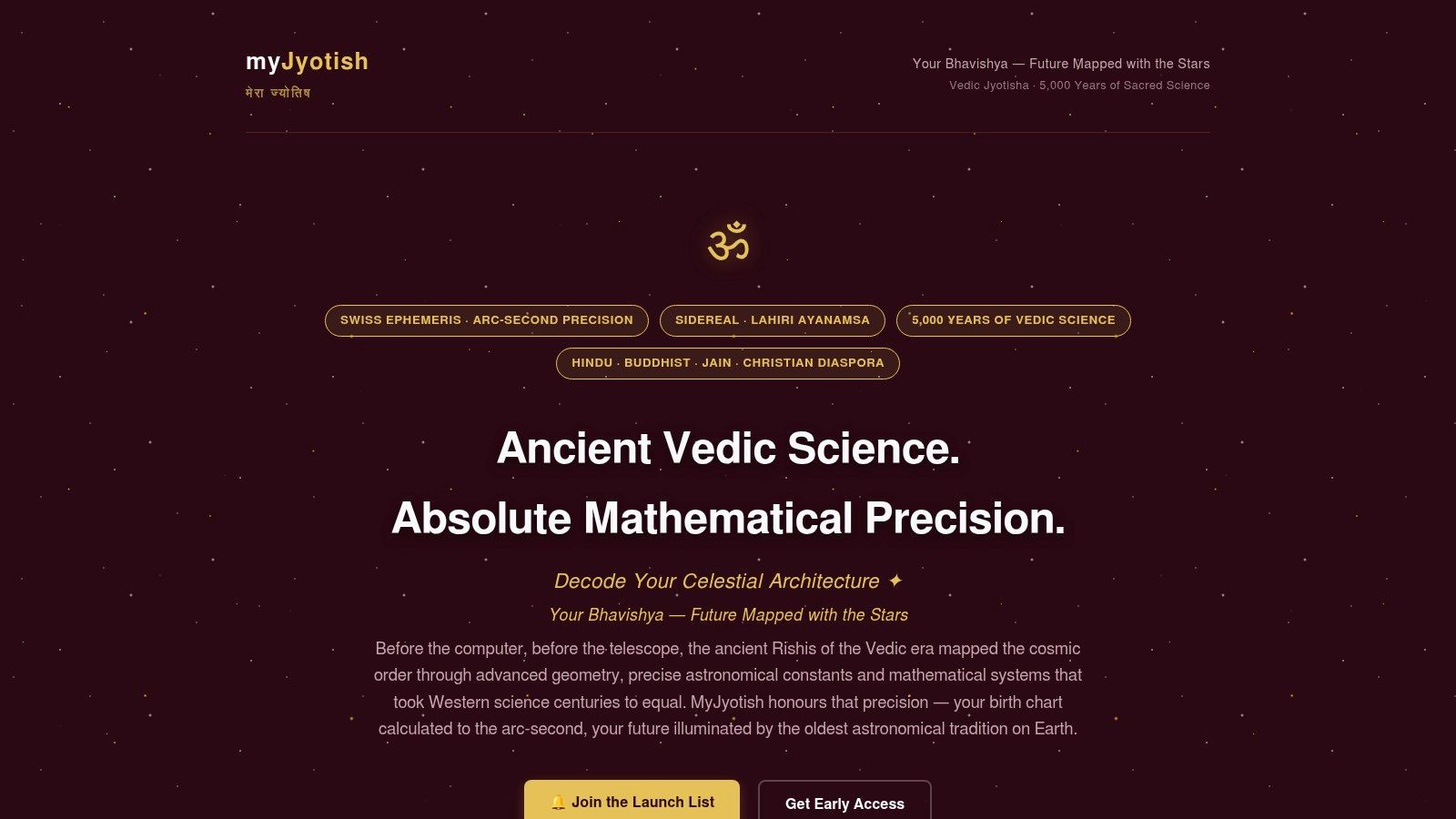
This one aims at international users who want a readable report rather than raw charting tools. myJyotish lists Janam Patri details including planetary positions, nakshatra, Vimshottari Mahadasha, Navamsa, Mangal Dosha, and Panchang, with printable reports in English, French, or Sanskrit. Family-oriented subscription options are part of the offer.
Compatibility is a clear focus, with 36-point Ashtakoota matching alongside the Mahadasha timeline. That combination suits couples who want a structured starting point to discuss, and published pricing information on the official site makes costs easier to check than in apps that reveal them late. Multilingual reports also help families where one report gets read across countries.
The trade-offs are depth and independence. Several features are subscription-based, the publicly described calculation depth is narrower than professional desktop software, and interpretations aren't independently validated. There's no stated past-event calibration step before the personalised guidance begins, so you're assessing plausibility rather than testing specific dated claims.
- Best for: Couples and international users who want chart plus compatibility in one report.
- Limits: Subscription costs for fuller features and thinner technical depth.
- Verification: Limited. Guna scoring is transparent arithmetic, interpretation beyond it is not tested against your history.
Reasonable for a first compatibility report. Thin for ongoing timing work.
10. Astroyogi
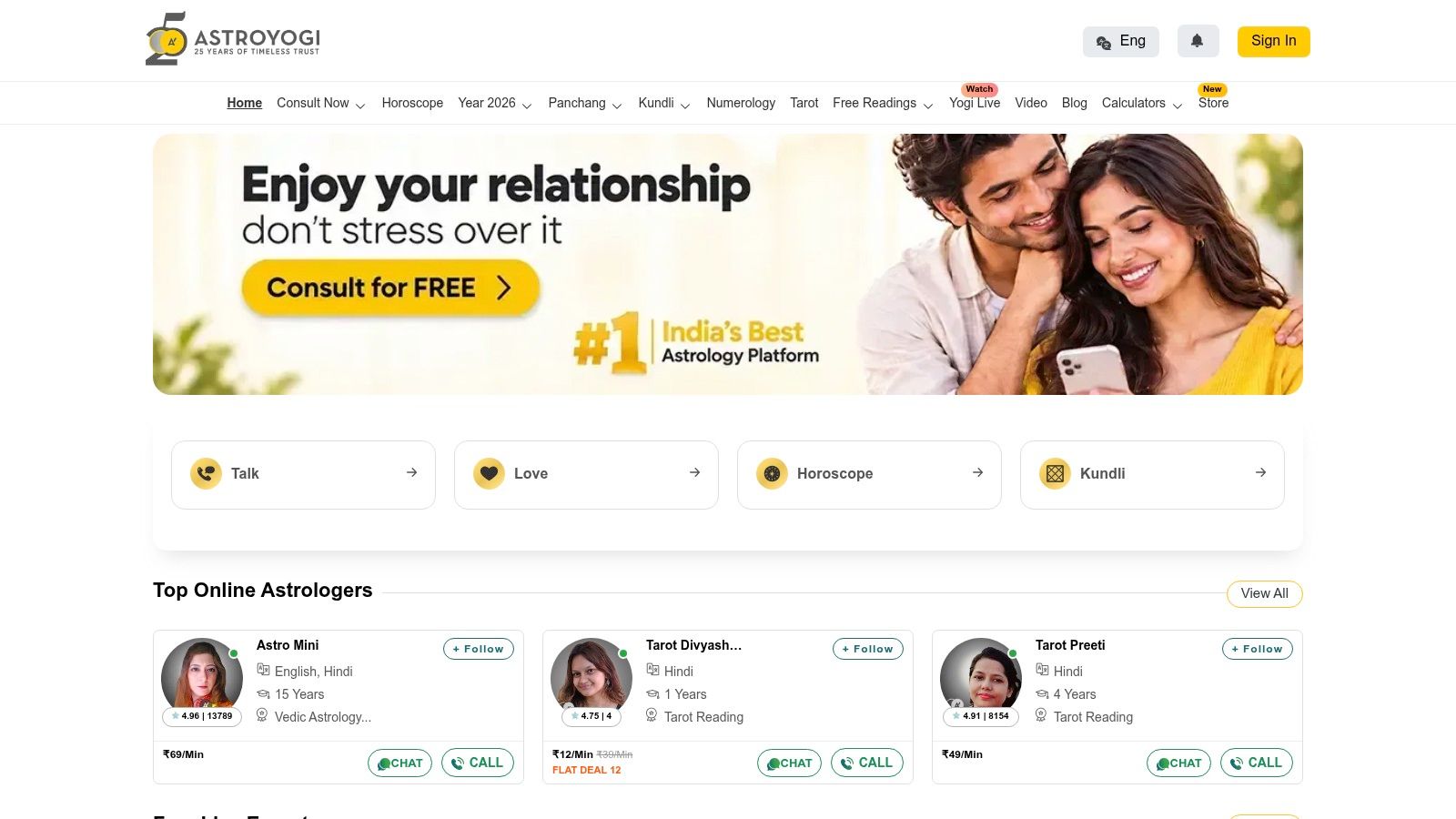
Sometimes you don't want software at all. You want a person. Astroyogi is a consultation platform offering astrologer profiles, calls and chat, free astrology content, live sessions, and tools such as kundli matching. The platform says its services are available in 173 countries and uses prepaid recharge packs for consultations.
Human conversation has real value for context, tone, and follow-up questions, and many people use both routes. Reporting in 2025 found that 64% of consumers use both AI and human astrologers, with apps used for quick guidance and humans sought for rituals or life-changing advice, according to coverage of split AI and human astrology use. That split is sensible, provided neither becomes the sole basis for a major decision.
Quality varies by individual astrologer, and cost depends on who you choose and how long you talk. The platform also includes non-Jyotish offerings, so check each profile's stated specialism. A spoken reading is also hard to audit later unless you keep your own dated notes of what was claimed.
- Strengths: Choice among human astrologers and international availability.
- Limits: Variable quality and session costs that add up without warning.
- Verification: Ask about your past first, and write down specific claims with dates.
Choose it for a human voice. Keep your own record.
How the 10 Jyotish apps compare on core focus, pricing model, and best use
| Item | Core Focus | Pricing Model | Best For |
|---|---|---|---|
| Anvaya (Recommended) | Classical Vedic readings with chart verification and structured chapters | One-time core purchase; optional add-ons | In-depth, ongoing Vedic guidance |
| AstroSage Kundli | Kundli charts, matching, predictions, and astrology tools | Free tools; paid reports and in-app purchases | Broad astrology features in one app |
| Jyotish App / Jyotish Computer | Browser-based chart creation, transits, and chart records | Premium features and pricing should be checked | Practitioners and students working with charts |
| Drik Panchang | Location-specific Hindu calendar and auspicious timings | Services described as free; check app stores | Panchang, festivals, and daily timing |
| Parashara's Light | Extensive Vedic charting and interpretation software | Paid desktop software | Serious students and practitioners |
| Jagannatha Hora (JHora) | Technical Jyotish calculations and chart research | Free to download | Students and researchers seeking detailed calculations |
| KundliAI | Browser-based Vedic charts with AI explanations | Free tier; paid question packs and reports | Users seeking accessible, conversational chart explanations |
| Jyotish Sarathi | Cross-platform charting with offline calculations and Siddhanta methods | Some advanced features require a paid plan | Users wanting offline tools across devices |
| myJyotish | Birth-chart reports, compatibility, and personalized guidance | Subscription-based features and family options | International users seeking reports and compatibility tools |
| Astroyogi | Human astrologer calls and chats, plus astrology tools | Prepaid consultation packs; cost varies | Users who prefer consultations with an astrologer |
Pick the App That Lets You Check Its Work
Match the app to the job in front of you. Checking tithi and festival dates over morning tea needs only a calendar like Drik Panchang, and paying for chart depth you never open is waste. Serious students who want to inspect divisional charts, dasha ladders, and planetary strengths belong in Jagannatha Hora or Parashara's Light. If you want a human voice you can push back against, a consultation platform like Astroyogi fits. AstroSage Kundli covers the broad middle. None of these choices is wrong. Choosing by star rating alone usually is.
Star ratings hide the specific disappointments that matter. In one mixed-method study of 57 users, only 11 respondents said the app met their expectations while 31 were dissatisfied with the advice or recommendations, with uncertainty about accuracy and privacy also reported, per independent user research on astrology app trust. A comparative study found that 85% of respondents used astrology apps, 43% only infrequently, and 90% considered free features sufficient, in a comparative study of astrology app preferences. Both samples are small, so treat them as directional signals rather than market-wide figures. They still point the same way: people keep free utilities like panchang and matching, and drift away from generic readings. Paid value has to be something a free horoscope cannot give you, such as full classical computation, confidence labels, or a record you can audit.
The market context explains the drift. One forecast places the worldwide horoscope and astrology apps market at approximately USD 4.46 billion in 2025, rising toward USD 15.86 billion by 2032, per market estimates for horoscope and astrology apps. A separate projection in Statista's overview of horoscope and astrology apps describes growth from roughly $2 billion in 2021 to almost $20 billion by 2031. Treat both as directional given differing methods. Markets that size reward daily notifications and retention hooks. Your interest is narrower: one tool that handles your birth data carefully and admits when it is unsure.
So run a short, honest trial with your own details. Give each serious candidate the same birth data and note which ayanamsha it declares. Ask what it says about two or three past periods you remember well, a job change, a move, a hard year, before you read anything about next year. Write down specific claims with dates and check later whether the wording survived intact or changed without notice. Read the privacy terms too: what birth and family data is stored, for what purpose, and whether you can export or delete it.
Key principle: Math first, language second. A reading that cannot be checked against your past has not earned your trust about your future.
If you want to see how a checkable reading is structured before committing to anything, inspect a sample reading cold and judge the format on its own. Look for three things: confidence shown per claim, timing tied to named dasha periods, and language that stays conditional. Ten minutes of that inspection tells you more than any store rating. The best jyotish app for you is the one whose work you can verify, whose limits are stated plainly, and whose records sit unchanged when you return in six months to see how it did.
That order is how Anvaya works: the classical chart math runs first, pramāṇa then checks the reading against events you already lived, and a dated Samhita stays saved so you can reopen it. As noted earlier, a few free chart-derived questions come before any payment, and there is no subscription; you pay only for what you read. One honest reading, before the noise finds you.