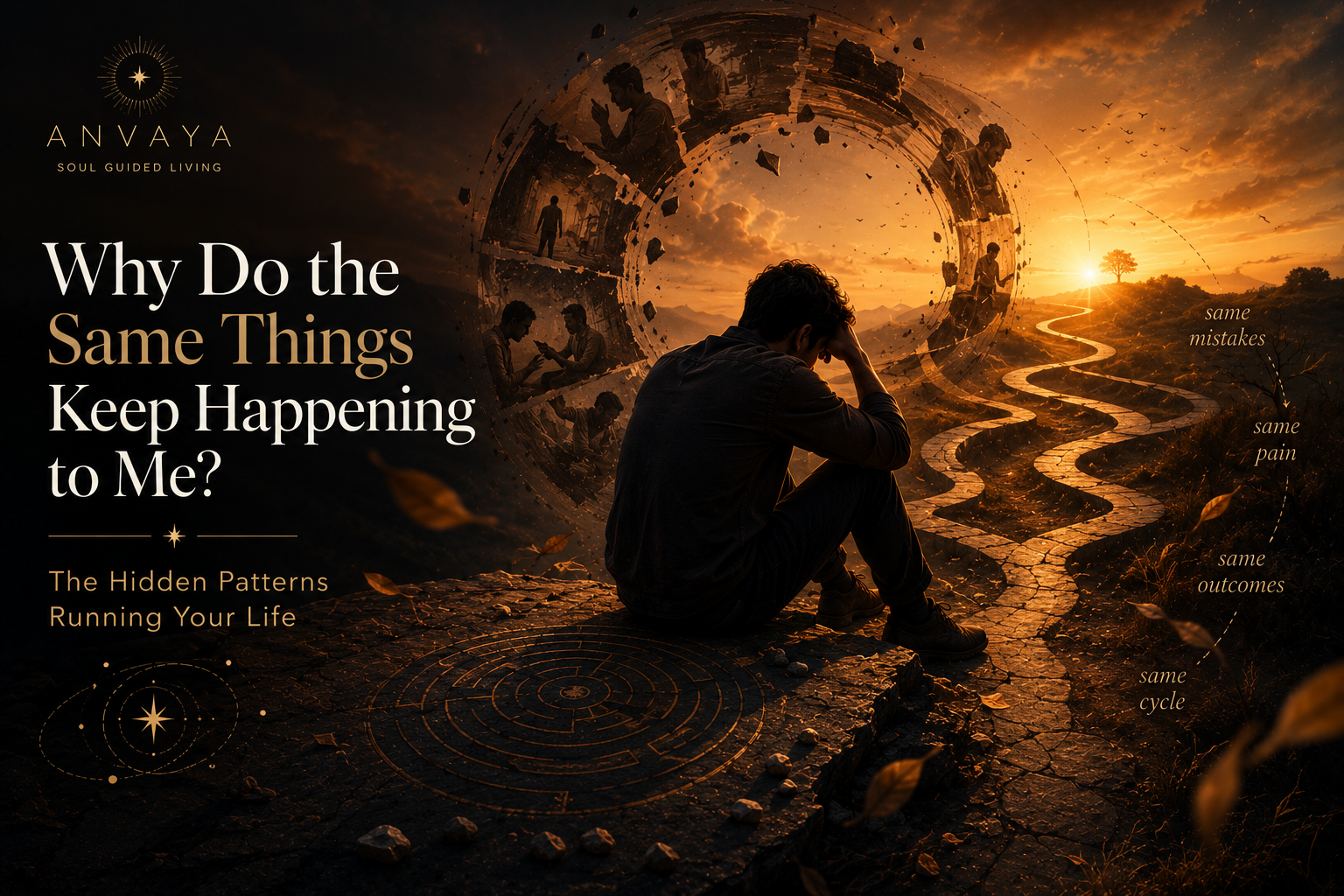
At some point, almost everyone arrives at the same disorienting realisation: the situation in front of them is new, but the shape of it is achingly familiar. A different employer, yet the same slow burnout and exit. A different relationship, yet the same argument and the same lonely ending. A different city, even, and somehow the same version of you, stuck in the same place.
When it happens enough times, you stop blaming circumstance and start to wonder, quietly, if the problem is you. It’s a heavy question. The honest answer is lighter than you fear.
It’s not bad luck. It’s a pattern.
Luck is random; your loops are not. The reason the same things keep happening is that you keep bringing the one constant variable into every situation — your own responses, defences, and timing. That’s not an accusation. It’s the most hopeful thing in this entire article. Bad luck can’t be changed. A pattern can.
If it were luck, you’d be powerless. Because it’s a pattern, you’re not.
The three places patterns hide
Recurring patterns tend to cluster in three areas of life. You’ll likely recognise yourself in at least one.
In relationships — the same role in every connection. Always the pursuer. Always the strong one. Always the one who leaves first, or gets left. The faces change; your position doesn’t.
In money and work — the same cycle of building something up and then, near the summit, quietly undoing it. Or the same flavour of job that looked different and turned out identical.
In timing — the same kind of season tripping you up again and again, because you keep meeting it with the same unconscious move.
Why patterns are invisible from the inside
Here’s the cruel design flaw. You never experience yourself choosing the pattern. You experience the world doing it to you. “Why do they always pull away?” “Why does this always happen to me?” The grammar gives it away — they, always, to me — a thing arriving from outside.
But play the footage of three or four episodes and the one figure present in every frame is you, holding the camera at the same angle each time. The pattern isn’t who keeps showing up. It’s the stance you keep taking when they do.
Patterns have seasons
There’s a layer beneath even this, and it’s the one most self-help misses: patterns don’t fire at random — they intensify in particular seasons. There are stretches when your need for security overwhelms everything and you grip too hard; stretches when restlessness runs the show and you blow up something good. These aren’t character flaws that strike out of nowhere. They track the longer cycles your life moves through. See the season, and the pattern stops feeling like fate and starts looking like weather you can prepare for.
How to start seeing yours
You can begin tonight, with brutal honesty and three steps.
Name the repeating ending. Not who was involved — the shape. Slow distance? A sudden cliff? You, checking out months early?
Find the moment it turned. In each episode, locate where new became familiar. What were you doing right then?
Ask what it protected. Whatever stance you took, assume it was guarding something — from rejection, from engulfment, from not being enough. Name it.
The word that repeats across your answers is the pattern. It’s usually a single thing, wearing different costumes.
How Anvaya surfaces your patterns
This is the precise problem Anvaya was built for — not to tell you a vague truth about yourself, but to make your specific hidden patterns visible. During calibration it offers dated, concrete reads — the recurring stances and the seasons that amplify them — and asks you to confirm or reject each one. The ones you confirm become a mirror you can finally use, because you verified them yourself.
The goal was never to shame the pattern out of existence. It’s gentler than that. You see the bend in the road before you reach it. And the next time you arrive there — for the first time in your life — you get to choose where to stand.